
①Why is the optical fiber industry able to achieve a strong momentum of "increased volume and price" by early 2026? ②Why do the H-share performances of leading technology companies generally outperform their A-shares?
Benefiting from multiple market positives, optical communication stocks have strengthened. As of the time of writing, $YOFC (06869.HK)$ the stock surged over 15% in the afternoon session, with a cumulative increase exceeding 370% year-to-date.
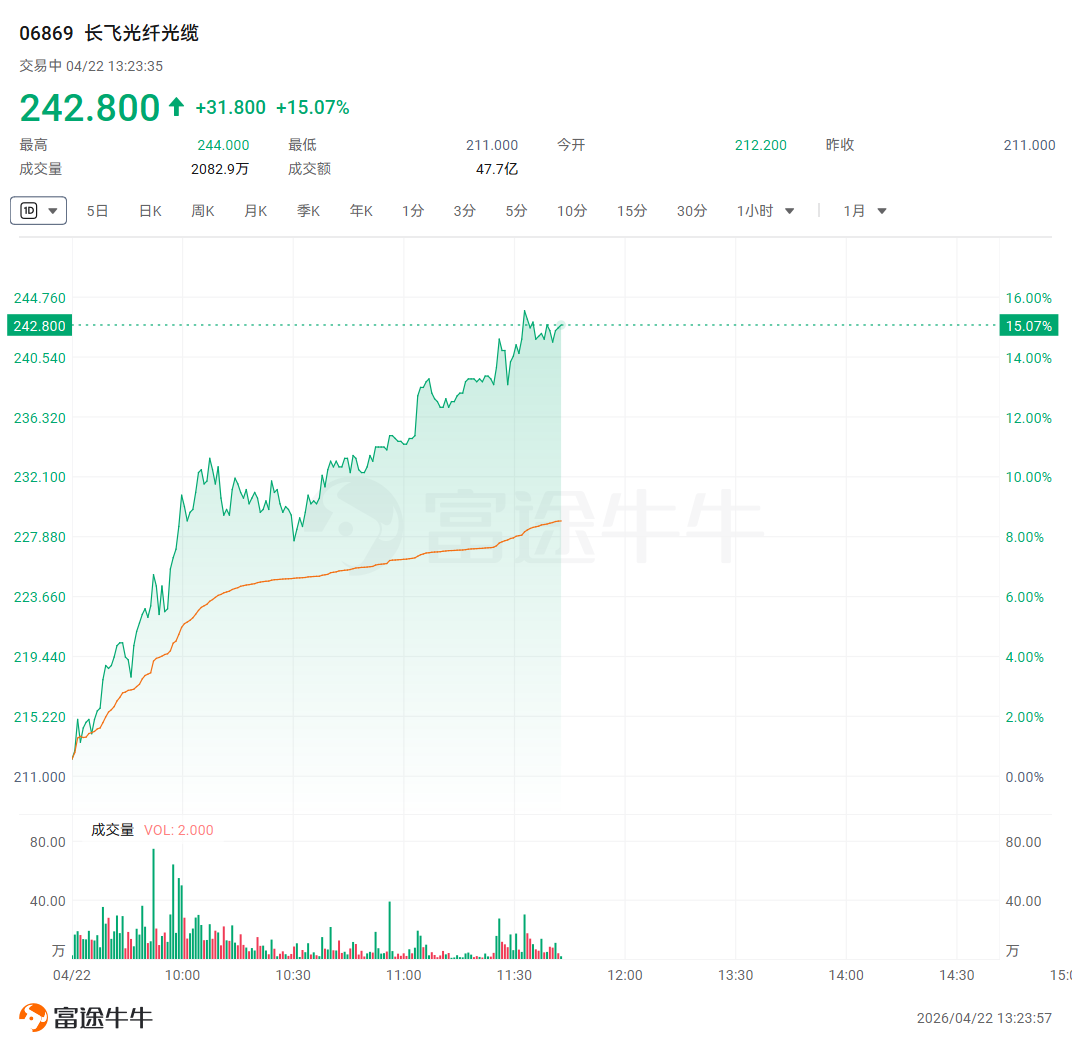
Since the beginning of this year, the optical fiber industry as a whole has shown a strong momentum of "increased volume and price." Industry insiders pointed out that the production and sales volume of optical fibers in the first quarter of 2026 increased nearly fivefold year-on-year, with prices experiencing explosive growth. Taking G.657.A2 optical fiber as an example, its unit price surged from 32 yuan per core kilometer last year to 240 yuan this year, marking a staggering increase of 650%.
 In addition, institutions noted that since January 2026, there has been a continued shortage of optical fiber preforms, with global production capacity nearing full utilization. Notably, Changfei Fiber Optic has maintained the top global market share in the three core products—optical fiber preform, optical fiber, and optical cable—for nine consecutive years since 2016 and is expected to benefit significantly from this supply-demand reversal during the upward cycle.
Optical communication stocks continue to be favored.
Morgan Stanley issued a thematic research report on April 20, pointing out that after the OFC (Optical Fiber Communication Conference), a new wave of investors continued to flow into the optical communication sector, with buying power still expanding, providing continuous support for stock prices in the sector. The report also emphasized that the annual production capacity of several optical communication enterprises has been almost entirely sold out, significantly reducing revenue uncertainty, and profit margin performance in the coming quarters will become the core focus of the market.
Morgan Stanley simultaneously raised the target prices of four major optical communication stocks: Corning (GLW.US) from $127 to $140; Lumentum (LITE.US) from $595 to $710; Coherent (COHR.US) from $250 to $290; and Ciena (CIEN.US) from $286 to $405, demonstrating the firm confidence of international investment banks in the long-term development prospects of the industry.
The current valuation level of the optical communication sector is historically on the higher side. If the market experiences lower-than-expected profit margins, significant expansion of Broadcom’s laser production capacity leading to supply-demand rebalancing, or deterioration in OCS competitive dynamics, the sector’s valuation may face potential risks of reverting to multiples of historical highs.
Changfei Fiber Optic Cable H-shares Surge
Boosted by the aforementioned industry-positive news, Changfei Fiber Optic Cable’s H-shares surged again, with gains breaking through 10%, while its corresponding A-share benchmark rose nearly 8% during the same period, showing significantly stronger performance in the Hong Kong market compared to the A-share market.
This phenomenon is not an isolated case but a common feature of many leading technology companies listed on the Hong Kong stock market. The underlying reasons can be analyzed from four dimensions:
The Hong Kong stock market has long been dominated by traditional industries such as finance, real estate, and consumer goods, with a severe shortage of high-quality hard tech stocks (e.g., new energy, semiconductors, AI computing power). As "golden tracks" for global capital allocation, the imbalance between supply and demand has made hard tech leaders listed in Hong Kong scarce assets, with international funds willing to pay a significant premium for their rarity.
The H-share floating capital of many leading technology companies is much smaller than their A-shares. For instance, the H-share floating shares of CATL account for only about 3.7% of its A-shares, while GigaDevice’s H-share floating ratio is merely 4.98%. Amid the simultaneous inflow of southbound and international funds, the smaller floating structure makes it easier for funds to quickly drive up prices, significantly amplifying the price elasticity of H-shares.
As China's economy shifts toward technology-driven transformation, global capital is accelerating the revaluation of Chinese hard tech assets. Companies like CATL, Montage Technology, and GigaDevice, leveraging their global market share and technological barriers, continue to attract international funds, driving the revaluation of their H-shares within the international valuation framework.
In recent years, the scale of southbound funds through the Shanghai-Hong Kong Stock Connect and Shenzhen-Hong Kong Stock Connect channels has continued to expand, becoming one of the most important sources of incremental funds in the Hong Kong stock market. These funds effectively transmit the high-growth expectations of the technology sector from the A-share market to the Hong Kong stock market, providing stable and continuous financial support for H-share premiums and further strengthening the relative performance advantages of leading technology companies' H-shares.
Editor/Jayden