
Source: Qile Club
When I tell people that Warren Buffett follows the 5-hour rule and spends 80% of his time reading and thinking, their reactions are always predictable: "He can do that because he is Warren Buffett, one of the richest people in the world. I will never reach that level, nor can I achieve the same."
Although this reaction may make people feel good about themselves, it certainly won’t make them smarter.
 Because the fact is: Buffett has spent most of his time reading and thinking since elementary school. Having more money or running a large company does not give you more free time.
Free time does not magically appear. Unless retired, people don’t have an abundance of free time. On the contrary, free time is the result of strategy. It is the outcome of perceiving time differently.
Out of curiosity about Buffett’s unique strategies, I read several books about him, most of his annual letters to shareholders, and watched almost all of his interviews.
Make no mistake... behind Buffett's seemingly effortless demeanor lies one of the most ruthless prioritizers in the world (in a good way).
Below are the six major strategies Warren Buffett has adopted throughout his career to gain more time for reading and thinking.
As you read these strategies, note that they are not like the typical bundled strategies seen online; they are not random. Most people overlook a deeper pattern—his primary mental model.
Strategy One: Eliminate busywork.
Buffett crossed out almost all tasks that a CEO must typically complete from his schedule:
He never talks to analysts (according to Buffett's estimate, a typical CEO spends 20% of their time talking to Wall Street analysts).
He rarely gives media interviews.
He does not attend industry events.
He has spent almost his entire career living in Omaha, Nebraska, a place outside New York City.
He hardly attends any internal meetings like a typical CEO would.
Importantly, these decisions did not happen by chance. To make them, Buffett had to constantly resist immense social pressure.
We learned how Buffett deals with distractions and obligations he is expected to fulfill through Michael Flint, Buffett’s private pilot.
Buffett once introduced Flint to a three-step strategy for prioritization, which I hope you will try right now to truly grasp the message:
First, Buffett asked Flint to write down his top 25 goals on a piece of paper. Now, write down your goals.
Next, he asked him to select the top five. So far, nothing out of the ordinary.
Finally, he instructed Flint to place the 20 targets he did not select on a 'must-avoid-at-all-costs' list.
In the third step, you can see Buffett's genius in setting priorities. At this point, most people would focus only on the top five goals and intermittently invest effort in the remaining ones.
But Buffett did not do that. He advised Flint: 'Under no circumstances should these things occupy your attention unless you have successfully completed the first five goals.'
Buffett's strategy is based on several fundamental principles:
20% of priority tasks account for 80% of our results. Buffett's top five priorities constitute 20% of his 25 goals.
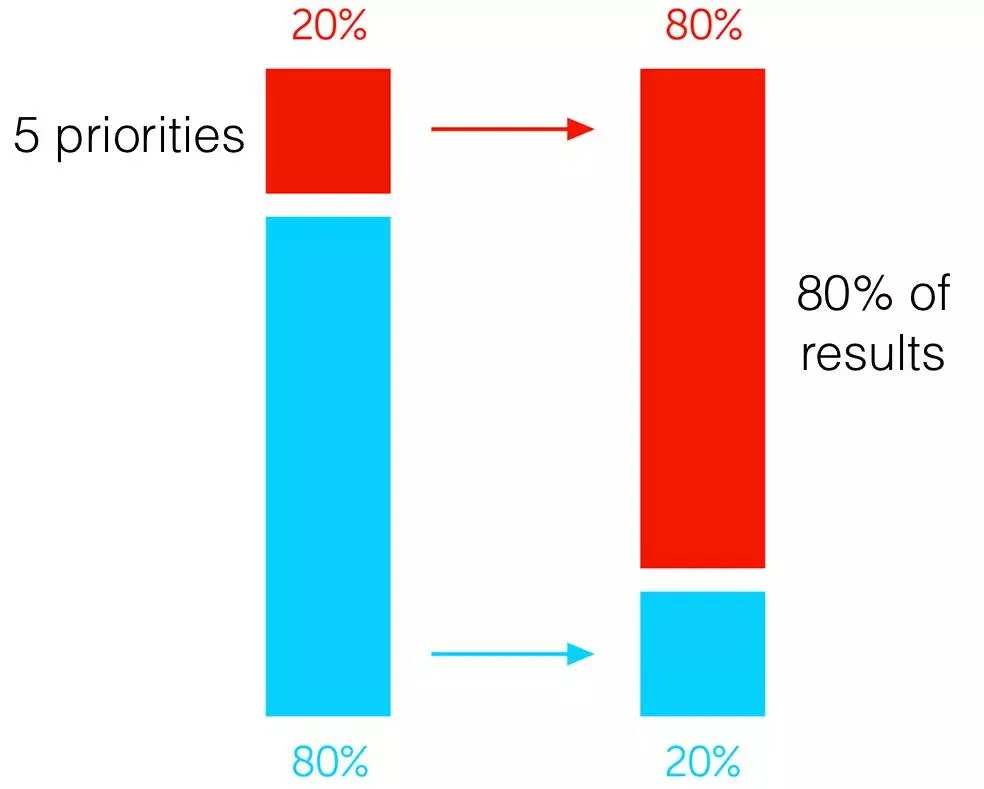
The real threat to our time does not simply come from distractions we know are wrong.
Instead, the true threat lies in those 'wolves in sheep's clothing'—activities that make us feel like we are working hard but ultimately do not change the situation. Buffett’s 'three-step approach' is specifically designed to prevent this!
The real challenge of prioritization lies in saying 'no!'
Saying 'yes' is easy. The real difficulty lies in saying 'no' to busywork, as ticking off an item on your to-do list gives a sense of accomplishment: fulfilling obligations to others or completing something simple.
Strategy Two: Work only with those you believe you could collaborate with forever.
“If you cannot imagine yourself working with someone for a lifetime, then do not work with them even for a day.”
— Silicon Valley angel investor Naval Ravikant
Similar to Buffett's strict review of his own work activities, he also conducts rigorous scrutiny of the people he collaborates with.
Buffett only collaborates with chief executives whom he trusts and who deliver results, believing that he can work alongside them for decades.
Therefore, prior to acquiring a company, he rarely engages in negotiations or due diligence, nor does he excessively interfere with the CEOs of the companies he acquires. Additionally, he enjoys conversing with these CEOs.
Strategy Three: Keep Things Super Simple
Buffett has eliminated nearly all bureaucracy within his company. Berkshire Hathaway’s portfolio companies employ close to 400,000 people, yet its actual headquarters has only about 20 employees. This is a photo from the 2014 Christmas party of one of the largest companies in the world:

Buffett’s personal life is also very simple. He lives in an unassuming house (where he has lived for 60 years), and his annual personal expenses amount to only $100,000.

In our careers, in our companies, and in our lives, it is very easy to make things complicated. In fact, this is the norm.
As you generate more profits, it is normal to hire more employees. As you earn more money, it is natural to spend more.
What is truly powerful and unique is the ability to simplify things. This requires effort and skill. It is also part of Buffett's genius.
It sounds strange, but when you compare the lifestyle he could have lived with the one he chose, one of the richest people in the world is also one of the greatest minimalists.
Strategy Four: Focus on a Few High-Quality Bets
Warren Buffett makes only a small number of investments each year.
I remember being shocked when I first heard this. "How could the most successful investor in human history make so few trades?"
William Thorndike, founding partner of Housatonic Partners, provides us with the answer to this question in his book 'The Outsiders.'
Buffett believes that a concentrated portfolio leads to extraordinary returns and that excellent investment opportunities are rare.
He has repeatedly told students that if they were given a card with only 20 punches at the start of their careers, representing the total number of investments they could make during their investment lifetimes, their investment outcomes would improve.
As he summarized in his 1993 annual report, "We believe that a policy that concentrates the portfolio will likely reduce risk if it increases an investor's intensity of thought about a business and also increases his satisfaction with its economic characteristics before purchasing it."
In short, Buffett means:
The trick to investing is to be there, watch the balls being pitched one after another, and wait for the ball to reach your best height. If people shout, 'Swing, you idiot!', just ignore them.
Strategy Five: Focus on Long-Term Investment
Buffett holds his stocks for the long term.
According to William Thorndike in his book The Outsiders, Buffett’s current top five stock holdings have an average holding period of more than 20 years.
In contrast, the average holding period for a typical mutual fund is less than one year. This indicates an extremely low level of investment activity, which Buffett refers to as 'near-lazy idleness'.
Buffett also applies a similar concept to intellectual investment. In the only authorized biography of Buffett, his biographer commented on what she learned from him: What you study and invest in should be knowledge that accumulates, so that knowledge can build upon itself.
Therefore, instead of learning something that may become obsolete tomorrow, such as a specific type of software (which no one will use in two years), choose things that will make you smarter ten or twenty years from now.
It’s not only Buffett who thinks about long-term investment.
Sam Altman, president of Y Combinator, the world's largest accelerator, calls long-term thinking 'one of the few remaining arbitrage opportunities in the market.'
Jeff Bezos measures the success of new projects over seven years, while most other publicly traded companies measure it over just three months.
Strategy Six: Avoid Chasing Technological Trends
One might assume that the greatest investor of all time would consistently strive to master the latest technology to remain at the forefront of the times.
Interestingly, the opposite is true. Below are some examples:
He has never had a computer in his office.
He has never used a stock ticker.
He does not own a smartphone.
These distinctive choices reflect certain characteristics of Buffett:
Buffett is acutely aware of the specific data he needs to make investment decisions.
He possesses enough confidence in his own ideas that he is unwilling to follow what is popular among the masses.
He proactively eliminates potential distractions from his environment rather than relying solely on willpower.
How to apply the core mental models of Warren Buffett?
Now, you understand. It is no coincidence that Warren Buffett has ample time for free reading and contemplation. His life was intentionally designed for this purpose.
These are not random strategies... they all stem from a crucial mental model: the 80/20 rule. In fact, 20% of effort yields 80% of results in many areas of our lives.
In every aspect of his life, be it relationships, investments, technology, or prioritization, Buffett is a master at ruthlessly focusing on a few critical matters while discarding everything else.
So, the question now is: How can you consistently and skillfully apply the 80/20 rule to your own life?
While Buffett's 'three-step approach' is highly useful in theory, I have found it somewhat lacking when applied in practice. It overlooks nuances that might derail the plans of ordinary individuals like us.
For instance, merely placing certain tasks on an 'avoid at all costs' list is insufficient. From my experience, avoiding such tasks requires effort and skill.
Moreover, determining priorities takes time, meaning you need to turn it into a new habit, which demands hard work and technique to establish consistently.
Therefore, here is the 13-step adjustment process I use, allowing you to prioritize your schedule according to the 80/20 rule.
1. Identify your true values.
When you prioritize without a clear set of values, your goals often feel hollow. Without your own guiding star, the goals you set are often a result of the cultural values you previously held.
Thus, under such circumstances, your goals are not truly your goals.
2. Identify your true objectives
Without setting clear goals, your daily priorities will be overwhelmed by urgent tasks that offer short-term rewards making you feel good. Having clear value-based goals allows you to focus on both short-term and long-term matters.
3. Allocate time for prioritization
I recommend setting aside at least the following blocks of time in your schedule: 15 minutes each day, one hour each week, three hours each quarter, and one day each year.
4. List everything you have to do
Taking it out of your mind and writing it down on paper is cathartic and provides material for the remaining steps.
5. Circle the top 20% of priorities that will yield 80% of the results
Here, you can address the issue of 'information overload,' identify what is truly important, and drive progress accordingly.
6. Practice the 80/20 rule as you would practice any other skill.
Applying the 80/20 rule doesn’t just mean asking yourself, 'What is most important?'
You can also view your priorities in different ways by learning and using different mental models, such as bottleneck analysis, the ICE method, or the critical path method.
Every time you set priorities, it’s an opportunity to practice how to better prioritize.
7. Identify the single most important priority.
The 80/20 rule follows the fractal principle, meaning there is another 80/20 within each 80/20.
So, if you reduce a list of 25 priorities to five, you can apply the 80/20 rule again to focus on the one priority that delivers 80% of the results from those five priorities.
8. Start with your 'one thing'.
When our day begins, we have the most energy and the fewest distractions. This makes it the perfect time to tackle the most difficult and important tasks.
If you leave one task for later in the day, it is highly likely that it will not be completed that day.
9. Set measurable metrics based on your 'one thing'.
The brain loves metrics, especially public ones. This is why social media platforms can train us so effectively, pushing us to constantly maximize our followers, likes, and comments.
When these vanity metrics go up, we feel like we are making progress and doing meaningful work.
However, at the end of the day, if you run a business, what matters more is generating profits. If you manage a non-profit organization, what counts more is improving the world. If you want to reduce loneliness, what’s crucial is enhancing high-quality interactions with close friends.
When I took the time to identify some truly important metrics and then genuinely focused on them, my business transformed overnight.
Once you do this, your brain will automatically and subconsciously aim to maximize these critical metrics rather than those vanity ones.
10. Put everything else on the 'avoid at all costs' list.
11. Conduct a pre-mortem check for your 'avoid at all costs' list.
The key is... in real life, avoiding certain things on the 'avoid at all costs' list requires significant energy and discipline. Without careful thought, you are likely to fall back into old habits.
To ensure this happens, I recommend conducting a pre-mortem check. Through this process, you can visualize your day and ask yourself, 'What might cause me to slip into old habits or distractions?'
By becoming aware of potential distractions before they occur, we can significantly increase the likelihood of avoiding them.
12. Practice saying 'no.'
Just as applying the 80/20 rule is a skill, saying 'no' is also a skill. This skill involves identifying areas where we should say 'no' but fail to do so, and then designing practical solutions for each situation.
13. Accept accountability and coaching.
From my experience, I often resist the most important things because they require me to confront my fears and self-destructive beliefs.
Therefore, when I share my priorities with others daily and weekly, and when others hold me strictly accountable and provide feedback, my productivity always improves.
Accountability helps me step on the gas. Coaching helps me take the other foot off the brake.
Each of these steps is absolutely critical. If you miss one of them, your ability to choose and stick to the right priorities will drop dramatically.
Conclusion
We all have 24 hours in a day. Therefore, working harder at being 'busy' won't get us very far.
Focus is one of the 20% of skills that bring about 80% of the results in our lives. It allows us to accomplish in a year what might take others a decade.
Moreover, by focusing on a few important tasks at work, we can gain time in our personal lives to maintain our health and spend quality moments with loved ones.
However, it is important to remember: In order to fully benefit from the power of focus, we need to regard it as a challenging skill that requires years of practice to develop.
While focus may sound simple, it demands significant emotional and cognitive resources to sustain. This is why, although everyone extols the power of focus, very few actually achieve it.
Editor /rice