
Top News
On Thursday before the market opened, an Iranian diplomatic source revealed on the 23rd that the preparations for negotiations between Iran and the United States in Pakistan might achieve a breakthrough "tonight or tomorrow." The declines in the three major U.S. stock index futures narrowed somewhat. As of press time, Dow Jones futures fell by 0.38%, Nasdaq futures dropped by 0.18%, and S&P futures declined by 0.16%.

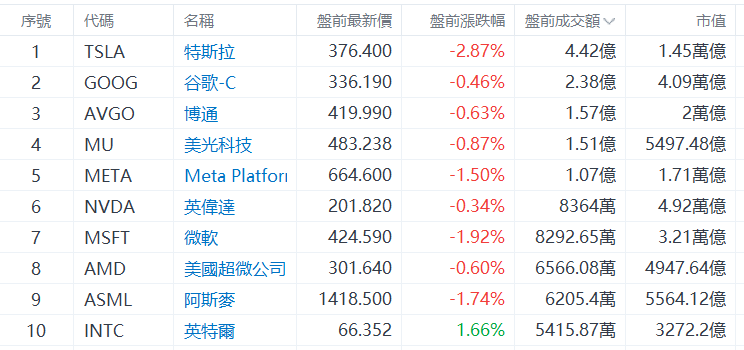
$Star Tech Companies (LIST2518.US)$Pre-market declines: Tesla fell nearly 3%, while Meta, Microsoft, and ASML Holding dropped over 1%.
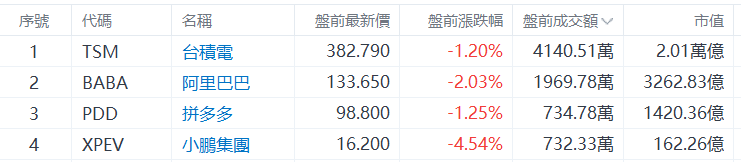
$China Concept Stocks (LIST2517.US)$Most stocks declined in pre-market trading, with XPeng Group falling over 4%, Alibaba dropping more than 2%, and PDD Holdings and TAL Education Group declining over 1%.
Individual Stock News
 Tesla significantly raised its 2026 capital expenditure forecast beyond expectations. The AI5 chip has entered the trial production phase ahead of schedule, with executives stating that 'Optimus will be the biggest product in history.'
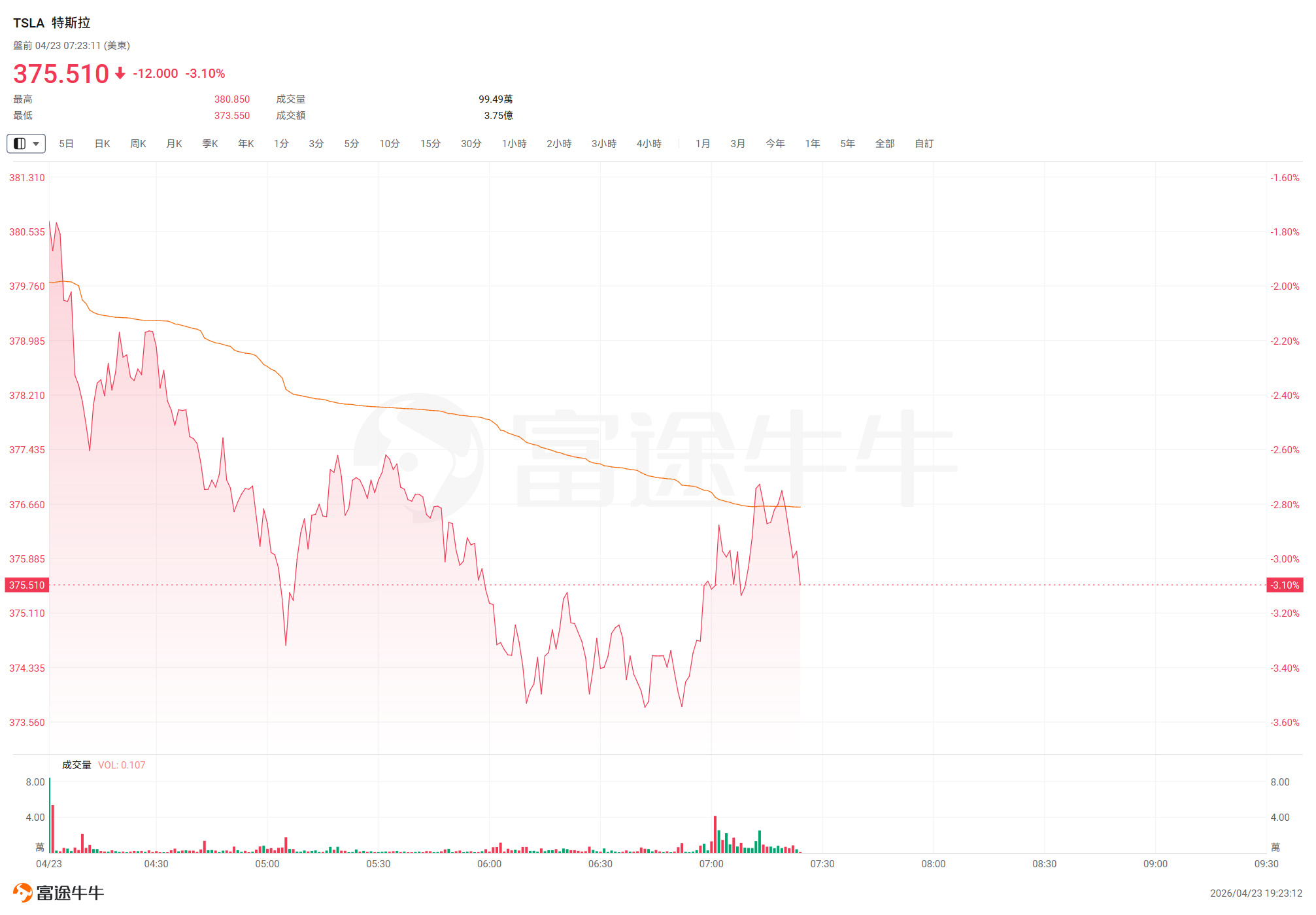
$Tesla (TSLA.US)$The stock fell more than 3% in pre-market trading. During Tesla's Q1 2026 earnings call, the company revealed a major strategic shift, explicitly stating that 'FSD is the core product, and vehicles are merely delivery platforms.' It was confirmed that the HW3 computing power can no longer support unsupervised FSD. To support the development of AI chips, Robotaxis, and Optimus robots, Tesla expects capital expenditures to exceed $25 billion in 2026. Elon Musk reiterated that Tesla is fully committed to an AI-driven and automated future. Tesla executives confirmed during the earnings call that comprehensive commercial licensing for FSD in China is 'not yet in place,' refuting previous rumors of an 'April 22 rollout.' According to Tesla's official Weibo account, the third-generation humanoid robot is expected to debut by mid-year, with formal production scheduled to begin between July and August 2026. Product testing is proceeding steadily, with external application scenarios anticipated for next year.
Nokia reported better-than-expected Q1 profits, with optical network sales surging 56% year-over-year.
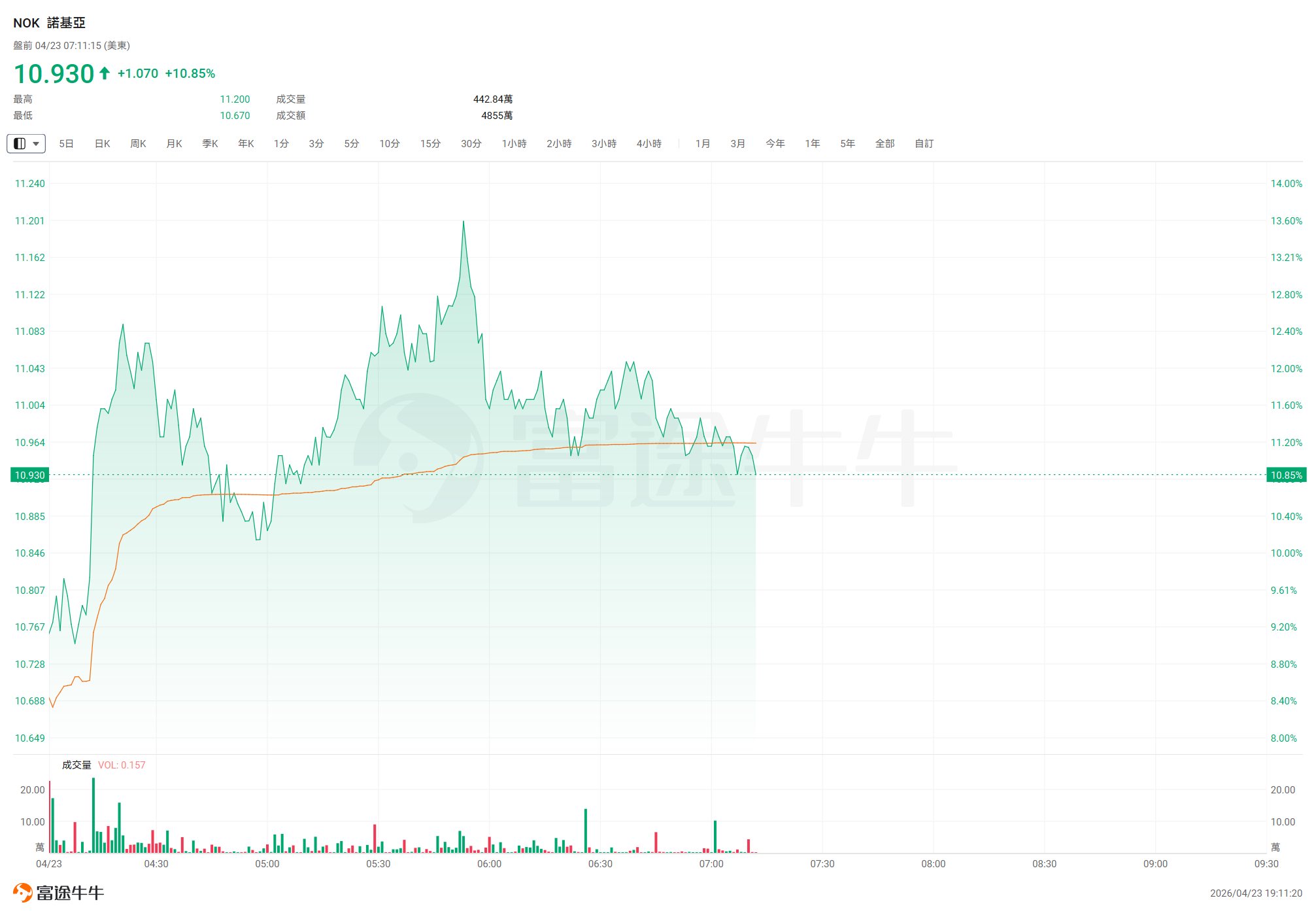
$Nokia Oyj (NOK.US)$Shares rose over 10% in pre-market trading after the company announced stronger-than-expected first-quarter earnings, reflecting the early rewards of its transition into artificial intelligence (AI) and cloud infrastructure. Data showed Nokia's net sales increased 3% year-over-year to €4.5 billion in Q1, slightly below analysts' average estimate of €4.6 billion. On profitability, adjusted operating profit for the quarter was €281 million, a 54% year-over-year increase, surpassing analysts' average expectation of €244 million. Net profit for the quarter reached €295 million, a staggering 93% year-over-year rise. Adjusted earnings per share stood at €0.05, up 67% year-over-year.
Intel is set to release its earnings report after market close, securing its first major customer for the 14A process technology.
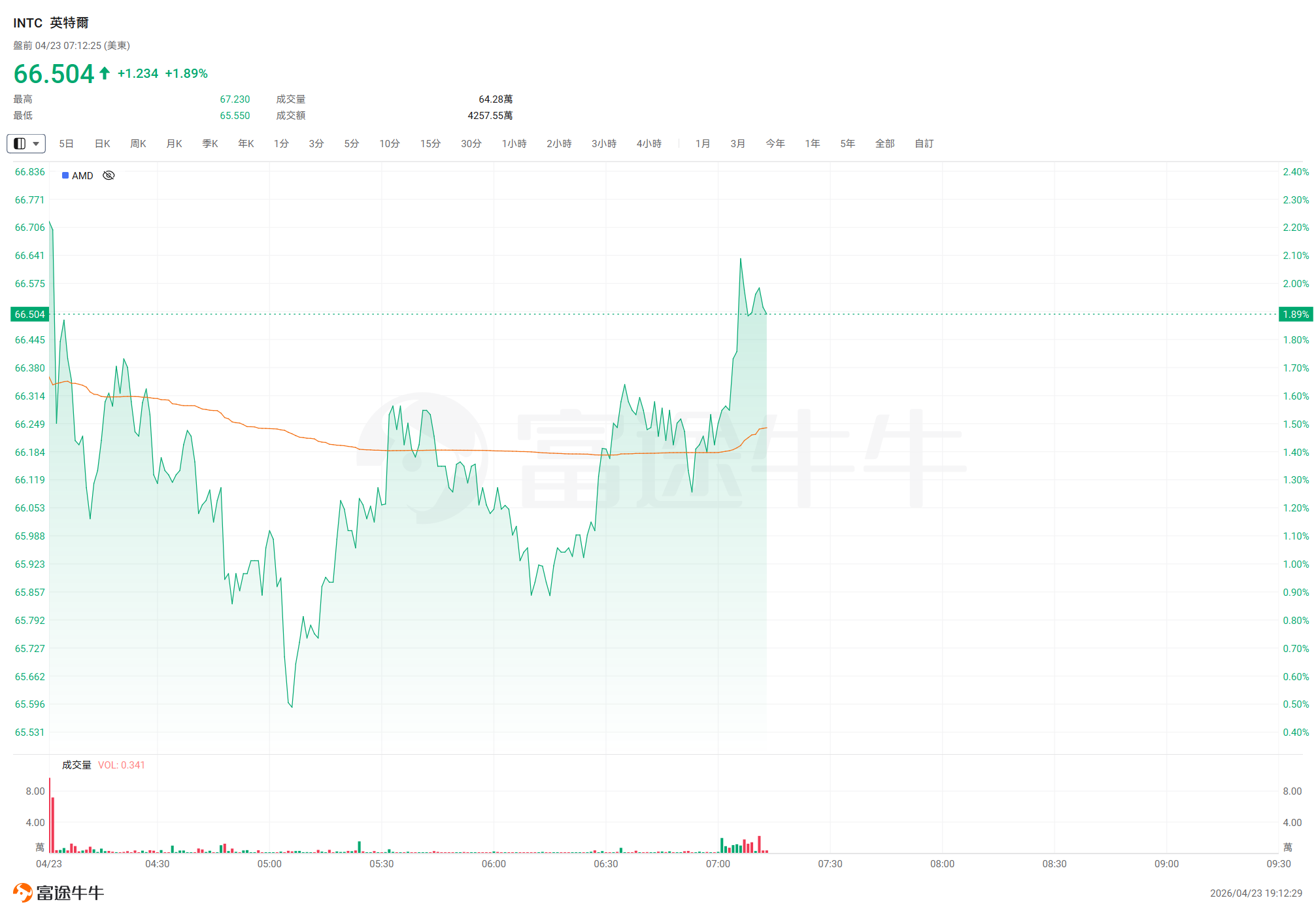
$Intel (INTC.US)$Shares rose nearly 2% in pre-market trading as Tesla plans to utilize Intel's advanced 14A manufacturing process for chip production within its Terafab project. This makes Tesla the first major customer for Intel's 14A technology. After the U.S. market closes on the 23rd, Intel will release its financial results from the previous quarter. So far this year, Intel's stock price has surged nearly 77%.
Further reading:Options Sir Breaks Down Hot Topics | CPU Trio: Intel Awaits Earnings, AMD & ARM Hit New Highs, How to Choose?
The sixth in US stock history! Broadcom secures Google as a major partner, joining the $2 trillion market capitalization club.
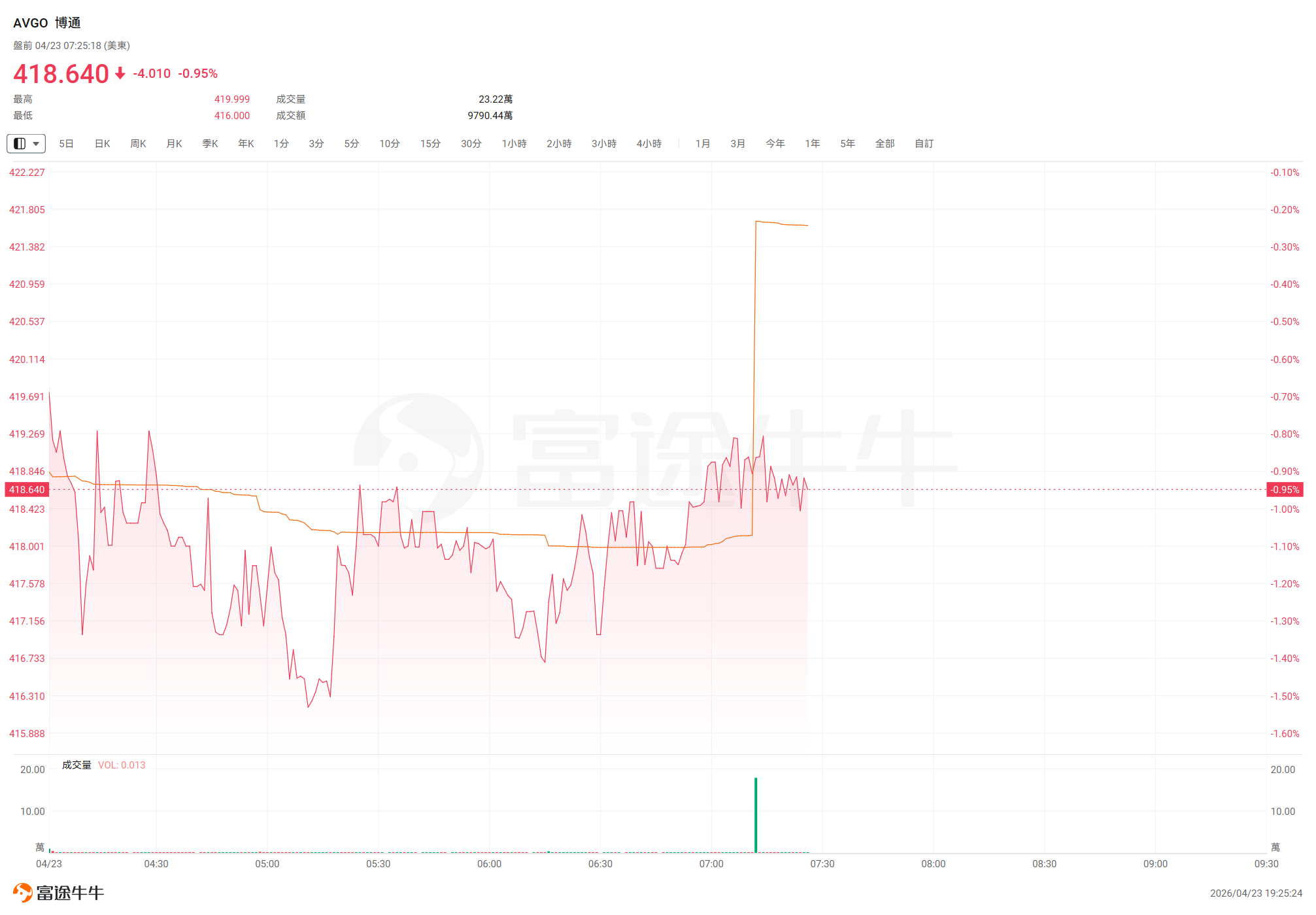
Wednesday,$Alphabet-A (GOOGL.US)$Announcing the launch of and$Broadcom (AVGO.US)$Announced the launch of the jointly developed eighth-generation Tensor Processing Unit (TPU), triggering a roughly 5% surge in Broadcom's stock price, closing at $422.65. This marked a record closing high since complete data became available in 2009 and represented the first new all-time high since 2026. According to Dow Jones Market Data, Broadcom's market value officially surpassed $2 trillion, making it the sixth company in U.S. stock market history to achieve this milestone after NVIDIA, Alphabet, Microsoft, Amazon, and Apple.
Netflix announces plan to repurchase $25 billion in shares.
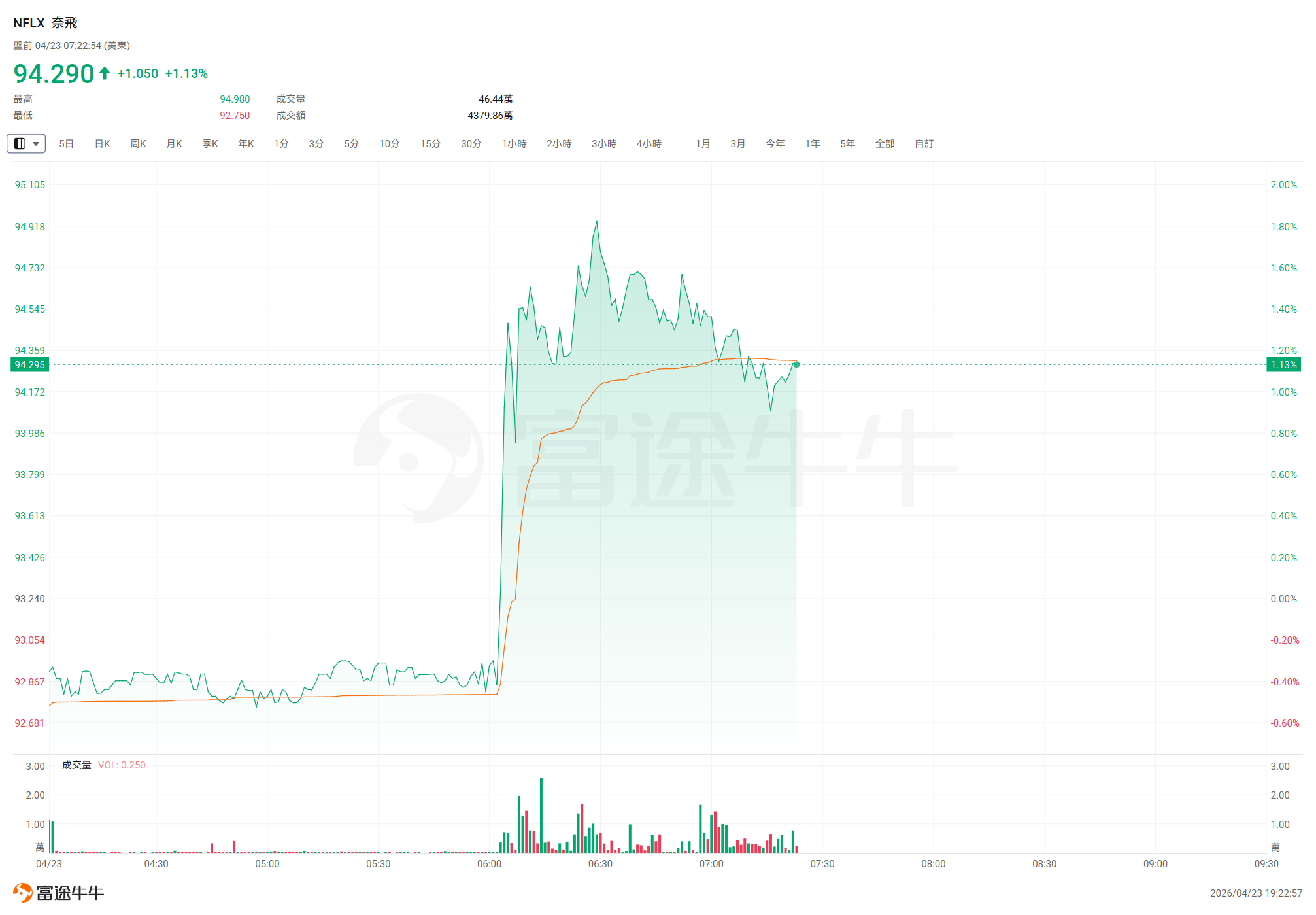
$Netflix (NFLX.US)$ Shares rose more than 1% pre-market after the company announced a plan to repurchase $25 billion worth of stock, following a decline in its share price due to disappointing earnings guidance. In a regulatory filing on Thursday, the company stated that this plan was an addition to the stock repurchase program announced in December 2024, which still had $6.8 billion available for buybacks. The new repurchase plan does not have an expiration date. This announcement came just days after Netflix's earnings report disappointed the market and Chairman and co-founder Reed Hastings announced his departure, causing the stock to fall. Since the earnings release on April 16, the company’s share price has dropped by more than 13%.
ServiceNow’s earnings met expectations, but concerns over the impact of AI persisted amidst headwinds from conflicts in the Middle East.
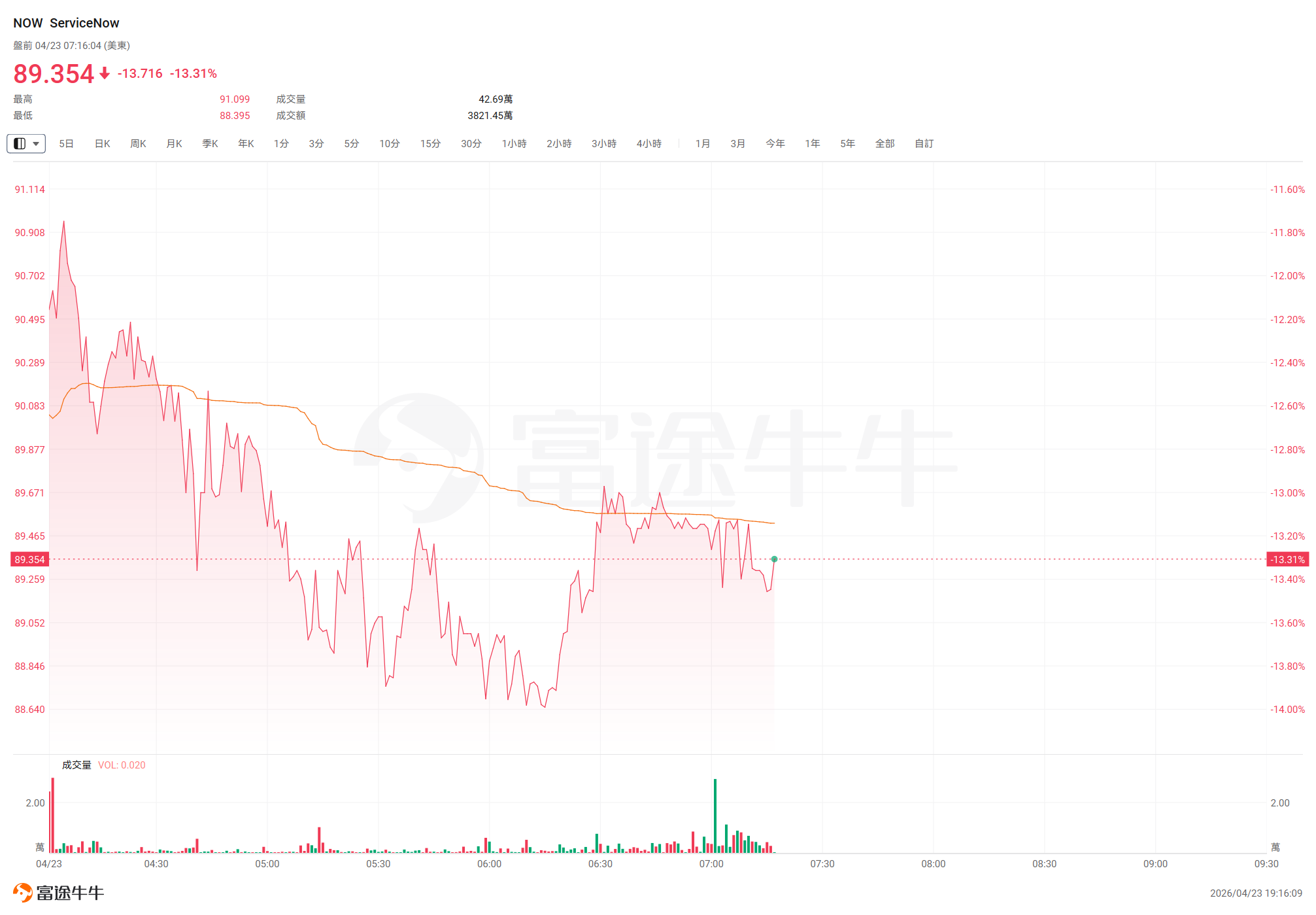
$ServiceNow (NOW.US)$ Shares fell more than 13% pre-market after the company released its Q1 2026 earnings. Despite management describing the results as 'once again exceeding the high end of guidance,' investor sentiment cooled significantly due to delays in closing several large deals caused by Middle East conflicts, combined with Wall Street’s ongoing skepticism about the outlook for enterprise software in the AI era. The earnings report showed total revenue of $3.77 billion and subscription revenue of $3.671 billion for Q1, both representing a 22% year-over-year increase and aligning closely with the average analyst estimates compiled by Bloomberg.
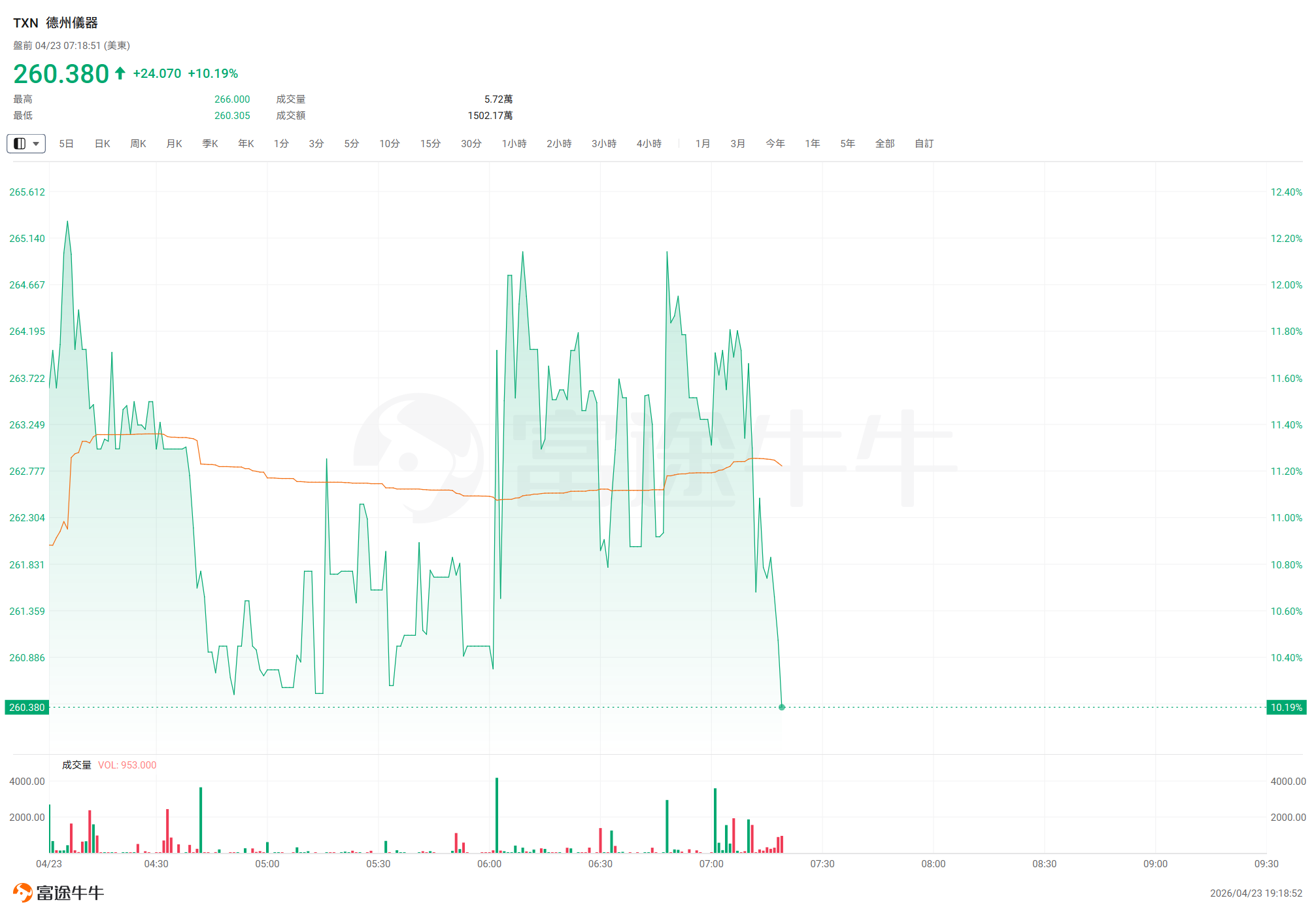
Texas Instruments delivered a 'home run' with its Q1 earnings, driving pre-market share prices higher.
$Texas Instruments (TXN.US)$ Shares surged more than 10% pre-market after the company reported nearly a 'home run' performance: Q1 revenue exceeded expectations, and strong growth in data center and industrial equipment spending led to impressive guidance. Texas Instruments’ Q1 revenue grew 19% year-over-year to $4.83 billion, surpassing the expected $4.52 billion, while net profit increased 31% to $1.545 billion. The company forecasts Q2 revenue between $5 billion and $5.4 billion, with earnings per share ranging from $1.77 to $2.05, both significantly above analysts’ previous estimates.
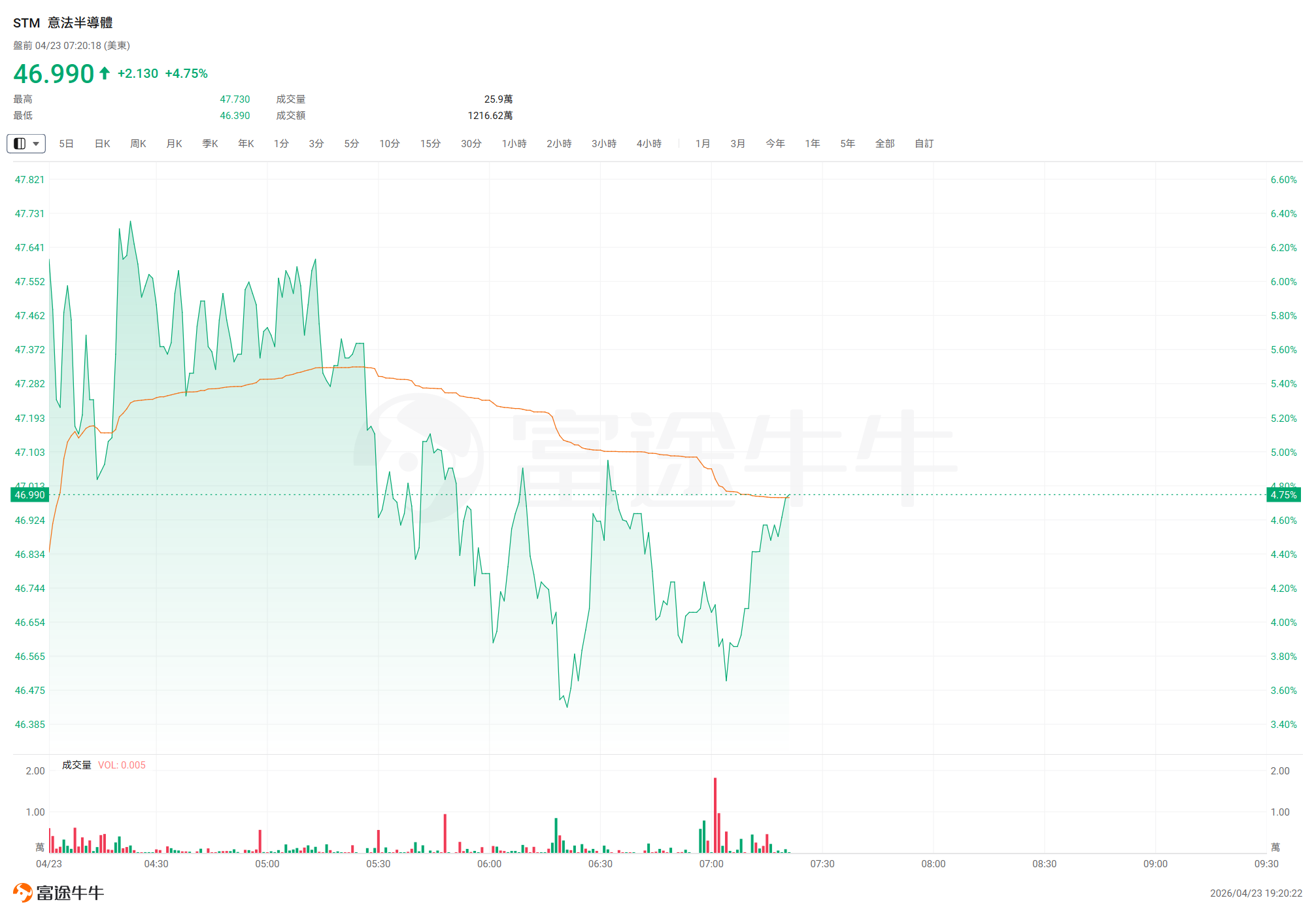
Traditional business recovery + AI business boom drives STMicroelectronics' Q1 results and guidance above expectations.
$STMicroelectronics (STM.US)$ The company announced better-than-expected first-quarter earnings on Thursday and projected further growth for the second quarter. Data showed that the company’s Q1 revenue increased 23% year-over-year to $3.1 billion, surpassing analysts’ expectations of $3.04 billion. Non-GAAP operating profit reached $171 million, also exceeding the anticipated $165.8 million.
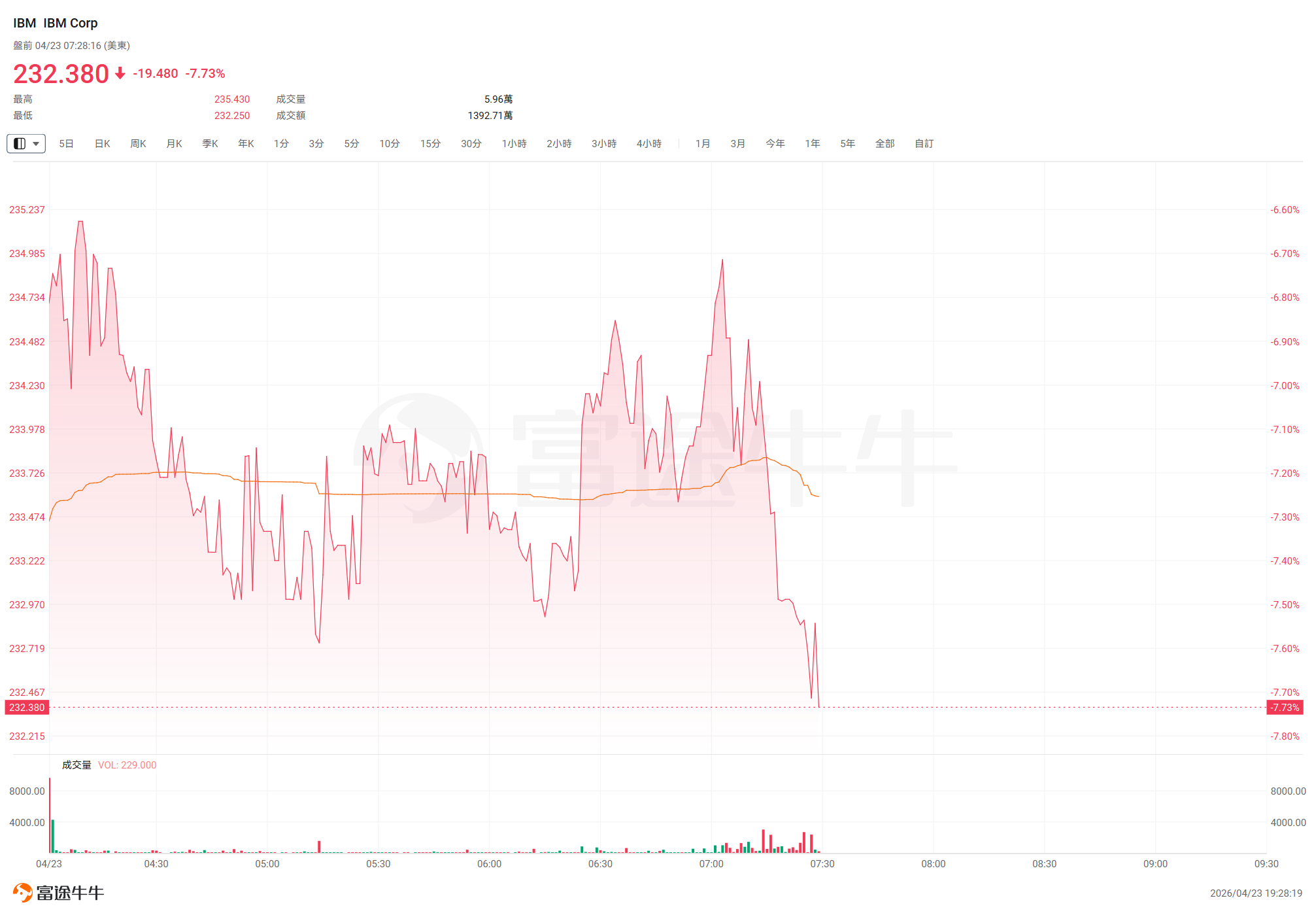
IBM Corp reported Q1 revenue and profits surpassing expectations, but shares plummeted pre-market due to lackluster software growth.
$IBM Corp (IBM.US)$ Shares dropped more than 7% pre-market despite the company reporting Q1 revenue of $15.9 billion, up 9% year-over-year and above expectations. Adjusted EPS was $1.91, also beating forecasts. Infrastructure revenue surged 15%, with mainframe sales jumping 51%. However, software revenue growth only met expectations, and consulting revenue increased by just 1% at constant currency rates, raising concerns about the impact of AI on traditional businesses. Shares fell more than 7% post-market.
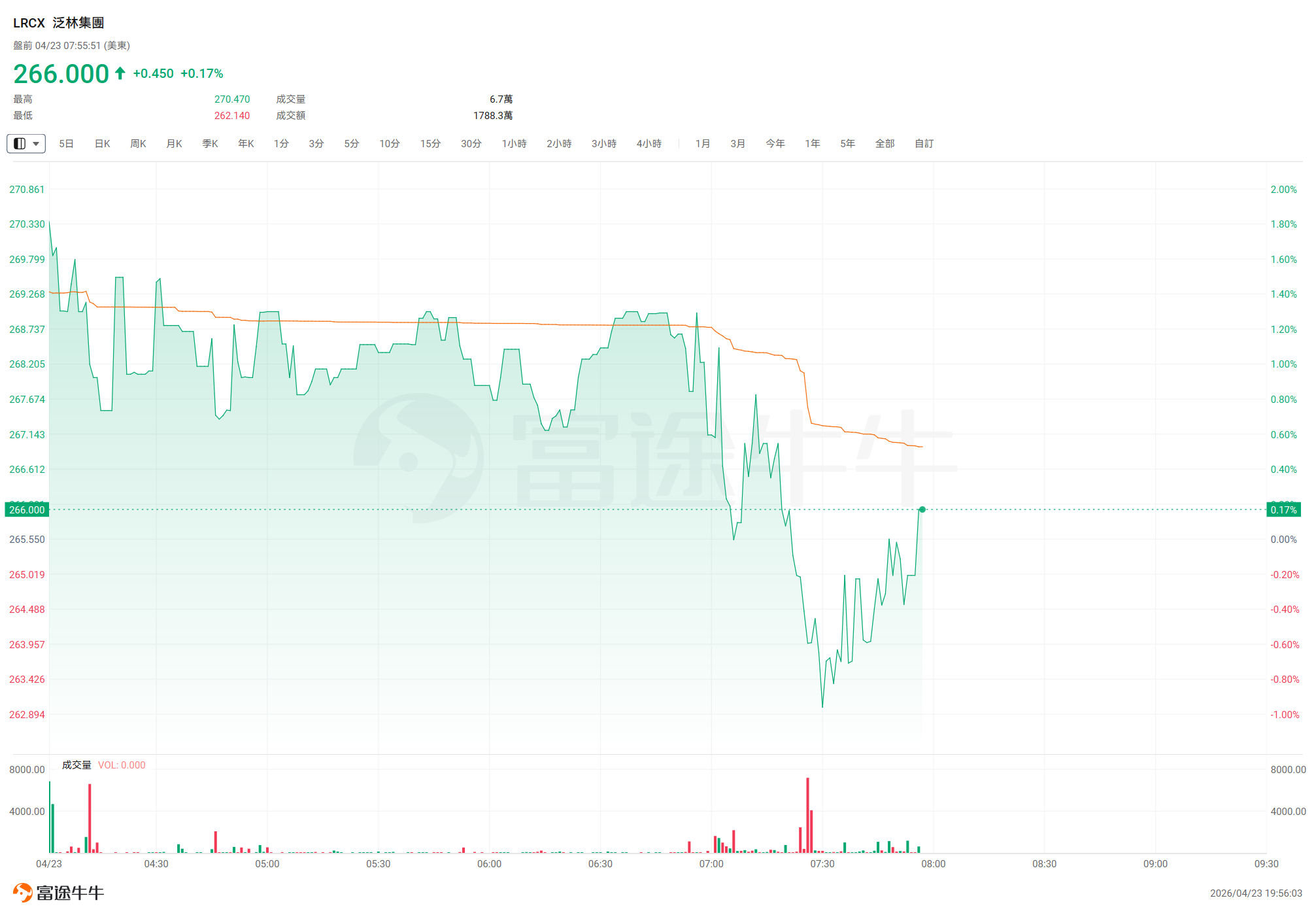
Lam Research posted record quarterly revenue, with the CEO stating that next year looks 'quite promising.'
$Lam Research (LRCX.US)$ Shares initially reversed gains before edging up 0.17% pre-market. Lam Research reported Q3 revenue of $5.84 billion and non-GAAP earnings per share of $1.47, both setting new records and surpassing Wall Street expectations, with China being the largest market. The company raised its next-quarter revenue guidance to approximately $6.6 billion, and the CEO noted that '2027 is shaping up to be quite a good year.' However, customer prepayments dropped to a near four-year low, drawing attention to fluctuations in short-term order patterns.
Report: SpaceX Plans to Manufacture Its Own GPUs and Warns of "Significant Capital Expenditure"
According to excerpts from the S-1 registration document obtained by the media, the company has listed "in-house GPU manufacturing" as one of its ongoing projects involving "significant capital expenditure." This is one of the risk factors disclosed to potential investors as SpaceX seeks to go public. The company also warned that it does not have long-term contracts with many direct chip suppliers, and there remains significant uncertainty regarding its ability to consistently secure sufficient computing power to support business growth. The significance of this news for the capital markets lies in the fact that once the plan to develop GPUs in-house advances, it could result in an incalculable scale of capital expenditure and impact the competitive landscape involving leading suppliers such as NVIDIA and Taiwan Semiconductor.
Global Macro
Trump States There Is "No Timeline" for Ending Conflict, Iran Receives First Payment for Strait of Hormuz Passage Fees
U.S. President Trump clearly stated on the 22nd that there is currently "no timeline" for when the conflict with Iran will end, and there is no need to rush. Although a ceasefire agreement at the military level has been extended, the confrontation between the two sides in the economic and shipping sectors continues to escalate. This high-stakes game of brinkmanship is dragging the global economy into a prolonged war of attrition with costs that are difficult to estimate.
In addition, on the 23rd local time, the deputy speaker of Iran's parliament announced that the first payment for passage fees through the Strait of Hormuz had been transferred to the central bank account. Iran’s arrangement for charging transiting vessels dates back to the initial ceasefire agreement. According to CCTV’s report on April 8, the two-week ceasefire agreement reached in early April included provisions allowing Iran and Oman to charge passage fees for transiting vessels. The funds raised by Iran will be used for post-war reconstruction.
Warsh Faces Difficult Path to Federal Reserve Leadership, U.S. Prosecutor: DOJ Will Not Abandon Investigation into Powell
Even after North Carolina Republican Senator Thom Tillis reiterated that he would continue to block Kevin Warsh’s appointment as Federal Reserve Chair unless the Department of Justice (DOJ) ends its investigation into Powell, the U.S. Department of Justice remained firm, stating it would not abandon the probe. On Wednesday, Eastern Time, U.S. Attorney Jenny Piro of the District of Columbia said she would continue to advance the investigation into cost overruns related to the renovation of the Federal Reserve building. Despite the controversial nature of this investigation, which jeopardizes the nomination of Trump's chosen successor for the role of Fed Chair, Kevin Warsh.
Reuters Survey: The Fed May Cut Interest Rates Once This Year, But Likely Not Until At Least Six Months From Now
The latest survey conducted by Reuters among economists shows that due to the energy shock triggered by the war, which has driven up already high inflation, the Fed will likely wait at least six more months before cutting interest rates. The nearly two-month-long Middle East conflict has caused fuel prices to surge and consumer confidence in the U.S. to plummet to historic lows, erasing previous market bets on Fed rate cuts. Nevertheless, most forecasters still believe that the Fed will cut interest rates at least once this year.
From storage, MLCC, ABF to indium phosphide, here is Goldman Sachs' latest perspective on the 'bottlenecks' in the AI computing power chain.
On April 22, a research report published by Daiki Takayama's team at Goldman Sachs pointed out that since the beginning of this year, the surge in demand driven by AI servers has pushed an already strained supply chain at the start of the year toward even more severe shortages. The report covers 11 key segments ranging from semiconductors, passive components to specialty materials, with significant upward revisions to supply and demand forecasts in five areas. From MLCCs, ABF substrates, PCB/CCL, memory, to indium phosphide (InP) substrates, supply-demand gaps have continued to widen over the past four months, and this trend is unlikely to reverse before 2027.
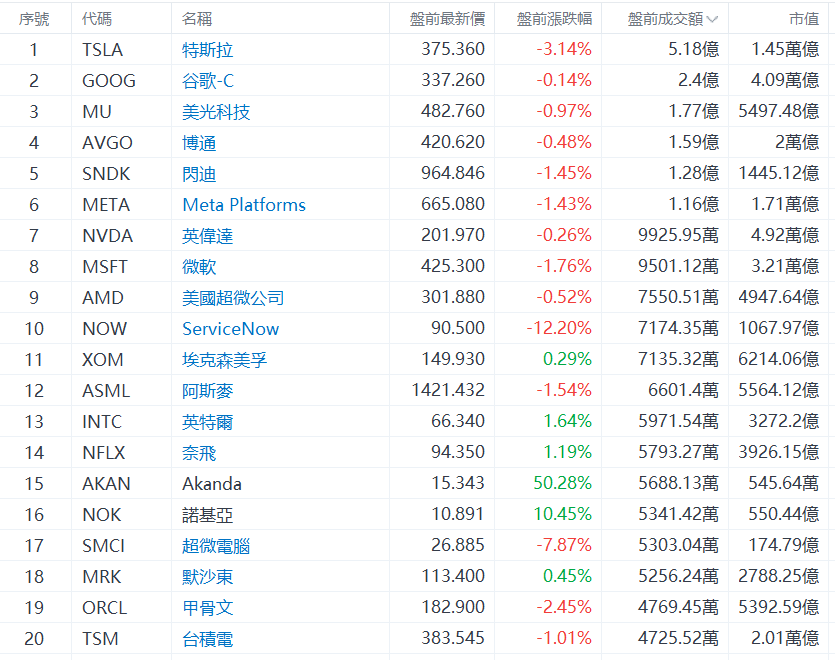
Top 20 pre-market trading volume stocks in the U.S.
Reminder of the US stock market macroeconomic calendar
(The following times are in Beijing Time)
20:30 U.S. Initial Jobless Claims for the Week Ending April 18 (in Ten Thousand People)
In the early hours of the following morning,
After the U.S. stock market close, Intel, SAP SE, and Newmont will release their earnings reports.
 Looking to pick stocks or analyze them? Want to know the opportunities and risks in your portfolio? For all your investment-related questions,just ask Futubull AI!

Editor/KOKO