
Lululemon's stock price fell more than 4% in pre-market trading on Thursday after the company announced the appointment of former Nike executive Heidi O'Neill as its new chief executive officer, concluding a months-long search for a successor. However, this decision failed to garner a positive response from investors.
According to Zhitong Finance, shares of Lululemon Athletica (LULU.US), a yoga-inspired athletic apparel brand, fell more than 4% in pre-market trading on Thursday after the company announced the appointment of former Nike (NKE.US) executive Heidi O'Neill as its new CEO, concluding a months-long search for a successor. However, this decision did not receive a positive response from investors.
O'Neill has over 25 years of experience at Nike, where she was responsible for global direct-to-consumer (DTC) and digital businesses. In a statement, Lululemon highlighted her critical role in brand revitalization, shortening product development cycles, and accelerating time-to-market. She is expected to officially take over as CEO of Lululemon in September, while the interim co-CEOs, Meghan Frank and Andre Maestrini, will continue their duties until the transition is complete.
 Market skepticism stems from experiences with Nike.
Despite O'Neill’s extensive industry experience, investors and analysts generally remain cautious about her prospects in the new role.
A core reason for the lukewarm market reaction lies in the weak performance of the business segments O'Neill oversaw at Nike. Although she served at Nike for many years, the company's stock price has also performed poorly over the past year and five years.
Analysts at Evercore ISI noted, “Critics may focus on the negative results of the DTC business that O'Neill was responsible for during the final phase of her tenure at Nike.”
Needham analyst Tom Nikic also stated that while O'Neill is an intriguing candidate, her senior leadership period coincided with what investors criticized as the 'Donahoe-era' strategic missteps at Nike, giving them reasonable grounds for skepticism.
Raymond James analyst Rick Patel pointed out in a research report, “O'Neill should possess the ability to manage complex global organizations, with particular strengths in innovation, consumer insights, marketing, and cultural relevance, thereby driving sales growth.”
However, he added, “We believe the market’s concern lies in the fact that Nike itself has been undergoing a transformation due to execution failures over the past few years.” He opined that Lululemon is unlikely to introduce significant strategic changes before next year.
Internal and external challenges intertwine.
Lululemon Athletica is currently facing multiple challenges. In addition to sluggish sales growth and fierce competition from emerging brands such as Alo and Vuori, the company is also embroiled in a proxy battle with its founder Chip Wilson. Wilson, who holds approximately 4.3% of the shares, has repeatedly criticized the brand for losing its 'trendy' appeal and is pushing to replace three board members at this year’s annual general meeting.
Meanwhile, Elliott Investment Management, an activist investor holding approximately $1 billion worth of shares, is also pressuring the company to replace its management. It is reported that Elliott previously favored the appointment of veteran retail executive Jane Nielsen as CEO rather than O'Neill, the board's final choice. This disagreement has heightened short-term market uncertainty.
Over the past 12 months, Lululemon Athletica’s stock price has fallen by approximately 38%, reducing its market capitalization to $18.8 billion. Over the past five years, the stock price has declined by more than 50%.
Core Issues Remain Unresolved
Analysts believe that O'Neill's arrival may bring much-needed product expertise and market insight for rebranding efforts. Jefferies analyst Randal Konik stated, "Ms. O'Neill may bring the product experience needed to reposition the brand, but so far, the core issues remain: ongoing proxy battles continue to add uncertainty, and high store productivity metrics still face downward pressure without signs of bottoming out."
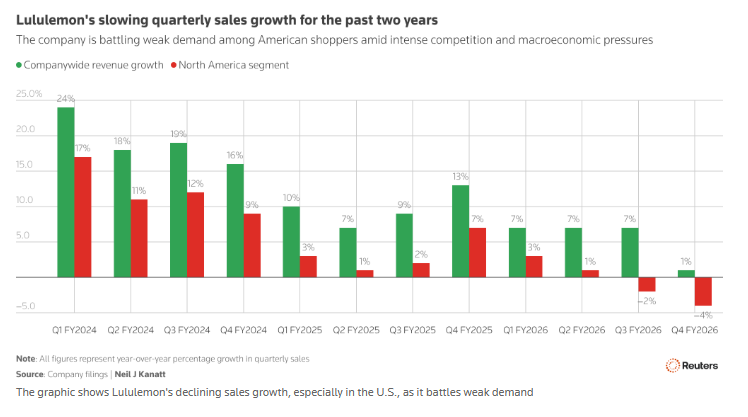
Lululemon Athletica has also faced controversies in recent years, including quality disputes over 'see-through yoga pants,' concerns about chemical substances in products, and multiple disappointing earnings guidance reports. Former CEO Calvin McDonald departed earlier this year, and his resignation news once triggered a strong stock price rebound, contrasting sharply with the decline caused by the appointment of the new leader this time.
Guggenheim analyst Simeon Siegel noted that this personnel appointment came as a surprise to most investors. He believes that O'Neill will need sufficient time to address internal issues and develop a restructuring plan, and the market should wait patiently for her subsequent strategic planning.
At the same time, he remains cautious: "We believe that Lululemon Athletica's brand foundation remains strong, but its current development has already been excessively overdrawn. Based on our analysis, the company's revenue is bound to undergo a phased adjustment, further intensifying profit-side pressures. Cost reductions will be insufficient to offset the impact of declining revenue."
Editor/joryn