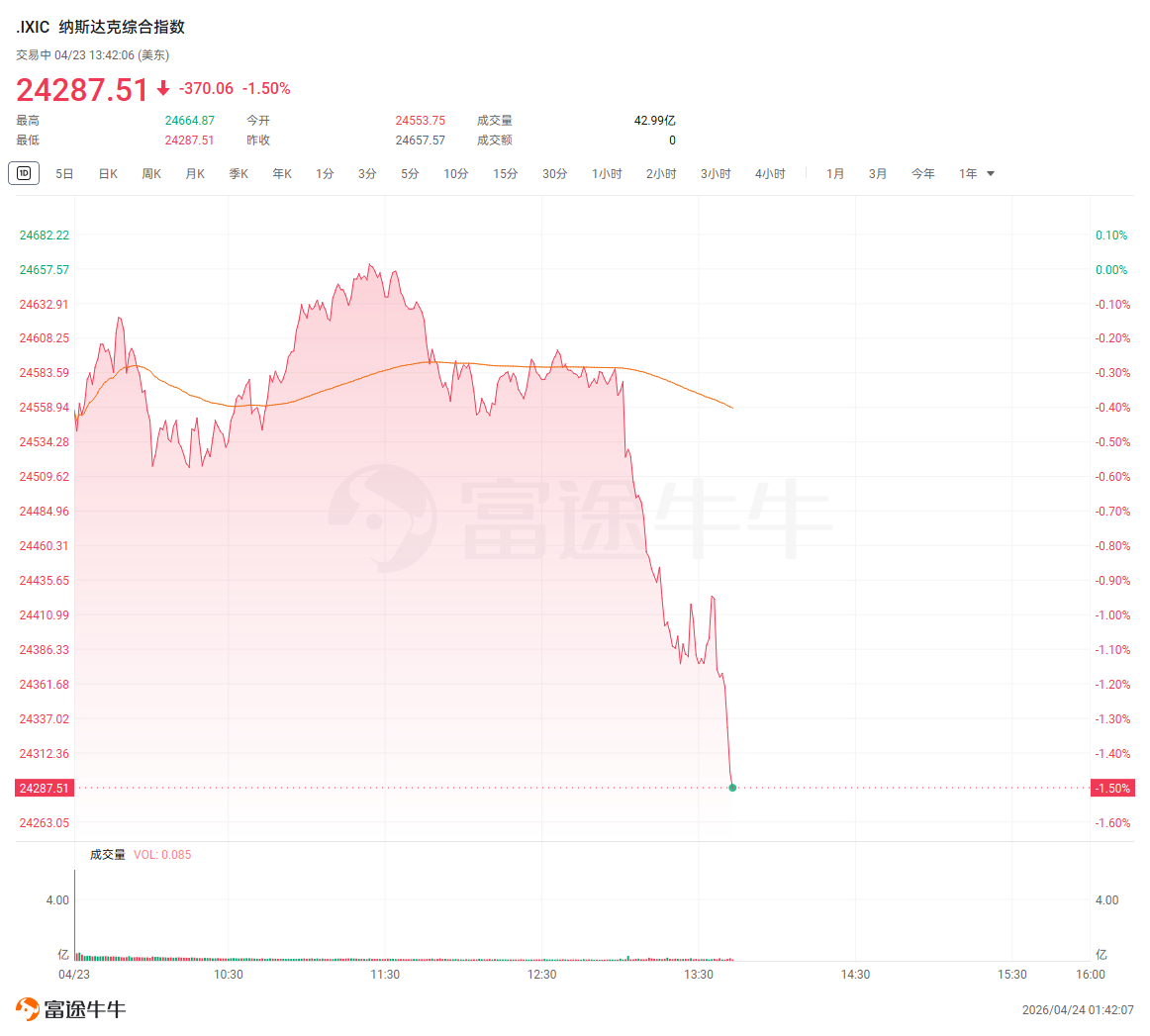
Following the news that the Speaker of Iran's Parliament had resigned from the negotiation team, U.S. stock market declines widened, with the Nasdaq falling over 1%. After reports from Tehran, crude oil prices hit a fresh daily high, rising more than 5%. Iranian media later reported that the activation of air defense systems was aimed at countering small drones. According to Iranian media, Iran has developed retaliatory plans targeting potential military actions by the U.S. and its allies. A Pakistani diplomat stated that U.S.-Iran talks have "reached an impasse." The Israeli Defense Minister threatened Iran: "Prepared to restart hostilities, awaiting the U.S. 'green light'." Iran’s Foreign Ministry said the focus of negotiations had shifted from nuclear issues to achieving a complete ceasefire. Iran's leadership collectively denied internal divisions, with the Supreme Leader asserting that public unity has caused rifts among adversaries. Iranian media reported that four Iranian tankers had broken through the U.S. blockade in the past two days. Iran’s Judiciary Chief stated that the U.S. dares not approach the Strait of Hormuz, with Iran's fleet standing ready in the strait. Iran’s Central Bank announced that the first payment for passage through the Strait of Hormuz had been received in the form of "cash foreign exchange."
The outlook for a U.S.-Iran peace agreement remains uncertain, and tensions in the Strait of Hormuz have escalated further. Even officials from Pakistan, the mediating party, acknowledged that U.S.-Iran talks have "reached an impasse." Israeli media reported that one of the key Iranian representatives in the U.S.-Iran talks, the Speaker of Iran’s Parliament, Kalibaf, had resigned from the negotiation team. Iranian media also reported that air defense systems in Tehran had been activated to intercept "hostile" targets. These developments negatively impacted financial markets that had previously held a "fragile optimism" about the prospects for peace talks.
According to reports by Xinhua News Agency, on Thursday, U.S. President Trump stated on social media that he had ordered the U.S. Navy to fire upon and sink any vessels found laying mines in the waters of the Strait of Hormuz.
 Trump stated:
"I have ordered the Navy to fire upon any vessels placing mines in the Strait of Hormuz. I have also ordered the mine-sweeping capabilities in the Strait of Hormuz to be increased to 'three times' their current level."
Meanwhile, according to CCTV News, the U.S. Department of Defense announced on social media on the 23rd local time that the U.S. military had conducted a maritime interception and boarding inspection of an oil tanker transporting oil from Iran. Xinhua cited Iranian media as reporting that data from a tanker monitoring website showed four Iranian oil tankers had broken through the U.S. blockade and entered Iranian waters within the past two days.
Earlier on Thursday, according toXinhua News Agencya diplomatic source from Iran told TASS that the preparations for negotiations between Iran and the United States in Pakistan could achieve a breakthrough "tonight or tomorrow."
Later, during the early trading session of the U.S. stock market, CCTV cited Saudi sources as stating that a Pakistani diplomat said the U.S.-Iran talks were 'at a standstill,' with progress being 'extremely slow.' The diplomat added that the United States remains committed to maintaining its maritime blockade against Iran. Iran has informed Pakistan that the U.S. blockade is an obstacle to its participation in the negotiations.
Xinhua cited Iranian media reports stating that, due to the failure of diplomatic solutions and 'complete distrust' in the sincerity of U.S. negotiations, Iran has developed a counter-response plan based on the principles of 'reciprocal response' and 'offensive deterrence' against potential U.S. and allied military actions.
This plan outlines specific Iranian responses under various scenarios, such as retaliating against Israeli and other U.S. ally power plants or critical oil and gas facilities if Iranian power plants or oil and gas facilities are attacked. Reports also indicate that Iran may launch surprise operations targeting U.S. interests outside the Middle East region. Similar reports were made by CCTV.
During the mid-session of the U.S. stock market on Thursday, according to Israeli media reports, Mohammad Bagher Ghalibaf, the Speaker of Iran's Islamic Consultative Assembly, withdrew from the negotiation delegation following the intervention of the Islamic Revolutionary Guard Corps. Subsequently, according to CCTV News, air defense systems in some areas of Tehran, Iran, were activated for reasons that remain unclear.
Following the news about the Iranian Speaker, the three major U.S. stock indexes accelerated their decline, with the Nasdaq Composite Index falling more than 1% at one point during the session.
Iran claims to have drawn up a list of retaliatory targets against the U.S. and its allies.
According toCCTV NewsCiting Iranian sources on Thursday, the 23rd local time, amid diplomatic setbacks and lack of trust in the negotiations, Iran has formulated a target list based on the principles of 'reciprocal response' and 'offensive deterrence' to address possible U.S. and allied military actions.
The list reportedly includes multiple response plans tailored to different scenarios. For example, if Iranian power plants are struck, Iran would retaliate with missile and drone strikes against power plants of Israel and other U.S. allies in the region; if Iranian oil and gas facilities are attacked, retaliation would target critical oil and gas facilities of Israel and U.S. allies, aiming to reduce global daily oil production by 25 million barrels over a year. If senior Iranian military or political figures are assassinated, attacks would be directed at information technology and artificial intelligence centers of relevant countries. If Iran's territorial sovereignty is violated (e.g., occupation of islands or ports), large-scale ballistic missile, cruise missile, and drone joint attacks would be launched against enemy aircraft carriers and attack helicopters. If the maritime blockade against Iran persists or escalates, the Bab-el-Mandeb Strait would be blockaded, and if necessary, the Strait of Hormuz would be fully blocked via extensive mining, cutting off all oil export pipelines. If the U.S. military uses regional bases to launch a ground invasion of Iran, Iran would coordinate with resistance front forces and local armed groups in the host country to conduct joint ground operations, relying on local civilians to capture U.S. soldiers. Additionally, Iran might carry out surprise operations targeting U.S. interests outside the region.
Some military and strategic analysts believe that once a conflict breaks out, the situation could rapidly spill over into the entire region as resistance fronts join in. U.S. allies, especially Israel and Gulf oil-producing countries, may become potential targets. Further analysis suggests that Iran would adopt an 'offensive deterrence' strategy at that time, potentially taking responses that go beyond defensive measures, aiming to impose heavy strategic costs on the enemy and its allies.
Analysts pointed out that if key shipping lanes are blocked and regional energy facilities are damaged, it will plunge the global energy market into an unprecedented crisis. Against this backdrop, the current ceasefire is viewed more as a temporary arrangement, with significant uncertainties remaining in the regional situation.
Iran’s judiciary chief: The U.S. dares not approach the Strait of Hormuz, and Iran’s fleet is standing ready in the strait.
According to Xinhua News Agency, Iran’s judiciary chief Ejei stated on the 23rd, 'The U.S. does not dare to approach the Strait of Hormuz.' The 'swarm' fleet of Iran’s Islamic Revolutionary Guard Corps is standing ready, prepared at any time to destroy U.S. defenses through 'saturation' attacks.
Ejei posted on social media, stating that he takes pride in the strength displayed by Iran’s armed forces in the Strait of Hormuz. The day before, Iran detained three vessels violating relevant regulations in this strategic waterway. Additionally, the U.S. has 'witnessed' the fate of two so-called advanced destroyers, the USS Frank E. Peterson and the USS Michael Murphy.
According to Iranian media reports on the 12th, two U.S. Navy destroyers recently attempted to enter the Persian Gulf. Iran’s Islamic Revolutionary Guard Corps Navy locked onto the targets, forcing the U.S. ships to retreat when they were 'just minutes away' from being completely destroyed.
Meanwhile, the U.S. Central Command posted on social media at Eastern Time on the 11th, stating that the USS Frank E. Peterson and the USS Michael Murphy crossed the Strait of Hormuz that day, and the U.S. military began creating conditions for mine-clearing operations in the Strait of Hormuz.
Iran's Central Bank: The First Payment for the Passage of the Strait of Hormuz Recorded as 'Cash Foreign Currency'
According to CCTV News, Iran's Central Bank confirmed that the first payment of tolls collected from ships passing through the Strait of Hormuz has been credited in the form of 'cash foreign currency.' Previously, there were reports that Iran was collecting tolls for passage through the Strait of Hormuz in the form of 'cryptocurrency.'
Earlier on Thursday, Haji Babaei, the Deputy Speaker of the Islamic Consultative Assembly of Iran, stated that Iran had received the first payment of the Strait of Hormuz toll and deposited it into the central bank account.
Air defense systems activated in parts of Tehran.
According to Iran's Mehr News Agency, on the evening of April 23 local time, air defense systems were activated in parts of Tehran, the capital of Iran, “currently intercepting hostile targets.” (CCTV International News)
Iranian leadership collectively denies internal division: We are all Iranians, revolutionaries.
In response to repeated claims by U.S. President Trump that there is an 'internal division and struggle' within Iran, on the evening of April 23 local time, Iranian President Pezeshkian, Speaker of Parliament Kalibaf, and Chief Justice Ejeh jointly posted on social media stating, “In Iran, there are no so-called ‘hardliners’ or ‘moderates.’ We are all ‘Iranians,’ we are all ‘revolutionaries.’ With the ironclad unity between the people and the government, as well as complete obedience to the Supreme Leader, we will make the aggressors regret their actions.”
Earlier that day, Trump posted on social media claiming, “Iran is having a very hard time trying to figure out who their leaders are; they have no idea. The ‘hardliners’ have been utterly defeated on the battlefield, while the ‘moderates’ aren't actually moderate but are gaining respect. The infighting between the two sides is simply insane.” (CCTV)
Israeli media: Israel denies airstrikes on Iran
Multiple Israeli media outlets cited sources on the evening of the 23rd to report that Israel did not launch airstrikes against Iran that night.
The Times of Israel website quoted an Israeli security official that evening as saying, 'Israel did not attack Iran.' Channel 12 also quoted a military source stating that Israel 'will not attack Iran now.'
According to Iranian media reports, explosions were heard over Tehran, the capital of Iran, on the evening of the 23rd, and the air defense system was activated to fire at 'hostile targets.' (Xinhua)
Iranian media: Activation of air defense systems aimed at countering small drones.
According to Xinhua News Agency citing Iran’s Fars News Agency on the 23rd, Iran activated its air defense systems in response to the appearance of small drones across multiple regions. The report stated that the sound of air defense systems being activated in Iran’s capital, Tehran, and several other cities was due to the detection of small drones, including Israel’s "Orbiter" reconnaissance drones.
Iranian media reported that earlier that evening, explosions were heard over Tehran, with air defense systems activated and firing at "hostile targets." Multiple Israeli media outlets subsequently cited their sources stating that Israel did not launch airstrikes against Iran.
The U.S. aircraft carrier 'George H.W. Bush' has entered the Indian Ocean.
The U.S. Central Command announced on social media on the 23rd local time that the 'Nimitz'-class aircraft carrier 'George H.W. Bush' was sailing in the Indian Ocean within the Central Command's area of responsibility on that day. (CCTV News)
Israeli Defense Minister threatens Iran: Prepared to restart hostilities, awaiting the U.S. 'green light.'
According to Xinhua News Agency, Israeli Defense Minister Katz stated on the evening of the 23rd that Israel is prepared to resume military action against Iran and is waiting for the "U.S. green light."
In a video statement that day, Katz said: "Israel is ready to go to war again with Iran. The Israel Defense Forces are prepared both defensively and offensively, and targets have been identified." Katz stated that Israel is waiting for the "U.S. green light" to "completely destroy the Iranian regime," and the military is prepared to deliver a "devastating blow" to Iran’s "most vulnerable points."
Xinhua News Agency cited Israeli media reporting that Katz presided over a special situation assessment meeting at the Israeli military headquarters that day, attended by senior Israeli military officers and defense agency officials. After the meeting, Katz stated that the Israeli military is fully prepared to resume military operations against Iran at any time. Operational plans include strikes against "successors" of Iran’s supreme leadership, key energy and power facilities, economic infrastructure, and more, which would push Iran back into the "dark Stone Age."
Trump stated on the 22nd that there is "no timetable" for ending the conflict with Iran and no need to rush. The White House similarly denied that Trump set a deadline for extending the ceasefire with Iran.
Iran's Ministry of Foreign Affairs: The focus of negotiations has shifted from the nuclear issue to a complete ceasefire.
According to CCTV News, the spokesperson for Iran's Ministry of Foreign Affairs formally responded on the 23rd regarding the appointment of Iranian Parliament Speaker Kalibaf as the head of Iran's delegation in Islamabad negotiations. The spokesperson emphasized that the nature of recent negotiations has fundamentally shifted, with the core issue no longer being the nuclear topic but rather the complete termination of the war.
The spokesperson explicitly noted that the nuclear issue is no longer the central focus; the current negotiation priority is a comprehensive ceasefire, with the primary task being the protection of national core interests. Key demands at the negotiating table include claims for war reparations, resolution of disputes over the Strait of Hormuz, and full lifting of sanctions.
Iran is also demanding tangible guarantees from the United States and Israel to ensure no future military aggression against Iran. Any final agreement must be based on the elimination of threats and the prevention of repeated aggression.
Iran's Ministry of Foreign Affairs: The so-called 'nuclear threat' is a political trap that has persisted for two decades.
According to CCTV News, Iranian Foreign Ministry Spokesperson Baghae stated on the 23rd that Western concerns about Iran’s nuclear program are purely political manipulations aimed at pressuring Iran.
Baghae pointed out that over the past two decades, Western countries have continuously fabricated lies about 'Iran making nuclear bombs' to intimidate the world. However, the narrative behind this is not fact-based but constitutes a 'political portrayal.' He emphasized that Iran has always conducted negotiations while safeguarding its nuclear rights and is prepared for various scenarios.
In accordance with previous consensus, relevant parties plan to hold a technical meeting in Vienna attended by the International Atomic Energy Agency. Baghae emphasized that Iran's participation in the negotiations aims to eliminate unreasonable accusations while ensuring that its legitimate rights remain unviolated.
Trump announces three-week extension of Lebanon-Israel ceasefire
U.S. President Trump stated on social media that senior representatives from Israel and Lebanon met with the U.S. side at the White House today. The meeting went very well! The United States will cooperate with Lebanon to help it protect itself from the threat posed by Hezbollah. The ceasefire between Israel and Lebanon will be extended for three weeks. I look forward to hosting Israeli Prime Minister Netanyahu and Lebanese President Aoun in the near future. (CCTV)
Editor/Liam