
Cybercab has entered the early production phase, indicating that Musk's long-term vision of a 'physical AI mega-plan' has transitioned from conceptual demonstration to the engineering ramp-up stage.
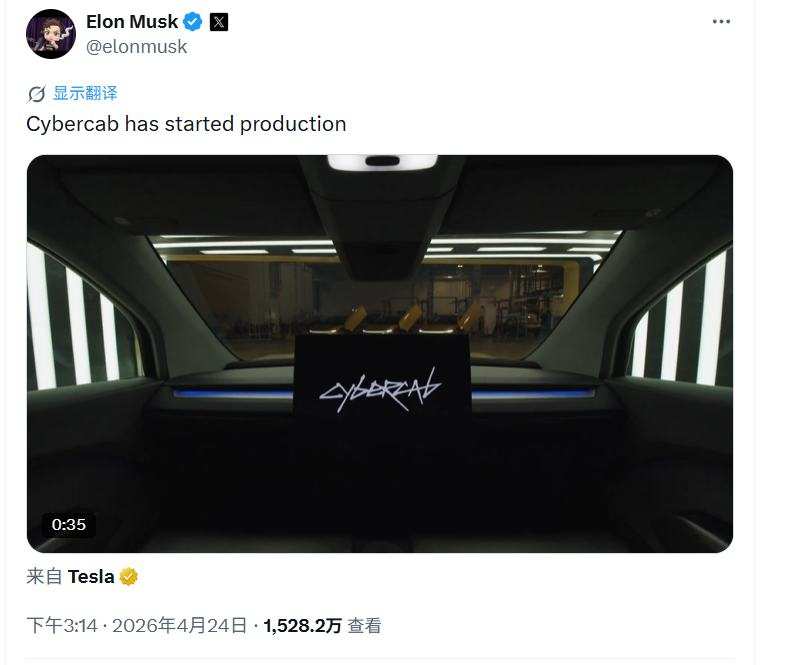
According to Zhitong Finance APP, Elon Musk, the world's richest person and co-founder and CEO of Tesla, stated in a post on X on Friday that Tesla has begun production of its Robotaxi model, the highly anticipated fully autonomous taxi named “Cybercab.” This marks the fulfillment of Musk’s long-standing commitment since 2024 to achieve large-scale mass production of the Cybercab, amid a backdrop of continuously declining global electric vehicle sales faced by this U.S.-based leader in electric vehicles.
From Tesla's latest earnings report and a capital expenditure plan exceeding $25 billion, Musk has clearly prioritized AI, Robotaxi, humanoid robots, and space-based AI data centers. The latest mass production update for Robotaxi is undoubtedly a key force in bringing Musk’s "Physical AI Master Plan" into its implementation phase.
 "The Cybercab you have been looking forward to has started production," Elon Musk said in a post on the X platform (formerly Twitter), sharing a related video.
Earlier this week, Musk emphasized the ongoing ramp-up process of Tesla’s new product lineup, while also cautiously noting the pace of production: "We are about to start producing Cybercab, and we will soon begin producing our Semi series trucks."
During Thursday's earnings call, he also stated that initial production would be slow because "whenever you have a completely new product with a new supply chain... you should expect the initial production processes for Cybercab and Semi to be very slow, but then gradually ramp up... until the end of this year, and certainly next year," Musk mentioned during the earnings meeting.
As the world's richest person to date, Musk has previously achieved what others thought impossible – creating a commercially viable high-frequency rocket launch business through SpaceX, mainstreaming electric vehicles through Tesla, the global leader in electric vehicles, and providing internet connectivity infrastructure services from space through Starlink. However, some doubt whether Musk can or even intends to complete his latest ambitious "epic-level" chip-making initiative outlined in Austin and whether he can truly realize his envisioned "super blueprint" for artificial intelligence, autonomous driving, humanoid robots, and space-based AI data centers.
"Tech Maverick" Elon Musk Ignites the "Physical AI" Revolution
The early production phase of Cybercab marks the transition of Musk’s long-envisioned "Physical AI Master Plan" from conceptual demonstration to engineering ramp-up. Starting next year, it is expected to enter the much-anticipated large-scale commercialization phase. The start of Cybercab production is a key milestone, which significantly enhances market credibility in Musk’s grand narrative of "Physical AI," further boosting Tesla’s fundamental outlook and propelling its stock price towards a new bull market trajectory.
However, Musk has clearly cautioned that the initial production of new supply chain products like Cybercab and Semi will be slow. Robotaxi expansion is also constrained by rigorous safety verification. The goal of covering "about a dozen states" by year-end still requires regulatory approval from national transportation authorities, safety data validation, fleet operational efficiency, and unit economic models to verify. This means Tesla’s stock price and high valuation are entering a phase of "high capital expenditure for Physical AI options": short-term pressure lies in free cash flow, medium-term focus is on the speed of Robotaxi deployment, and the long-term ceiling depends on whether Optimus (the "Titan") humanoid robot and space-orbit-level AI computing power infrastructure system can form a true commercial closed loop.
Under Elon Musk's leadership, Tesla is making an even stronger commitment to the "Physical World AI Superplatform"—where the Optimus humanoid robot represents one of the most aggressive production bets but is not the sole focus. What Tesla is fully committed to is not just the standalone Optimus robot, but an entire Physical AI superplatform driven by Tesla's AI supercomputing-powered FSD and Robotaxi autonomous vehicles as the front end, with Tesla's AI chip computational power serving as the core AI infrastructure, and Optimus representing the ultimate growth form.
According to insights from NVIDIA CEO Jensen Huang, 'Physical AI' emphasizes enabling robots/autonomous operating systems to perceive, reason, and complete a full set of actions in the real world, heralding an era where 'Physical AI' assists in the evolution of human civilization. 'Physical AI' focuses on empowering robots/autonomous systems to perceive, reason, and act in the real world, with these three capabilities forming the critical toolchain to advance models from 'mere conversational ability' to 'functionality in the physical world.'
From an industry logic perspective, Tesla’s long-term growth narrative is shifting from electric vehicle manufacturing to becoming a "super-platform company at the Physical AI level." Once Tesla’s expected growth engines shift to Robotaxi, Optimus, in-vehicle inference, robotic inference, and xAI/SpaceX’s space-based training and deployment computing power chain, the actual infrastructure bottleneck will no longer primarily involve batteries and whole-vehicle components, but rather advanced logic chips, 2.5D/3D/3.5D advanced packaging, data center storage chips, large solar and energy storage systems, and core supply chain security amid geopolitical tensions.
With the start of Cybercab production, Tesla has officially entered the 'AI cash-burning era.'
Investors are undoubtedly focusing on whether Robotaxi expansion can scale, the mass production and commercialization pace of the Optimus humanoid robot, capital expenditures on AI computing power, and financing pathways for the epic chip manufacturing project codenamed "Terafab." Additionally, SpaceX and its IPO plans, along with the blueprint for a space-based AI data center, have clearly entered the center of Tesla earnings discussions. The growth prospects of SpaceX-led commercial aerospace and its IPO have become key marginal variables influencing Tesla’s valuation premium and the so-called "Musk premium."
The core signals from Tesla's latest earnings report and the commencement of Cybercab production are clear: the company is accelerating its transformation from a traditional electric vehicle manufacturer to a physical AI super-platform company focused on 'FSD/Robotaxi autonomous driving mobility systems, Optimus humanoid robots, Terafab large-scale chip manufacturing projects, and space-based AI computing infrastructure.'
In the first quarter, Tesla’s revenue was approximately $22.39 billion, representing a year-on-year increase of 16%. Free cash flow unexpectedly recorded a positive inflow of $1.44 billion, surpassing market expectations of cash burn. However, this appears to be more of a short-term improvement due to delayed capital expenditure rather than a structural change, as the company has raised its planned capital expenditures for 2026 from over $20 billion to over $25 billion. Tesla's CFO also explicitly stated that negative free cash flow would occur in the remaining part of the year. In other words, the real strategic turning point under Elon Musk's leadership lies in Tesla entering a heavy capital investment cycle to pave the way for an AI-driven supercomputing ecosystem encompassing FSD, Robotaxi, Cybercab, Optimus, Semi, space-based AI computing infrastructure, and chip manufacturing ambitions.
The preliminary production of Cybercab has begun, marking a critical step in Musk's 'physical AI mega blueprint.' However, narrative realization and large-scale commercial deployment are two distinct matters. As Musk stated, initial production of Cybercab will be slow but is expected to accelerate by the end of this year and into next year. He also mentioned that Robotaxi coverage could reach 'around a dozen states' in the U.S. by the end of the year, though he acknowledged that expansion will be constrained by stringent safety validations. It is unlikely that Robotaxi will make a 'super significant' financial contribution this year, with meaningful contributions likely delayed until next year.
Technically, this means Tesla’s core challenge is not just about producing Cybercab, but proving that its fully unsupervised FSD (Full Self-Driving) subscription software can achieve a regulatory-compliant, insurable, and scalable operational safety level across multiple cities, diverse climates, and varied boundary scenarios. In terms of valuation, the commencement of Cybercab production has indeed increased market confidence in Tesla’s Robotaxi growth narrative, but it has yet to fully address investors’ key concerns regarding 'large-scale commercial operational data' and 'unit economic models.'
Whether Tesla can advance its grand narratives around AI, FSD, Robotaxi, humanoid robots, and even SpaceX’s space-based AI data centers from long-term visions to execution stages verifiable by capital markets may become the strongest driver propelling Tesla’s stock toward a new bull market trajectory. What the market needs in the medium to long term is not just strong quarterly earnings reports, but a narrative reset demonstrating that Tesla is transitioning from an 'AI optionality' to achieving 'milestone-based phased commercialization.' Without clearer evidence of execution, even if short-term financial figures look robust, the stock price is unlikely to escape the pattern of 'strong earnings, weak valuation.'