
NVIDIA surged over 4% on Friday, setting a new all-time closing high, with its market capitalization firmly above the $5 trillion mark. Analysts believe that next week's earnings reports from Microsoft, Amazon, Alphabet, and Meta will be critical variables, as their AI capital expenditure trends will directly impact NVIDIA and the semiconductor sector’s mid-term performance.
$NVIDIA (NVDA.US)$ The company’s market value has stabilized above the $5 trillion threshold, solidifying its position as the world's highest-valued company.
On Friday, April 24, NVIDIA's stock price closed up 4.32% at $208.27, surpassing the previous all-time closing high set on October 29.
 NVIDIA is$S&P 500 Index (.SPX.US)$the largest single contributor behind the 4.7% gain. Data shows that NVIDIA alone accounted for approximately 20% of the index’s increase.
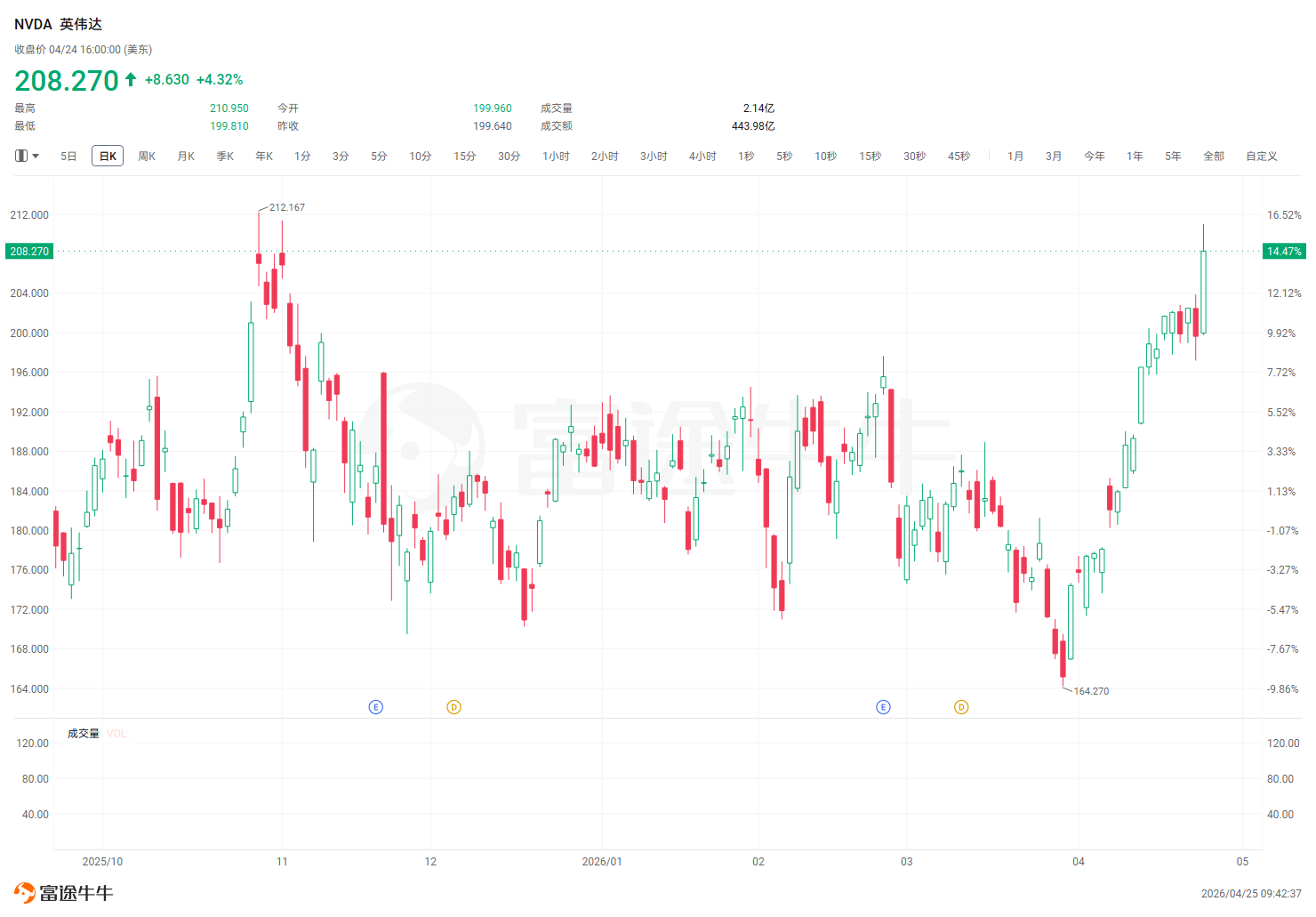
Just four weeks ago, NVIDIA had retreated 20% from its peak, and this rally marks its complete breakout from nearly a year of volatility, becoming a landmark event in the new wave of AI chip-related rallies in the U.S. stock market.
Investors are bracing for a key test next week, $Microsoft (MSFT.US)$ 、 $Amazon (AMZN.US)$ 、 $Alphabet-A (GOOGL.US)$ and $Meta Platforms (META.US)$ when quarterly earnings reports will be released in succession. The latest signals on AI capital expenditure will influence market sentiment toward NVIDIA and the broader semiconductor sector.
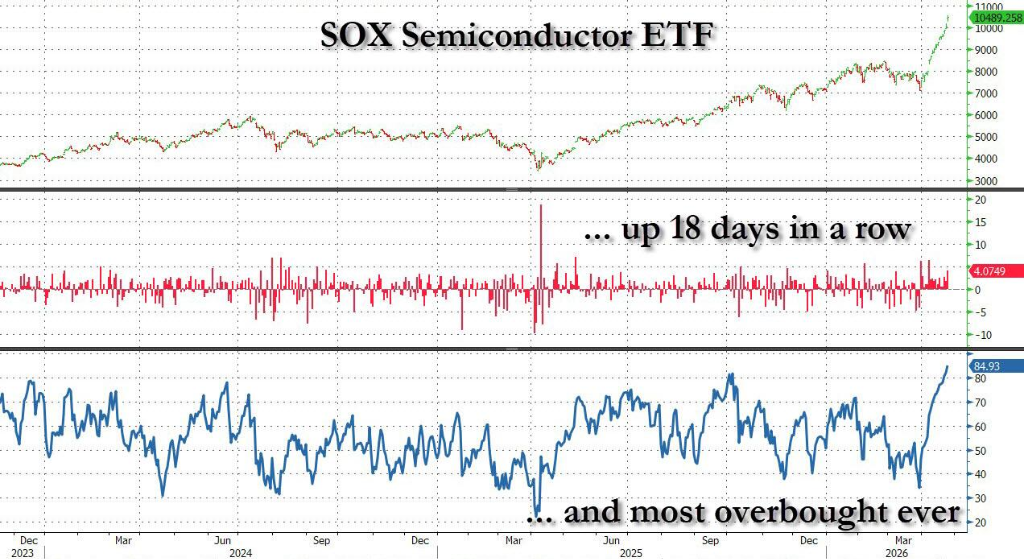
The Philadelphia Semiconductor Index has risen for 18 consecutive days, setting a new historical record.
This breakthrough by NVIDIA occurred against the backdrop of widespread strength in the semiconductor sector.
$PHLX Semiconductor Index (.SOX.US)$ The stock closed higher for the 18th consecutive trading day, setting a record for the longest winning streak, with technical indicators showing the highest level of overbought conditions in history.
This week$Texas Instruments (TXN.US)$Intel also reported strong earnings, providing additional support for the sector.
According to Wall Street News, Texas Instruments issued its revenue and profit guidance for the second quarter, both of which exceeded Wall Street expectations. Its stock price surged by approximately 20% on Thursday, marking the best single-day performance since the burst of the dot-com bubble, while it slightly declined by 1.8% on Friday.
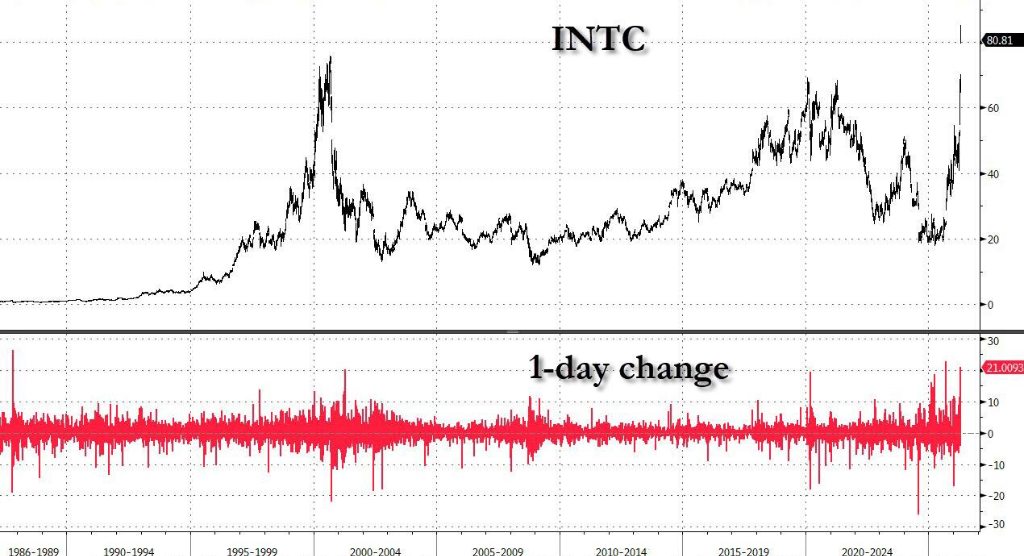
After Intel released robust earnings and an optimistic outlook guidance after the US stock market closed on Thursday, its stock price soared by 28% at one point on Friday, recording the largest single-day gain since "Black Monday" in 1987, and eventually closed up by about 21%, surpassing the previous all-time high set during the peak of the dot-com bubble.
Market strategists widely attribute this round of rebound to the continued rise in AI infrastructure investment. Paul Nolte, a market strategist at Murphy & Sylvest Wealth Management, stated:
The scale of capital inflow into the AI sector is staggering, and we have yet to see any signs of slowdown. Against this backdrop, it is not surprising that NVIDIA has become the standout in the tech stock resurgence.
However, he also pointed out that the market still requires more data for confirmation:
I am waiting for the earnings results to gain a clearer understanding of the capital expenditure outlook. Even so, I believe there are sufficient reasons to remain optimistic about NVIDIA’s prospects.
The upcoming earnings reports of tech giants such as Microsoft will be key variables next week.
In addition to the rising heat in AI infrastructure, geopolitical influences have also driven investors to seek refuge in the technology sector supported by solid profit growth.
Whether the current market optimism can sustain largely depends on the upcoming earnings reports of tech giants scheduled for release next week.
Microsoft, Amazon, Alphabet, and Meta, as the four largest capital expenditure entities in the AI infrastructure field, will provide crucial guidance for the mid-term trend of the semiconductor sector through their quarterly performances and management outlooks on future investments.
Analysts believe that if the aforementioned companies maintain or increase their AI infrastructure spending plans, it will directly strengthen market expectations for demand growth at NVIDIA. Conversely, any signals of a slowdown could put pressure on current valuations.
Editor/Jeffy