
Large technology companies are preparing to invest hundreds of billions of dollars in building artificial intelligence infrastructure. Yet their plans hinge on a unique Dutch equipment manufacturer, which most Americans have never heard of.
ASML is the world's only supplier capable of mass-producing the sophisticated machines required for cutting-edge chips. These chips enable OpenAI's ChatGPT and Google's Gemini to deliver instantaneous, human-like responses, which is key to their widespread popularity.
Today, ASML is going all out to meet the surging demand across the industry. The company is constructing new factories, upgrading existing clean rooms, and developing advanced machines that can produce more chips. Additionally, to expedite decision-making, ASML is increasing its engineering workforce while cutting leadership positions.
 ASML CEO Christophe Fouquet stated this month after the company raised its full-year revenue forecast: 'We don't want to become a bottleneck for our customers. We are leveraging every available resource to ensure that does not happen.'
Four U.S. tech giants — Microsoft, Meta Platforms, Amazon, and Google under Alphabet — plan to invest over $600 billion this year alone in building artificial intelligence infrastructure. This, in turn, has spurred chipmakers, including Taiwan Semiconductor, to accelerate their investments, further driving up demand for ASML's machines.
This boom has solidified ASML's position as Europe's most valuable company. Its market capitalization has surpassed European luxury giants such as LVMH and Hermes, making ASML one of the few tech darlings in the region.
Senior analyst David Dai of Bernstein stated: 'All of their clients are saying, Please give us as many machines as possible. By the way, we will need more next year, and even more by 2028.'
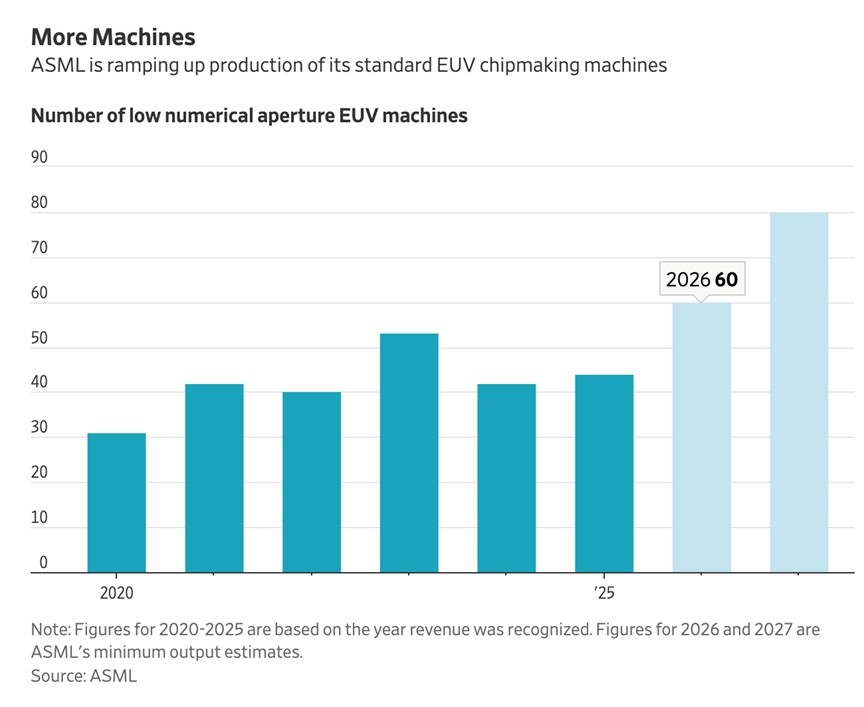
ASML insists it can meet customer demand. The company stated this month that it plans to produce at least 60 standard extreme ultraviolet lithography machines this year, representing a 36% increase over 2025 sales. Executives said that by next year, ASML's production capacity should reach at least 80 units.
The market demand for ASML's next-generation EUV lithography machines remains uncertain. A recent statement by a Taiwan Semiconductor executive indicated that the company plans to use standard EUV machines for as long as possible due to the high cost of advanced EUV models. Some analysts estimate these machines could cost approximately $400 million or more.
To help boost production capacity, ASML expects to invest about $2.2 billion this year in real estate, infrastructure, and equipment, marking a roughly 20% increase over 2025. An executive stated this month that hiring and training costs will also rise to accommodate faster production speeds.
However, increasing production is no easy task. ASML's high-end lithography machines, comparable in size to a school bus, are among the most complex devices ever manufactured by humanity. Inside, high-powered lasers emit beams that flatten and vaporize tiny droplets of molten tin. This process generates intense ultraviolet light, which the machine uses to print microscopic patterns onto silicon wafers.
These machines take months to assemble, with components sourced from hundreds of different suppliers. Technicians dressed in protective gear assemble the machines in cleanrooms where the air is purified to prevent contamination. Even a single dust particle could disrupt the entire production process.
"This is the inevitable outcome of building an expensive, structurally complex tool with a highly intricate supply chain," said Jeff Koch, an analyst at SemiAnalysis and former ASML employee. "You can't scale up quickly or easily."
The company is not the only potential bottleneck in the race for artificial intelligence. Its customers need to build enough cleanrooms to house the machines they want to purchase, a massive undertaking that requires specialized construction techniques, power connections, and ample energy supplies.
ASML learned lessons from the pandemic when an unexpected surge in demand led to a backlog of orders.
During this period, the company developed plans to significantly increase its production capacity and advanced time-consuming tasks such as obtaining construction permits and building new cleanrooms. Although these cleanrooms are not immediately needed, executives say that constructing them in advance means ASML will be better prepared to ramp up production.
In recent years, the company has built cleanrooms in the United States, Germany, and South Korea. Construction of a new campus near its headquarters in the Netherlands is expected to begin this year.
The pandemic also prompted ASML to collaborate more closely with its supply chain. In 2023, the company created a new position on its executive board dedicated specifically to supplier affairs.
The company regularly meets with suppliers to ensure all are prepared to expand at the same pace. Chief Financial Officer Roger Dassen told The Wall Street Journal earlier this year that no supplier wants to be singled out for criticism due to lack of preparation, referring to these meetings as "benign peer pressure."
ASML's transition to faster growth has been remarkably swift. Last summer, the company warned investors that it might not achieve growth by 2026. However, in recent months, amid the booming industry plans for artificial intelligence infrastructure, ASML has raised its sales forecasts. Earlier this month, the company stated that annual sales are expected to range between $42 billion and $47 billion, up from $38 billion last year.
At the same time, technological advancements are enabling customers to produce more chips from a single machine. ASML stated that certain new high-end machines can increase wafer output by 10 wafers per hour compared to previous models. The company also offers upgrade services for older machines already sold to enhance their production efficiency.
In the long term, ASML is working on industrializing a stronger light source, which will significantly improve the production efficiency of its machines. However, this process may take several years.
"Our customers are very pleased to be able to produce more wafers on any equipment," said Fokai in a video released on ASML's website earlier this month.
One challenge facing ASML is that most of the talent in southern Netherlands has already been recruited by the company and its suppliers.
To avoid poaching talent from its own supply chain, ASML is collaborating with universities to find candidates from across the Netherlands and abroad.
Dassen stated in an interview that if customer demand grows beyond ASML's expectations, "we will find ways to meet that demand. Just as they can pour concrete on the ground, so can we."
Editor/joryn