From being publicly named by Trump as someone required to resign, to securing a meeting that impressed him and led to the U.S. government acquiring a 10% stake in Intel – a deal investors view as a crucial lifeline for the company. Just months into his tenure as CEO, Lip-Bu Tan achieved this remarkable turnaround. Following this, he seized the opportunity presented by the 'CPU renaissance' driven by proxy AI, boosting operating profit margins by 500 basis points and gaining Tesla’s endorsement for the 14A process technology. Intel has returned from the 'brink of survival' to center stage.
Two years ago, $Intel (INTC.US)$ it faced an 'existential question'; today, this semiconductor giant's stock price has reached a historical high. With earnings far exceeding expectations and a record-breaking price surge, it has demonstrated its recovery potential to the market.
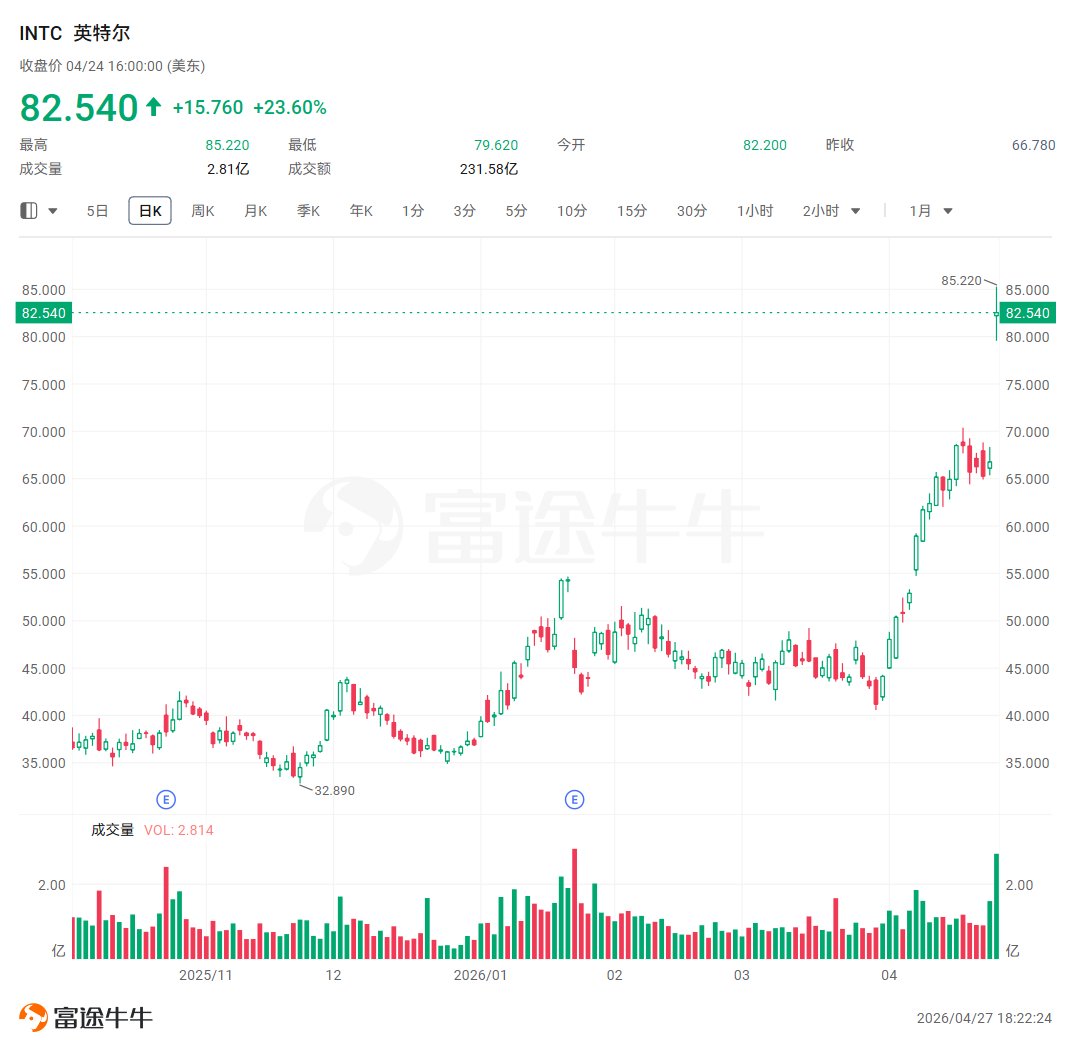
Last Friday, Intel's stock price surged by as much as 28%, marking the largest single-day increase since 1987, ultimately closing up about 21%, surpassing the historical high from the internet bubble era. The direct driver of this stock price surge was the Q1 earnings report: revenue of $13.6 billion, compared to analysts' expectations of $12.4 billion, exceeding forecasts by approximately 9.3%. Adjusted EPS was $0.29, versus an expectation of $0.01. The midpoint of the Q2 revenue guidance was $14.3 billion, compared to expectations of $13.1 billion.
 The outperformance across all three core metrics was driven by robust demand for server CPUs fueled by the rapid adoption of agentic AI applications.
John Pitzer, Vice President of Investor Relations at Intel, described these results as 'compelling evidence of tangible progress in execution.' Jay Goldberg, an analyst at Seaport Research, noted that Intel is now on 'the firmest footing it has been in years.'
The core of this turnaround, moving from an 'existential question' to a historical high, lies in CEO Lip-Bu Tan seizing the opportunity presented by a structural shift in AI application models. The focus of the market going forward will be whether the 14A process technology can deliver on its promises and whether the foundry business can establish a sustainable customer base.
$Intel (INTC.US)$ Last Friday, the stock price surged by 23.6%, hitting an all-time high, with a cumulative increase of over 123% year-to-date; it continued to rise by approximately 3% in pre-market trading today.
How did Intel fall into an existential crisis?
Two years ago, Intel’s situation was far more dire than the public realized. Goldberg stated bluntly that Intel's survival was 'an existential question,' and the company had 'completely lost its way technologically.'
One of Intel's most fatal mistakes, according to Goldberg, was failing to adopt extreme ultraviolet (EUV) lithography equipment in a timely manner — a key tool for manufacturing advanced chips — while Taiwan Semiconductor had already surpassed Intel in chip manufacturing and was producing chips for Intel’s main CPU competitor, AMD.
During Pat Gelsinger’s tenure as Intel's former CEO, he pushed hard to revitalize U.S.-based manufacturing, leading over $100 billion in investment plans across Arizona, New Mexico, Oregon, and Ohio, making Intel the largest beneficiary of the Biden administration’s CHIPS and Science Act. However, Goldberg pointed out that Gelsinger failed to effectively cut costs or improve corporate culture to motivate employees, relying instead on short-term measures like stock buybacks, which compromised the company’s long-term technological competitiveness to some extent.
Five months after taking office, challenges arose: a political reversal storm.
In March 2025, Lip-Bu Tan assumed the role of Intel CEO. Five months later, political pressure suddenly escalated as Trump publicly named him on Truth Social, demanding his immediate resignation.
Within less than a week, the situation reversed. Trump subsequently posted that he had a "very interesting" meeting with Lip-Bu Tan. Following this, the U.S. government announced the acquisition of a 10% stake in Intel, a deal investors viewed as a crucial lifeline for the company.
Taking a longer-term perspective, the reforms initiated since Lip-Bu Tan took office have begun to show initial success. John Pitzer, Vice President of Investor Relations at Intel, stated that the company's foundry capacity supply has exceeded expectations, and closer collaboration mechanisms have been established with clients.
"CPU Renaissance" and Process Breakthrough: AI Evolution Reshapes Market Dynamics
The core logic behind Intel's recent rebound lies in the structural shift in AI application patterns. In a research report, Mark Lipacis, an analyst at Evercore ISI, referred to this trend as the "CPU Renaissance"—with the rise of AI agent tools, the demand for CPUs in AI systems capable of autonomously performing complex tasks is expected to surge significantly, potentially reversing the CPU-to-GPU ratio from 1:8 to 8:1.
Lipacis pointed out that since Lip-Bu Tan took over, Intel’s operating profit margin has improved by 500 basis points, and its debt situation has also shown signs of improvement. As a leading chip manufacturer, Intel's strategic value has become increasingly prominent amid escalating geopolitical tensions.
Ivan Feinseth, an analyst at Tigress Financial Partners, gave a positive evaluation of Lip-Bu Tan’s leadership, stating that he is "exactly the type of CEO Intel needs." He noted that while continuing Gelsinger’s foundry strategy, Lip-Bu Tan has achieved substantial improvements in execution.
Positive signals have also emerged at the process technology level. John Pitzer, Vice President of Investor Relations at Intel, stated that the cycle time and yield of the company’s latest 18A process node have exceeded expectations, and discussions with customers regarding the next-generation 14A process node are "progressing very smoothly."
Notably, Elon Musk, CEO of Tesla, stated during this week’s earnings call that the Terafab chip manufacturing project will adopt Intel’s 14A process, providing additional endorsement for the commercial prospects of this node. Pitzer mentioned that both Musk and Lip-Bu Tan share similar perspectives on driving chip innovation and addressing AI-driven supply-demand gaps.
What is the next challenge for Intel after reaching the summit?
Despite Intel's recent performance boosting market confidence, analysts remain cautious about its long-term prospects. Goldberg noted in a research report that Intel has 'essentially secured its mid-term survival,' but the feasibility of its foundry business remains uncertain. The ability to attract sufficient external customers will be a key variable in determining whether Intel can return to the forefront of chip manufacturing.
Intel's story is far from over. While record-high stock prices have bolstered confidence, the market's ultimate verdict will depend on whether the 14A process technology can deliver on its promises and whether the foundry business can establish a sustainable customer base.
Editor/Jayden