
① Driven by the 'super cycle' of AI and memory chips, Advantest, the leader in semiconductor testing equipment, saw its net profit for the fiscal year 2025 surge 132.9% year-on-year, with revenue and operating profit also reaching record highs; ② Core metrics for the fiscal year 2026 are expected to maintain growth; ③ The company secured its first mass production order for silicon photonics chip testing equipment and anticipates production will double next year and the year after.
Cailian Press report on April 27 (Editor: Shi Zhengzhi) At dusk on Monday Beijing time, Advantest, the global leader in semiconductor automatic testing equipment, released its fiscal year 2025 annual report ending March. Boosted by the AI boom cycle, all major financial indicators of the company hit record highs, and it expects to break records again this fiscal year.
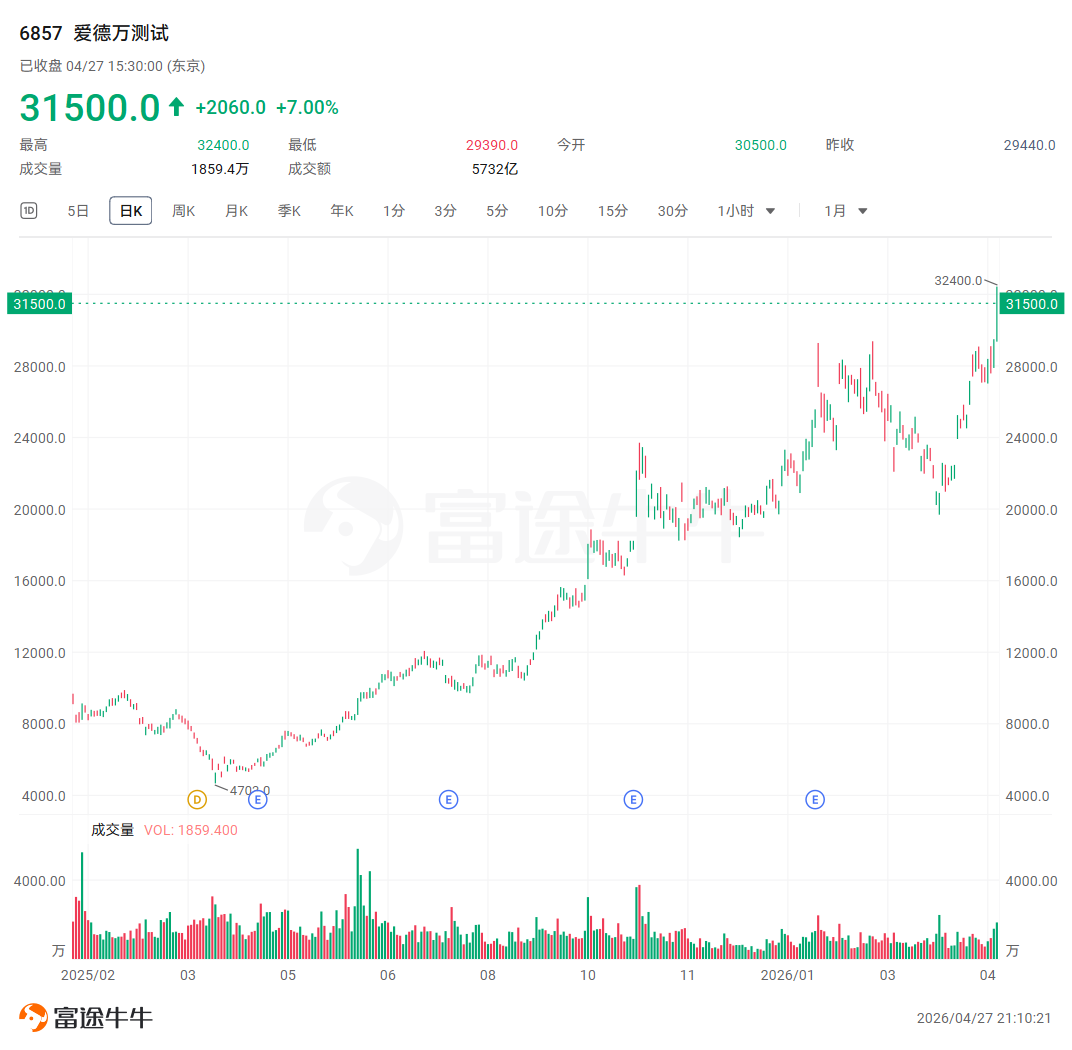
Before the earnings release, the market had already 'voted with its feet.' Advantest surged 7% on the Tokyo market on Monday, setting new records alongside major semiconductor equipment manufacturer Tokyo Electron and fiber optic super stock Fujikura, also pushing the Nikkei 225 Index to close above the 60,000-point mark for the first time in history.
 The company’s earnings report shows that net profit for the fiscal year 2025 reached 375.4 billion yen (approximately RMB 16.1 billion), a sharp increase of 132.9% from the previous fiscal year’s 161.2 billion yen, and significantly higher than the guidance of 328.5 billion yen provided in January this year. Profit margin jumped from 20.7% to 33.3%. Annual revenue of 1.12 trillion yen and operating profit of 499.1 billion yen also hit record highs.
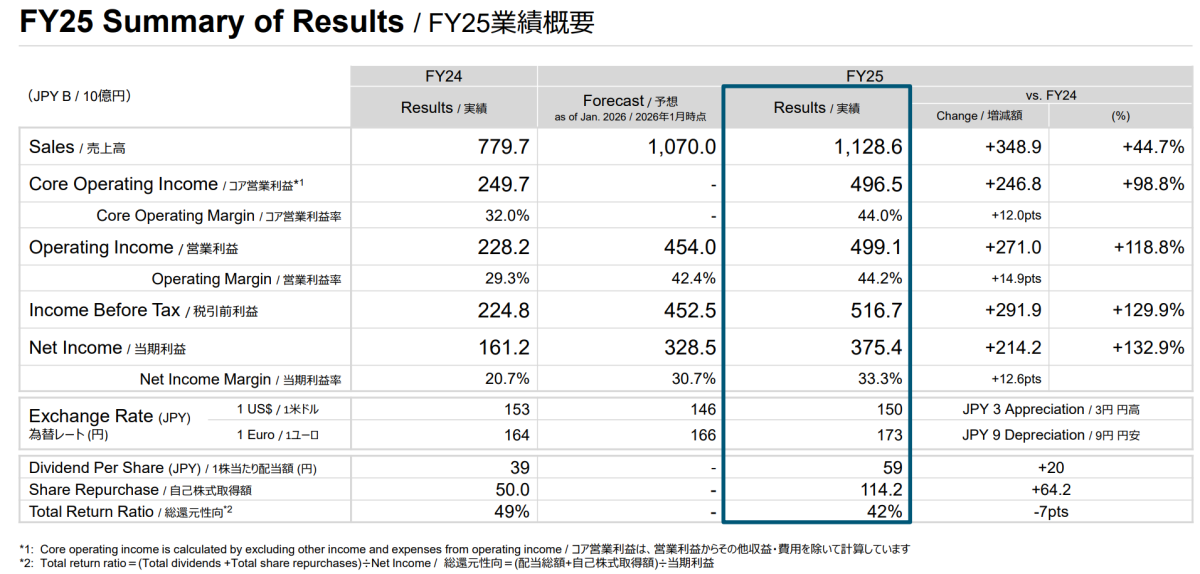
Similar to many AI-related high-performing stocks, Advantest has also shown a recent sharp acceleration in performance. From January to March this year, the company reported a net profit of 126.9 billion yen, more than tripling year-on-year, with a sequential growth rate of 61%.
The company's earnings report indicates that riding the wave of the AI and memory chip 'super cycle,' the testing equipment market is experiencing a significant expansion phase, with the company’s market share further increasing.
Advantest disclosed that as the global testing equipment market size expanded to $9 billion in fiscal year 2025, the company’s market share rose to 65%, up from 58% in the prior year when the market size was $6 billion. Specifically, the market share in SoC testing equipment increased from 56% to 66%, while the share in memory chip testing slightly dropped from 63% to 61%.
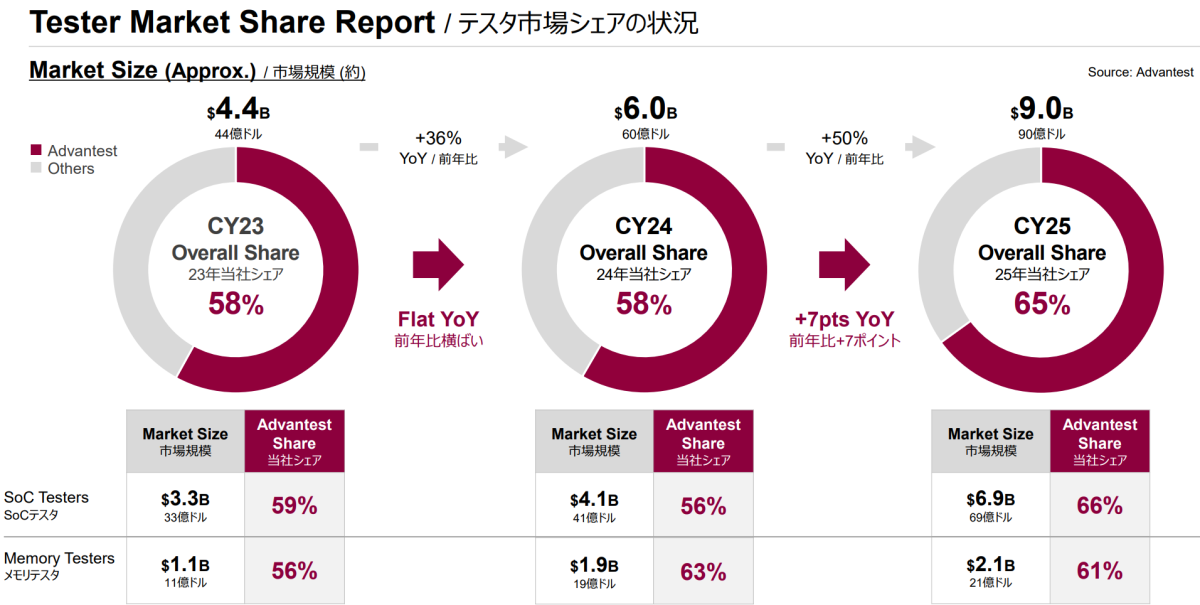
The company also forecasts that the SoC testing market size will increase from USD 6.9 billion to USD 8.7-9.5 billion in the fiscal year 2026 (ending next March), and the memory chip testing market size will rise from USD 2.1 billion to USD 2.2-2.7 billion.
As demand for testing grows, Advantest is also investing in expanding its production capacity. The company’s capital expenditure for this fiscal year is JPY 450 billion (a year-on-year increase of 31.2%), and R&D expenses are expected to grow to JPY 100 billion (a year-on-year increase of 28%).
The company also predicts that revenue, operating profit, and net profit for the fiscal year 2026 will continue to reach new highs, with growth rates expected to exceed 20% across the board.
Doug Lefever, CEO of Advantest, stated at the earnings briefing that the company will meet growing demand by upgrading existing equipment and expanding production facilities to support the introduction of new systems. He pointed out that the company plans to accelerate the process of increasing annual production capacity for SoC testing systems to approximately 10,000 units, a goal that will be achieved earlier than initially anticipated. Regarding the timeline for reaching the 10,000-unit capacity, he said: “We hope to achieve it by the end of 2028, but it may be postponed until 2029.”
Advantest also disclosed in its earnings report that it has received its first large-scale automatic testing equipment order for silicon photonics (SiPh) chips.
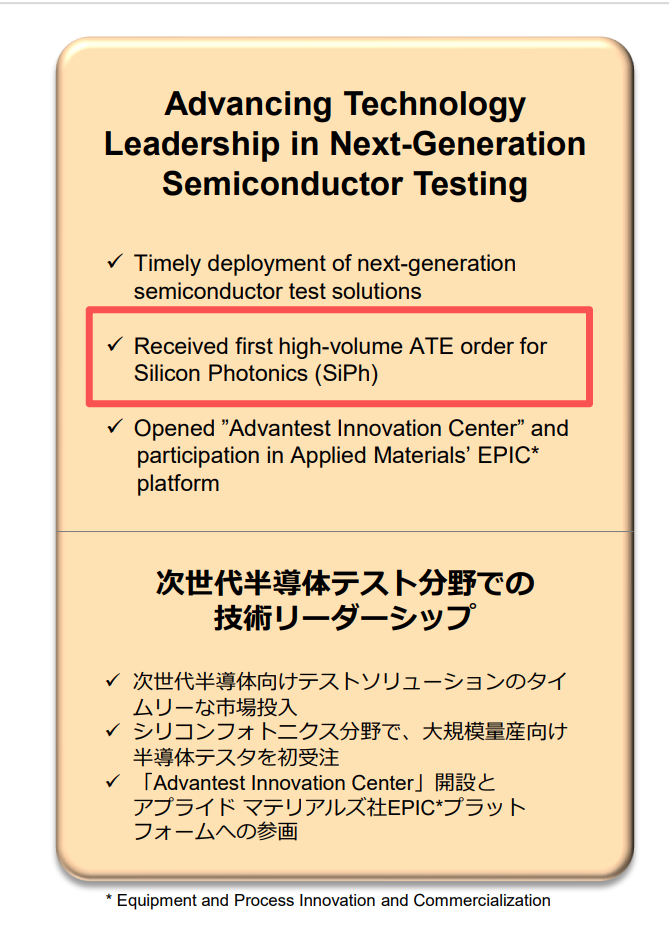
Regarding this highly market-focused field, the company stated: “This year will mark the first year of entering mass production. It is expected that the scale will double next year and at least double again the following year, though it is still difficult to determine how large this market will ultimately become at this stage.”
Editor/Jayden