
The global economy's reliance on oil has significantly decreased, US inflation expectations remain stable, and the essence of the March US stock market decline was AI panic trading. Regional geopolitical conflicts in the Middle East are unlikely to disrupt the US tech-driven growth cycle.
From reduced oil dependency to profit growth logic driven by tech giants, multiple factors contributed to the unexpected resilience shown by the US stock market during the Iran war.
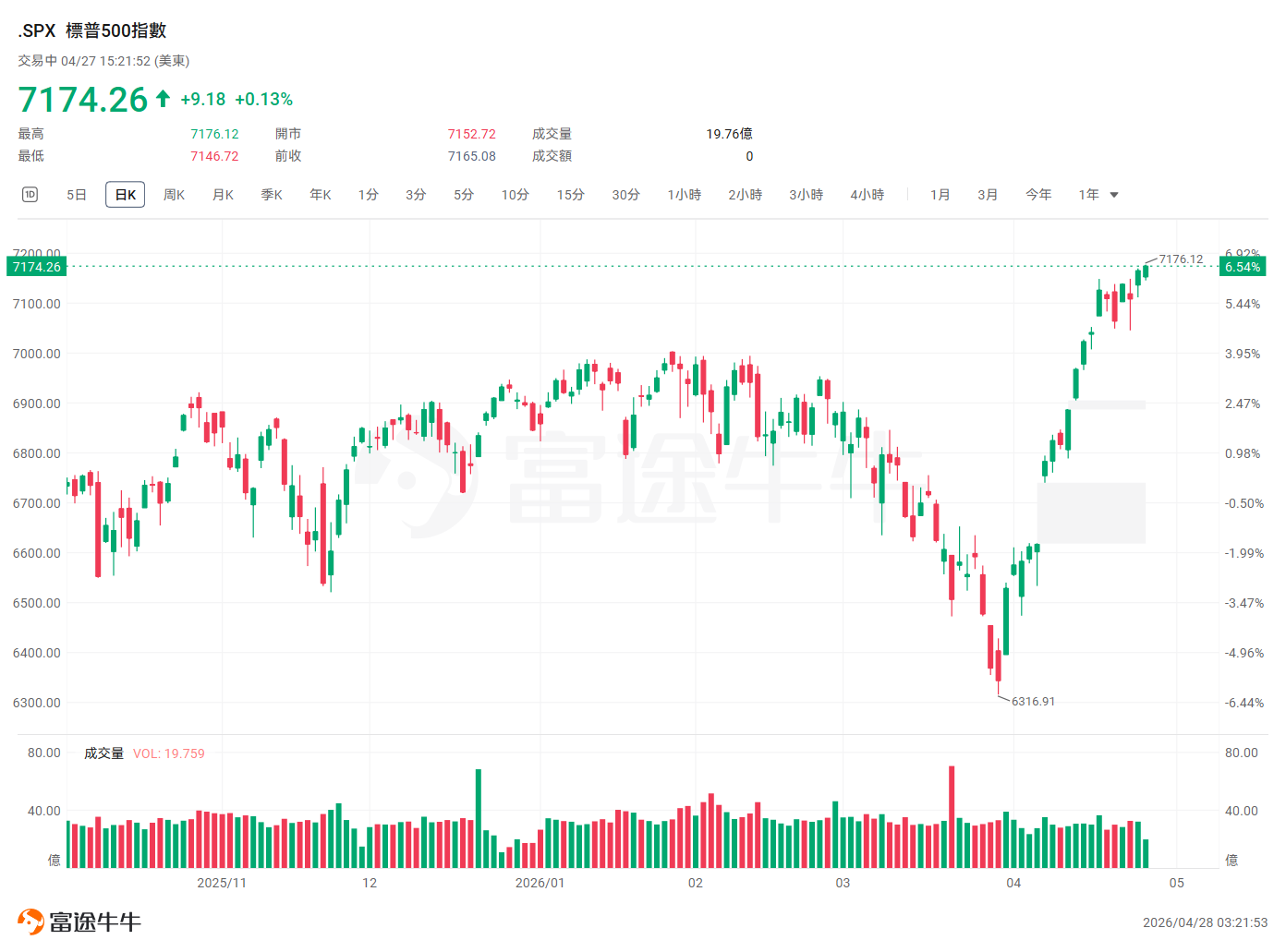
Since April, the US stock market has rebounded strongly, forming a stark contrast with the ongoing conflict. The market widely attributes this to Trump repeatedly signaling that a "US-Iran agreement is imminent," although no signs of an agreement have emerged so far, and both sides have indicated readiness to continue fighting.
 $S&P 500 Index (.SPX.US)$The decline began as early as the end of January, a full month before the conflict erupted. The real trigger for this market downturn was 'AI panic trading.' Institutions such as Goldman Sachs, Morgan Stanley, and JPMorgan recently advised buying previously AI panic-hit stocks on dips, which indeed led this month’s rally.
Inflation indicators confirm the market's calm. Since the outbreak of the war, the US five-year breakeven inflation rate has risen by only 0.2 percentage points to 2.6%, while the two-year Treasury yield remains within the Federal Reserve's short-term interest rate target range of 3.5% to 3.75%. The market does not believe the central bank needs to resume rate hikes to address new inflation pressures.
A relatively mild reaction in the oil market, stable inflation expectations, undisturbed profit growth logic driven by technology, and retail investors deeply internalizing the strategy of 'buying the dip'—these combined factors have bolstered the confidence of the US stock market during wartime.
The Truth Behind the March Decline: It Was AI Panic, Not War
To understand why the US stock market has ignored this war, it is first necessary to clarify a popular but inaccurate narrative—that the Iran war caused the market decline in March.
In fact, the S&P 500 Index began a moderate decline as early as the end of January, a full month before the war broke out. What truly triggered the market was the so-called 'AI panic trading,' where investors sold shares of companies in software, logistics, and white-collar services that were perceived to be threatened by artificial intelligence.
This wave of AI-triggered selling extended into March, coinciding with the outbreak of the war, resulting in a nearly 8% cumulative decline in the S&P 500 for the month.
Approximately 60% of the decline was attributed to just 20 stocks, the vast majority of which are highly correlated with AI sentiment, including the Mag 7 and$Broadcom (AVGO.US)$、 $Micron Technology (MU.US)$ 、$Lam Research (LRCX.US)$. and$Applied Materials (AMAT.US)$。
The remaining 40% of the decline was concentrated in four sectors. While the industrial sector is indeed directly related to the conflict, the financial, healthcare, and other technology sectors were not directly impacted by the war. Moreover, their individual contributions to the overall decline of the S&P 500 are almost negligible compared to those of the tech giants.
Significant reduction in oil dependency, stable inflation expectations
For investors who experienced the 1970s, the Middle East war easily evokes painful memories of oil embargoes, inflation, and bear markets. However, the global economy's reliance on oil has significantly diminished today.
Currently, the value of oil production accounts for approximately 2% of global output, which is only about a quarter of the level during the Iranian Revolution in 1979. Even so, only one-fifth of this oil needs to pass through the currently contested Strait of Hormuz.
The actual movement of oil prices reflects this logic. After adjusting for inflation, oil prices nearly tripled from 1973 to 1974 and more than doubled from 1979 to 1980; whereas since the outbreak of this war, the increase in oil prices has been only about 40%, which is relatively moderate.
Currently, spot oil prices are significantly higher than market expectations for the coming months, despite no substantial indications of an impending end to the conflict.
The relative stability of oil prices has also translated into similarly muted movements in inflation expectations.
Since the outbreak of the war, the U.S. five-year breakeven inflation rate has risen by only 0.2 percentage points to 2.6%. The two-year Treasury yield remains within the Federal Reserve's short-term interest rate target range of 3.5% to 3.75%, indicating that the market does not expect the central bank to raise rates in response to new inflationary pressures.
The certainty of the interest rate path has eliminated one of the most critical sources of uncertainty in valuation models.
A technology-driven business cycle demonstrates strong immunity to geopolitical conflicts.
From a fundamental corporate perspective, the 'immunity' of the U.S. stock market to geopolitical conflicts is also well-documented.
Approximately 30% of the revenue of S&P 500 constituents comes from overseas, but less than 3% originates from the Middle East and Africa. Even if persistently high oil prices suppress consumption and weigh on sales, the pressure should first manifest as a significant rise in inflation expectations—a signal that has yet to appear.
Meanwhile, the market is benefiting from a genuine technology-driven business cycle.
According to analyst forecasts compiled by Bloomberg, the 'Mag 7,' along with Broadcom and Micron Technology, are expected to contribute 70% of the S&P 500's 20% revenue growth over the next 12 months. This highly technology-concentrated market may face risks of over-concentration and AI disruption, but it is not something a regional conflict in the Middle East can shake.
Retail investors' 'buy-the-dip' behavior has become a stabilizer for self-correcting markets.
Another force that cannot be overlooked is retail investors.
Having undergone multiple rounds of market education, they have deeply internalized the strategy of 'ignoring volatility and persistently buying.' During the pandemic-induced sell-off in the spring of 2020, they entered the market en masse; during last year’s tariff panic, they bought again.
This conflict has so far failed to provide them with a similar opportunity to buy at lower levels—perhaps partly because they themselves have propped up the market.
The US stock market is reaching new highs, not because investors believe the war in Iran is about to end. The market never truly focused on this conflict from the beginning and will not do so in the future—unless the conflict spills beyond the Middle East borders and escalates into a global conflict.
Editor/Rocky