
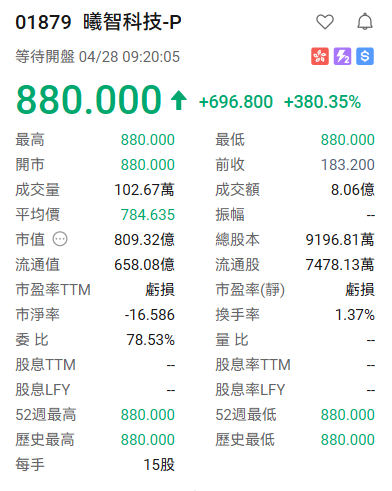
Today, $XIZHI TECH-P (01879.HK)$ Officially listed on the Hong Kong Stock Exchange, becoming the world's first 'AI optical computing stock.' During the pre-market trading session starting at 9:00 a.m., as of press time, Xizhi Technology was quoted at HKD 880 per share, representing an increase of over 380% compared to the issue price of HKD 183.2 per share.
Against the backdrop of growing demand for computing power driven by large-scale models, traditional electronic computing and electronic interconnects are facing multiple constraints such as power consumption, bandwidth, and latency. It is within this context that optoelectronic hybrid computing has garnered attention. As a company focused on optoelectronic hybrid computing, Xizhi Technology’s listing allows optical computing and optical interconnects to attract more capital participation.
The growth of Xizhi Technology also reflects Shanghai's industrial cluster advantages in integrated circuits, artificial intelligence, and silicon photonics. Behind Shanghai's emergence as the home of the world's first 'AI optical computing stock' lies the resonance of strategy, industrial ecosystem, talent, and market forces.
 From a broader perspective, this development not only benefits Shanghai and Pudong in establishing a global benchmark for silicon photonic computing but also promotes the self-reliance and controllability of China’s silicon photonics industry at the foundational technology level. Additionally, it aids in reshaping the next-generation computing architecture for national AI computing infrastructure, thereby empowering the long-term development of artificial intelligence.
Demand for optical interconnects is clear, with enormous potential for optical computing.
Amid the recent wave of Chinese technology companies going public in Hong Kong, apart from Xizhi Technology, there are also $MINIMAX-W (00100.HK)$ large model enterprises such as $BIREN TECH (06082.HK)$ 、 $ILUVATAR COREX (09903.HK)$ and GPU companies like
So what exactly is 'optical computing'?
Shen Yichen, founder and CEO of Xizhi Technology, told Caixin reporters: Compared to the overall trend of Chinese technology companies catching up with global leaders, in the fields of silicon photonics and optical computing, no comparable companies have yet emerged in the global capital markets.
To address the aforementioned limitations, the industry has shifted toward copper interconnects and traditional optical modules. However, copper interconnects are only capable of 'short-distance, low-bandwidth' transmission; traditional optical modules struggle to overcome bandwidth bottlenecks, achieving only 'long-distance, low-bandwidth' transmission. In response, Xizhi Technology is primarily approaching the issue from two directions: first, by using light to build better interconnect capabilities, and second, by leveraging light to enhance computing power.
Optical computing refers to data processing using photons instead of electrons. Compared to traditional electronic computing, optical computing inherently offers advantages such as low latency and high throughput, enabling a significant leap in single-chip performance.
Shen Yichen told reporters from Cailian Press, 'The application scenarios for photonic computing mainly fall into two directions: one is large model inference, especially low-latency large model inference, which can effectively leverage the characteristics and advantages of optical computing; the other is AI for science, where the high throughput and high concurrency capabilities of optical computing can find broader development potential.'
Currently, Xizhi Technology’s product portfolio in the optical computing business includes the flagship PACE series of optoelectronic hybrid computing acceleration products, the Gazelle development system, the OptiHummingbird acceleration card, and LTSimulator.
In terms of optical interconnect solutions, compared to electrical interconnects, they offer lower latency, higher bandwidth, and greater energy efficiency. Xizhi Technology provides comprehensive solutions that connect GPUs, CPUs, xPUs, switches, and storage chips through optical signals.
Shen Yichen emphasized that the demand for optical interconnects is currently more defined, with faster implementation timelines; whereas optical computing remains in the early stages of commercialization. However, as a disruptive new computing paradigm, it holds vast market value and potential for innovation.
According to Frost & Sullivan, by 2025, the market penetration rate of optical computing chips in China’s AI inference chip market will be less than 0.5%, but it is expected to reach 20% by 2040.
Approximately 70% of the funds raised will be allocated to R&D, with an impressive lineup of investors.
According to the prospectus, approximately 70% of the proceeds from this fundraising by Xizhi Technology will be used for R&D over the next five years. Of this, about 35% will be dedicated to advancing optical interconnect business, focusing on core technologies such as high-end silicon photonics chip design and high-speed optoelectronic transmission, while another 35% will go toward continuous R&D in optical computing, concentrating resources on iterating and developing the next generation of optoelectronic hybrid computing cards to accelerate commercial deployment.
Xizhi Technology has established two major product lines—photonic computing and photonic networking—based on three core technologies: photonic matrix computing (oMAC), on-chip optical networks (oNOC), and inter-chip optical networks (oNET). It has successfully deployed three end-to-end optical interconnect clusters, each consisting of thousands of GPUs.
The prospectus shows that the company's revenues for 2023 to 2025 were RMB 0.38 billion, RMB 0.60 billion, and RMB 1.06 billion respectively, with gross profit increasing from RMB 0.23 billion in 2023 to RMB 0.41 billion in 2025. During the same period, the company's cumulative R&D expenditure exceeded RMB 1.1 billion.
In terms of business structure, optical interconnects constitute the main source of revenue for Xizhi Technology. From 2024 to 2025, revenue from Scale-up optical interconnect products increased from RMB 47.02 million to RMB 75.58 million. In 2025, Xizhi Technology ranked first in the domestic market among independent Scale-up optical interconnect solution providers in China, capturing approximately 88.3% of the market share.
Regarding the optical computing business, its revenue model shifted in 2025 from being primarily technology development service-oriented to product sales-oriented. According to the prospectus, total revenue from the optical computing business in 2025 was RMB 22.09 million, accounting for 20.8% of total revenue.
Notably, the lineup of cornerstone investors introduced by Xizhi Technology for its Hong Kong listing is considered exceptionally robust.
The prospectus reveals that the cornerstone investor group comprises industry leaders, sovereign funds, international long-term capital, and top-tier specialized capital, including AI computing power supply chain giants such as Alibaba and China Mobile Capital, international sovereign funds like GIC and Blackrock, leading European and American long-term funds, as well as top domestic private equity firms such as Hillhouse and Jinglin, and multi-strategy tech industry funds.
Prior to the IPO, Xizhi Technology had completed multiple rounds of financing, involving investors such as China Mobile, Tencent, Baidu, Saudi Aramco, Sequoia Capital, Matrix Partners, Temasek, Heli Capital, Changfei Industrial Fund, CAS Star, China Reform Fund, Shanghai State Investment, Shanghai Science and Technology, Yi Jing Capital, and Pudong Venture Capital.
A representative from Pudong Venture Capital recently told a Caixin reporter that the group, together with China Mobile, Shanghai State Investment, and China Reform Fund, participated in Xizhi Technology's Series C round of financing, which exceeded RMB 1.5 billion. The group contributed RMB 100 million, primarily considering regional industrial layout, technological barriers, and team strength.
Xizhi Technology focuses on two niche areas: electro-optical hybrid computing and optical interconnects, representing a critical node in the integrated circuit supply chain for the Pudong New Area. This investment will enhance the clustering effect of Pudong’s electro-optical industry chain, strengthen Pudong’s core function in future industrial technology innovation, and help Pudong become a 'talent magnet.'
Editor/KOKO