A series of stocks associated with OpenAI fell due to reports that OpenAI had recently failed to meet its internally set targets for user growth and sales.
Reports that OpenAI recently failed to meet its internal targets for user growth and sales have reignited concerns about whether the substantial investments by technology companies in artificial intelligence (AI) infrastructure can yield reasonable returns. A series of stocks associated with OpenAI have declined in value. Data shows that $SoftBank Group (9984.JP)$ stocks listed in Japan plummeted by up to 11% on Tuesday. Following the opening of the U.S. stock market on Tuesday, shares of several of OpenAI's core partners also dropped – as of the time of writing, $NVIDIA (NVDA.US)$fell by more than 3%,$Advanced Micro Devices (AMD.US)$、 $Oracle (ORCL.US)$ Dropped more than 5%. $CoreWeave (CRWV.US)$Dropped by more than 7%.
According to a report on Monday, OpenAI, once at the forefront of the AI boom, has missed its sales targets for several consecutive months in 2026, mainly due to competitor Anthropic’s growing market share in programming and enterprise-level markets, with its Claude AI model receiving widespread acclaim. User churn remains a challenge, and ChatGPT failed to meet the internal goal of achieving 1 billion active users per week by the end of 2025. Meanwhile, Google's Gemini AI model gained significant popularity last year, with a substantial increase in user numbers, thereby eroding OpenAI’s market share.
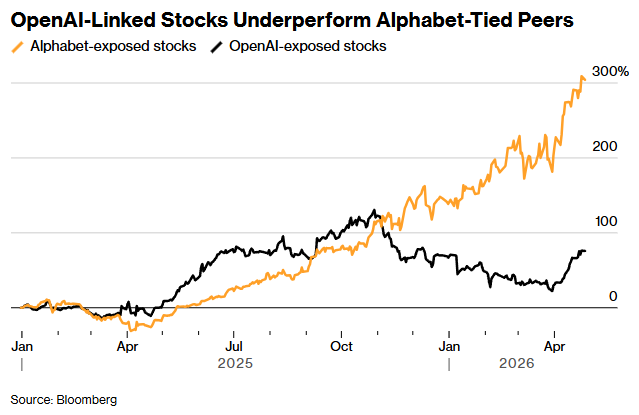
 Notably, Google’s pursuit of OpenAI is also reflected in a series of stocks associated with Google. Data indicates that in recent months, a basket of stocks related to OpenAI has significantly underperformed their peers. Since the end of 2024, this group of stocks has risen by approximately 75%, while a similar basket of stocks related to Google has surged over 300% during the same period.
Anna McDonald, Director of Investment Strategy at Hargreaves Lansdown, stated: "Since the launch of ChatGPT, OpenAI's growth has been extremely impressive, but competitors are seizing opportunities from both sides." Some analysts had previously predicted that Google and Anthropic would continue to weaken OpenAI's leading position.
OpenAI’s Chief Financial Officer, Sarah Frier, stated in communications with other executives that if sales growth is insufficient, the company may be unable to afford the required computing power costs in the future. OpenAI previously committed to investing over $1.4 trillion in AI infrastructure. Meanwhile, investor concerns are rising about AI developers and tech giants, believing their investments in data centers and AI chips are excessive, with unclear return prospects.
As a result, investors are now highly vigilant, seeking evidence in this earnings season on whether tech companies remain firmly committed to their previously announced massive capital expenditure plans for building AI infrastructure.
Amanda Lyons, head of research at Group Capital, stated: "This is what the market needs to see to sustain the AI narrative. The subtlety lies in the narrow path. Any signs of a slowdown in spending will be viewed as a negative signal by the ecosystem. However, if spending suddenly increases significantly, it could raise questions about return on investment and sustainability."
Intensifying Competition! OpenAI Shifts Strategic Focus to Enterprise Market
In response to fierce competition from rivals such as Anthropic and Google, OpenAI announced earlier this month that it would shift its strategic focus to the enterprise market. OpenAI’s Chief Revenue Officer, Denise Dreyer, sent a four-page memo to OpenAI employees outlining the company’s strategic direction, emphasizing the need to retain users and signaling "OpenAI’s pivot towards the enterprise market."
In Dresser’s ideal vision, OpenAI’s strategic focus will fully pivot to the enterprise market by integrating the model layer (Spud), platform layer (Frontier), cloud channels (AWS), and implementation services (DeployCo) to create a closed-loop ecosystem. This multi-product integration aims to enhance customer stickiness, leveraging computational power advantages and platform breadth to establish dominance in the platform war against Anthropic.
However, in the enterprise market, Anthropic has become an unavoidable direct competitor for various vendors. Facing competitive pressure from Anthropic, Dreyer directly criticized Anthropic in the memo, stating that Anthropic’s narrative is built on fear, restrictions, and the belief that a small elite should control AI. She claimed that OpenAI’s positive message will ultimately win people over – building powerful systems, implementing appropriate safeguards, expanding accessibility, and helping people achieve more.
Dresser argued that Anthropic's inability to secure sufficient computing resources has led to product limitations, poor usability, and a lack of structural advantages. As a 'single-product company,' she judged Anthropic to be at a disadvantage in the platform wars, struggling to adapt to the trend of AI spreading to non-developers. Additionally, Dresser accused Anthropic of inflating its annualized revenue through accounting practices — such as fully recording income-sharing agreements with$Amazon (AMZN.US)$and Google — claiming its actual revenue was overstated by approximately $8 billion.
However, Dresser's vision for OpenAI shifting its strategic focus towards the enterprise market has not been embraced by the market. On one hand, while Anthropic’s Claude initially entered the market as a programming tool named Claude Code, it has since expanded into multiple use cases such as enterprise knowledge bases, customer service, and compliance, demonstrating rapid scenario expansion and commercialization. Whether OpenAI’s platform strategy can effectively suppress Anthropic remains to be seen.
Meanwhile, Anthropic is completing its computing power architecture, signing new agreements with$Alphabet-A (GOOGL.US)$and$Broadcom (AVGO.US)$CoreWeave, which will provide several gigawatts of next-generation TPU computing power starting in 2027. On the market side, among first-time purchasers of AI services, Anthropic has a win rate of 70%, while OpenAI’s is only about 30%.
In April, Anthropic disclosed that its annualized revenue exceeded $30 billion, surpassing OpenAI’s disclosed annualized revenue of $25 billion. In the premium enterprise market, recent institutional data shows that the gap between OpenAI, whose market share has fallen to 35.2%, and Anthropic has now narrowed to just 4.6 percentage points. At this rate, Anthropic is expected to surpass OpenAI within the next two months.
OpenAI's shift in focus to the enterprise market marks the company's second adjustment to its product roadmap within the past six months. Some OpenAI investors have expressed concerns that, despite the company's preparations for an initial public offering (IPO) as early as this year, this strategic realignment may leave it in a relatively vulnerable position against competitors like Anthropic and the resurgent Google.
An early investor of OpenAI remarked, “You already have a business like ChatGPT with 1 billion users and annual growth rates of 50% to 100%. Why shift the focus to the enterprise market and coding?” He added, “This is a company that severely lacks focus.”
Uncertainty Looms Over IPO Prospects
OpenAI is widely expected to complete its public listing by 2026. Meanwhile, reports suggest that Anthropic executives have discussed the possibility of going public as early as the fourth quarter of this year. Amidst both OpenAI and Anthropic seeking to go public as quickly as this year, news that OpenAI has failed to meet its internally set targets for user growth and sales has sparked widespread concern over the AI giant’s commercial sustainability. Coupled with its weaker competitive position in the enterprise market compared to Anthropic, this is leading some investors to question its high valuation, potentially creating obstacles for its path to an IPO.
Despite OpenAI completing a $122 billion funding round last month at a valuation of $852 billion, reports indicate that OpenAI shares are gradually losing favor in the secondary market, with some equity positions nearly unclaimed. The reason lies in investors rapidly shifting their focus to its main competitor, Anthropic. It is reported that Anthropic's valuation in the private secondary market has now surpassed $1 trillion, overtaking OpenAI.
Ken Smyth, founder of Next Round Capital, a marketplace for private equity secondary transactions, noted that demand for OpenAI stock is declining in the market they operate. In recent weeks, several hedge funds and venture capital firms holding large stakes contacted them to sell approximately $600 million worth of OpenAI shares.
If this had happened last year, these OpenAI shares would have been snapped up within days, but now buyers' perspectives have shifted. Smythe explained: 'In fact, we couldn't find anyone among hundreds of institutional investors willing to take over these shares.' These investors also informed him that they have prepared $2 billion in cash if Anthropic shares become available.
This situation is also evident among Wall Street's top wealth management firms. According to insiders, banks including Morgan Stanley and Goldman Sachs have begun offering OpenAI shares to high-net-worth clients without charging performance fees. However, Goldman Sachs still charges standard performance fees for clients interested in investing in Anthropic, typically around 15% to 20% of profits.
Although neither OpenAI nor Anthropic permits investors to trade shares on the secondary market without their consent, many investors can still sell their interests through alternative mechanisms such as special purpose vehicles. Meanwhile, investors in primary funding rounds are often given the opportunity to subscribe to additional shares in subsequent financing rounds to maintain their ownership percentage. Rather than outright refusal (which might offend those prominent companies), they may choose to participate in the subscription and then sell part of their position in the secondary market. This also makes the discreet 'secondary market for unlisted companies' somewhat informative.
Adam Crowley, co-founder of another trading platform Augment, pointed out that while OpenAI claims to have a strong consumer base from an operational perspective, it has been slow in capturing more profitable enterprise clients. Meanwhile, Anthropic dominates the higher-margin enterprise market, making its growth trajectory appear stronger than OpenAI’s.
In addition to challenges such as sluggish growth and intensifying competition, Elon Musk’s lawsuit against OpenAI further impacts the company’s high valuation. Musk’s legal challenge regarding OpenAI’s transition into a for-profit entity officially commenced on Monday.
This lawsuit was filed by Musk and his AI company xAI in 2024. The defendants include OpenAI CEO Altman, co-founder Greg Brockman, and key investors.$Microsoft (MSFT.US)$It is reported that Musk accused Altman and OpenAI of abandoning their non-profit mission at the time of establishment and instead pursuing commercial interests, becoming a "closed-source subsidiary" of Microsoft. He also accused Microsoft of benefiting from its early donations to OpenAI while "deliberately aiding and abetting" OpenAI.
In the amended relief request filed by Musk on April 7, five key demands were outlined, one of which was a request for the court to remove Altman from his position on OpenAI’s non-profit board and to dismiss both Altman and Brockman from their executive roles in OpenAI’s for-profit entity. Additionally, reports indicate that Musk is seeking $150 billion in damages and stated that if any compensation is awarded, he intends to allocate the funds to OpenAI’s charitable division.
Altman and Brockman have been the central drivers behind OpenAI’s financing and strategic partnerships. If Musk prevails in the lawsuit, changes in OpenAI’s management or corporate structure could force the postponement of its IPO plans, limiting the company’s cash flow and expansion pace. Meanwhile, a decline in employee equity value could lead to talent attrition, with both capital and talent potentially shifting to competitors like Anthropic and Google DeepMind.
This legal case has come at a critical juncture as OpenAI pushes forward with its IPO plans. Analysts noted that as the legal dispute unfolds in court, its ripple effects will become a focal point of attention across the entire AI industry. Analysts stated, "Given OpenAI's plan to conduct a record-breaking IPO in the second half of this year, this will cast a shadow and pose resistance for the company."
Editor/Lambor