
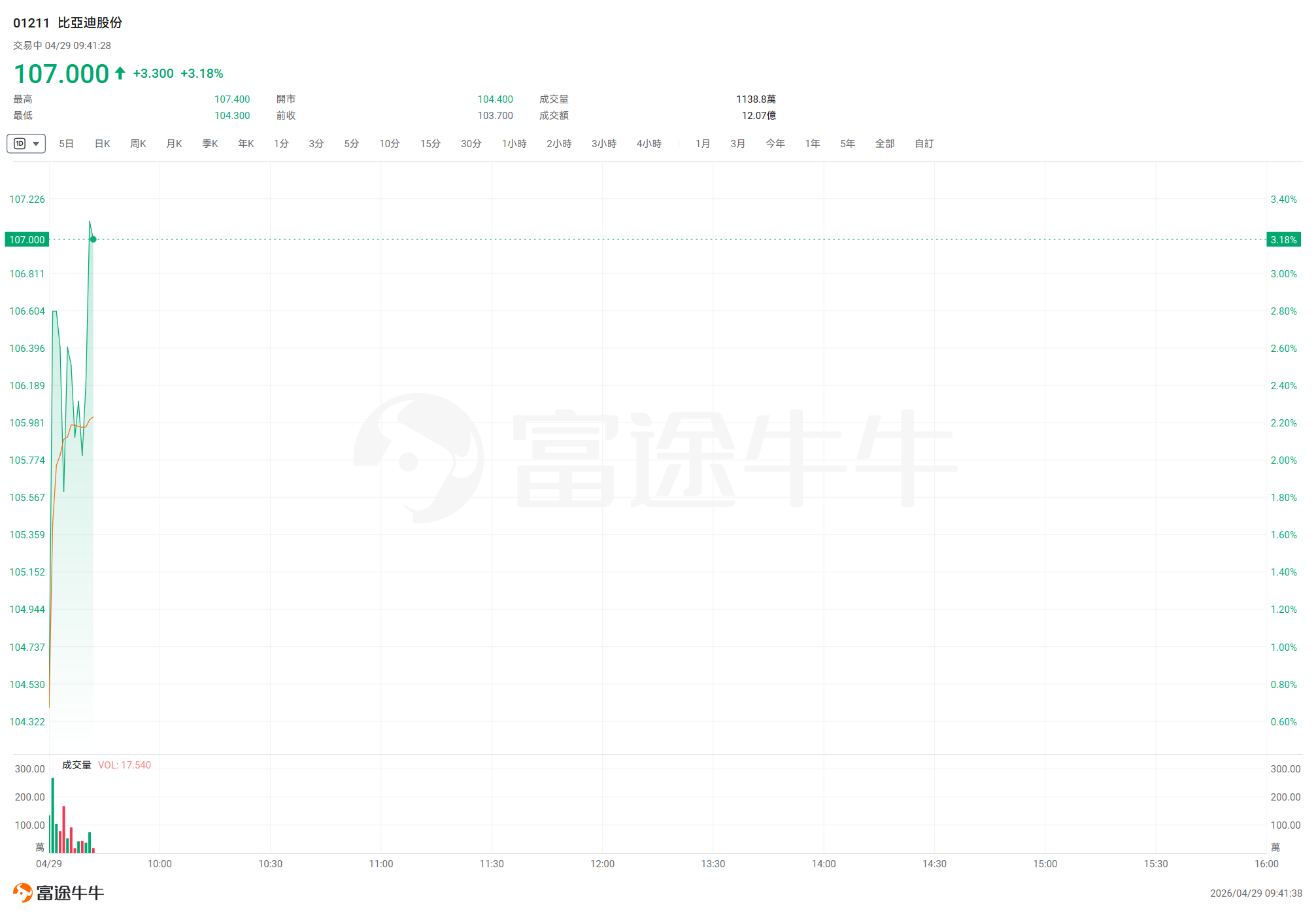
On April 29, BYD's stock price increased by more than 3%, closing at HKD 107. The trading volume reached HKD 1.207 billion.
$BYD COMPANY (01211.HK)$ / $BYD Company Limited (002594.SZ)$ A highly divergent earnings report was released: net profit halved, revenue declined year-over-year but slightly exceeded expectations. Meanwhile, positive signals emerged with overseas sales surging by over 50% and more than 30,000 pre-orders received within 24 hours for the new model 'Tang'.
In addition, due to a significant increase in the cost of storage hardware, the price of the Tian Shen Zhi Yan B auxiliary driving laser version for certain models will be raised from 9,900 yuan to 12,000 yuan.
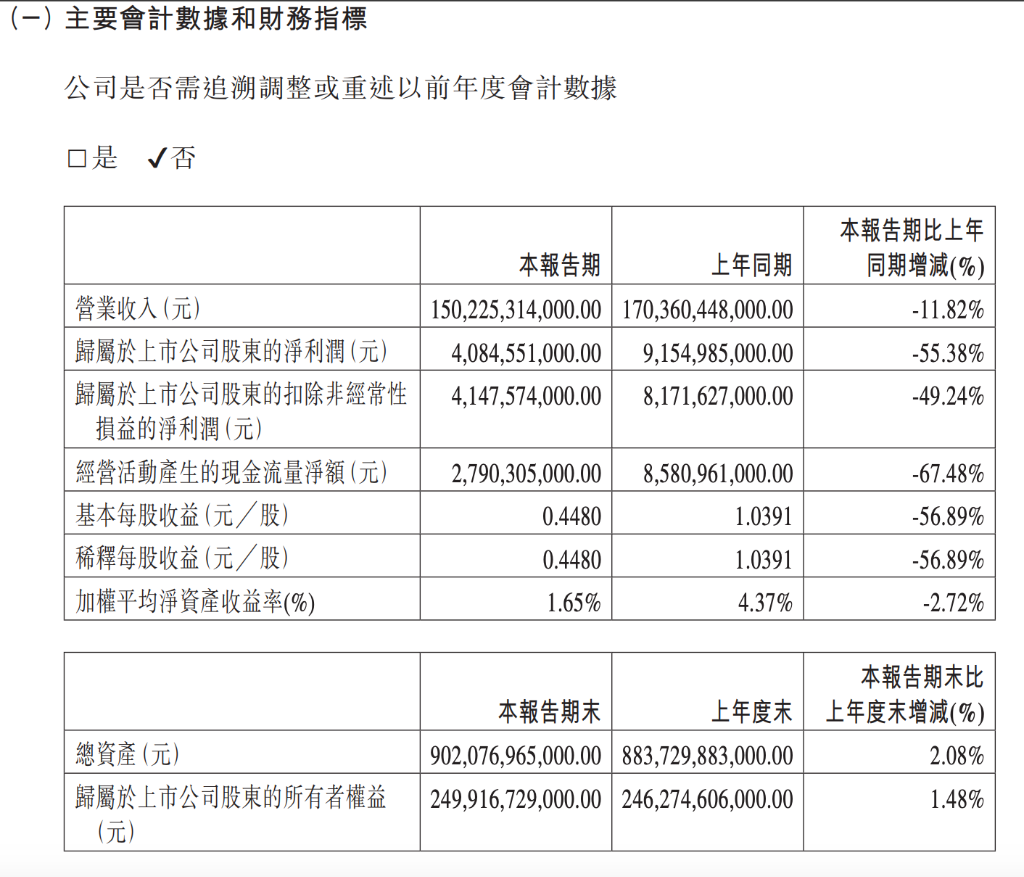
 According to the Hong Kong Stock Exchange filing by BYD, in the first quarter of 2026, the company reported revenue of RMB 150.225 billion, a year-over-year decrease of 11.82%, surpassing Bloomberg’s consensus estimate of RMB 140.4 billion. Net profit attributable to shareholders of the listed company amounted to RMB 4.085 billion, representing a significant year-over-year decline of 55.38%, closely aligning with the average forecast of RMB 4.1 billion by five analysts compiled by Bloomberg. Basic earnings per share fell from RMB 1.04 in the same period last year to RMB 0.45, while the weighted average return on equity narrowed from 4.37% to 1.65%.
The decline in profit was mainly driven by non-operating factors. Financial expenses surged 210% year-over-year to approximately RMB 2.1 billion due to foreign exchange gains and losses, which reversed from a gain of about RMB 1.9 billion in the same period last year to a loss this quarter. Additionally, R&D expenses amounted to RMB 11.34 billion, down approximately 20% year-over-year, slightly below market expectations of RMB 11.93 billion; selling expenses were RMB 5.83 billion, compared to RMB 6.18 billion in the same period last year.
Eugene Shaw, an analyst at Macquarie Capital, noted in a report prior to the earnings release that margin pressure in the first quarter appeared to be underestimated but is expected to ease in the coming quarters.
Overseas sales surge and new vehicle pre-orders send positive signals
Some positive signals are emerging. Driven by rising oil prices stimulating demand for electric vehicles, overseas sales surged by more than 50% in the first quarter. Exports accounted for approximately 45% of BYD’s first-quarter deliveries, positioning the company well to achieve its target of selling 1.5 million vehicles overseas this year.
Additionally, within 24 hours of unveiling the new 'Tang' SUV at the Beijing Auto Show, BYD received over 30,000 pre-orders, boosting the company's stock price on Monday. The model is equipped with BYD’s latest Blade Battery, offering a range of nearly 1,000 kilometers on a single charge, with an expected starting price of RMB 250,000.
Joanna Chen, an analyst at Bloomberg Intelligence, noted before the earnings release that a recovery trend seems to be forming in the second quarter. New models featuring the second-generation Blade Battery are attracting more foot traffic to showrooms, while global energy shocks caused by Middle East conflicts have also brought robust orders for the company’s overseas electric vehicle and energy storage businesses.
Reversal of foreign exchange gains and losses led to a 210% surge in financial expenses.
The core reason for the sharp decline in profit stemmed from significant fluctuations in foreign exchange gains and losses.
In the same period last year, BYD recorded foreign exchange gains of approximately RMB 1.9 billion under financial expenses; however, this quarter saw a reversal to foreign exchange losses, causing financial expenses to skyrocket 210.04% year-over-year to about RMB 2.1 billion. This single factor alone imposed a drag of approximately RMB 4 billion on profit.
Meanwhile, the fair value of derivative financial instruments shifted from a profit of RMB 246 million in the same period last year to a loss of RMB 101 million, with fair value changes resulting in a 141% year-over-year decline; investment income also plummeted from nearly RMB 700 million to less than RMB 100 million, marking an 87.68% year-over-year decrease. The叠加of these non-operating factors was the main driver behind the halving of net profit.
R&D expenses decline, capitalization rate increases.
On the expense side, a notable change is the accounting treatment of R&D investment.
R&D expenses for this quarter amounted to RMB 11.344 billion, compared to RMB 14.223 billion in the same period last year, representing a year-over-year decrease of approximately 20.2%. However, the balance of development expenditure on the balance sheet increased from RMB 5.971 billion at the beginning of the year to RMB 8.285 billion, a rise of 38.75%. This indicates that part of the R&D investment has shifted from expensing to capitalization, thereby reducing current expenses and providing some support to profit.
This change itself does not represent a decline in R&D intensity but rather reflects adjustments in the pace of the company's R&D projects and accounting estimates.
Operating cash flow declines, financing needs rise
Net cash flow from operating activities amounted to 2.79 billion yuan, a significant year-on-year decrease of 67.48%, primarily due to a reduction of approximately 35.4 billion yuan in cash received from the sale of goods and provision of services. This change may be related to extended payment cycles from downstream clients, intensified price competition within the industry, and shifts in the sales structure.
On the balance sheet, inventory balances increased from 138.421 billion yuan at the beginning of the year to 160.414 billion yuan, an increase of approximately 15.9%, creating certain pressures on capital occupation against the backdrop of declining revenue. Short-term borrowings rose from 38.485 billion yuan to 66.296 billion yuan, marking a 72.27% increase, indicating a notable rise in the company’s financing needs.
From the perspective of investment activities, capital expenditures have shown some contraction. Cash paid for the acquisition of fixed assets, intangible assets, and other long-term assets amounted to 22.063 billion yuan, decreasing by approximately 40% year-on-year. This partially explains the phenomenon where the balance of construction in progress increased from 48.294 billion yuan to 59.318 billion yuan, but the growth rate slowed.
 Upgraded performance updates, a step ahead in seizing opportunities!
Guidance: Open Futubull > Stock Page > Click on the [Company] Tab >Earnings Express
Editor/Jayden