
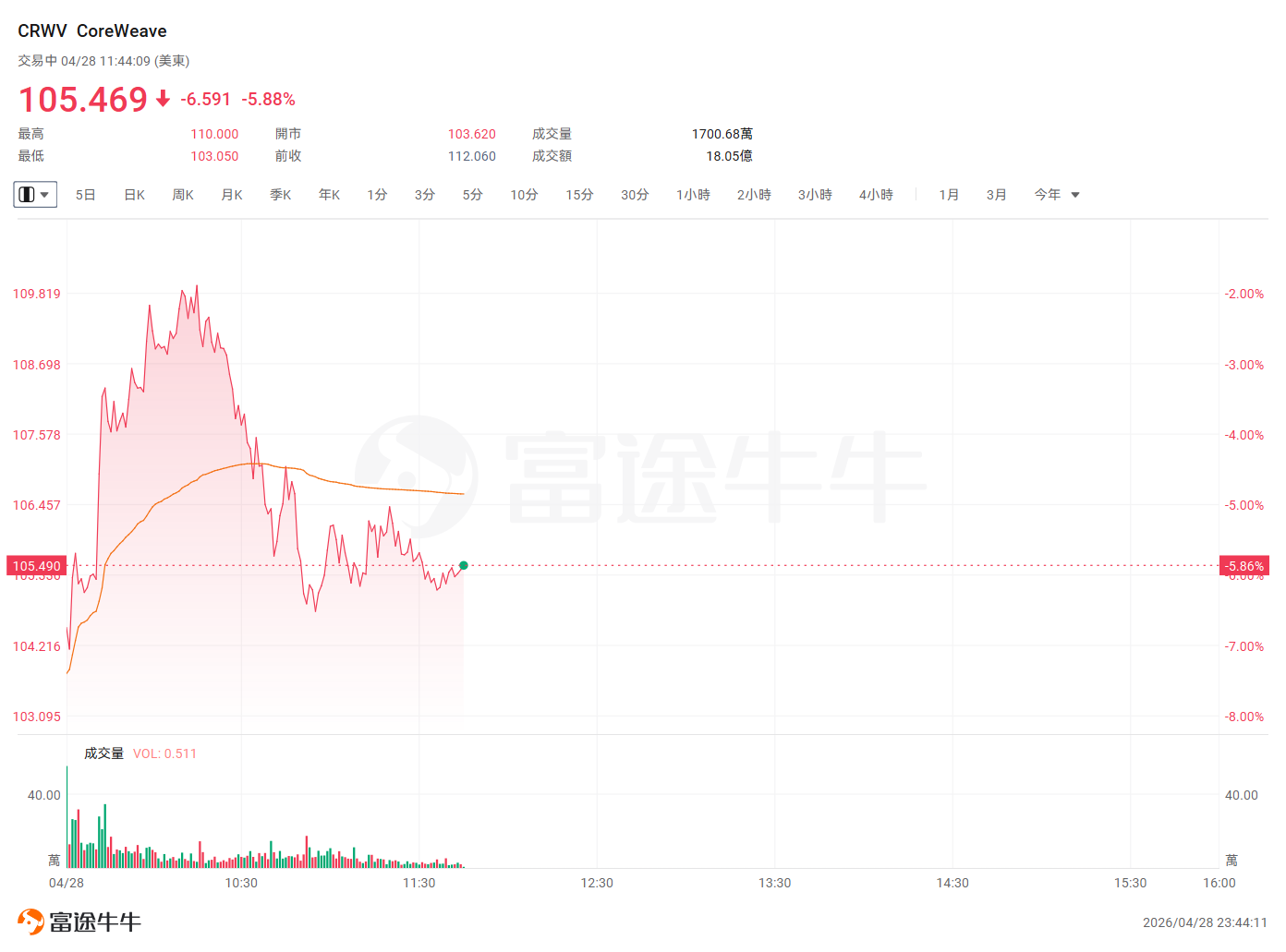
CoreWeave's stock price dropped more than 5% at the market open following OpenAI's below-expectation sales targets, which triggered a collective decline among related concept stocks. The company promptly responded, stating that its customer base is diverse and continuously expanding, now including top-tier firms such as Meta, Microsoft, Google, and Anthropic, in addition to OpenAI. CoreWeave emphasized that the demand for AI computing power is driven by the overall expansion of the ecosystem, with supply-demand gaps remaining a central narrative, and reiterated that the company’s fundamentals remain solid.
Following reports that OpenAI's sales targets were not met, related concept stocks collectively came under pressure. CoreWeave quickly responded, stating that its business does not rely on a single client and that demand for AI computing power still exceeds supply. However, market concerns have not fully dissipated, with the company’s stock price still falling more than 5% in early U.S. trading.
On April 28, according to Bloomberg, a CoreWeave spokesperson stated in an email declaration that OpenAI is "a great partner, but not our only partner." The company noted that its customer base is "diverse and expanding," covering$Meta Platforms (META.US)$, Anthropic, $Microsoft (MSFT.US)$ 、 $Alphabet-C (GOOG.US)$ 、 $IBM Corp (IBM.US)$ , Perplexity AI, Jane Street, and many other institutions.
 $CoreWeave (CRWV.US)$ The company also stated that as more companies develop and deploy artificial intelligence (AI), the demand for computing power continues to grow. "We still see demand across the entire AI ecosystem exceeding supply, particularly as inference scales expand." This statement aims to signal to the market that even if OpenAI faces growth pressures, CoreWeave's fundamentals remain unshaken.
OpenAI's sales pressure triggers market chain reaction
According to a report by The Wall Street Journal on Monday, citing informed sources, OpenAI failed to meet its self-imposed sales targets for several months in 2026, partly due to competitor Anthropic's continued market share gains in programming and enterprise sectors. Meanwhile, ChatGPT did not achieve its internal goal of reaching one billion active users per week by the end of 2025, with user churn remaining pressured due to the rise of Google Gemini.
The report stated that OpenAI's Chief Financial Officer, Sarah Friar, has expressed concerns in communications with other executives: if sales growth is not fast enough, the company may struggle to afford future computing expenditures. OpenAI previously announced commitments exceeding $1.4 trillion in AI infrastructure investments.
This news has sparked widespread skepticism in the market regarding the return on investment in AI infrastructure.$SoftBank Group (9984.JP)$Share prices fell by more than 7.5% at one point in the Tokyo market. SoftBank Group committed $30 billion in OpenAI’s $110 billion funding round completed in February this year. Including the latest commitment, its total investment in OpenAI will reach $64.6 billion by the end of the year, with an equity stake of approximately 13%.
CoreWeave’s customer matrix covers leading AI manufacturers
CoreWeave is a representative company in the 'new cloud' (neocloud) sector, focusing on providing high-performance cloud computing leasing services for AI workloads. The list of clients disclosed in this response indicates that its business coverage has become quite extensive.
Notably, CoreWeave's customer matrix now includes Anthropic, OpenAI, Google, and Meta—four of the largest AI model developers globally. Among them, Meta Platforms has committed to purchasing up to $21 billion worth of computing power from CoreWeave, while Anthropic has signed a multi-year data center lease agreement with CoreWeave to support its Claude model services.
According to CoreWeave's disclosure in February this year, the company currently operates 43 active data centers and has contracted over 3 gigawatts of server farm power capacity. Tech giants such as Microsoft have also turned to new cloud service providers like CoreWeave to rapidly expand their capabilities in building and delivering AI products.
The logic behind computing power demand remains unchanged, with the supply-demand gap still being the core narrative.
The core logic of CoreWeave's response this time is that the demand for AI computing power does not depend on the sales performance of a single model company but is driven by the expansion of the entire ecosystem. The company emphasized that, particularly against the backdrop of continuously surging AI inference demands, supply still struggles to keep up with the pace of demand growth.
This statement directly addresses the market's core concern—whether the massive investments by AI developers and large tech companies in areas such as data centers and chips can yield sufficient returns. For CoreWeave's investors, the company’s ability to maintain customer diversification and continue expanding revenue sources beyond OpenAI will be a key variable in assessing its long-term value.
Editor/Rocky