In response to market concerns about slowing sales growth and failure to meet internal targets, OpenAI publicly stated on Tuesday that its consumer and enterprise businesses are operating at "full speed."
In response to market concerns about slowing sales growth and failure to meet internal targets, OpenAI publicly stated on Tuesday that its consumer and enterprise businesses are operating at "full speed," with demand continuing to grow, while downplaying the impact of related negative reports.
OpenAI stated in a declaration that demand from enterprise customers and its nascent advertising business continues to grow. "The internal atmosphere within the company is very positive," the company said in a statement. The Wall Street Journal reported on Monday evening that OpenAI had failed to achieve several internal goals as competitors continued to make progress. OpenAI described the report as "a typical example of clickbait."
 Oracle responded by expressing great excitement about the collaboration with OpenAI.
Previously, The Wall Street Journal reported on Monday evening that OpenAI had failed to meet several internal growth targets as competitors captured market share. The report also noted that OpenAI's Chief Financial Officer, Sarah Friar, was concerned that insufficient sales growth could leave the company unable to meet its rising computing power demands in the future.
Following the news, shares of several OpenAI partners fell on Tuesday.$Oracle (ORCL.US)$dropped by more than 4%,$CoreWeave (CRWV.US)$Shares dropped by more than 5.7%. The stock volatility highlighted OpenAI’s central role in a complex network of investments and transactions involving top cloud computing providers and chip manufacturers. Investors, already concerned about a potential bubble in AI infrastructure, have begun to question whether OpenAI and other tech companies' plans to invest hundreds of billions of dollars in building data centers and purchasing chips over the coming years will yield reasonable returns.
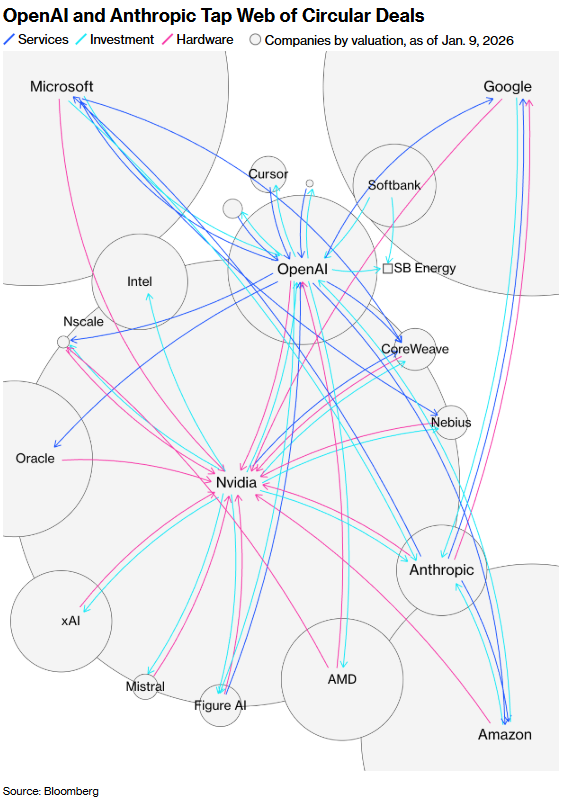
At the same time, investor concerns about a potential bubble in AI infrastructure continue to rise. The market has started to question whether OpenAI and other tech companies' multi-billion-dollar plans to build data centers and purchase chips over the next few years can deliver reasonable returns.
In response, OpenAI stated that expanding computing resources remains a "key driver" for the company, emphasizing that increased computing power will help it continuously enhance customer product experiences. The company noted that deploying more computing power is not merely a cost but an essential foundation for sustaining long-term competitive advantages.
According to a previous Bloomberg report, earlier this month, OpenAI informed investors that its early significant expansion of computing resources provided a key advantage over long-term competitor Anthropic, although the latter has been catching up rapidly.
However, it is worth noting that even before The Wall Street Journal report was published, OpenAI had already begun adopting a more cautious approach to infrastructure investment.
The company recently announced its plan to suspend a project in the UK, while$Microsoft (MSFT.US)$agreeing to lease data center capacity in Norway originally intended for OpenAI. According to reports from March, due to delays in financing negotiations,$Oracle Corp Japan (4716.JP)$OpenAI has abandoned plans to expand its flagship AI data center in Texas.
Market analysts believe these adjustments indicate that OpenAI is not engaging in unrestrained expansion but is instead seeking a balance between its high-investment strategy and capital constraints.
On the other hand, CoreWeave has also attempted to stabilize market sentiment by emphasizing that OpenAI is not its sole partner. The company stated that its clients also include $Alphabet-C (GOOG.US)$ 、$Meta Platforms (META.US)$, Anthropic, and Microsoft, and noted that demand for computing power continues to grow.
OpenAI predicts that users will shift en masse to the lower-cost ChatGPT subscription tier.
Previously undisclosed forecasts indicate that OpenAI expects its lower-cost, ad-supported subscription tier to not only attract new users but also lead tens of millions of paying subscribers to downgrade their subscription levels. Below are OpenAI's key projections:
1. User growth: OpenAI anticipates that its lower-cost, ad-supported subscription tier will attract new users while prompting tens of millions of paying subscribers to reduce their subscription levels.
2. Decline in Plus subscriptions: The number of subscribers to ChatGPT Plus, the flagship monthly paid plan, is projected to drop by 80% this year, falling to approximately 9 million users.
3. Pro subscription forecast: The user base for the most expensive Pro plan is expected to double; however, it will still account for less than 1% of the total user base.
4. Advertising-driven revenue: Forecasts show that advertising will become the largest single revenue driver. By 2030, advertising is expected to generate approximately $102 billion in revenue, accounting for about 36% of total revenue.
According to OpenAI’s Chief Revenue Officer (CRO), enterprise sales currently account for more than 40% of total revenue.
Wedbush: Overreaction
Wedbush analyst DivesTech described the sell-off of Oracle following The Wall Street Journal's report that OpenAI had recently failed to meet its new user and revenue targets as an "overreaction."
Wedbush believes that OpenAI has seen "extremely high demand" in both consumer and enterprise markets. The firm "strongly" disagrees with claims of a slowdown in growth. Analysts informed investors in a research note that Oracle's backlog of $553 billion is primarily driven by a $300 billion cloud contract with OpenAI over the next five years, which is projected to contribute $30 billion in revenue to the company.
The bank is confident in Oracle's ability to complete a $50 million financing round. It believes that recent concerns surrounding OpenAI have been exaggerated and noted that the company has sufficient funding to meet its computing power needs for at least the next three years.
 Futubull AI: Your portfolio manager!Your stock-picking advisor!

Editor/Rocky