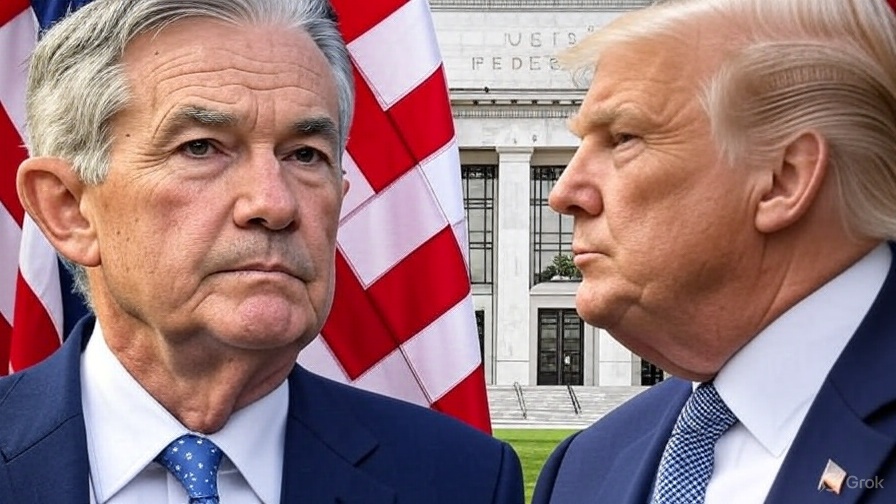
The Federal Reserve's decision is about to be announced, with no change in interest rates almost certain. What truly has the market on edge is this: will Chairman Powell leave after his term ends? Trump’s pick, Kevin Warsh, is already at the gates, vowing to completely overhaul the Fed. Powell still holds one card – remaining as a governor. Will he play it?
The Federal Reserve is holding a policy-setting meeting in Washington this week. The outcome of the meeting will be announced at 2:00 PM Eastern Time on Wednesday (2:00 AM Beijing Time on Thursday), followed by a press conference with Fed Chair Powell 30 minutes later. Given that this may be his last press conference as chair, investors are not only focused on policy signals but also assessing the future direction of the Fed's leadership.
According to widespread market expectations, the Federal Open Market Committee (FOMC) will announce that it will maintain the benchmark interest rate within the range of 3.5% to 3.75%, marking the third consecutive meeting without a rate change.
 Compared to interest rate trajectories, the market’s focus has clearly shifted toward personnel changes. Powell’s term will end on May 15, and his remarks during the post-meeting press conference are seen as a key indicator for assessing his future role. He has previously hinted that he might continue serving as a member of the Federal Reserve Board after his term as chair concludes.
Changes in energy markets and inflationary pressures form an important backdrop for the current policy environment. The impact of the Iran war has driven up energy prices, compounded by supply chain disruptions, raising upside risks to inflation while also weighing on economic growth. In this increasingly uncertain environment, most policymakers have opted to adopt a wait-and-see stance, refraining from adjusting interest rates for now.
Political factors surrounding leadership transitions are emerging as another central theme. U.S. President Trump has continued to pressure the Federal Reserve to implement significant rate cuts, while his nominee for the next chair, Kevin Warsh, has publicly stated that he would push for a 'regime change' at the Fed.
Analysts at Evercore ISI noted in their report that the pace of policy changes under Warsh’s leadership would depend on the turnover of members within the Board of Governors and the Federal Open Market Committee, with particular attention on whether Powell decides to step down from his position as a governor.
A key development has occurred in the confirmation process. Senator Thom Tillis stated on Sunday that he would support advancing Warsh’s nomination to a vote in the Senate Banking Committee, signaling that the main obstacle to his confirmation path has been removed. Tillis had previously blocked the nomination due to an investigation into a $2.5 billion renovation project at the Federal Reserve headquarters; however, he reversed his position following the U.S. Department of Justice’s announcement that the investigation had concluded. Several lawmakers, including Tillis, had criticized the probe as politically motivated.
Despite the conclusion of the investigation, related controversies have yet to fully subside. Powell’s term as a Fed governor extends until January 2028, and he has indicated that he will not step down until the investigation is 'fully, truly resolved with transparency and definitive conclusions.' It remains unclear whether the DOJ’s handling satisfies these criteria.
Jeanine Pirro, the U.S. Attorney for the District of Columbia who announced the closure of the investigation, stated that she has requested the Fed’s internal oversight body to review the renovation project and noted that reopening a criminal investigation remains a possibility if deemed necessary.
The policy statement itself is expected to undergo only minor adjustments. Several economists believe that the Federal Reserve might update its description of the labor market to reflect recent data trends—while hiring activity remains sluggish, overall employment conditions have stabilized.
In terms of interest rate guidance, there is also a possibility of changes in wording. Some officials hope to send a more hawkish signal, emphasizing that the next policy move could be a rate hike rather than a cut, in response to inflationary pressures exacerbated by the conflict with Iran. To signal this sentiment, officials could revise their language to describe how they are considering the 'extent and timing of further adjustments' to the benchmark interest rate.
Economists at Deutsche Bank noted in a report that removing the word 'further' from the statement would weaken the previously implied dovish stance suggesting consecutive rate cuts. The Federal Reserve had cut rates three times by the end of 2025.
In addition, Federal Reserve Governor Milan is expected to cast another dissenting vote against the mainstream decision. Since joining in September last year, he has dissented at every meeting. Considering that Warsh has been nominated to replace him, this could also be Milan’s last policy meeting.
U.S. Treasury Traders Brace for Long-Term Yields Breaking 5%
Traders in the U.S. Treasury options market are preparing for long-term bond yields to surge above 5%.
This week, as Brent crude oil prices broke through $110 per barrel, there was a surge in demand for options hedging against further sell-offs in the bond market in the coming days, pushing yields higher. Several large put option trades targeting 10-year U.S. Treasuries are set to expire on Thursday — the day after the Federal Reserve convenes its interest rate decision meeting.
The accumulation of these bearish trades reflects market concerns: policymakers, who are expected to keep rates unchanged, may comment on the impact of energy prices and supply chain disruptions on inflation, increasing the likelihood of tighter monetary policy in the future. On Wednesday, the Senate Banking Committee is also expected to vote on Warsh's nomination to replace Powell as Federal Reserve Chair, clearing the path for confirmation before Powell’s term ends in mid-May.
Collin Martin, Head of Fixed Income Research and Strategy at Charles Schwab, stated that risks troubling U.S. Treasuries include stubborn inflation, fiscal concerns, and rising global bond yields. He believes that unless there are more signs of weakness in the labor market, the 10-year yield is more likely to rise toward 4.5% rather than retreat to 4%.
On Monday, a large position in long-term bond options was purchased, betting that the 20-year U.S. Treasury yield would break through 5.15%. As the 30-year U.S. Treasury yield rose to 4.97% on Tuesday, hitting its highest level since March 27, the trade has already generated profits of approximately $8 million.
The recent influx of demand for put options has driven up the premium for long-term bond futures put options relative to call options. The put-call skewness has sharply declined, indicating that the cost of hedging against sell-offs has reached its highest level in about a month.
Alex Manzara, a derivatives broker at R.J. O'Brien & Associates, stated that these operations are partly driven by a general hedging demand stemming from shifts in forward-looking inflation expectations. He noted that rising oil prices have transitioned from a narrative more skewed toward economic slowdown to one of inflation, which is also reflected in the higher yields observed in the bond markets of the UK, Germany, and Japan.
Editor/KOKO