
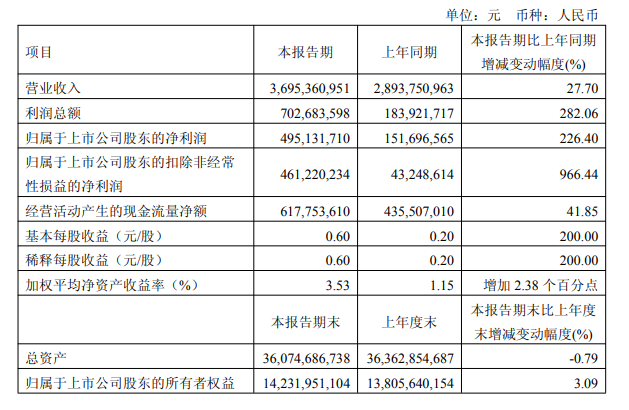
In the first quarter, Yangtze Optical Fiber and Cable Company achieved operating revenue of 3.695 billion yuan, representing a year-on-year increase of 27.70%; net profit attributable to shareholders of 495 million yuan, marking a year-on-year increase of 226.40%; and non-recurring net profit attributable to shareholders of 461 million yuan, reflecting a year-on-year surge of 966.44%.
The AI large model arms race is reshaping the prosperity cycle of the entire optical fiber industry, with Changfei Optical Fiber's first-quarter earnings report confirming this assessment.
In the first quarter of 2026, Changfei Optical Fiber achieved operating revenue of 3.695 billion yuan, a year-on-year increase of 27.70%; net profit attributable to shareholders of 495 million yuan, a year-on-year increase of 226.40%; and non-GAAP net profit attributable to shareholders of 461 million yuan, a year-on-year increase of 966.44%.
 The most critical highlight of this quarter is the significant recovery in gross margin. The company’s operating costs increased by only approximately 3.5% year-on-year, significantly lower than the revenue growth rate, driving the quarterly gross margin to about 41.5%, an increase of approximately 13.7 percentage points compared to the same period last year.
A surge in gross margin was the key driver behind the sharp rise in profits.
In the first quarter, Changfei Optical Fiber achieved operating revenue of 3.695 billion yuan, a year-on-year increase of 27.70%; operating costs amounted to 2.161 billion yuan, increasing by only about 3.5% year-on-year. The clear divergence between revenue and cost growth rates directly led to a substantial expansion in gross profit.
Based on financial report data calculations, the company’s gross profit for the first quarter was approximately 1.534 billion yuan, with a gross margin of around 41.5%; in the same period last year, gross profit was approximately 806 million yuan, with a gross margin of around 27.8%. This indicates that the gross margin improved by approximately 13.7 percentage points year-on-year, representing the most significant change in the income statement for this quarter.
Driven by the increase in gross margin, the company’s operating profit reached 707 million yuan, compared to 119 million yuan in the same period last year; total profit amounted to 703 million yuan, a year-on-year increase of 282.06%; net profit attributable to shareholders was 495 million yuan, a year-on-year increase of 226.40%. The company’s single-quarter net profit margin attributable to shareholders was approximately 13.4%, compared to approximately 5.2% in the same period last year, reflecting a significant improvement in profitability.
It should be noted that the quarterly report did not disclose segmented business revenue, pricing, sales volume, or changes in product mix; therefore, the specific sources of the gross margin improvement still require further detailed disclosure. However, based on the financial results, there was a clear recovery in the company’s core profitability during the first quarter.
Non-GAAP net profit nearly increased tenfold, indicating an improvement in profit quality.
Compared to the 226.40% growth in net profit attributable to shareholders, the growth in non-GAAP net profit attributable to shareholders was even more aggressive.
In the first quarter, the company's non-GAAP net profit attributable to shareholders reached 461 million yuan, representing a year-on-year increase of 966.44%. The non-GAAP net profit margin was approximately 12.5%, compared to only about 1.5% in the same period last year. This indicates that, after excluding non-recurring items such as government subsidies and changes in the fair value of financial assets, the company’s core profits still achieved substantial growth.
Regarding non-recurring gains and losses, the total non-recurring gains and losses for the first quarter amounted to 33.91 million yuan, mainly including:
Government subsidies of 41.23 million yuan;
Gains or losses related to changes in the fair value of financial assets and financial liabilities, as well as disposal gains or losses of 11.97 million yuan;
Gains or losses from the disposal of non-current assets amounted to -0.62 million yuan;
Other non-operating income and expenses amounted to -4.65 million yuan;
The combined impact of income tax and minority interests was approximately 14.02 million yuan.
In terms of proportion, non-recurring gains and losses accounted for approximately 6.9% of net profit attributable to shareholders this quarter, contributing limitedly to overall profit. By comparison, in the same period last year, net profit attributable to shareholders was 152 million yuan, while non-GAAP net profit was 43.25 million yuan. The difference between the two exceeded 100 million yuan, indicating greater influence from non-recurring factors.
This is one of the more noteworthy aspects of this quarterly report: the profit growth of Yangtze Fibre Optic and Cable Company Limited (Changfei) was not primarily driven by one-time gains but reflected simultaneous improvements in core operating margins and non-GAAP profits.
Overall expenses were under control, with relatively higher increases in financial expenses.
From the cost perspective, the company's total sales, management, R&D, and financial expenses in the first quarter amounted to approximately RMB 7.47 billion, representing a year-on-year increase of about 23.8%, which is lower than the revenue growth rate; the period expense ratio was approximately 20.2%, a slight decrease from approximately 20.8% in the same period last year.
Breaking it down:
Sales expenses were RMB 1.61 billion, an increase of approximately 39.9% year-on-year, with an expense ratio of approximately 4.35%, higher than approximately 3.97% in the same period last year.
Management expenses were RMB 3.02 billion, an increase of approximately 13.1% year-on-year, with the expense ratio decreasing from approximately 9.22% in the same period last year to approximately 8.16%.
R&D expenses were RMB 2.05 billion, an increase of approximately 16.6% year-on-year, with an expense ratio of approximately 5.56%, lower than approximately 6.09% in the same period last year.
Financial expenses were RMB 79.08 million, an increase of approximately 74.6% year-on-year, with an expense ratio of approximately 2.14%, compared to approximately 1.56% in the same period last year.
The significant increase in financial expenses warrants attention. According to the financial report, interest expenses in the first quarter were RMB 63.67 million, close to RMB 62.69 million in the same period last year; interest income was RMB 30.56 million, showing a notable year-on-year increase. Therefore, the rise in financial expenses may also be influenced by foreign exchange or other financial items, though the quarterly report did not elaborate further.
In terms of R&D investment, the company's R&D expenses in the first quarter exceeded RMB 2 billion, maintaining a certain level of investment intensity. Although the R&D expense ratio decreased year-on-year, this was mainly due to faster revenue growth, with the absolute amount still increasing.
Investment income continued to weigh on performance, while income tax expenses rose significantly.
In the income statement, investment income remained a drag. The company’s investment income in the first quarter was -RMB 75.44 million, compared to -RMB 56.24 million in the same period last year, with losses widening by approximately RMB 19.20 million. Among this, investment income from joint ventures and associates was -RMB 77.89 million, compared to -RMB 67.69 million in the same period last year, remaining the primary source of the drag.
In terms of other income, the company recognized RMB 78.41 million in the first quarter, compared to RMB 49.53 million in the same period last year, representing a year-on-year increase of approximately 58.3%, which contributed to profit growth. The gain from fair value changes amounted to RMB 8.71 million, compared to RMB 2.34 million in the same period last year.
Regarding impairment, the company's credit impairment loss in the first quarter was RMB 44.04 million, up from RMB 29.49 million in the same period last year; the asset impairment loss was RMB 10.95 million, down from RMB 26.69 million in the same period last year. Combined, these two items had a negative impact on profits of approximately RMB 55 million.
In terms of income tax expenses, the first quarter figure was RMB 117 million, compared to only RMB 6.7 million in the same period last year. With total profit increasing significantly, the company's effective tax rate rose to approximately 16.7%, compared to about 3.6% in the same period last year. This also indicates that pre-tax profit growth this quarter was stronger and sufficient to offset the net profit elasticity after the rise in taxes.
Operating cash flow outperformed profit, while investment and debt repayment led to a reduction in cash.
Cash flow was another highlight this quarter.
In the first quarter, the company’s operating cash inflow reached RMB 4.477 billion, representing a year-on-year increase of approximately 29.6%; cash received from the sale of goods and provision of services amounted to RMB 4.221 billion, up by approximately 33.4% year-on-year. Operating cash outflow was RMB 3.859 billion, marking a year-on-year increase of approximately 27.8%. Ultimately, net cash flow from operating activities stood at RMB 618 million, growing by 41.85% year-on-year.
This net operating cash flow not only exceeded the figure from the same period last year but also surpassed the attributable net profit for the current period of RMB 495 million, indicating a strong quality of realized profits.
However, the ending balance of cash and cash equivalents was RMB 5.409 billion, a decrease of RMB 222 million from the beginning of the period, mainly due to three factors:
Net cash flow from investing activities was -RMB 510 million, primarily including payments of RMB 336 million for the acquisition of fixed assets, intangible assets, and other long-term assets, as well as RMB 2.473 billion for investments.
Net cash flow from financing activities was -RMB 290 million, including RMB 1.512 billion in borrowings and RMB 1.747 billion in debt repayments, reflecting a net debt repayment status.
The impact of exchange rate changes on cash and cash equivalents was -RMB 39.61 million.
In terms of structure, the company’s operating activities generated cash, but investment and debt repayment consumed cash. By the end of the period, the company still held RMB 5.525 billion in cash, maintaining a relatively high level of cash reserves.
Inventory increased, while accounts receivable remained stable.
In terms of working capital, several items are worth noting.
By the end of the first quarter, the company's accounts receivable amounted to RMB 5.906 billion, slightly lower than RMB 5.950 billion at the end of the previous year. Against the backdrop of revenue growing by nearly 30% year-on-year, the accounts receivable did not expand simultaneously, corroborating the improvement in operating cash flow.
Regarding inventory, the closing balance was RMB 3.504 billion, an increase of approximately 11.1% compared to RMB 3.153 billion at the end of the previous year. The rise in inventory may be related to stockpiling, order delivery schedules, or production capacity arrangements, but the quarterly report did not disclose more detailed reasons. Subsequent attention should be paid to whether the increase in inventory can be smoothly converted into revenue and whether there is any impairment pressure.
Additionally, financial assets at fair value through profit or loss increased from RMB 1.683 billion at the end of the previous year to RMB 1.909 billion; other equity instrument investments decreased from RMB 571 million to RMB 503 million, corresponding to the negative change in 'fair value changes in other equity instrument investments' within other comprehensive income for the current period.
Other comprehensive income turned negative, with fluctuations in exchange rates and equity investments dragging down total comprehensive income.
Although net profit grew significantly, the company’s other comprehensive income for the first quarter was -RMB 129 million, compared to +RMB 12.12 million in the same period last year. As a result, the total comprehensive income amounted to RMB 456 million, lower than the net profit of RMB 585 million for the period.
Among this, other comprehensive income attributable to the parent company’s owners was -RMB 112 million, mainly including:
Other equity instrument investments recorded a fair value change of -RMB 55.95 million;
Cash flow hedge reserves decreased by RMB 15.46 million;
Foreign currency financial statement translation differences amounted to -RMB 39.13 million.
This reflects that the company has been impacted by market and exchange rate fluctuations in terms of the fair value of equity investments, hedging instruments, and foreign currency financial statement translations. For an enterprise with overseas operations and financial asset allocations, subsequent comprehensive income may continue to fluctuate with market conditions.
The shareholder structure remains stable, with the employee stock ownership plan entering the top ten.
As of the end of the first quarter, the total number of ordinary shareholders of the company was 66,203.
Among the top ten shareholders, Hong Kong Central Clearing (Agent) Limited held 421 million shares, accounting for 50.91%. Its holdings represent the company's foreign-listed foreign-invested shares, including some H-share shareholders. China Huaxin Post & Telecommunications Technology Co., Ltd. held 180 million shares, accounting for 21.72%, while Wuhan Yangtze River Communications Industry Group Co., Ltd. held 119 million shares, representing 14.35%.
In addition, Harvest International Capital Management Limited, CPE Aspen Investment Limited, and E Fund Management Co., Ltd. held 3.26%, 3.02%, and 2.58% of the shares, respectively. The company’s 2025 Employee Stock Ownership Plan held 6 million shares, representing 0.72%, ranking among the top ten.
The financial report indicates that none of the shares held by the top ten shareholders were pledged, marked, or frozen. Additionally, neither the top ten shareholders nor the top ten unrestricted tradable shareholders participated in securities lending businesses.
Editor/Lambor