
Blue Owl's stock price is approaching a 'doomsday' level, with earnings reports becoming the next risk factor.
According to Zhitong Finance, in the first quarter of 2026, the U.S. private credit market has reached a crossroads of intense confrontation between bulls and bears. As one of the fastest-growing sectors in the $1.8 trillion to $2 trillion alternative asset landscape, this industry is undergoing unprecedented scrutiny — with the alternative asset management company at the center of the storm.$Blue Owl Capital (OWL.US)$It has become a core thermometer for measuring its health. According to Zhitong Finance, the company is set to release its Q1 earnings report before the U.S. stock market opens on April 30, at which time it will face intensive questioning from investors and Wall Street analysts.
Private Credit Industry Crisis: A Growing Trust Gap from 'Redemption Restrictions' to 'Permanent Closure'
 In February 2026, Blue Owl announced the permanent closure of redemption windows for one of its private credit funds, which had a scale of $1.6 billion. Investors may only wait for the fund's gradual liquidation. The market views this as a landmark event exposing risks in the private credit sector.
Just over a month later, even more shocking data was revealed: In early April, Blue Owl disclosed that its non-listed Business Development Company (BDC) funds had experienced an unprecedented wave of redemptions. Among them, the flagship fund OCIC, valued at $36 billion, received redemption requests accounting for approximately 21.9%, compared to just 5.2% in the previous quarter; the smaller OTIC fund, focused on the technology sector, saw redemption requests surge to 40.7%, up from 15.4% in the previous quarter. A total of approximately $5.6 billion in assets were requested for redemption, but only payouts capped at 5% were ultimately approved, with about $4.2 billion forcibly retained within the fund. On the day the news was released, Blue Owl’s stock price plummeted by 10% during pre-market trading.
In the above redemption arrangement, Blue Owl explicitly attributed the unusual proportions to heightened market concerns over 'AI-related disruptions impacting software companies.' Management attempted to reassure the market, stating that they 'continue to observe significant divergence between public discussions on private credit and underlying portfolio trends' — a statement that has now become a benchmark reference point for evaluating management's wording in this quarter's earnings report.
The chain reaction within the industry continues. At the beginning of March, Blackstone’s private credit fund BCRED received redemption applications reaching 7.9%, exceeding its 7% cap; Blackrock’s corporate loan fund also recorded a record-high 9.3% in redemption applications, with about $1.2 billion in redemption requests similarly controlled below the 5% cap.
As Blue Owl's earnings report is about to be released, preliminary results from peers in the alternative asset management space have already provided some reference points for market sentiment:$Ares Management (ARES.US)$On April 1, the company lowered its Q1 outlook guidance, preliminarily estimating realized net performance income of approximately $75 million, higher than $41 million in the same period last year but lower than the previous internal guidance of about $100 million. The company deferred recognition of certain strategy performance income to subsequent quarters while reaffirming its unchanged annual net performance income target of over $350 million.
TPG released its Q1 earnings report on April 29, with Non-GAAP earnings per share at only $0.26, significantly lower than the market expectation of $0.60 (i.e., $0.34 below expectations), and a quarterly economic equity return rate of -2.6%. The company’s GF Score was recorded at 63/100, with growth dimension scoring as low as 1/10. TPG’s current P/E ratio stands at a high of 94.4 times; the combination of elevated valuation and weak profitability has further heightened investors' cautious assessment of the alternative asset management sector. Additionally, both Ares and TPG maintained their full-year guidance unchanged, reflecting management's continued confidence in medium- to long-term business trends, but short-term pricing and performance pressures remain evident.
Why is Blue Owl at the center of the storm after its rating downgrade?
On April 8, 2026, Moody's downgraded the outlook for Blue Owl’s OCIC Fund from 'Stable' to 'Negative' and simultaneously revised the overall outlook for the U.S. Business Development Company (BDC) industry from 'Stable' to 'Negative.' Moody's explicitly pointed out that redemption requests for OCIC in the first quarter were 'significantly higher than peers,' and it projected that 'redemption requests will remain elevated over the next few quarters, capital inflows will further slow, gradually eroding OCIC’s currently robust capital and liquidity position.'
Notably, Moody's also highlighted a structural risk: most redemption requests came from a very small number of investors, exposing a certain level of concentration within OCIC’s shareholder base.
In addition,$S&P Global (SPGI.US)$In March, Cliffwater’s $33 billion private credit fund outlook was also downgraded from 'Stable' to 'Negative.' Blue Owl’s stock price has fallen by approximately 40% year-to-date, closing at a record low of $8.45 on April 6.
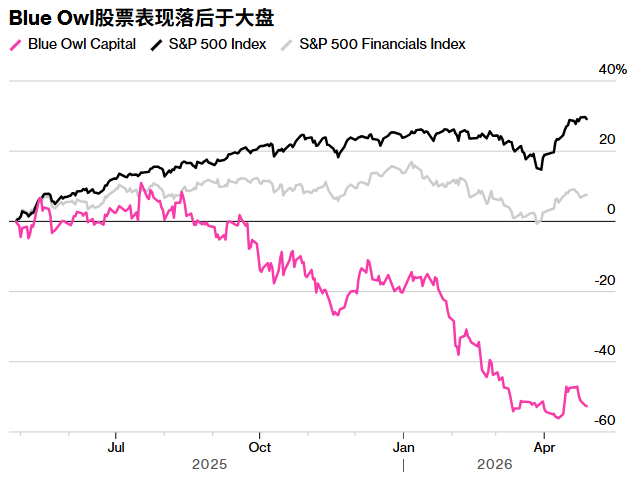
Blue Owl has become the 'focal point' of the private credit sector in this round of turbulence and an excellent indicator for observing the health of the private credit industry due to its significant credit exposure to borrowers in the software industry. According to Morgan Stanley data, the software industry currently accounts for about 26% of non-listed BDC portfolios and approximately 19% in private credit CLOs.
A deeper issue lies in the structure: the maturity profile of these loans exhibits a 'front-loaded' characteristic. Eleven percent of direct loans to the software industry are set to mature in 2027, with the proportion rising to 20% in 2028. If market liquidity continues to tighten and lenders’ risk appetite declines, a large number of software debtors will face sharply rising refinancing costs, and the difficulty of rolling over debt will directly increase default risks.
Morgan Stanley's analyst team, led by Joyce Jiang, warned that the credit fundamentals of software industry loans are the weakest across all sectors, characterized by 'high leverage and low debt service coverage.' Morgan Stanley forecasts that default rates on direct private credit loans will rise from the current approximately 5% to around 8%, nearing the peak default levels seen during the COVID-19 pandemic.
Buying opportunity? Earnings reports show 'weakness amid stability': valuations have priced in 'doomsday' scenarios, awaiting disproval.
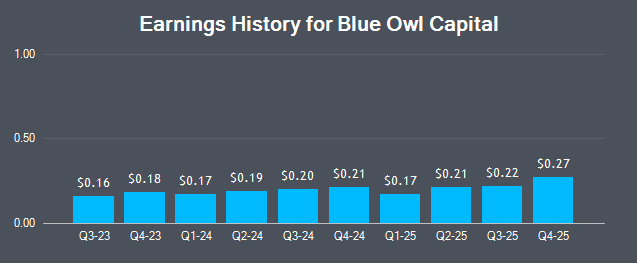
On the eve of the official release of the earnings report on April 30, the forward-looking tone presented a subtle sense of 'weakness amid stability.' According to analysts' consensus estimates, Blue Owl’s assets under management for the first quarter are expected to reach $316 billion, with fee-related earnings anticipated at $384 million, both showing growth compared to the same period last year. Zacks consensus EPS estimate is $0.19, up approximately 11.8% year-on-year, with revenue forecasted at $698.6 million. However, Zacks' quantitative model suggests a low probability of the company exceeding expectations this quarter.
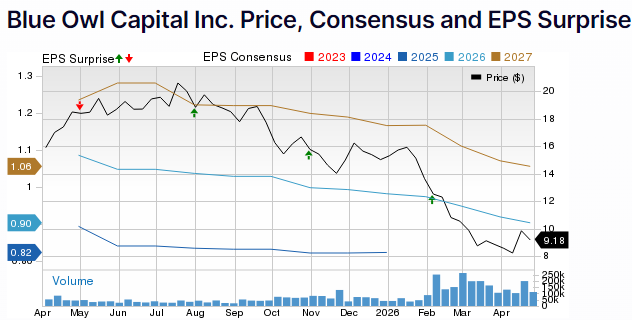
The rating distribution for Blue Owl on Wall Street is also intriguing — there are no 'sell' ratings, with 11 'buy' and 5 'hold' recommendations. Wilma Burdis, an analyst at Raymond James, offered a representative perspective: 'The current valuation of the stock already incorporates numerous 'doomsday' scenarios. Compared to the anticipated significant reputational damage, sustained positive financing momentum will be a favorable signal.'
Craig Siegenthaler, an analyst at Bank of America Securities, holds a more conservative stance, forecasting that overall performance in the first quarter will be 'relatively weak,' primarily due to declines in fundraising within private credit, reduced net inflows, and diminished trading volumes alongside widening leveraged loan spreads negatively impacting investment returns.
Focus on three core metrics
First, financing momentum and redemption trends. Marc Lipschultz, Co-CEO of Blue Owl, stated during the February earnings call that there were no 'red flags' or even 'warning signs' in the company’s technology lending business. Investors expect this earnings report to provide updates verifying whether this assertion still holds true. Meanwhile, the persistence of high redemption activity in non-listed BDCs on the retail side will be a critical factor in assessing the extent of drag on net fund inflows, which is essential for evaluating future management fee income paths and the company’s overall liquidity management.
Second, the credit quality of software assets. Against the backdrop of Morgan Stanley's warnings of default rates climbing to 8% and the approaching wave of loan maturities, Blue Owl's provisioning adequacy for software loans and marginal changes in non-performing loan rates will become the most crucial metrics to observe. Additionally, investors must continue scrutinizing its credit exposure in data center financing — the vulnerability created by successfully doubling flagship fund raising while encountering obstacles in financing some high-value projects will test whether the company can effectively manage its overall credit risk exposure.
Third, whether institutional demand can offset retail weakness. In the face of ongoing pressure on retail sentiment, the ability of institutional capital to form sufficient alternative inflows will be a key test for transforming overall funding sources in the alternative asset management space. Ares’ weak guidance yet maintained full-year targets reflect the coexistence of differentiated operational resilience and challenges at the frontline.
Finian O’Shea, an analyst at Wells Fargo & Co, provided a more contextualized and complex background to this situation: currently, some publicly traded BDC shares are trading at low levels, making valuations attractive, and narrowing spreads create opportunities for excess returns in portfolios with genuinely stable credit — but he simultaneously cautioned, 'We remain prudent about potential ongoing losses.'
In addition, listed BDCs, like stocks, are traded and will also release their financial results in the coming weeks. Blue Owl’s publicly traded investment vehicle focused on the technology sector$Blue Owl Technology Finance (OTF.US)$, as well as its primary publicly traded private credit tool$Blue Owl Capital (OBDC.US)$Will release earnings reports next week.
Editor/Deng