
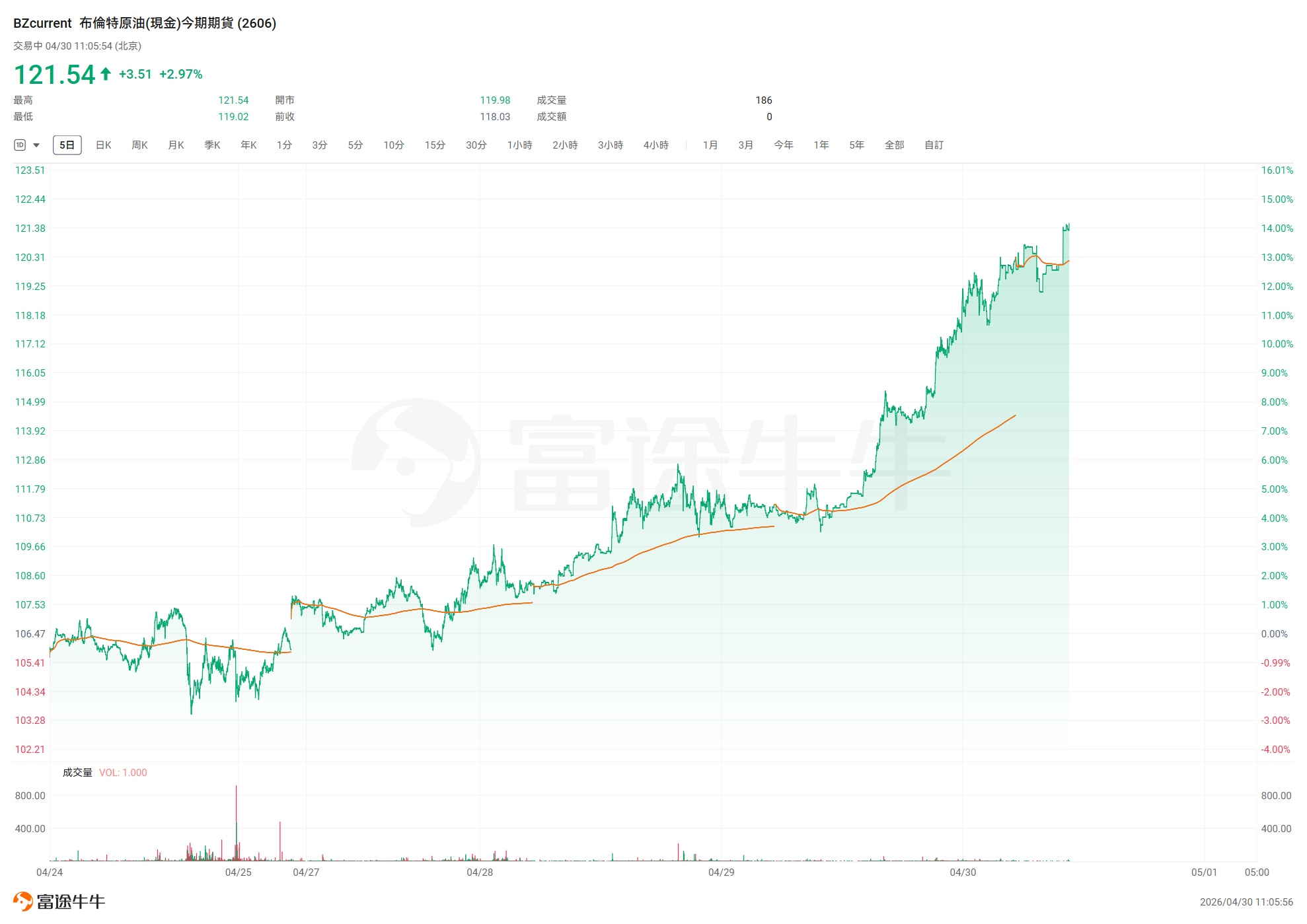
The deadlock in the Strait of Hormuz is evolving from a short-term shock into a prolonged repricing. Trump stated that a blockade is "more effective than bombing" and rejected Iran's three-phase negotiation proposal. Brent crude oil prices rose for eight consecutive days, nearing $122, hitting a two-year high. The yield on 30-year U.S. Treasury bonds surpassed 5%, while gasoline prices in the United States climbed to their highest level since the war. The market no longer bets on the sudden reopening of the strait but has factored in a "months-long blockade." The Speaker of Iran's Parliament indicated that the next move for oil prices could be $140.
The deadlock in the Strait of Hormuz is shifting the oil market from a short-term shock to a prolonged repricing. Trump's insistence on imposing a maritime 'blockade' on Iran has driven Brent crude to rise for the eighth consecutive day, surpassing $120 per barrel, amid rising energy shortages, inflation expectations, and bond market sell-offs.
According to reports by Xinhua News Agency, Trump stated on the 29th that he would continue the maritime blockade on Iran until Iran agrees to reach an agreement that addresses U.S. concerns over Iran's nuclear program. He described the blockade as 'in some ways more effective than bombing,' stating that Iran's situation 'will only get worse,' and indicated no plans to lift the blockade.
 Brent crude surged nearly 10% on Wednesday, marking its eighth consecutive trading day of gains and setting the longest winning streak in nearly four years. US WTI crude rose by 7%. Traders' optimism about the resumption of energy flows in the Gulf following a three-week ceasefire is beginning to wane.
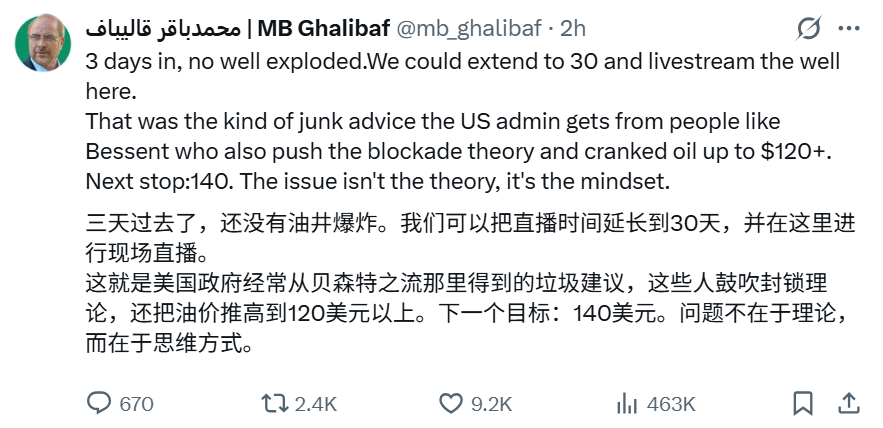
Iranian Parliament Speaker MB Ghalibaf responded on social platform X, saying, 'Three days have passed, and no oil wells have exploded. We can extend it to 30 days and livestream the oil wells here.' He also claimed that those pushing the 'blockade theory' had driven oil prices above $120, adding, 'Next step: $140.'
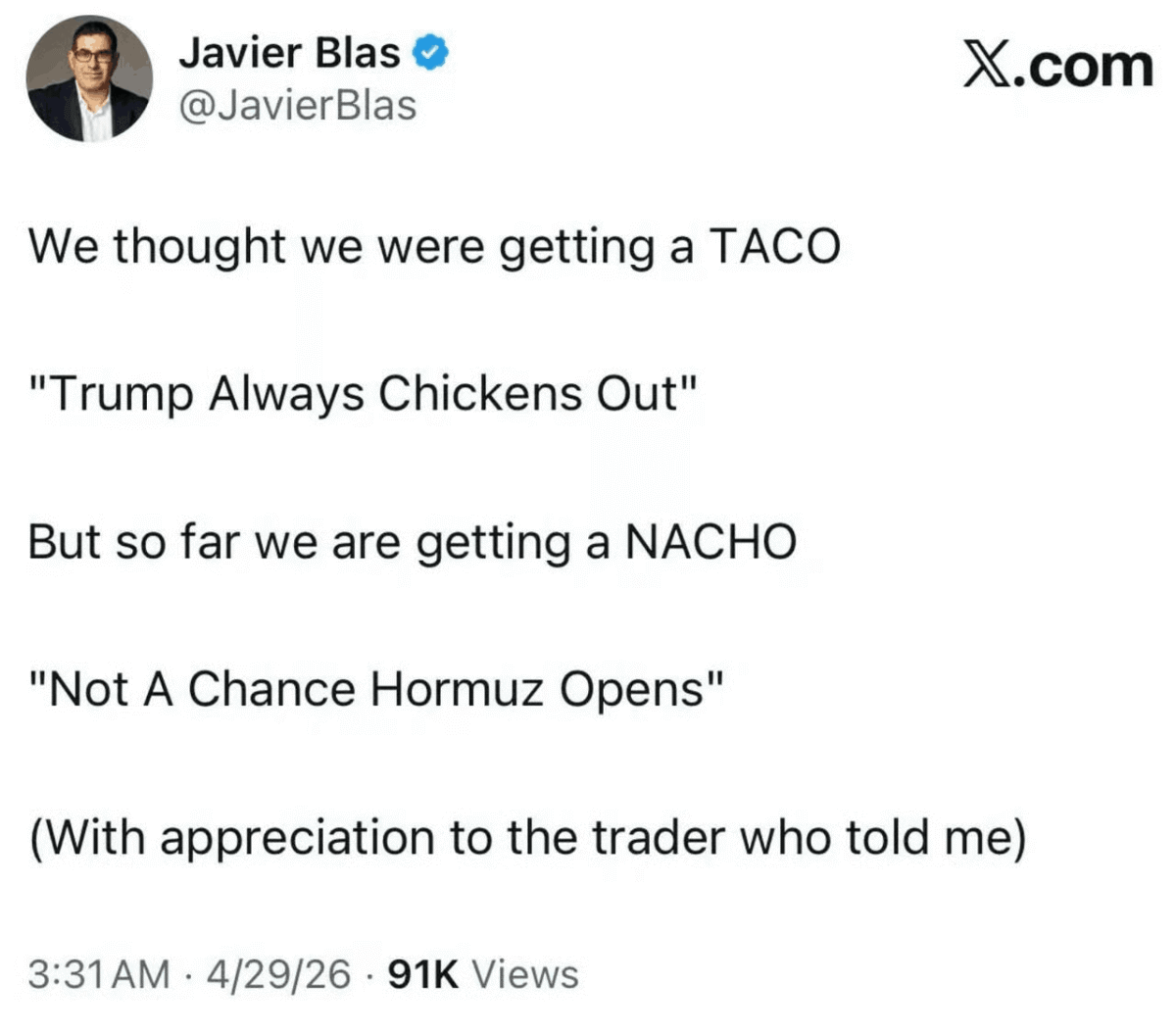
Bloomberg energy and commodities columnist Javier Blas wrote that the market had expected to see 'TACO,' meaning 'Trump Always Chickens Out,' but what they got instead was 'NACHO,' or 'Not A Chance Hormuz Opens.' Such comments reflect diminishing market expectations for the Strait of Hormuz to reopen in the short term.
'Blockade' becomes the core bargaining chip in negotiations.
Before the conflict, the Strait of Hormuz carried about one-fifth of global oil flows. Due to Iran's threats of attack and the U.S. maritime blockade, shipping through the strait remains near a standstill.
According to reports by Xinhua News Agency, Trump’s latest statement indicates his rejection of a new negotiation proposal submitted by Iran via Pakistan. The proposal suggested a three-phase negotiation process: the first phase addressing the end of the war, the second focusing on navigation through the Strait of Hormuz, and the third involving Iran's nuclear issue. U.S. officials told the media that Trump was dissatisfied with the proposal because the first two phases did not address Iran's nuclear program.
The report states that Trump continues to view the blockade as his primary leverage. If Iran does not back down, he will consider military action. Three informed sources revealed that the U.S. Central Command has developed a 'short and intense' strike plan against Iran, though Trump declined to disclose specific military plans during the interview.
Iran, meanwhile, signaled a hardline stance. Press TV reported on the 29th, citing an unnamed senior security official, that if the U.S. continues its maritime blockade of Iran in the Strait of Hormuz, Iran will respond to America's 'ongoing piracy' with 'practical and unprecedented military actions.'
Oil prices have priced in a 'long-term deadlock.'
Oil prices accelerated their rise on Wednesday, primarily due to the market beginning to reassess the duration of the blockade. Previously, traders still bet on the possibility of the strait suddenly reopening, an expectation that capped further upward movement in oil prices. Following Trump's latest statement, the market shifted to pricing in the risk of a blockade lasting 'months rather than days or weeks.'
Hamad Hussain of Capital Economics stated that the possibility of the Strait of Hormuz reopening abruptly has been a key factor restraining further increases in oil prices. However, the market is now responding to a stronger expectation that the U.S. blockade of the Strait of Hormuz could last for months.
Ole Hansen, head of commodity strategy at Saxo Bank, said, 'As long as there is no sign of an end, oil prices will increase by a few dollars every day.' He noted that the market is tightening, and prices need to reflect this. Robert Yawger, head of energy futures at Mizuho Securities USA, also told Bloomberg that the market will continue to rise as long as there is no resolution to the deadlock or at least a reopening of the Strait of Hormuz.
Michelle Brouhard, head of policy and geopolitical risk at Kpler Ltd., told Bloomberg Television that the deadlock could last for weeks. She believes that ultimately, either global markets will send a signal to Trump that they can no longer tolerate an oil shortage, or Iran will indicate a desire to resume oil exports.
Inflation and bond markets are under synchronized pressure.
The rise in oil prices has already spilled over into the bond market. The spike in oil prices triggered a sell-off in U.S. long-term Treasury bonds, with the 30-year yield reaching 5% for the first time since last summer. Traders are betting that the U.S. economy may face more persistent inflationary pressures.
The Federal Reserve kept interest rates unchanged on Wednesday. The Fed stated that the Gulf oil supply crisis triggered by the war is 'increasing the high degree of uncertainty in the economic outlook.' Some voting members opposed signaling in the policy language the potential for lowering borrowing costs in the future, indicating that the shadow of the war has influenced interest rate discussions.
Fuel prices are also rising. Data from the American Automobile Association (AAA) shows that U.S. gasoline prices rose to $4.23 per gallon on Wednesday, the highest level since the U.S.-led war against Iran began. For major economies, rising energy costs mean that inflationary pressures may re-intensify.
The UAE’s exit from OPEC has not yet alleviated supply concerns.
New uncertainties have emerged on the supply side, but the market has temporarily chosen to overlook them. The United Arab Emirates decided to withdraw from OPEC on Tuesday; however, traders have not reduced their bets on rising oil prices as a result.
Since the conflict began, the UAE's production has remained far below its OPEC quota due to the severe constraints on its export capacity caused by Iran's threats to shipping in the Strait of Hormuz. Therefore, even if the UAE has the capacity to increase production, the additional supply would struggle to effectively reach the global market as long as the strait remains impassable.
Nadège Dufossé, Head of Global Multi-Asset at Candriam, stated that the initial geopolitical disruptions are transitioning into a more prolonged phase. For investors, the key variables have shifted from daily oil price increases to the duration of the blockade, inflation repricing, and whether central banks are forced to reassess their interest rate trajectories.
Editor/KOKO