
The core lies in Google Cloud's revenue surging by 63%, with its backlog nearly doubling to USD 46.2 billion, providing a clear return logic for its AI capital expenditure through substantial orders. In contrast, concerns have been raised about the other three companies due to their cloud growth falling short of expectations or lacking a path to monetization. The market logic is now clear: it only rewards AI investments backed by orders and penalizes those that burn cash without a way to generate returns.
On April 29, $Alphabet-A (GOOGL.US)$ 、 $Meta Platforms (META.US)$ 、 $Microsoft (MSFT.US)$ 、 $Amazon (AMZN.US)$ four major technology giants released their earnings reports, all of which exceeded Wall Street's expectations. However, the market only rewarded one of them.
Alphabet's stock price surged over 7% after hours on Wednesday (April 29), making it the sole winner of this earnings season's "Super Bowl." Google Cloud's quarterly revenue grew 63% year-over-year to $20 billion, with its backlog nearly doubling to $46.2 billion, providing a clear return on substantial capital expenditures. CEO Sundar Pichai stated in the earnings call: "Our AI investments and full-stack strategy are lighting up every corner of our business."
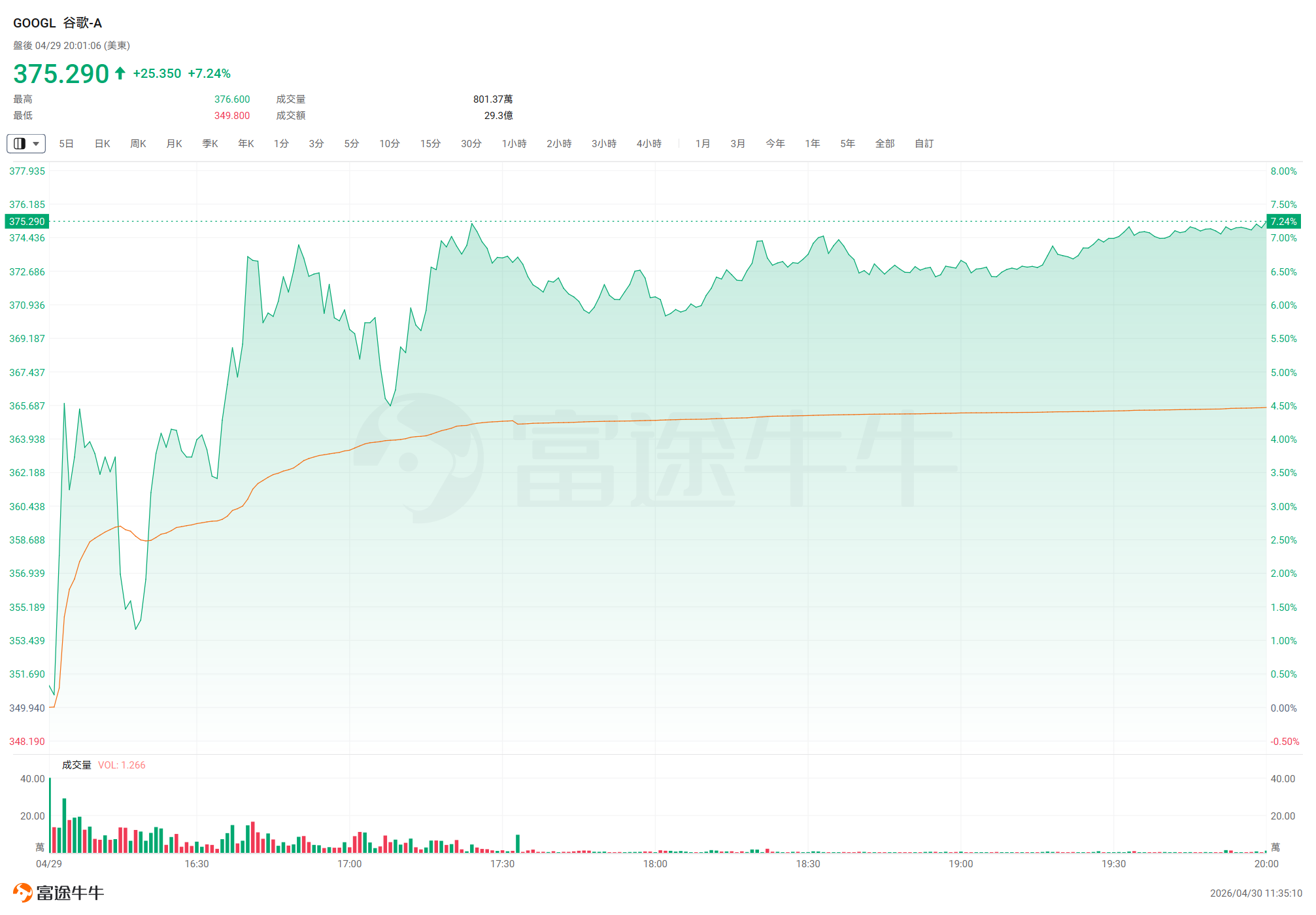
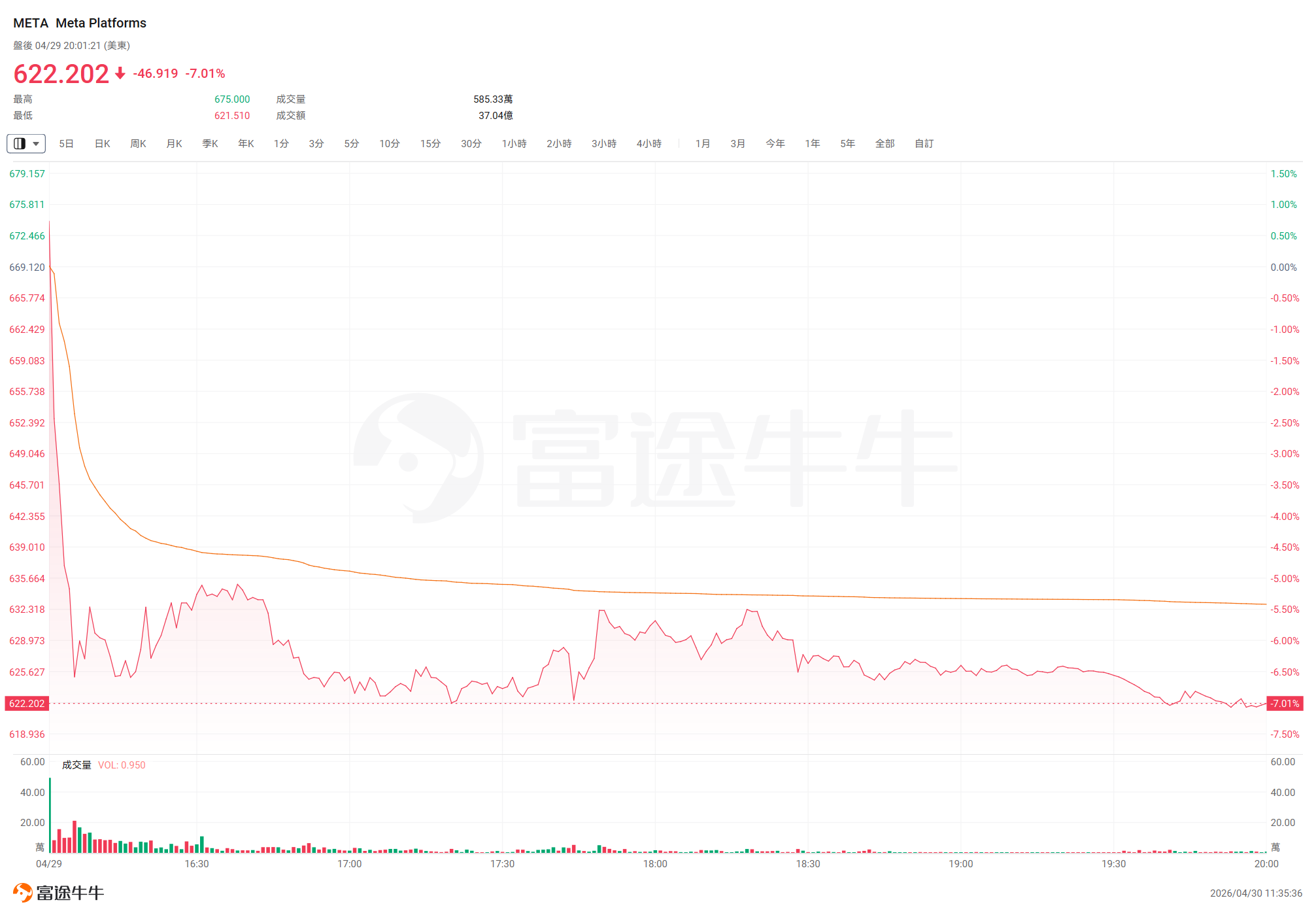
 Meanwhile, Meta's shares fell more than 7% after hours, while Microsoft and Amazon each dropped approximately 2%. The common challenge for the three companies is that their capital expenditures have surged significantly, but their cloud businesses either underperformed expectations or merely met market forecasts. Investors' concerns about whether AI investments can translate into visible returns have notably increased.
Analysts pointed out that the core divergence in this earnings season does not lie in whose performance is better, but rather in whose spending is more convincing. This also reflects the market’s reevaluation of the AI narratives of tech giants—investments backed by orders are being rewarded, while those burning cash without a clear path to monetization are being penalized.
Google: Cloud Business Booms, AI Investments Recognized
The key highlight for Alphabet this quarter is concentrated in Google Cloud.
The earnings report showed that cloud revenue grew 63% year-over-year to $20 billion, with an operating profit margin of 33%, surpassing market expectations. More importantly, Google Cloud's backlog nearly doubled from the previous quarter to $46.2 billion, driven primarily by AI demand and Tensor Processing Unit (TPU) hardware sales.
This figure directly endorses Alphabet’s decision to increase its capital expenditure plan. The company raised its full-year capital expenditure guidance from the prior range of $175 billion to $185 billion to $180 billion to $190 billion and hinted at a "significant increase" in capital expenditures by 2027.
Investors are so captivated by Google Cloud's growth that they are willing to overlook Alphabet's increased capital expenditure forecast. Direxion Capital Markets Director Jake Behan noted in a report: "Alphabet's investments are paying off because they are backed by a $460 billion order backlog."
Chief Financial Officer Anat Ashkenazi stated during the conference call:
"The internal and external demand for our AI computing resources is at an unprecedented level." Pichai also added: "If we could meet the demand, cloud revenue could have been even higher."
Advertising business remained robust as well. Search advertising revenue grew by 19% year-over-year to $60.4 billion, YouTube ad revenue increased by 11% to nearly $10 billion, and subscription, platform, and device businesses grew by 19% to $12.4 billion.
Amazon and Microsoft: Cloud Business Growth Becomes Focal Point
Unlike Alphabet's smooth sailing, Amazon and Microsoft’s cloud businesses performed solidly but failed to fully meet extremely high market expectations.
Jefferies analyst Brent Thill wrote in a post-earnings report that while AWS accelerated its growth to 28% this quarter, the result was slightly below the target range of 28% to 30%.
UBS Group analyst Stephen Ju also noted that AWS’s 28% growth fell short of UBS and investor expectations, which were above 32% and 30%, respectively, potentially weighing on the stock price in the short term.
However, Amazon's strong performance in e-commerce and advertising, along with optimistic guidance for the second quarter, provided some support for the stock price.
On Microsoft's side, despite reporting a sequential increase of 5 million paid Copilot subscriptions, Azure’s revenue growth of 39% merely met expectations.
Barclays analyst Raimo Lenschow commented that Microsoft’s first-quarter results were solid but lacked any major surprises.
He pointed out that Azure’s steady growth of 39% (at constant currency) compared to AWS’s 28% and GCP’s significant acceleration of 63% may spark further market debate.
Moreover, Microsoft plans to invest $190 billion in capital expenditures this year, which is $38 billion lower than market expectations, potentially raising questions about its AI momentum.
Meta: Surge in Capital Expenditure Raises Concerns
Meta finds itself in a more awkward situation.
Analysts pointed out that although its first-quarter revenue grew by 33%, surpassing expectations, it was not sufficient to justify the increase in capital expenditure in the eyes of investors.
Meta now plans to spend between $125 billion and $145 billion in 2026, higher than the previous estimate of $115 billion to $135 billion. Unlike the other three hyperscale cloud computing companies, Meta does not offer cloud services for AI computing to customers.
UBS Group analyst Esha Vaish noted that the increase in capital expenditure guidance and the second-quarter revenue guidance meeting expectations offset the positive surprise from first-quarter revenue and profit exceeding forecasts, thus weighing on the stock price. Investors will closely monitor data points related to its product development (such as commercial chatbots/Meta AI) as well as the rationale behind the increased capital expenditure budget.
 AI-powered earnings insights in three steps to establish an options strategy! Open Futubull > Stock Page > Click [Company] >Earnings Express

Editor/KOKO