
① Over the past 120 days, Figure's production efficiency has increased 24-fold; ② The first-pass yield at the end of Figure's production line has exceeded 80%, and is improving weekly; ③ At the industry level, the scale production of humanoid robots is generally accelerating.
On April 29 local time, Brett Adcock, founder of the humanoid robotics company Figure, posted on social platform X that over the past 120 days, Figure’s production efficiency has increased 24-fold – from one robot per day to one robot per hour.
Adcock stated that Figure will produce 55 robots just this week.
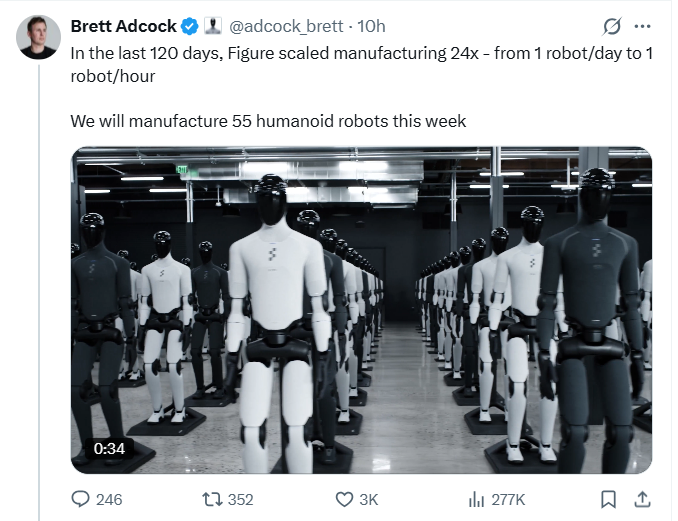
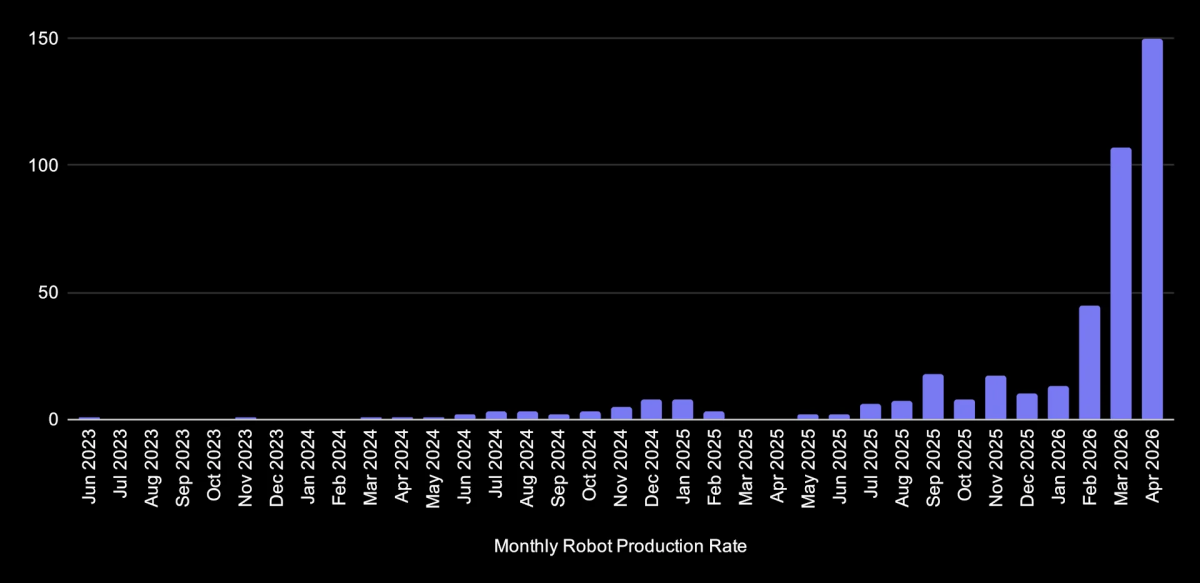
 Image source: Figure
On the same day, Figure released the latest progress of its BotQ mass production facility: the first-pass yield at the end of the production line has exceeded 80% and is increasing weekly; the first-pass yield of the battery production line reached 99.3%, with over 500 battery packs delivered; more than 9,000 actuators have been produced, covering more than 10 different SKUs (Stock Keeping Units).
It is reported that BotQ is Figure’s first generation of automated production line, officially launched on March 15, 2025. This production line is mainly used for manufacturing Figure 03 (third-generation humanoid robots), driven by customized Manufacturing Execution Software, operating simultaneously across more than 150 networked workstations.
Notably, in the BotQ factory, humanoid robots themselves participate in transporting and assembling new robots.
Figure stated: “The more robots we have, the more data we generate for our humanoid artificial intelligence model, Helix. This growth also enables us to deploy more robots into the real world, leveraging direct feedback from actual operational environments to enhance our systems and capabilities.”
To date, Figure has established a comprehensive End-of-Line (EOL) testing and production process testing system. Each robot must pass over 80 functional validation tests before final acceptance. These include multi-limb stress tests and comprehensive 'aging' tests — during aging tests, the robot performs full-body exercises such as squats, shoulder presses, and jogging, repeating the cycle thousands of times to simulate real-world usage scenarios and preemptively eliminate early failures.
At the industry level, the scale production of humanoid robots is generally accelerating.
Guojin Securities noted that Tesla's supply chain is expected to complete the construction of large-scale production lines in the first half of the year and commence mass production in August. The shipment volume of leading domestic suppliers is anticipated to increase from thousands to tens of thousands of units, with primary applications in secondary development, navigation, inspection, and other areas. At this stage, the supply chains and technologies of leading companies will converge. Globally, the robotics industry will enter an 'arms race.'
In terms of investment, the institution noted that Tesla's supply chain has undergone four years of iteration and is now approaching an inflection point where hardware supply chains are converging. With a focus on certainty and growth potential, key attention should be given to Tuopu Group, among others. $SANHUA (02050.HK)$ Furthermore, companies such as Apple, Google, OpenAI, and Figure have successively reached crucial milestones in the development of humanoid robots, transitioning from conceptualization to realization. It is recommended to closely monitor Yilun Co., Ltd., among others.
Editor/KOKO