
The mining and metals industry is expected to experience a sustained upward trend.
According to Zhitong Finance, fund managers have expressed that the mining and metals industries are set for a sustained upward trend. Driven by the investment boom in artificial intelligence infrastructure, increased defense spending, and investors offloading overvalued technology stocks, substantial funds are flowing into the mining and metals sectors at the fastest pace in years.
The supercycle begins
 Data from research firm ETFGI shows that as of March 31, the assets under management of mining exchange-traded funds (ETFs) more than doubled to $87.4 billion, compared to $37 billion a year earlier.
Meanwhile, the oil, gas, and agriculture sectors are also attracting significant capital inflows. Market funds are aggressively shifting toward hard assets, marking a historic change in asset style.
In the first quarter of this year, investors poured $8.24 billion into the mining sector, reversing market sentiment compared to the first three months of 2025. At that time, the comprehensive tariff measures announced by U.S. President Donald Trump triggered an outflow of $2.52 billion.
Evy Hambro, portfolio manager at Blackrock, stated that funds are beginning to shift from highly valued technology stocks to hard assets, which he described as the 'early stages of a commodities supercycle.'
The Morningstar U.S. Technology Index fell 9% in the first quarter. The share prices of the world's two largest mining companies, BHP Group Ltd and Rio Tinto, both hit record highs.
Copper prices rose in tandem with BHP Group Ltd’s stock price
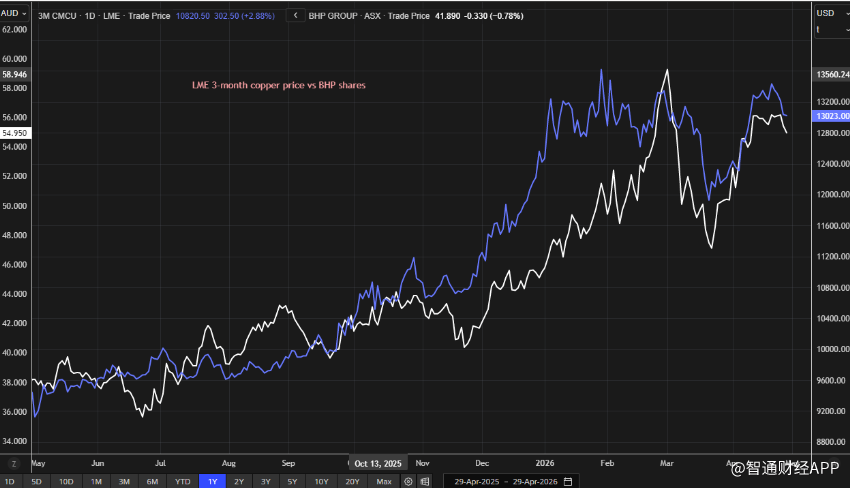
Hambro noted that due to substantial increases in capital investment in grid infrastructure, data centers, electric vehicles, and charging stations, the metal intensity of gross domestic product (GDP) is rising.
Unlike the urbanization-driven boom in China at the beginning of the 21st century, Hambro said that demand in this cycle is 'stronger and more resilient' because artificial intelligence, electrification, and defense sectors have diversified globally.
However, analysts and investors have indicated that the shift of capital inflows into the metals market has heightened the risk of significant price volatility. This is because the metals market, compared to global equities and bonds, is relatively small in scale and thus more susceptible to bottlenecks in mining, refining, and transportation.
Taosha Wang from Fidelity stated that a supercycle focused on mining and energy has arrived as conflicts with Iran are forcing governments to prioritize supply security.
Industrial Metals and Gold Capture Attention
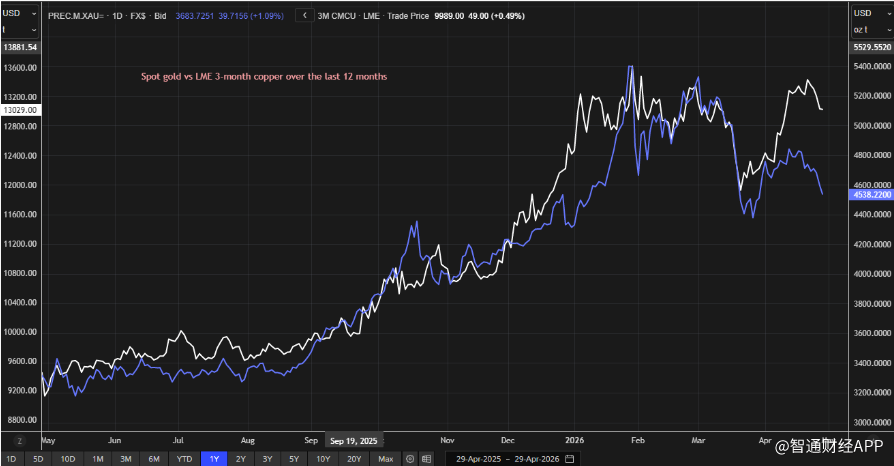
Capital flows have shown a tilt towards industrial metals. In March, copper funds attracted $198 million in investments, while a sharp rise in gold prices triggered profit-taking. The VanEck Gold Miners ETF (GDX) lost $710 million last month but still recorded nearly $1 billion in inflows year-to-date.
The plunge in gold prices during the geopolitical crisis has drawn attention. Instead of seeking traditional safe-haven assets, the market appears to be betting that the conflict with Iran will stimulate real economic responses, requiring raw materials such as copper, steel, and rare earth elements for energy security and infrastructure investment.
Gold vs. Copper Prices Over the Past 12 Months
Data from ETFGI shows that oil and gas funds saw net inflows of nearly $6 billion in the first quarter. Fund managers have said this further confirms the view that investors are preparing for an infrastructure investment boom.
Some investment managers find diversified mining companies like BHP Group Ltd and Rio Tinto attractive because they sit at the intersection of multiple demand drivers.
Anix Vyas, portfolio manager at Harding Loevner, stated: "Both copper and aluminum are in high demand, especially amid the escalating crisis in Iran." He also noted that Rio Tinto produces both metals and can benefit from surging demand in data centers and industrial applications.
Vyas described this shift as investors moving away from software companies vulnerable to AI disruption and toward companies with more enduring competitive advantages, such as mining firms that control critical mineral resources.
Small Market, Big Volatility
The relatively small scale of the metals futures market means that the influx of substantial capital can exacerbate volatility, even as the overall trend remains upward.
Last year, the trading volume of metal futures such as copper and aluminum on the London Metal Exchange (LME) reached 21 trillion US dollars, while the trading volume of gold futures on the Chicago Mercantile Exchange (CME) exceeded 25 trillion US dollars. In comparison, the trading volume of Nasdaq 100 futures reached 85 trillion US dollars, and that of S&P 500 futures surpassed 135 trillion US dollars.
The sharp fluctuations in fund flows within mining ETFs highlight how quickly market sentiment can shift and how susceptible these markets are to reversals.
The industry also represents a small share of global equity markets, with the top five mining companies accounting for only 0.4% of the MSCI World Equity Index, compared to 16.8% for the top five technology companies. Metals and mining products make up just 0.57% of the total stock ETF market size.
Currently, the enterprise value-to-EBITDA multiples of major mining companies remain at 7 to 8 times, far below the 14 times reached during the boom period of 2008-2010. This suggests a highly optimistic outlook if a supercycle materializes.
Charlie Aitken, Chief Investment Officer of Australia's Regal Partners Group, stated, "Copper sits at the intersection of all industries and is in severe undersupply. I firmly believe that copper prices could double or even triple over the next decade, and returns from investing in copper mining companies will significantly outpace the rise in spot copper prices." The firm is overweight in mining and metals assets, with assets under management reaching AUD 21 billion (equivalent to USD 15.05 billion) as of the end of March.
It is worth noting that while investing in the mining sector can hedge against inflation risks, the massive inflow of capital may further drive up commodity prices. Combined with inflationary pressures from geopolitical conflicts in Iran disrupting energy markets, this poses potential risks to global economic growth.
Editor/Deng