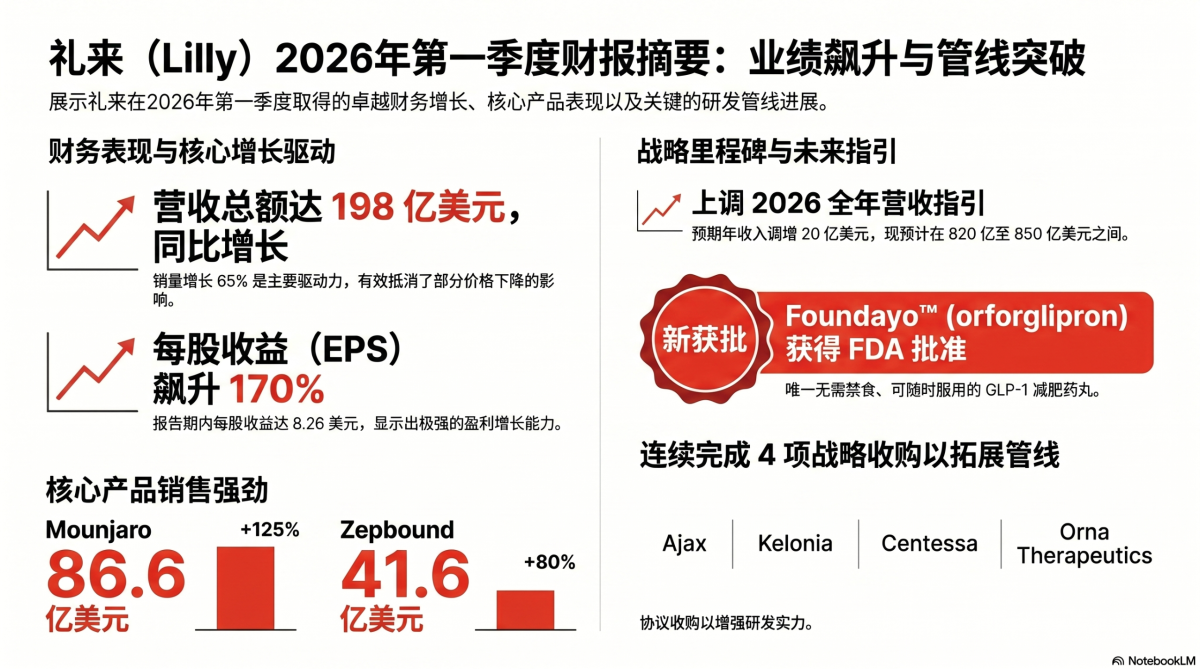
The core growth drivers are Mounjaro and Zepbound, with sales nearly doubling and contributing approximately 65% of revenue. Despite strong fundamentals, weak early prescriptions for the oral weight-loss drug Foundayo have raised concerns. The company is also acceleratingM&Apipeline progress to strengthen its long-term growth strategy.
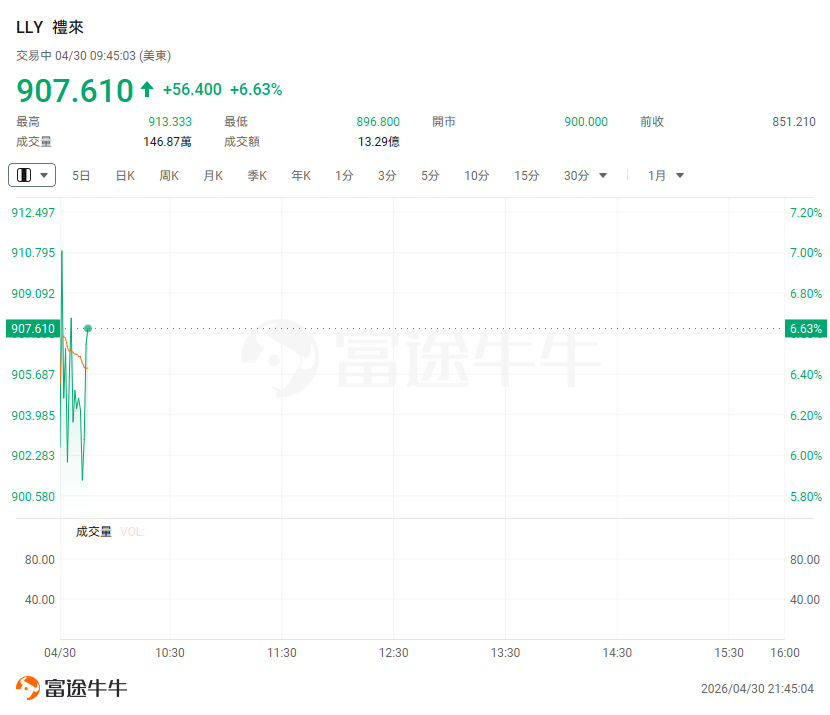
$Eli Lilly and Co (LLY.US)$ Driven by the strong performance of its GLP-1 weight-loss and diabetes drugs, the company delivered a first-quarter earnings report that significantly exceeded market expectations. It promptly raised its full-year guidance, causing its stock price to surge nearly 7% at the opening of trading.
Eli Lilly and Co's total revenue in the first quarter reached $19.8 billion, a year-on-year increase of 56%, surpassing the FactSet consensus estimate of $17.78 billion. Adjusted earnings per share were $8.55, an increase of 156% from $3.34 in the same period last year, also far exceeding the market expectation of $6.97. The company raised its full-year revenue guidance to between $82 billion and $85 billion, up from the previous range of $80 billion to $83 billion. Full-year adjusted earnings per share guidance was increased to between $35.50 and $37.00, compared to the earlier range of $33.50 to $35.00.
 Following the earnings announcement, Eli Lilly and Co's stock rose more than 6% at the start of US trading. However, lingering concerns persist regarding the early prescription data for its newly launched oral GLP-1 drug, Foundayo, posing a potential headwind to upward price momentum.
Sales of GLP-1 dual leaders nearly doubled, far exceeding expectations
The core drivers of Eli Lilly and Co’s performance were its two GLP-1 drugs, Mounjaro and Zepbound, which together accounted for approximately 65% of the company’s total revenue.
Global revenue from Mounjaro (tirzepatide, used for type 2 diabetes) reached $8.7 billion in the first quarter, a year-on-year increase of 125%, surpassing the FactSet estimate of $7.3 billion. Revenue in the U.S. market amounted to $4.2 billion, up 59% year-on-year, while revenue outside the U.S. reached $4.4 billion, a significant jump from $1.2 billion a year ago, primarily driven by higher volumes following its inclusion in China's National Reimbursement Drug List (NRDL), but facing substantial pricing pressure.
Revenue from Zepbound (the same molecule, used for weight loss indications) in the U.S. market totaled $4.1 billion in the first quarter, a year-on-year increase of 79%, slightly above the FactSet estimate of $4.1 billion. According to MarketWatch, on a global scale, Zepbound sales were approximately $4.2 billion, representing an increase of about 83% from $2.3 billion in the same period last year. Sales growth for both drugs was primarily driven by increased demand, though partially offset by declines in realized prices.
Early performance of the new oral drug Foundayo disappoints the market
Despite the overall impressive results, early market performance of Eli Lilly and Co's newly launched oral GLP-1 weight loss drug Foundayo (orforglipron) has raised concerns among analysts. The drug officially launched on April 9, and in this earnings report, the company did not disclose specific sales figures, merely describing its debut during the first full week post-launch as "strong."
However, according to MarketWatch, total prescriptions for Foundayo in its second week on the market were only 3,700, far behind the 18,400 prescriptions for Novo-Nordisk A/S's oral Wegovy during the same period. Leerink analyst David Risinger subsequently lowered his target price for Eli Lilly and Co from $1,296 to $1,058, noting that the growing adoption of oral Wegovy is compressing the prescription demand space for Foundayo. HSBC analysts also recently downgraded Eli Lilly and Co, citing excessive hype in the weight loss drug market and questioning the sustainability of out-of-pocket payment models in a weakening economic environment.
Eli Lilly and Co's stock price has fallen by 21.2% year-to-date, while the S&P 500 Index has risen by 4.0% over the same period.
Aggressive M&A strategy with positive pipeline progress
Facing increasing competitive pressures in the GLP-1 market, Eli Lilly and Co is actively channeling its abundant cash flow into diversified acquisitions. According to MarketWatch, the company completed the acquisition of four biotech firms within the past month, spanning multiple therapeutic areas beyond metabolic health. This includes the $6.3 billion upfront acquisition of Centessa Pharmaceuticals, which focuses on sleep disorder treatments, and the $3.25 billion upfront acquisition of Kelonia Therapeutics, a developer of in vivo CAR-T therapies. Additionally, the company has reached agreements to acquire Orna Therapeutics and Ajax Therapeutics.
In terms of pipeline progress, Foundayo achieved positive results in a Phase 3 clinical trial for patients with Type 2 diabetes who are obese or overweight and have cardiovascular risks; Jaypirca, in combination with venetoclax and rituximab, showed promising Phase 3 data for the treatment of relapsed or refractory chronic lymphocytic leukemia (CLL) or small lymphocytic lymphoma (SLL); retatrutide also delivered favorable news in its Phase 3 study for Type 2 diabetes.
R&D expenses for the first quarter increased by 28% year-over-year to $3.5 billion, accounting for 18% of revenue; marketing, sales, and administrative expenses rose by 19% to $2.9 billion, primarily to support new product launches. The company also announced plans to host an investor community meeting on December 7, 2026.
Editor/Jayden