
SanDisk's revenue surged 97% year-over-year, with its data center business tripling in a single quarter; Western Digital's revenue increased by 45% year-over-year. Both companies provided guidance significantly surpassing expectations, yet their after-hours stock prices fell by 6% and 8%, respectively. Analysts noted that against the backdrop of Western Digital's approximately 900% rise over the past year and SanDisk's roughly 3300% increase since its IPO, robust performance had already been fully priced in, and the guidance 'lacked sufficient surprises,' triggering profit-taking in the market.
The better the earnings report, the harder the fall?
On April 30 local time, a leading U.S. memory storage giant $Western Digital (WDC.US)$and$SanDisk (SNDK.US)$ successively announced their third-quarter financial results, with revenue, profits, and guidance all surpassing Wall Street expectations, while also providing a robust outlook for the next quarter.
 However, the market reaction was unexpectedly negative: both stocks plummeted after hours, with Western Digital falling as much as 8.2% and SanDisk dropping over 6%. Following the opening of the US stock market today, SanDisk fell more than 4%, while Western Digital dropped over 5%.
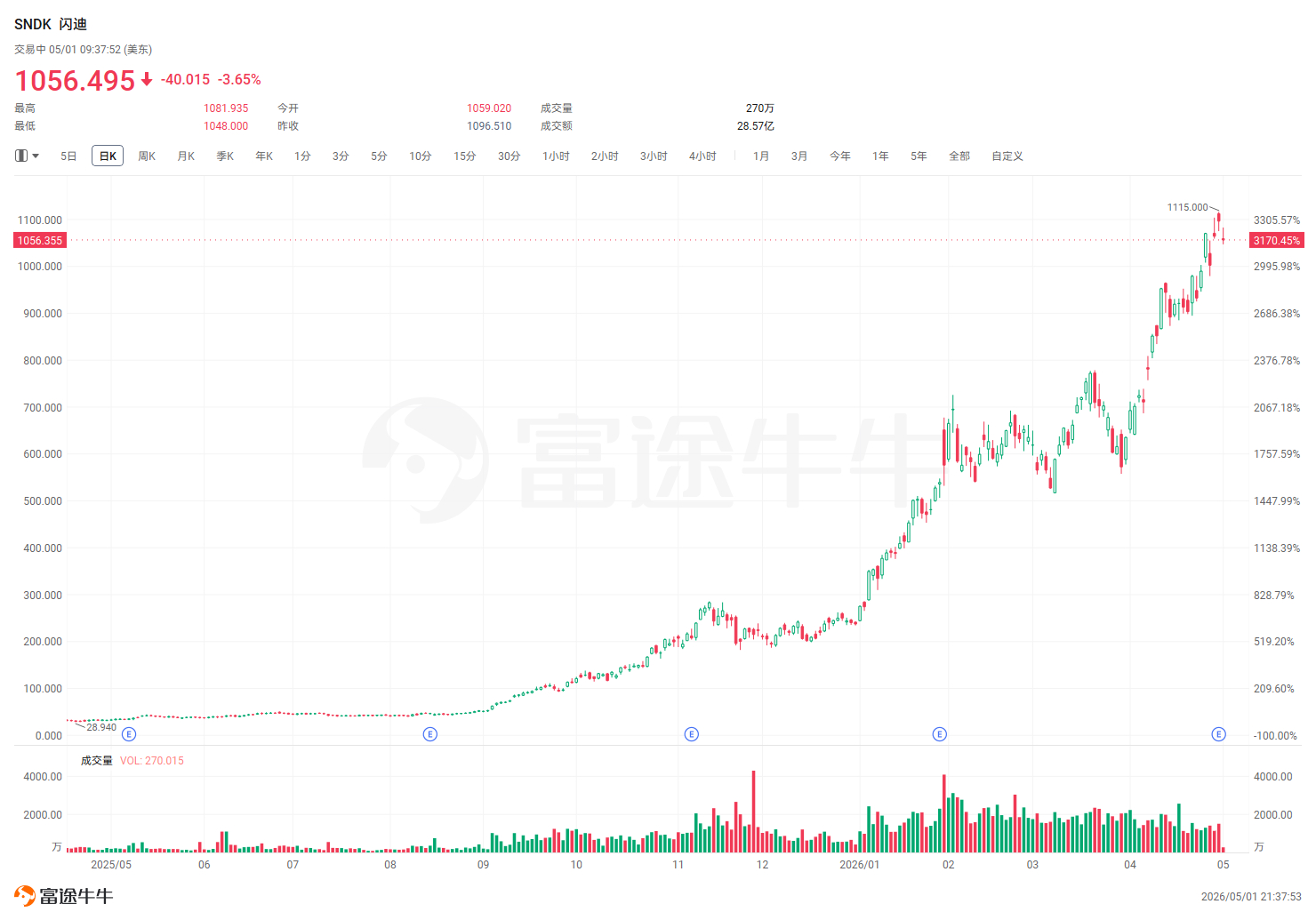
This trend is less a rejection of performance than a 'reckoning' of prior gains. Analysts noted that against the backdrop of Western Digital's approximately 900% rise in a year and SanDisk's roughly 3300% surge since its IPO, robust performance had already been fully priced in, and guidance 'lacked sufficient surprises,' triggering profit-taking in the market.
How strong were the earnings reports?
Let’s look at the numbers.
SanDisk reported third-quarter revenue of $5.95 billion, a staggering 97% year-over-year increase, far surpassing analysts' expectations of $4.7 billion. Adjusted earnings per share were $23.41, nearly 1.6 times the analysts' forecast of $14.54. Data center business revenue more than tripled year-over-year, reaching $1.47 billion in a single quarter. SanDisk's net profit for the quarter reached $3.62 billion, compared to a loss of $1.93 billion in the same period last year — marking a complete reversal in profitability.
Western Digital was no less impressive. Third-quarter revenue reached $3.34 billion, a 45% year-over-year increase, surpassing analysts’ expectations of $3.25 billion; adjusted earnings per share were $2.72, higher than the expected $2.39; net profit hit $3.12 billion, compared to just $520 million in the same period last year.
In the earnings statement, Western Digital CEO Irving Tan said: “The demand drivers are very clear: almost every type of AI workload — from training, inference, agent AI, to physical AI — generates data that needs to be stored persistently and efficiently on hard drives.” He also announced a 20% increase in quarterly dividends to $0.15 per share.
SanDisk CEO David Goeckeler characterized this quarter as a turning point: 'This quarter marks a fundamental inflection point for SanDisk — our technological leadership is driving a deliberate transformation toward the highest-value end markets, led by our data center business.'
The guidance remains robust, but the market 'was not satisfied enough.'
Following the earnings release, both companies provided next-quarter guidance that exceeded expectations.
SanDisk forecasts revenue for the fourth fiscal quarter to be between $7.75 billion and $8.25 billion, with a midpoint of approximately $8 billion, significantly higher than analysts' prior expectations of $6.49 billion to $6.62 billion. Adjusted earnings per share are projected to be between $30 and $33, also substantially surpassing analyst expectations of $22.70 to $23.38.
Western Digital anticipates fourth-quarter revenue in the range of $3.55 billion to $3.75 billion, with adjusted earnings per share between $3.10 and $3.40, both figures exceeding analyst expectations of $3.46 billion in revenue and $2.75 in earnings per share.
Why did the market sell off despite such strong guidance?
After a 900% increase, 'good' is no longer sufficient.
This brings us to a key context.
Data shows that Western Digital's stock price has surged by approximately 900% over the past year, while SanDisk, which was spun off from Western Digital and listed independently in February 2025, saw its stock price soar from an IPO price of $36 to around $1,063 after-hours, reflecting an increase of about 3,300%.
Michael Ashley Schulman, Partner at Cerity Partners, analyzed: 'The earnings guidance from both companies failed to provide the 'wow factor' needed to sustain their current strong momentum.'
In other words, these two stocks had already priced in the expectation of an 'explosion in AI-driven storage demand.' When the earnings report confirmed market expectations without delivering additional 'surprises,' profit-taking pressures were unleashed.
Earlier this week, Seagate's strong earnings forecast triggered a collective surge in storage stocks. Shares of SanDisk have already risen by approximately 350% year-to-date, while Western Digital’s shares have also increased by over 150%. At such elevated levels, 'less-than-stellar' news could become a trigger for sell-offs.
There is no doubt about the demand for AI-driven storage.
Notably, this decline in stock price was not due to skepticism about fundamentals.
According to Reuters, the earnings and guidance from SanDisk, Western Digital, and Seagate collectively confirmed that the robust demand for storage products driven by the construction of AI data centers continues. The growth rate of demand for data storage in AI systems consistently outpaces supply, enabling companies like SanDisk to continuously raise prices.
Prior to the earnings release, Bank of America analyst Wamsi Mohan noted that demand exceeding supply has created a 'favorable pricing environment.'
Western Digital CEO Irving Tan specifically highlighted that the company’s gross margin reached 50.5% this quarter, significantly higher than a year ago. SanDisk announced that its board had approved a $6 billion share repurchase plan.
Editor/Lambor