
Apple CEO Tim Cook announced his resignation in September, stating, "There is no one on this planet I trust more than John Ternes." Cook warned that "storage costs will have an increasingly significant impact in Q3," and expressed "uncontainable excitement" about the Indian market. The CFO announced the abandonment of the long-standing "net cash neutral" goal, authorizing an additional $100 billion for share repurchases.
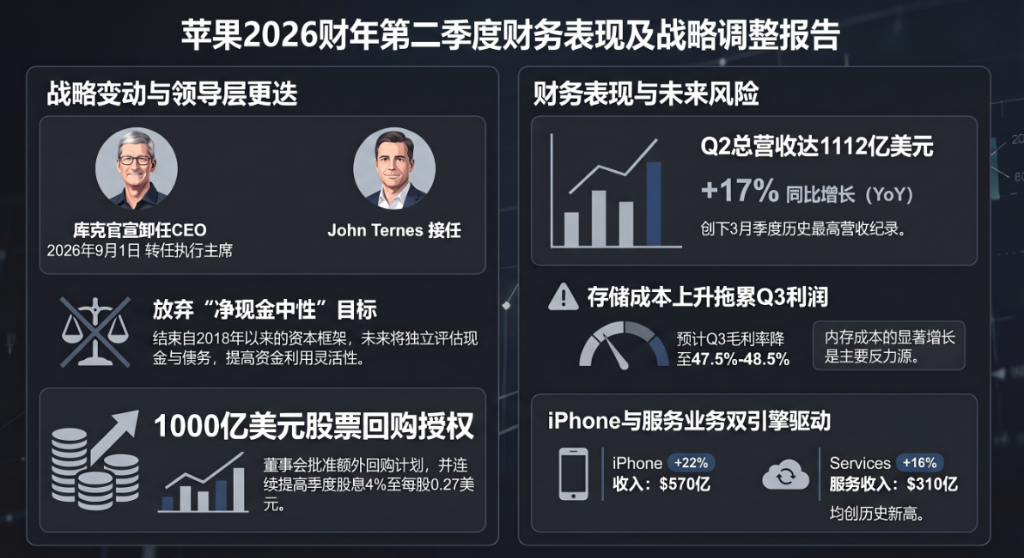
Apple delivered a strong quarterly financial performance, but market attention is quickly shifting to two key variables: an impending high-level leadership transition and the potential pressure on future profit margins caused by rising memory costs.
After the US stock market closed on April 30, Apple reported its second-quarter results for fiscal year 2026, with revenue reaching $111.2 billion, a 17% increase year-over-year, setting a new record high for the March quarter and surpassing the upper limit of its previous guidance.
 At the same time, the company announced that it would complete the CEO transition in September this year. Current CEO Tim Cook will step down as CEO and assume the role of executive chairman, succeeded by John Ternes, a 25-year veteran executive at Apple.
On the market front, Apple's guidance for the next quarter indicates revenue growth of 14% to 17% year-over-year, but management warned that memory costs would continue to exert "increasing pressure" after the June quarter, and acknowledged ongoing supply bottlenecks for multiple Mac products.
Based on robust cash flow, Apple announced an additional $100 billion share repurchase authorization and raised its quarterly dividend by 4% to $0.27 per share. However, the company also declared it was abandoning the "net cash neutral" capital structure target it had maintained since 2018.
Tim Cook officially announces his resignation: "There is no one on this planet I trust more than him."
Before the earnings presentation began, current CEO Tim Cook personally confirmed the market's focus: he will step down from his position as CEO on September 1 this year and transition to the role of executive chairman, succeeded by senior executive John Ternes.
Cook stated during the meeting:
I have just celebrated my 28th year working at Apple, with 15 years as CEO, and in fact, this is my 89th earnings call.
He added:
This is the right time for a transition. First, our business performance is outstanding... Second, we have an incredible product roadmap. Most importantly, we have the right leader ready to take over.
Regarding his successor, Cook offered extremely high praise:
As I said, there is no one on this planet I trust more than John Ternus to lead Apple into the future. John is a brilliant engineer, a profound thinker, possesses extraordinary character, and is a natural leader.
John Ternus also delivered a brief speech, pledging to continue the "thoughtfulness and discipline in financial decision-making" established during Cook’s tenure after assuming the role in September.
He also revealed that Apple is currently in the most exciting period for building products and services in his 25-year career.
The iPhone 17 cycle is robust, with demand for MacBook Neo "far exceeding expectations."
On the business front, despite supply chain constraints, the new product cycle has demonstrated tremendous momentum.
iPhone revenue for this quarter reached $57 billion, representing a 22% year-over-year increase.
Cook noted that the iPhone 17 series, including the newly added iPhone 17e, is the strongest product lineup in Apple's history. The A19 and A19 Pro chips, which deeply integrate Apple Intelligence, have significantly driven upgrade demand.
Cook cited third-party data indicating that customer satisfaction for the iPhone 17 series in the U.S. market is as high as 99%.
Equally popular is the Mac business. Mac revenue for the quarter was $840 million, marking a 6% year-over-year increase. However, during the Q&A session, management acknowledged that the Mac business is facing severe supply constraints.
Cook stated:
For Mac Mini and Mac Studio, these two products serve as excellent platforms for AI and agent tools. Customers have recognized their value much faster than we anticipated, leading to demand far exceeding expectations. Additionally, the response to MacBook Neo has been phenomenal, with demand also significantly surpassing forecasts.
Cook further noted:
Looking ahead, we believe it may take several months for supply and demand of Mac Mini and Mac Studio to reach equilibrium.
Services business hits another all-time high as advertising expansion continues.
Revenue from the services segment reached $31 billion, marking a 16% year-over-year increase and setting a new historical record. Nearly all subcategories within services achieved record performance.
The number of paid accounts and transactional accounts has reached an all-time high, supported by Apple's installed base of over 2.5 billion active devices, providing a continuous growth foundation for this business.
Advertising revenue achieved year-over-year growth.
CFO Kevan Parekh confirmed in response to analyst inquiries that Apple introduced new ad placements in App Store search results earlier this year. This summer, the company will also roll out advertising products for local businesses in Apple Maps across the United States and Canada.
He emphasized that Apple’s advertising strategy will continue to prioritize user privacy while pursuing commercial expansion.
The gross margin of the service business was 76.7%, a slight increase of 20 basis points from the previous quarter, primarily driven by changes in product mix.
AI drives up R&D spending; management warns of rising storage costs.
In response to market attention on 'intelligent agent smartphones' and edge AI architecture, Apple executives did not disclose specific product forms but clearly stated that the company is significantly increasing its investment to compete in the AI era.
Tim Cook stated:
You can see from our operating expense data that if we drill down and look separately at R&D versus selling and administrative expenses, you will find that the acceleration in R&D spending far exceeds the overall growth rate of the company. We are clearly making substantial investments.
Regarding the collaboration with Google on foundational models, Tim Cook briefly responded that 'the cooperation is proceeding smoothly.'
Management issued a warning concerning market concerns about profit margins.
Kevan Parekh pointed out during the conference call that the product gross margin for the March fiscal quarter declined by 200 basis points, weighed down by weakened seasonal scale effects and rising memory costs.
Tim Cook added that in the Q2 quarter, higher storage costs were partially offset by gains from inventory carryover, but in the upcoming Q3 quarter, 'we expect storage costs to rise significantly.' Tim Cook stated:
I can tell you that after the June quarter, we believe that storage costs will increasingly impact our business.
When pressed on whether rising costs would affect pricing or market share, Cook only cautiously responded, “We will evaluate a range of options.”
Management’s gross margin guidance for the June quarter is in the range of 47.5% to 48.5%, which represents a slight decline from the current quarter.
The Greater China region surged by 28%, and Tim Cook described his excitement about India as “indescribable.”
In terms of global expansion, Apple delivered highly noteworthy results in two key emerging markets.
Facing intense competition, revenue in the Greater China region grew significantly by 28% year-over-year this quarter, setting a new historical high for the March quarter in this region, with overall growth reaching 33% in the first half of the year.
Cook revealed that the iPhone was the best-selling model in urban areas, while the Mac Mini and MacBook Air were respectively the top-selling desktop and laptop computers locally. Cook stated:
I visited there in March, and our stores saw double-digit growth in foot traffic… I am extremely satisfied with the progress we’ve made in the first half of this year.
Additionally, the Indian market is becoming a new core growth engine for Apple.
Cook referred to India as a “tremendous opportunity” and noted that the majority of Indian consumers purchasing Apple devices are buying their first such product. Cook emphasized:
All in all, I am extraordinarily excited about the Indian market—it’s almost indescribable.
A major shift in capital structure: Apple abandons its 'net cash neutral' goal.
In terms of financial strategy, this earnings call delivered a highly market-influential signal: Apple will abandon its long-standing 'net cash neutral' financial target.
Since 2018, Apple has been reducing its vast cash reserves to achieve a balance between cash and debt, cutting net cash by over $100 billion cumulatively.
At the end of this quarter, Apple held $147 billion in cash and marketable securities, with total debt amounting to $85 billion, resulting in net cash of $62 billion.
CFO Kevin noted:
As the company enters a new phase of development, we believe that independently assessing cash and debt is the right approach for us. This allows us to make better economic decisions based on business factors and market conditions, optimizing our use of the debt and cash portfolio.
However, he emphasized that this change does not affect the company’s commitment to returning excess cash to shareholders, as evidenced by the additional $100 billion share repurchase plan.
Looking ahead to the third quarter of fiscal year 2026, Apple expects total revenue to grow by 14% to 17% year-over-year. Excluding currency impacts, service revenue growth will be similar to this quarter, with gross margin projected to range between 47.5% and 48.5%.
Full transcript of Apple's Q2 2026 earnings call (assisted by AI tools):
Director of Investor Relations Suhasini Chandramouli:
Good afternoon, and welcome to Apple's earnings call for the second fiscal quarter of 2026. I am Suhasini Chandramouli, Director of Investor Relations. This call will be recorded. Today’s agenda begins with remarks from Apple’s CEO Tim Cook, followed by a brief statement from John Ternes, after which CFO Kevan Parekh will present. Following their remarks, we will open the floor to questions from analysts.
Please note that some statements made during today's discussion are forward-looking, including but not limited to those concerning revenue, gross margin, operating expenses, other income and expenses, taxes, capital allocation, and future business outlook. These statements involve risks and uncertainties that could cause actual results or trends to differ materially from forecasts, including risks associated with macroeconomic conditions, tariffs and other measures, as well as legal and regulatory proceedings affecting the company’s business and financial performance.
For additional information, please refer to Apple’s most recent Form 10-Q, Form 10-K, and the Form 8-K filed today with the Securities and Exchange Commission (SEC), along with related press releases. Further details will also be available in tomorrow’s Form 10-Q for the quarter ended March 28, 2026, and in our other reports and filings submitted to the SEC. Apple does not assume any obligation to update any forward-looking statements, which reflect circumstances only as of the date they were made. Now, let me turn it over to Tim for his opening remarks.
CEO Tim Cook:
Thank you, Suhasini.
Good afternoon, and thank you all for joining us on this call. Before we dive into this quarter’s results, I would like to address the recent announcement regarding our leadership transition. I have been with Apple for 28 years, serving as CEO for 15 of them. In fact, this will be my 89th earnings call. The impact Apple has had on users' lives will always be a source of immense pride for me, and I hold endless gratitude for our incredible team. Because of them, Apple is an unparalleled company, and I genuinely believe this uniqueness is irreplicable.
There were multiple considerations behind the timing of this transition. First, our business performance has been exceptional—our first half of this year was very strong, achieving double-digit year-over-year growth. Second, our product roadmap is highly promising. Most importantly, we now have the right person to take on this role. As I said, there is no one on this planet I trust more than John Ternes to lead Apple into the future.
John is a brilliant engineer with deep insight and outstanding character, and he is a natural leader. I am confident he will push us beyond what we think is possible, delivering the best products and services to our users. It is an honor to call him a colleague and friend; calling him Apple’s CEO makes me even prouder.
Over the next few months, John and I will work closely together to ensure a seamless transition. I look forward to officially taking on the role of Executive Chairman on September 1st. As I told John, whatever he needs, I will fully support.
I am deeply confident in Apple’s future. We have the right team in place to fulfill the promise of this company. I also want to extend my deepest gratitude to our shareholders, especially long-term ones, for your trust and unwavering support over the years, which means so much to all of us.
Next, I would like to invite John to say a few words. John?
John Ternes:
Thank you, Tim. And thank you all for joining this conference call.
In my view, Tim is one of the greatest business leaders of all time. It is an immense honor to step into the role of Chief Executive Officer, and receiving Tim's trust and endorsement means a great deal to me. I fully share Tim’s gratitude towards our shareholders, especially the long-term shareholders who have been with us for many years, for their continued confidence in the company.
One hallmark of Tim’s tenure has been the consistently thoughtful, prudent, and disciplined approach to financial decision-making within the company. I want everyone to know that after I officially take over in September, Kevin and I will continue to uphold this principle.
This is an exceptionally exciting time for Apple. As Tim mentioned, we have an inspiring product roadmap ahead. While I won’t disclose specific details, I can say that in my 25-year career at Apple, this is the most thrilling period of product and service development I have ever witnessed. The opportunities before us are boundless, and I am incredibly optimistic about the future.
At this moment, I would like to extend my deepest gratitude to Tim, the executive team, and every employee at Apple as we look forward to embracing the important missions ahead together.
Now, I’ll hand the floor back to Tim.
Chief Executive Officer Tim Cook:
Thank you, John. Now let’s move on to this quarter’s results.
Today, Apple is pleased to report revenue of $111.2 billion for the quarter, representing a 17% year-over-year increase, setting a new March quarter record and exceeding the high end of our guidance range — an achievement made despite supply constraints.
Customer enthusiasm for iPhone has been extraordinary, with revenue growing 22% year over year to set a new March quarter record. Services revenue also reached an all-time high, increasing 16% year over year. Earnings per share (EPS) reached a new March quarter record of $2.01, up 22% year over year.
We achieved March quarter revenue records in all geographic segments with double-digit year-over-year growth, including strong double-digit growth in Greater China and the rest of the Asia Pacific region. We set March quarter revenue records in both developed and emerging markets, achieving double-digit growth in nearly all emerging markets we track, including India.
This year marks the 50th anniversary of Apple. Through celebrations at our global retail stores and events with our users, we have reflected on this remarkable journey shared with our customers, expressed gratitude to everyone involved, and looked forward to the next chapter of our innovation story. We have always believed that those who dare to think differently can change the world, and we are deeply proud to create tools and technologies that help them achieve this vision.
In March, through a series of unforgettable Innovation Weeks, we delivered exciting updates to iPhone, iPad, and Mac, fully showcasing the charm of human creativity and the spirit of innovation. We also unveiled MacBook Neo, bringing the powerful experience of Mac to even more users at a groundbreaking price point. I will provide more details later on all the exciting offerings we have brought to our customers over the past few months.
iPhone
iPhone performed exceptionally well this quarter, generating $57 billion in revenue, setting a new March quarter record, which was achieved despite supply constraints.
This quarter, we welcomed the addition of the iPhone 17e, further enhancing what was already the strongest iPhone lineup in history. The iPhone 17e delivers outstanding performance and the core iPhone experience, offering excellent value for both enterprise teams and individual consumers.
The entire lineup is powered by the latest generation of Apple chips for iPhone — A19 and A19 Pro, which include a neural accelerator in the GPU, significantly boosting AI capabilities. This is the most powerful, versatile, and feature-rich family of iPhones we have ever created. With exceptional performance and battery life, as well as deep integration with Apple Intelligence, iPhone continues to set the standard for smartphones.
The iPhone 17 Pro and Pro Max are equipped with our most advanced camera system to date, featuring 8x optical-quality zoom and a new front-facing burst autofocus camera, enabling entirely new ways to frame, create, and share, allowing users to capture stunning photos and videos. In fact, astronauts on the Artemis II mission used the iPhone 17 Pro Max to capture breathtaking images of Earth and space during their mission.
Meanwhile, iPhone Air users are enjoying professional-grade performance with our thinnest iPhone ever. The iPhone 17 has not only attracted upgrades from previous-generation users but also won over a large number of new users choosing iPhone for the first time. The market response across the entire product line has been highly encouraging. In fact, measured by cumulative sales since launch to the March quarter, the iPhone 17 family has become the most popular product lineup in our history. According to IDC data, we achieved market share growth this quarter.
Mac
Mac revenue for the March quarter was $8.4 billion, a 6% increase year-over-year. Despite supply constraints, unexpectedly strong demand drove overall performance. We are deeply pleased with the market performance of our most advanced Mac lineup ever. This quarter, both the number of upgraders and new Mac users reached record highs for a March quarter. According to IDC data, we achieved market share growth this quarter.
From Mac Mini to MacBook Pro, Mac is the best platform for AI applications. Apple silicon delivers exceptional performance, industry-leading energy efficiency, and the ability to run advanced models locally that were previously unattainable. The enthusiastic adoption of these capabilities by users has been truly inspiring.
The MacBook Neo made its debut in the March quarter, introducing a groundbreaking price point that created a new way to experience Mac, with market enthusiasm far exceeding expectations. The M5 version of the MacBook Air further enhances speed and responsiveness for everyday tasks, maintaining its position as the world's most popular laptop. The MacBook Pro equipped with M5 Pro and M5 Max elevates performance to new heights, significantly expanding users’ AI capabilities on portable devices. For desktop users, the Studio Display pairs perfectly with Mac, while the all-new Studio Display XDR brings unparalleled image quality and immersive experiences to professional workflows.
iPad
iPad revenue was $6.9 billion, an 8% increase year-over-year. iPad continues to empower students, small business owners, artists, and many other users with its unique flexibility, enabling them to work, learn, create, and connect in innovative ways.
This quarter, our iPad lineup is stronger than ever, led by the iPad Air powered by the M4 chip. The iPad Air achieves a leap in performance, pushing the boundaries of iPad usage to new heights, encompassing advanced creative workflows, powerful productivity applications, and immersive learning experiences. With the latest Apple silicon, N1 wireless networking chip, and C1X modem, users can stay seamlessly connected no matter where they are.
Wearables, Home, and Accessories
Revenue from the Wearables, Home, and Accessories category for the March quarter was $7.9 billion, a 5% increase year-over-year. The Apple Watch Ultra 3, Apple Watch Series 11, and Apple Watch SE have become indispensable companions in users' lives, offering much more than fitness tracking by providing meaningful health insights and support. From helping users stay active and achieve fitness goals to delivering scientifically-backed health insights and facilitating deeper communication with healthcare providers, the Apple Watch remains a constant companion. Witnessing how the Apple Watch continues to help users better understand their health, make informed decisions, and even change or save lives in many cases holds profound significance for us.
This quarter, we introduced the AirPods Max 2, delivering stunning sound quality and the most advanced active noise cancellation experience to date. The AirPods Pro 3 combines ultimate immersive listening with intelligent adaptive features that adjust flexibly to users' movements, workouts, and lifestyles. Whether for local calls or international conversations, AirPods make communication effortless. Powered by Apple Intelligence-driven real-time translation, AirPods also bridge language barriers.
Beyond real-time translation, Apple Intelligence encompasses dozens of powerful capabilities, from visual intelligence to photo cleanup, seamlessly integrating into users' most important daily moments. A more personalized Siri will also be available to users later this year—stay tuned.
What truly sets Apple apart is the way Apple Intelligence is deeply integrated into the core of each platform—powered by Apple chips and designed from the ground up to deliver fast, personalized, and privacy-focused intelligent experiences. This is not AI as a standalone feature, but rather an indispensable part of intuitive cross-device experiences. It builds upon years of innovation, from the Neural Engine to advanced on-device processing, offering immense capabilities while fully respecting user privacy.
With a unique combination of performance, energy efficiency, and on-device capabilities, an increasing number of developers and researchers are adopting our products as a robust platform for building and running agent-based AI. Combining this deep integration with our unwavering focus on user experience, the Apple platform is undoubtedly the best place to experience AI.
Services Business
Revenue from the services business reached an all-time high of $31 billion, achieving double-digit growth in both developed and emerging markets, with most service categories setting new revenue records.
Apple TV+ has brought together renowned storytellers. Audiences have enthusiastically embraced returning series such as 'Your Friends and Neighbors,' 'Shrink,' and 'For All Mankind,' while also discovering new favorites like 'Widow's Bay.' Over the six years since its launch, Apple TV+ has won more than 800 awards and received over 3,400 nominations, establishing itself as one of the most prestigious brands in the entertainment industry.
For sports fans on Apple TV+, this has been an exciting period. The Formula 1 season kicked off in March, offering U.S.-based Apple TV+ subscribers an excellent viewing experience. The new Major League Soccer (MLS) season is now in full swing, with subscribers in over 100 countries and regions enjoying unrestricted access to every match. Friday Night Baseball is also celebrating its fifth year on Apple TV+, delivering a season full of thrilling matchups.
Retail
In retail, we set a new revenue record for the March quarter, with store foot traffic remaining exceptionally high throughout the quarter. From New York to Chengdu to Paris, stores around the world became central stages for Apple’s 50th anniversary celebrations, creating heartwarming moments. We were also delighted to open our sixth store in India. Our steady growth in India in recent years is a key component of our broader strategy to expand our customer base in emerging markets globally.
Sustainability
At Apple, we believe that strong innovation and exceptional quality can go hand-in-hand with sustainability. Over the past year, we achieved new milestones in environmental protection, including using 30% recycled materials in all products shipped in 2025, a historic high; employing 100% recycled cobalt in all Apple-designed batteries; and using 100% recycled rare earth elements in all magnets. We also met our goal of eliminating plastic from packaging, with all Apple products now using fiber-based packaging. These achievements are a testament to the forward-thinking innovation of our teams.
U.S. Supply Chain Layout
We have also made positive progress in advancing U.S. supply chain innovation. As part of our $60 billion commitment to the U.S., we are pleased to announce that production of the Mac Mini will move to the U.S. later this year, alongside the expansion of a facility in Houston with a brand-new manufacturing site. In March, we were delighted to welcome four new companies into our Made in the U.S. initiative, which will support the production of key materials and components for Apple products sold globally. These include sensors critical for iPhone camera stabilization as well as integrated circuits essential for features like collision detection and activity tracking.
Building on our Made in the U.S. initiative, we are also committed to establishing an end-to-end semiconductor supply chain across the country. For instance, at Taiwan Semiconductor’s Arizona facility, Apple is expected to procure over 100 million advanced chips.
While accelerating support for U.S. innovation, we are also making significant investments in the American workforce. Later this year, we look forward to opening a new Advanced Manufacturing Center in Houston, led by Apple experts offering hands-on training tailored for students, supplier employees, and American businesses. Whether around the world or right here at home, we take immense pride in Apple's ability to enrich and support the communities we serve.
Looking ahead, we are excited to welcome developers back to the Apple campus for WWDC26. We can’t wait to share the work we’ve been doing—from advancements in AI to exciting new software and developer tools—making it an extraordinary week.
As always, guided by our North Star—our users—we remain relentless in pursuing stronger innovation. As we celebrate Apple's 50th anniversary, we do so with even greater enthusiasm and confidence about the next 50 years and beyond.
Next, let me hand over to Kevin.
Senior Vice President and Chief Financial Officer Kevan Parekh:
Thank you, Tim. Good afternoon, everyone.
Revenue for the quarter was $111.2 billion, up 17% year-over-year, setting a new all-time high for the March quarter, with records set across all geographic regions. Foreign exchange provided a tailwind of approximately 2.5 percentage points to the quarter's growth rate.
Additionally, the iPhone faced supply constraints, and to a certain extent, so did the Mac. We believe that if foreign exchange tailwinds were excluded and the adverse impact of supply constraints were added back, the company's total revenue growth rate for this quarter could have been higher.
Financial Highlights
Product revenue reached $80.2 billion, increasing by 17% year-over-year, primarily driven by double-digit growth in iPhone sales, setting a new record for the March quarter. The active installed base across all major product categories and geographic regions surpassed 2.5 billion devices, reaching an all-time high.
Service revenue amounted to $31 billion, reflecting a 16% year-over-year increase. The vast majority of markets we track performed strongly, achieving double-digit growth.
The company’s overall gross margin stood at 49.3%, surpassing the upper end of the guidance range and improving by 110 basis points sequentially. Product gross margin was 38.7%, declining by 200 basis points sequentially, while service gross margin was 76.7%, rising by 20 basis points sequentially.
Operating expenses totaled $18.9 billion, up 24% year-over-year, slightly above the upper end of the guidance range, primarily due to a one-time charge included in SG&A. Net profit reached $29.6 billion, with diluted earnings per share at $2.01, marking a 22% year-over-year increase. Both net profit and diluted earnings per share set new records for the March quarter, driving strong operating cash flow of $28.7 billion.
Detailed Revenue by Product Line
iPhone
iPhone revenue reached $57 billion, growing by 22% year-over-year, driven by the iPhone 17 family. The iPhone achieved double-digit growth in most of the markets we track, including the United States, Latin America, Greater China, Western Europe, India, Japan, and Southeast Asia. The active installed base of iPhones reached a new high, with record iPhone upgrade numbers for the March quarter. According to recent surveys by Worldpanel, the iPhone is the best-selling model in the United States, urban areas of China, the United Kingdom, Australia, and Japan. We are extremely pleased with the positive reception of the iPhone 17 family. In fact, a recent survey by 451 Research shows that customer satisfaction for the iPhone 17 family in the United States is as high as 99%.
Mac
Mac revenue was $8.4 billion, increasing by 6% year-over-year, propelled by recent product launches, including the MacBook Neo. We achieved growth in both developed and emerging markets, with double-digit increases in numerous emerging markets such as India and Indonesia. As Tim mentioned earlier, the number of new Mac users reached a record high for the March quarter, pushing the total installed base of Macs to an all-time high. In the United States, the latest customer satisfaction report for Mac users stands at 97%.
iPad
iPad revenue amounted to $6.9 billion, growing by 8% year-over-year, driven by continued strong performance from the iPad equipped with the A16 chip and the iPad Pro with the M5 chip. As the iPad continues to attract new users globally, its installed base reached a new high. Over half of customers purchasing iPads this quarter were first-time buyers, many of whom came from emerging markets. We achieved double-digit revenue growth for iPads in emerging markets such as India, Mexico, and Thailand. According to the latest report by 451 Research, user satisfaction in the United States stands at 98%.
Wearables, Home, and Accessories
Revenue from Wearables, Home, and Accessories reached 7.9 billion USD, representing a 5% year-over-year increase driven by strong performance in wearables and accessories. Emerging markets delivered standout results, achieving a new revenue high for the March quarter. The installed base of wearables reached an all-time high, with over half of the customers purchasing Apple Watch this quarter being new users. In the United States, customer satisfaction for Apple Watch stood at 96%.
Services Business
Services revenue hit a historic high of 31 billion USD, growing 16% year-over-year, with both developed and emerging markets achieving record highs. As Tim mentioned, most service categories also set new revenue records.
We remain optimistic about the future growth of our services business. With an installed base of over 2.5 billion active devices, we have a solid foundation for growth. This quarter, both transaction accounts and paid accounts reached new highs, with an increasing number of users engaging with our services.
We continue to enhance service quality and expand our offerings. For instance, Apple Pay has now been extended to over 50 markets, while providing deeper support for enterprise customers. Building on this, we launched Apple Business—a new integrated platform combining hardware, software, and enterprise services—to help businesses efficiently manage device deployment and scale operations.
An increasing number of enterprises are choosing Apple devices to boost productivity and performance. Marsh, a leading professional services firm, conducted a large-scale refresh of its corporate devices, replacing them with the iPhone 17. For security considerations and internal AI development needs, it simultaneously adopted Macs. Leveraging the powerful unified memory architecture of Apple silicon, leading AI developers like Perplexity are choosing Mac as the preferred platform for building enterprise-grade AI assistants to support autonomous agents and improve work efficiency.
The entire Mac product line is meeting the needs of diverse users. From MacBook Pro and MacBook Air to our new product, MacBook Neo, the MacBook Neo has garnered strong responses in the enterprise and education sectors due to its unprecedented quality, affordability, and industry-leading security. For example, Kansas City Public Schools is transitioning high school students' devices from Windows laptops and Chromebooks to MacBook Neo, completing their transformation into a fully Apple-equipped campus. In India, Freshworks, a leading enterprise software provider, deployed over 5,000 MacBook Pros and MacBook Airs to accelerate its AI development initiatives.
Cash Position and Capital Returns
At the end of the quarter, we held 147 billion USD in cash and marketable securities. During the quarter, 5.8 billion USD of debt matured, while commercial paper remained unchanged at 2 billion USD, bringing total debt to 85 billion USD. Consequently, net cash at the end of the quarter was 62 billion USD.
This quarter, we returned $15 billion to shareholders, including $3.8 billion in dividends and equivalent expenditures, as well as $11 billion spent on repurchasing 42 million shares of Apple stock through open market transactions.
Repurchase activities are influenced by various factors, which we evaluate comprehensively. As you are aware, we recently announced the transition plan for our Chief Executive Officer. Overall, our capital allocation philosophy remains unchanged: first, to invest in all necessary requirements to support the business, followed by returning excess cash to shareholders over time.
Net cash neutrality has served as an effective framework for our capital structure. Since 2018, we have significantly optimized our balance sheet, reducing net cash by over $100 billion. Looking ahead, we will no longer treat net cash neutrality as a formal target but will instead assess cash and debt independently. Capital returns will remain a key component of our overall strategy, committed to creating long-term value for shareholders.
To this end, the Board has authorized an additional $100 billion for share repurchases, and we are also increasing the dividend by 4% to $0.27 per common share. This cash dividend will be paid on May 14, 2026, with a record date of May 11, 2026.
June Quarter Outlook
Before discussing the outlook for the June quarter, it is important to note that the following expectations are based on two premises: first, that global tariff rates, policies, and enforcement methods remain unchanged as of this conference call; second, that the global macroeconomic outlook does not deteriorate further compared to today.
We expect total company revenue for the June quarter to grow between 14% and 17% year-over-year, taking into account the impact of supply constraints. For iPad, year-over-year comparisons will be challenging due to the high base effect from the launch of new iPad models equipped with the A16 chip in the same period last year.
Regarding services revenue, we anticipate a year-over-year growth rate similar to that of the March quarter, excluding the favorable impact of foreign exchange tailwinds. Notably, foreign exchange contributed approximately 2.5 percentage points to the company’s total revenue growth rate in the March quarter, with a slightly higher impact on the services segment.
We expect gross margins to range between 47.5% and 48.5%; operating expenses to be between $18.8 billion and $19.1 billion; other income and expenses (OI&E) to approximate $250 million (excluding the mark-to-market impact of minority equity investments); and the tax rate to be around 17%.
That concludes the report. Tim and I will now open the floor for questions.
Director of Investor Relations Suhasini Chandramouli:
Thank you, Kevin. Please limit your questions to two per person. Operator, let's begin with the first question.
Q&A Session
Operator: The first question comes from Erik Woodring at Morgan Stanley. Please go ahead.
Erik Woodring (Morgan Stanley):
Thank you very much, Tim. I’ll save any congratulations or farewells for next quarter; it’s been a pleasure working together. I’d like to ask you to clarify the supply constraints mentioned in the prepared remarks—specifically, to what extent did demand for iPhone and Mac exceed supply during the March quarter? Does the June quarter guidance also reflect these product lines’ supply constraints, or are you looking at a guidance that is not constrained by supply? I have one follow-up question as well. Thank you.
Tim Cook:
In the March quarter, we did experience supply constraints, primarily with iPhone and to a lesser extent with Mac. As mentioned in our previous earnings call, the constraints were mainly due to the availability of advanced process nodes required for our SoC chips.
Looking ahead to the June quarter, supply constraints will primarily affect several Mac models. This is due to continued strong demand combined with less flexibility in the supply chain than usual.
There are two reasons for the supply constraints on Mac: First, the adoption rate of Mac Mini and Mac Studio as excellent platforms for AI and agent tools has exceeded our expectations, leading to higher-than-anticipated demand. Second, the market response to MacBook Neo has been unprecedentedly enthusiastic, with demand significantly surpassing forecasts. Record numbers of new Mac users were added in the March quarter, partly driven by MacBook Neo.
We believe it may take several months for supply and demand for Mac Mini and Mac Studio to reach equilibrium. We hope this information helps you understand the supply situation for the second and third quarters.
Erik Woodring:
Thank you for your detailed explanation, Kevin. I have a question. The adjustment to the net cash-neutral target was somewhat unexpected — you mentioned it remains a good path but is no longer a formal target. Could you elaborate on this? When you refer to 'making investments,' do you mean organic or inorganic investments? Any further clarification would be greatly appreciated. Thank you.
Kevin Parekh:
Certainly, thank you for the question. Let me provide further clarity, as this is primarily about capital structure. The net cash-neutral target did indeed serve us well as a framework and played a significant role since 2018. However, we believe that evaluating cash and debt independently is now the most appropriate approach at this stage. It allows us to make better economic decisions on optimizing the use of debt and cash to support our business, while taking into account both operational factors and market conditions, all while maintaining strong financial discipline and flexibility.
Regarding capital returns, we remain steadfastly committed to returning excess cash to shareholders. As always, we first prioritize necessary investments in the business before returning surplus cash. Our track record speaks for itself: Since initiating our buyback program, we have returned over $1 trillion cumulatively to shareholders, with more than $850 billion through share repurchases. Additionally, we have increased our buyback authorization by $100 billion, adding to the remaining balance from the prior authorization, which underscores our focus on capital returns and our unwavering commitment to creating long-term value for shareholders.
Operator: The next question comes from Ben Reitzes of Melius Research. Please go ahead.
Ben Reitzes (Melius Research):
Tim, there’s been a lot of discussion around AI-driven devices — some suggest that edge AI and intelligent agents could drive a smartphone upgrade cycle, potentially even redefine device form factors, though perhaps not entirely. With the rise of intelligent agent technology, how should we view this trend? Does it point toward entirely new form factors or will it reshape the current landscape?
Tim Cook:
We won’t disclose future product roadmaps, but I can say that the iPhone achieved 22% growth this quarter, following an outstanding first quarter. From its launch through the March quarter, it marked the strongest product cycle in history, and we are very pleased with the results.
Ben Reitzes:
Alright, thank you. A follow-up question on supply constraints and gross margin — Tim, the market’s primary concern revolves around the trajectory of gross margins post the June quarter, considering component costs and various pressures. Overall, do you and Kevin believe that the range of 47% to 48% is sustainable, or is visibility limited beyond the June quarter? Any directional guidance would be greatly appreciated. Thank you.
Tim Cook:
Let me specifically address memory, as I think this is at the heart of the question. To provide some context on the timeline: In the December quarter, the impact of memory was very minimal, which can be seen in the gross margin results. As we previously mentioned, the impact would be slightly greater in the March quarter, and indeed, we did see higher memory costs, though partially offset by gains from prior inventory.
In our guidance for the June quarter, we expect memory costs to rise significantly, again partially offset by prior inventory gains. Beyond the June quarter, while we are not providing specific forecasts, we anticipate the impact of memory costs will continue to increase. We will keep evaluating the situation and, as previously stated, consider various response strategies.
Operator: The next question comes from Michael Ng of Goldman Sachs. Please go ahead.
Michael Ng (Goldman Sachs):
Good afternoon, thank you. Following the success of MacBook Neo, could you elaborate on how it has helped penetrate new customer segments such as education, price-sensitive markets, or emerging markets? How do you view the opportunities in markets with lower penetration rates, and how will the future product roadmap support this strategy?
Tim Cook:
Currently, MacBook Neo remains supply-constrained, and the market response has exceeded our expectations even before its launch — and we were already optimistic about this product. The goal of MacBook Neo is clear: to bring Mac to more users who previously did not own one. It primarily targets new Mac users and long-time users who have not upgraded their devices in a while, and we have performed well in both groups.
As Kevin mentioned, school districts such as Kansas City Public Schools are switching from Chromebooks and Windows PCs to MacBook Neo. I am hearing about more and more cases like this, both at the district level and among individual consumers, and we are very satisfied with the progress so far.
Michael Ng:
My second question is for Kevin. Earlier this year, Apple added new ad placements in App Store search results. How much has this contributed to services growth and its outperformance? Additionally, it is reported that you plan to introduce ads in the Maps app this summer. Could you elaborate on Apple's overall advertising strategy?
Kevin Parekh:
Our advertising business has achieved year-over-year growth. As you noted, we recently introduced new ad placements on the App Store search results page, providing developers with more opportunities to promote their apps on a platform trusted by users. This summer, we will introduce ads within search and discovery touchpoints in Apple Maps in the United States and Canada, creating new channels for local businesses to reach potential customers.
Importantly, we believe we can help businesses of all sizes grow through advertising while maintaining an excellent user experience and respecting users' fundamental right to privacy.
Operator: The next question comes from Wamsi Mohan of Bank of America. Please go ahead.
Wamsi Mohan (Bank of America):
Tim, you mentioned that the impact of memory cost pressures will increase further after the June quarter. Apple has a strong track record in supply chain efficiency and long-term partnerships. Facing this cost pressure, from a strategic perspective, would Apple prioritize maintaining stable pricing to gain market share while competitors are under strain, or focus more on protecting profit margins? How should we interpret this trade-off?
Tim Cook:
In response to rising memory costs, we will comprehensively evaluate various solutions and it is not appropriate to make further comments at this stage.
Wamsi Mohan:
Follow-up question: How does Apple plan its overall commercialization strategy in the era of AI agents? Which aspects will be led internally by Apple, and which will rely on partners? From a long-term perspective, in which areas will Apple increase investment? Is this related to your adjustment regarding net cash, implying that Apple may need to build more AI infrastructure?
Tim Cook:
We are clearly increasing our investments, as evidenced by the figures in our operating expenses. When broken down further, R&D spending is growing significantly faster than the company’s overall growth rate. We see opportunities in both our products and services and are confident about future prospects.
Kevin Parekh:
To add to that—right from the start, we have considered AI as a critical area of investment for Apple. Beyond our regular product roadmap, we are making incremental investments, and I want to emphasize this point again.
Operator: The next question comes from Amit Daryanani at Evercore. Please go ahead.
Amit Daryanani (Evercore):
Good afternoon. First question: iPhone has achieved over 20% growth for several consecutive quarters, and the guidance for the June quarter also suggests continued momentum. Could you provide deeper insights into the key drivers behind iPhone’s strong growth and the sustainability of this trend?
Tim Cook:
The growth driver is the iPhone 17 family, and this achievement was made despite supply constraints. Users love the design, performance, durability, camera system, burst auto-framing feature, and the integration of Apple Intelligence across the entire platform in the 17 series.
Geographically, growth highlights are spread across regions — from the United States to Latin America, Greater China, Western Europe, India, Japan, and Southeast Asia. Most of the markets we track have achieved double-digit growth, and the number of upgrade users has reached a record high for the March quarter. The core support behind all this growth is the remarkable customer satisfaction rate of 99% for the iPhone 17 family in the United States, which is extremely rare and highly encouraging for us.
Amit Daryanani:
My second question, Tim, relates to what will be our last earnings call with you. If I may, I’d like to ask about leadership transition. To my recollection, you mentioned that Steve’s advice to you was: Don’t ask what I would do, do what’s right. This has been an invaluable asset for Apple and its shareholders. What advice would you give to John to help him carry forward Apple’s strengths while writing the company’s next chapter?
Tim Cook:
Steve’s advice lifted a huge weight off my shoulders and guided me throughout my 15 years as CEO. For John, I told him that one of the most important decisions he will make is how he allocates his time. My advice to him is to invest his time in areas that deliver the most value to the company and its users, and to never lose sight of our North Star — our mission is to create the best products in the world that truly enrich people’s lives. As long as every decision revolves around this mission, the business will naturally thrive, and we will continue to have the ability to launch more outstanding products, creating a virtuous cycle that sustains itself. Thank you for your question.
Operator: The next question comes from David Vogt of UBS Group. Please go ahead.
David Vogt (UBS Group):
Tim, I’d like to return to the topic of the supply chain. In your prepared remarks and previous responses, I didn’t hear a clear statement on whether the iPhone faced supply constraints in the June quarter. Could you elaborate on your supply assurance capabilities regarding SoC and memory? Are you considering alternative memory sources beyond traditional partners? What gives you confidence that the iPhone will not face supply constraints in the June quarter? I also have a follow-up question.
Tim Cook:
The primary supply constraints in the March and June quarters stemmed from the availability of advanced process nodes required for SoCs, rather than memory. I will not speculate on when supply and demand will fully align. Realistically, it may take several months for the Mac Mini and Mac Studio to return to a balance between supply and demand, and it is currently unclear when this situation will end. This is not due to any fundamental issue but purely because we underestimated demand, and there are lead times involved in adjusting the supply chain, which requires time to correct. Supply constraints in the June quarter were mainly concentrated in the Mac product line, including the Mac Mini, Mac Studio, and MacBook Neo.
David Vogt:
The gross margin of the services business remains robust. Are we approaching a ceiling where scale effects make it increasingly difficult to further improve profitability? Or do some businesses still have room to reduce losses and drive overall service gross margin higher?
Kevin Parekh:
Our services portfolio comprises various business models and profit characteristics, with differing growth rates. At any given time, relative performance will influence the overall gross margin. The sequential improvement of 20 basis points in services gross margin this quarter was primarily driven by changes in product mix. Future trends are harder to predict, but we remain optimistic about the overall trajectory. Some services are improving profitability as they scale, while our broad portfolio exhibits varying growth characteristics at different times. Overall, we are satisfied with our current development trajectory.
Operator: The next question comes from Samik Chatterjee of JPMorgan. Please proceed.
Samik Chatterjee (JPMorgan):
Tim, last quarter you discussed two parallel tracks in foundational model development: collaboration with Google and internally developed models. Could you provide an update on the progress of these two key initiatives? Is additional investment required to maintain balanced progress between the two efforts?
Tim Cook:
That's a good question. We are indeed increasing our investment, which is reflected in the operating expenses figures, with R&D showing particularly significant growth on a year-over-year basis. Our cooperation with Google is proceeding smoothly, and we are satisfied with the current state of collaboration as well as the work we are advancing independently.
Samik Chatterjee:
Kevin, a follow-up question. The sequential decline in product gross margin this year has been relatively moderate compared to previous years. Is this primarily due to changes in product mix, or has foreign exchange also contributed? Could you further break down the reasons for this year’s variance and clarify the impact of foreign exchange on this quarter's gross margin?
Kevin Parekh:
Sure. The product gross margin declined sequentially by 200 basis points in Q2, mainly driven by seasonal deleveraging effects and rising memory costs, as Tim mentioned.
From the perspective of the company’s overall gross margin, it increased by 110 basis points sequentially, primarily driven by favorable changes in product mix, lower tariff-related costs, but partially offset by seasonal deleveraging effects and rising memory costs. Regarding the lower tariff-related costs within the gross margin, I would like Tim to provide further clarification.
Tim Cook:
The gross margin of 49.3% in the March quarter does include the impact of tariff-related costs. However, the tariff costs in the March quarter were lower than those in the December quarter for three reasons: first, a seasonal decline in product sales; second, the full-quarter benefit of the reduction in IEEPA tariff rates; and third, the reduction in global tariff rates under Section 122.
Regarding the application for tariff refunds, we are progressing according to established procedures. We plan to reinvest any refund amounts received into innovation and advanced manufacturing in the United States, which will be incremental investment, independent of our existing commitments in the U.S.
Kevin Parekh:
Lastly, a brief addition regarding foreign exchange: the sequential change in gross margin from the first quarter to the second quarter was not significantly impacted by foreign exchange.
Operator: The final question comes from Aaron Rakers of Wells Fargo & Co. Please go ahead.
Aaron Rakers (Wells Fargo & Co):
Thank you and congratulations on this quarter's outstanding performance. Tim, could you provide some insights into the situation in the Chinese market, particularly from a competitive perspective? Has supply constraints affected your competitors in China?
Tim Cook:
We are very pleased with our performance in Greater China. Revenue grew by 33% in the first half of this year, with a 28% year-on-year increase in the March quarter, setting a new quarterly record, primarily driven by iPhone sales, which also achieved a historical high for the March quarter.
In terms of specific products, iPhone is the best-selling model in urban areas of China, the Mac Mini is the top-selling desktop computer, and the MacBook Air is the most popular notebook model. We have excelled across all product lines. In March, I visited China with my team, where we observed double-digit growth in store traffic. Together with local communities, we celebrated Apple's 50th anniversary, creating an unforgettable atmosphere. This performance in the first half of the year has left me deeply gratified.
Aaron Rakers:
In recent quarters, the Indian market has frequently been a topic of discussion. Could you share your perspective on the evolution of the Indian market, as well as the opportunities presented by the growing iPhone installed base and the rise of the middle class in this vast mobile market?
Tim Cook:
I believe this represents a significant opportunity. We have been deeply engaged in India for a long time. India is the world's second-largest smartphone market and the third-largest PC market. Although we have performed quite well there, our market share remains relatively low, which underscores the vast potential for growth.
India has a large population transitioning into the middle class, and we offer them high-quality products, both now and in the future. Across all our product categories — from iPhone to Mac, iPad, and Apple Watch — the majority of buyers in the Indian market are new users of these products, which is an excellent sign for expanding the local installed base. Overall, I am extremely excited about the prospects of the Indian market.
Director of Investor Relations Suhasini Chandramouli:
Thank you, Aaron. A replay of today’s conference call will be available for the next two weeks via Apple Podcasts, the apple.com/investor website, and by phone. The telephone replay number is 866-583-1035, with confirmation code 2803309 followed by the pound key. The replay is expected to be available by 5:00 PM Pacific Time today.
Members of the media with further questions may contact Josh Rosenstock at 408-862-1142. Financial analysts with additional questions may contact me, Suhasini Chandramouli, at 408-974-3123. Thank you all for participating today.
Operator: This concludes today’s conference. Thank you for your participation. Goodbye.
Editor/Jeffy