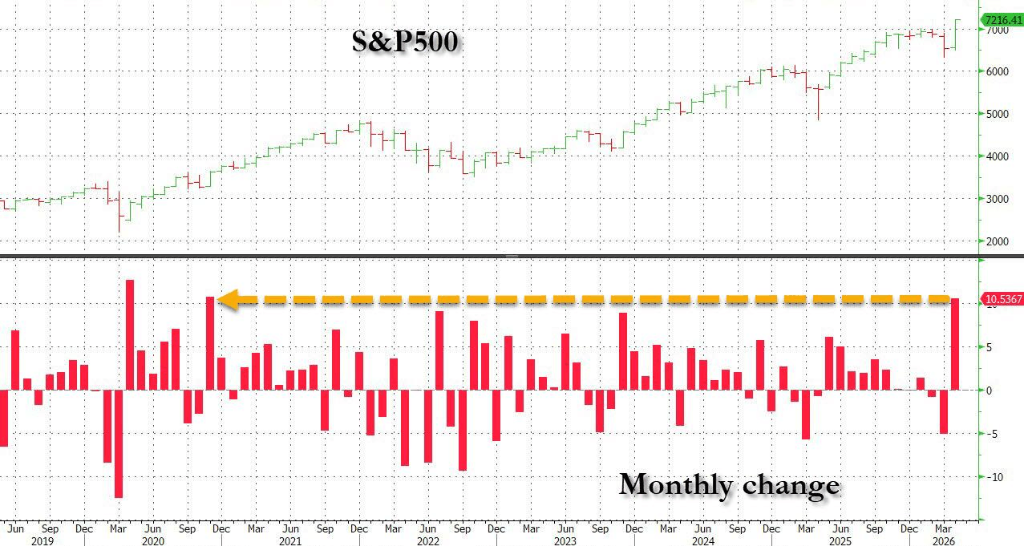
The US stock market ended April on a strong note, with the S&P 500 surging 10% for the month, marking its best monthly performance since November 2020. Alphabet delivered impressive earnings, driving its share price up nearly 10% in a single day. Caterpillar's stock rose over 9%, driven by power demand from AI data centers. Despite geopolitical tensions, rising inflation, and delayed expectations of Federal Reserve rate cuts, market sentiment remained dominated by corporate earnings and the AI narrative.
The US stock market concluded April with strong performance, as the appeal of corporate earnings and AI narratives overshadowed concerns about war, inflation, and interest rates.
On Thursday,$S&P 500 Index (.SPX.US)$Up 1% to a record high, and in terms of the entire month's performance, the S&P 500 rose 10% in April, marking its best monthly performance since November 2020.
 $Alphabet-A (GOOGL.US)$and$Caterpillar (CAT.US)$Strong earnings reports have become the core driver of the market.
Alphabet's stock soared nearly 10%, achieving the largest single-day market capitalization increase in the company’s history, which also ranks as the second-largest single-day market cap gain for a US corporation. Caterpillar, driven by surging demand fueled by AI data centers, saw its stock rise 9% to a record closing high.
Ray Baraldi, CEO of 2/13 Strategic Partners, said:
The market has been testing the gap between AI enthusiasm and reality. What you previously observed was excitement over AI potential, but now there is a rigorous examination of the actual landscape – investors ultimately need to see tangible results.
Google: Backlog provides "endorsement of returns," AI investments gain market recognition
Alphabet's highlights for this quarter were heavily concentrated in Google Cloud business.
The earnings report showed cloud revenue grew 63% year-on-year to USD 20 billion, with an operating profit margin of 33%, significantly surpassing market expectations. More crucially, Google Cloud's backlog nearly doubled from the previous quarter, reaching USD 46.2 billion, primarily driven by AI demand and TPU chip sales.
The company raised its full-year capital expenditure guidance from the previous range of USD 175 billion to 185 billion to USD 180 billion to 190 billion and hinted that capital expenditure would "increase significantly" by 2027. Jake Behan, head of Direxion Capital Markets, pointed out:
Alphabet's investments have gained market recognition, supported by a backlog of $460 billion in orders.
Chief Financial Officer Anat Ashkenazi stated during the conference call that the internal and external demand for AI computing resources is "at an unprecedented level."
Chief Executive Officer Sundar Pichai added that cloud business revenue could have been higher if all demands were met. Pichai noted during the conference call:
Our AI investments and full-stack strategy are energizing every aspect of the business.
The advertising business remains robust. Search advertising revenue grew by 19% year-over-year to $60.4 billion, YouTube ad revenue increased by 11% to nearly $10 billion, and subscription, platform, and device revenue rose by 19% to $12.4 billion.
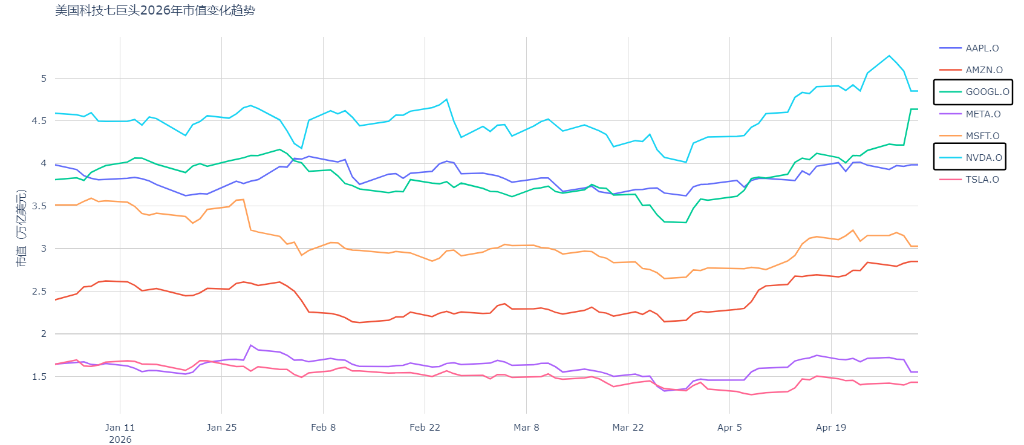
As of Thursday's close, Alphabet's market capitalization reached $4.65 trillion. Among the Mag 7, it ranks second only to$NVIDIA (NVDA.US)$market capitalization.
Caterpillar: Driven by AI data centers, this long-standing industrial giant has become a new favorite.
Caterpillar's strong performance offers another narrative on the benefits of AI investment.
Earnings reports show that Caterpillar’s revenue for this quarter increased by 22% year-over-year to $17.4 billion, surpassing S&P Capital IQ’s forecast of $16.4 billion. Revenue from the construction industry grew by 38%, while the power and energy segment increased by 22%.
Chief Executive Officer Joe Creed noted during the earnings call that much of the growth in the power and energy segment stemmed from the boom in data center development and the associated power demands required for cloud computing and generative AI. Caterpillar’s engines and turbines provide primary and backup power as well as electrical infrastructure for these facilities.
The backlog data is more straightforward. Creed stated that the company’s current order backlog has reached $63 billion, a 79% increase from a year ago. He noted:
Customers are placing longer-term orders, with some extending as far as 2028.
Regarding production expansion plans, Creed indicated that they will 'commence immediately.'
Data shows that Caterpillar is the second-largest component by weight in the Dow Jones Industrial Average, accounting for over 10% of the index's weight. Its 10% single-day gain on Thursday directly contributed to the Dow's 790-point increase for the day.
According to Bloomberg, Bank of America analyst Michael Feniger wrote in a research report that while the war in Iran poses short-term risks for Caterpillar, it could trigger a new wave of energy project construction, which 'might provide growth opportunities by 2027.'
War and the Fed take a backseat as AI narratives dominate market sentiment.
Despite ongoing escalation of geopolitical risks in April, the stock market showed noticeable insensitivity to these developments.
As mentioned by Wall Street News, Trump will receive a briefing on new military options targeting Iran, causing crude oil prices to rise temporarily before retreating, with near-month U.S. crude futures falling to $105 per barrel on the same day.
David Waddell, Chief Investment Strategist at Waddell and Associates, said:
Iran seems unwilling to come to the negotiating table, and Trump might overturn the table entirely.
In terms of macroeconomic data, the Federal Reserve's preferred inflation gauge showed that inflationary pressures rose further in March after the war drove up energy prices.
The GDP growth rate for the first quarter was 2%, lower than economists' expectations, with consumer spending showing signs of slowing. The yield on the 10-year U.S. Treasury bond closed at 4.389%. Waddell commented:
The market always tests a new Federal Reserve Chair, but at least one symbolic interest rate cut is expected by the end of the year.
Waddell concluded that the tailwinds brought by the global wave of industrial construction are "sufficient to outweigh the difficulties of absorbing rising energy costs," and "the strength of this rally is surprising."
Editor/Jeffy