
Top News
Before the market opened on Friday, the three major U.S. stock index futures collectively rose. As of now, the Dow Jones futures were up 0.45%, Nasdaq futures increased by 0.03%, and S&P 500 Index futures gained 0.31%.
Reports indicate that Iran responded to the United States via Pakistan on Thursday, addressing the latest U.S. revisions to the agreement. Both WTI and Brent crude oil prices dropped more than $1 in the short term; U.S. stock index futures surged, with S&P 500 futures rising 0.4% and Nasdaq 100 futures erasing earlier losses; spot gold rallied over $10 in the short term, narrowing daily losses to 0.7%.

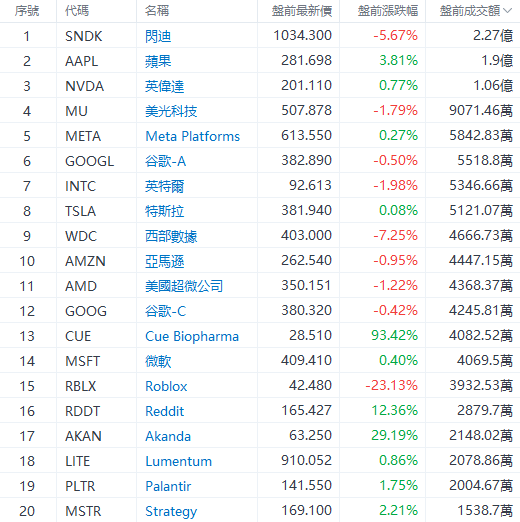
Most leading technology stocks declined during pre-market trading. $Micron Technology(MU.US)$ 、 $Intel (INTC.US)$ Falling by approximately 2%, $Amazon(AMZN.US)$ 、 Advanced Micro Devices (AMD.US) 、 $Google-C(GOOG.US)$ Others experienced minor declines; $Apple(AAPL.US)$ Shares rose nearly 4% after earnings were released.
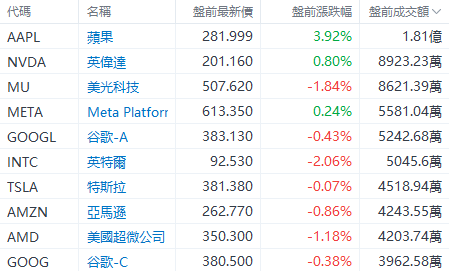
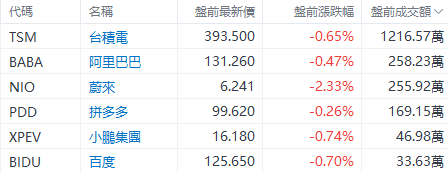
 Most popular Chinese stocks traded lower during pre-market hours, $Nio(NIO.US)$ Dropping more than 2%, $Alibaba(BABA.US)$ 、 $PDD Holdings (PDD.US)$ 、 $JD.com(JD.US)$ 、 $Baidu (BIDU.US)$ Including those that followed the downward trend.
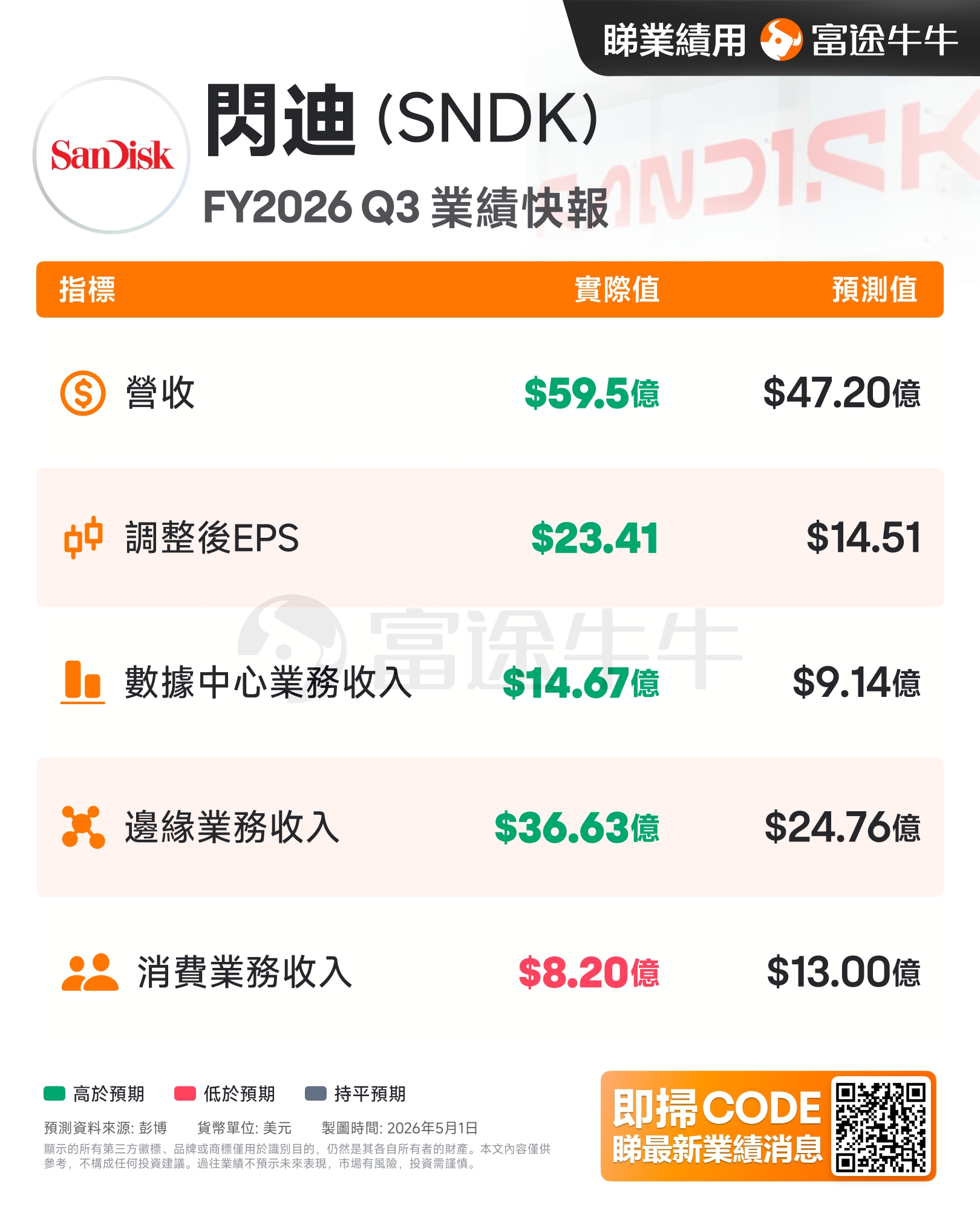
$Western Digital (WDC.US)$ The stock fell more than 7% during pre-market trading, SanDisk (SNDK.US) With another dropping over 6%. Both companies reported earnings that exceeded market expectations, but analysts noted that guidance 'lacked sufficient surprises.'
On April 30, after the US stock market closed, SanDisk delivered a third-quarter financial report that far exceeded market expectations. On the basis of a 97% quarter-over-quarter surge in Q3, the company still anticipates an approximate 35% increase at the midpoint of its revenue guidance for Q4. Analysts pointed out that the company's fundamentals are indeed in a strong upward phase of the AI storage cycle, but the stock price has already risen by more than 3,300% over the past 12 months and around 360% year-to-date, with much optimism already priced into the shares.
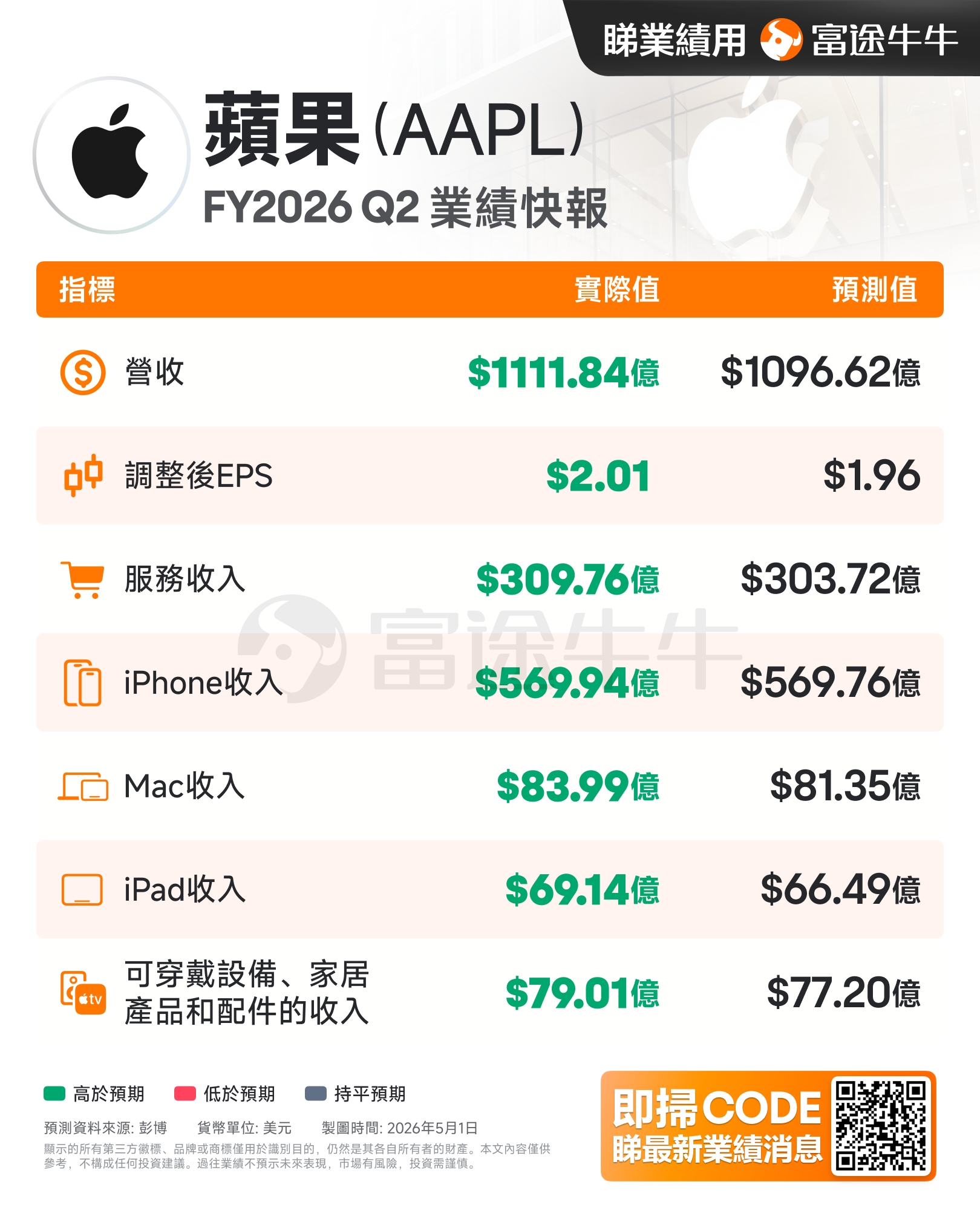
Apple rose nearly 4% during pre-market trading as revenue in China continued to grow by double digits last quarter. iPhone revenue hit a record high for the same period, and this quarter's revenue guidance was unexpectedly strong.
In the previous fiscal quarter ended March, Apple's revenue and EPS both hit record highs for the same period, increasing by nearly 17% and 22% year-over-year, respectively. iPhone revenue grew by 22%, slightly above the average analyst estimate. Service revenue increased by 16%, marking a new quarterly high for the third consecutive year. Revenue from Greater China surged by 28%, though performance in European and American markets was lackluster. Apple raised its dividend by 4% and authorized an additional $100 billion in share repurchases. The revenue guidance for the current fiscal quarter indicates growth of 14%-17%, surpassing analysts' expectations, with a gross margin forecast as high as 48.5%.
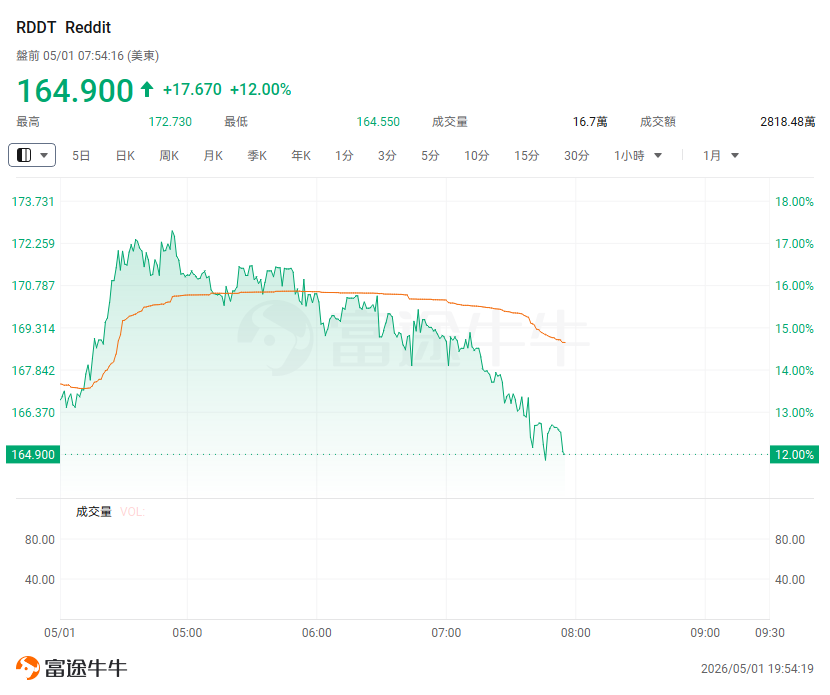
$Reddit(RDDT.US)$ Shares soared over 12% in pre-market trading after Q2 guidance was released, projecting revenue between $715 million and $725 million, above market expectations.
Reddit announced its second-quarter guidance for 2026, expecting revenue between $715 million and $725 million, surpassing market expectations of $711.6 million. Adjusted EBITDA is projected at $285 million to $295 million, also exceeding analysts’ forecasts of $277.1 million.
Additionally, the number of active advertisers grew by 75% year-over-year, while revenue increased by 69% year-over-year to $663 million, surpassing market expectations of $610.9 million. Daily active unique visitors rose by 17% year-over-year to 126.8 million, and global average revenue per user (ARPU) increased by 44%. Reddit stated that it is continuously improving ad placement efficiency through AI tools, including an AI-powered ad copy generator tailored for Reddit scenarios. Performance-based ad revenue now accounts for more than 60% of total advertising revenue.
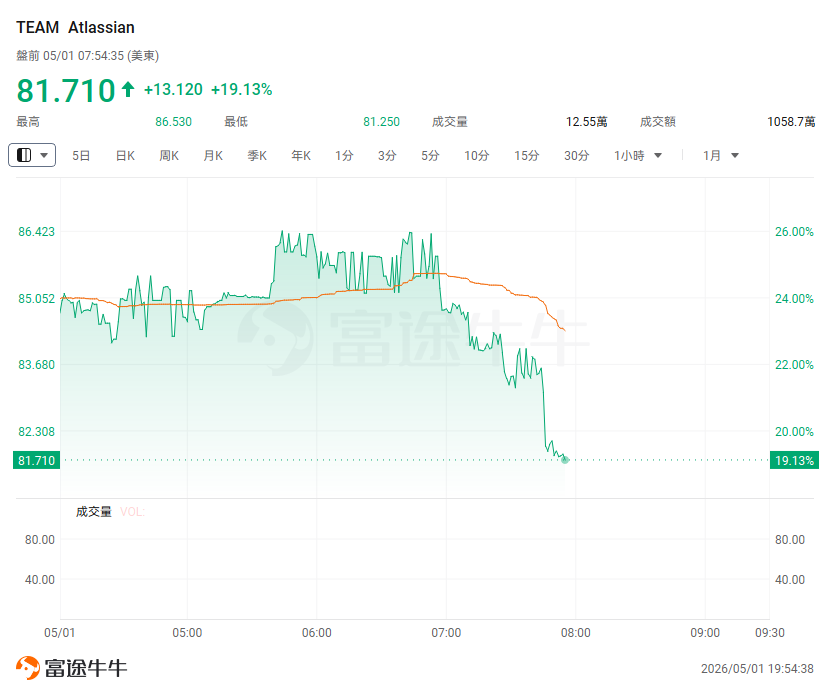
Workflow software company Atlassian (TEAM.US) Shares surged over 19% in pre-market trading as Q3 earnings and revenue exceeded expectations.
Workflow software company Atlassian reported its third-quarter earnings as of March 30, surpassing expectations for both profit and revenue. Its stock price soared over 20% in after-hours trading. The company reported third-quarter revenue of $1.787 billion, higher than the previous estimate of $1.696 billion. Earnings per share were $1.75, surpassing the earlier forecast of $1.33.
The company also raised its full-year revenue growth forecast for the fiscal year ending June to 24%, up from the prior projection of 22%. Cloud and data center revenue forecasts were slightly increased, and adjusted gross margin and operating margin projections were similarly revised upward.
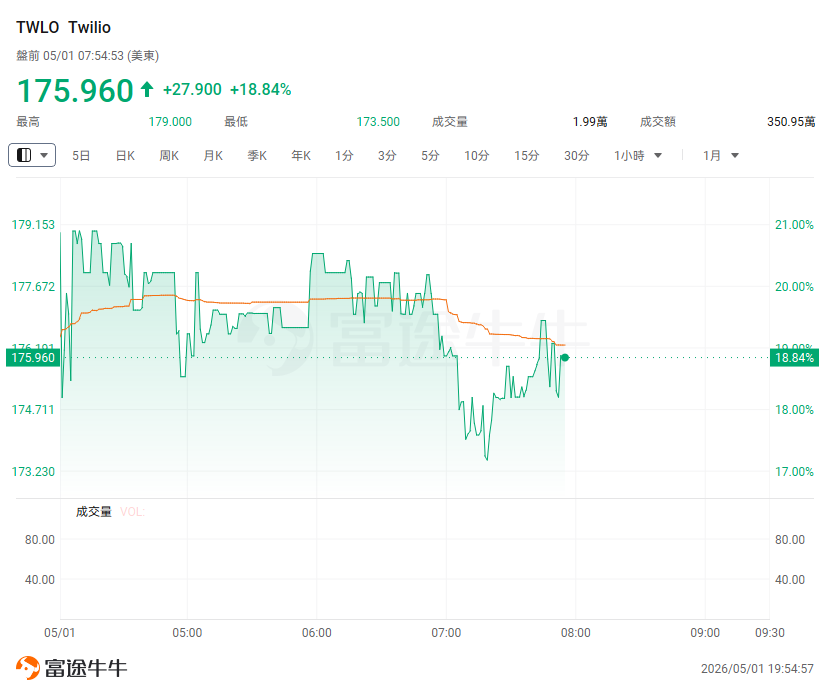
Cloud communications leader $Twilio(TWLO.US)$ Shares surged nearly 19% in pre-market trading as both revenue and earnings exceeded expectations, and the company raised its full-year growth guidance.
TWLO announced first-quarter 2026 sales of $1.41 billion (a year-over-year increase of 20%), significantly surpassing market expectations of $1.34 billion. The organic growth rate accelerated to 16% from 12% in the previous quarter, also exceeding prior expectations of approximately 10.5%. The company forecasts second-quarter sales to reach $1.425 billion (a year-over-year increase of 16%, 2.5% higher than market expectations) and has raised its full-year organic growth guidance from around 8.5% to approximately 10%.
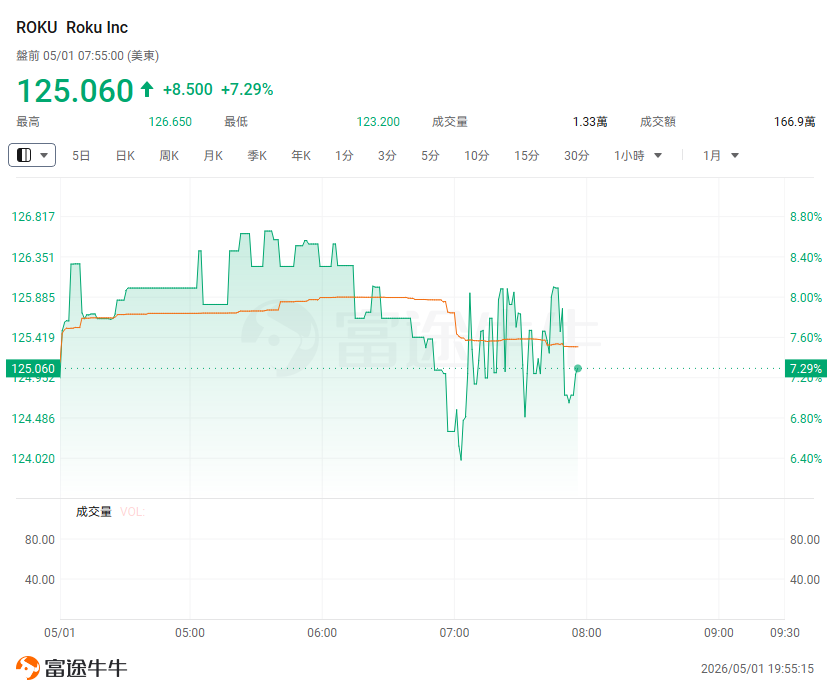
$Roku Inc(ROKU.US)$Shares surged over 7% pre-market as Q1 revenue and profits exceeded expectations, with full-year guidance raised.
ROKU delivered better-than-expected results for the first quarter of fiscal year 2026 after the market closed on Thursday. The report highlighted a significant recovery in the advertising market and ongoing optimization of platform operational efficiency, enabling Roku to achieve a pivotal performance turning point this quarter.
The company reported total revenue of $1.25 billion for the quarter, representing a substantial year-over-year increase of 22.4%, surpassing market forecasts of $1.20 billion. In terms of profitability, Roku successfully reversed last year’s losses, achieving a net income attributable to common shareholders of $85.7 million, equivalent to diluted earnings per share (EPS) of $0.57, which exceeded analyst expectations in the range of $0.33 to $0.35.
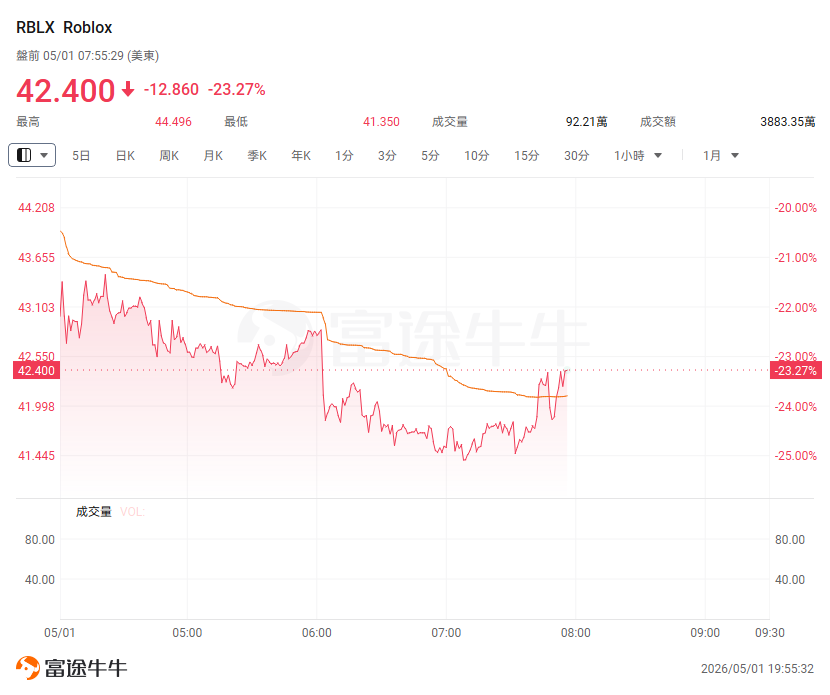
Online video gaming platform $Roblox(RBLX.US)$ Shares plummeted 23% pre-market after the company significantly lowered its annual bookings forecast.
RBLX reported its Q1 earnings after the market close on Thursday, with a diluted loss per share of $0.35, widening from a loss per share of $0.32 in the same period last year. Analysts surveyed by FactSet had expected a loss per share of $0.41.
Revenue for the first quarter ended March 31 increased to $1.44 billion from $1.04 billion in the same period last year. However, this fell short of the $1.74 billion anticipated by analysts surveyed by FactSet. The company expects second-quarter revenue to be in the range of $1.39 billion to $1.45 billion, compared to analyst expectations of $1.88 billion.
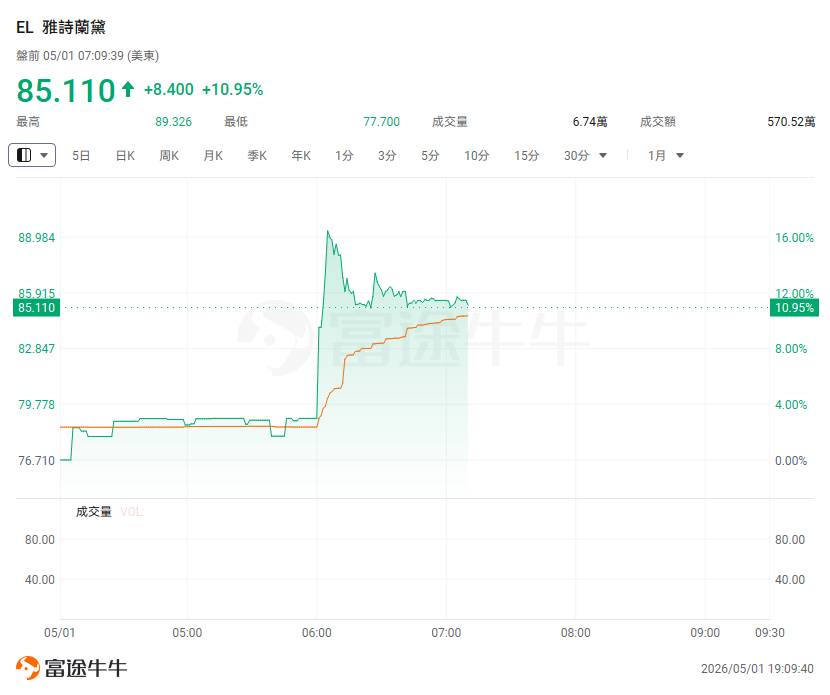
$Estee Lauder (EL.US)$ Shares surged nearly 11% pre-market as the company reported third-quarter net sales of $3.71 billion, above expectations of $3.69 billion, and adjusted earnings per share of $0.91, surpassing forecasts of $0.65.
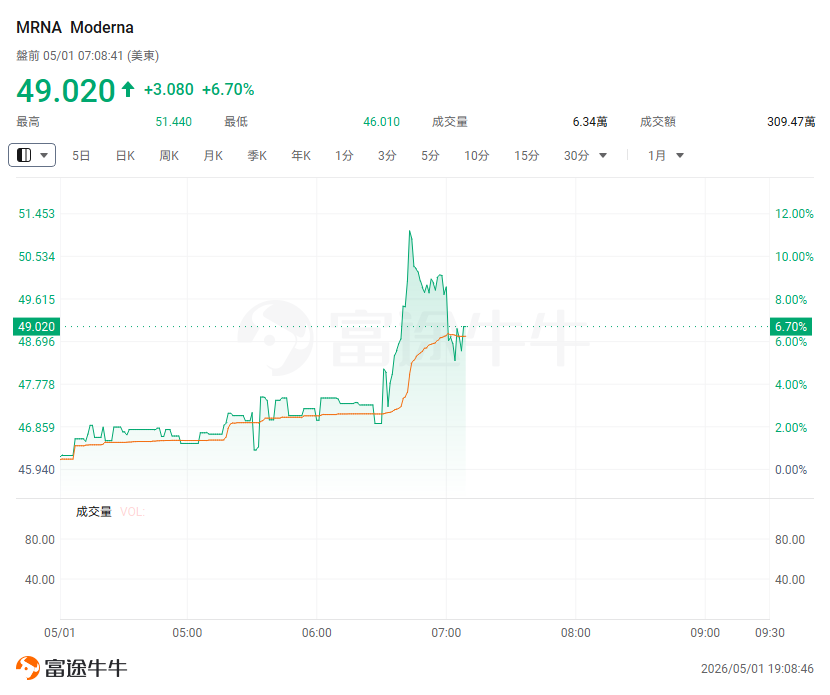
Moderna(MRNA.US) Shares of Moderna surged over 10% during pre-market trading. The company's Q1 revenue reached $389 million, surpassing market expectations, compared to $108 million in the same period last year.
SpaceX: The Starship project has accumulated investments exceeding $15 billion, with plans to launch the 'Starlink V3' satellites in the second half of 2026.
SpaceX's IPO registration documents reveal that the cumulative investment in the Starship project has surpassed $15 billion. The company is preparing to roll out an upgraded prototype. SpaceX plans to launch the first batch of its new and more powerful 'Starlink V3' satellites in the second half of 2026.
Bank of America: Global hyperscale cloud computing enterprises may reach $1 trillion in AI-related capital expenditure by 2027.
Bank of America Securities released a semiconductor industry research report. Following the release of Q1 2026 financial results and updated capital expenditure outlooks from four major U.S. tech giants—Google, Microsoft, Amazon, and Meta—the analyst team led by Vivek Arya raised their forecast for global hyperscale cloud computing enterprises’ capital expenditure in 2026 to over $800 billion, reflecting a 67% year-on-year increase. They further anticipate this figure will exceed $1 trillion in 2027, representing approximately 25% year-on-year growth.
The U.S. Department of Defense has reached agreements with seven AI companies.
The U.S. Department of Defense issued a statement today (May 1) announcing agreements with seven leading artificial intelligence companies: SpaceX, OpenAI, Google, NVIDIA, Reflection, Microsoft, and Amazon Web Services (AWS). The statement noted, 'These agreements accelerate the transformation of the U.S. military, aiming to build an AI-driven combat force while enhancing the military’s ability to maintain decision-making superiority across all warfare domains.'
The U.S. SEC has approved Nasdaq's launch of predictive options, linked to the 100 Index and its Micro Index.
The U.S. Securities and Exchange Commission (SEC) approved Nasdaq's proposed rule change on Thursday, April 30, local time, allowing the listing and trading of prediction market options linked to benchmark indices on its MRX exchange. This new instrument, referred to as 'Outcome-Related Options (OROs),' marks a significant regulatory breakthrough for mainstream U.S. securities exchanges in introducing event-prediction financial products.
The core mechanism of this product adopts a typical binary settlement model, with its trading logic highly simplified into a 'yes or no' determination of specific market outcomes. In practice, investors pay a premium to bet on whether the relevant index will be above or below a preset level at contract expiration.
Global Macro
Is war on the brink of restarting? Israeli media reports suggest that U.S.-Iran talks may collapse as early as the beginning of next week, with Israeli officials 'on high alert.'
According to Xinhua News Agency, Israeli media reported on Friday, May 1, that the United States was "likely on the verge of deciding" whether to resume military action against Iran, while Israel was intensifying preparations for a potential "renewed conflict" with Iran.
The report came as Trump received a briefing at the White House from General Brad Cooper, commander of the U.S. Central Command, on military options. Meanwhile, Israeli officials held a series of intensive consultations, believing that momentum for a decision by Washington was building.
According to Channel 12 in Israel, Israeli officials are "standing ready" to prepare for the possible collapse of U.S.-Iran negotiations as early as next week. The report cited recent briefings to cabinet ministers, stating that the U.S. might need to "push" its pressure campaign in the Strait of Hormuz through military strikes on Iran's natural gas, energy facilities, and government infrastructure.
As Congress exerts pressure and the 60-day deadline approaches, a senior U.S. official claimed that hostile actions against Iran have concluded.
Currently, the debate over the legal authorization concerning the Iran conflict is intensifying within the U.S. government. According to CCTV News, on April 30 local time, a senior U.S. government official who wished to remain anonymous stated that, under the War Powers Resolution, 'the hostilities that began on February 28 have concluded.'
The official noted that the two-week ceasefire reached between the U.S. and Iran on April 7 has been extended, and 'since April 7, there have been no clashes between U.S. troops and Iran.'
These remarks come less than a month before the May 1 deadline of 60 days. Under the 1973 War Powers Resolution, unless formally declared by Congress or authorized, the President must gradually cease the use of force within 60 days of deploying troops into a conflict, with an additional 30-day grace period allowed for withdrawal. On February 28, the U.S. and Israel began their attacks on Iran, and by Friday, it had been exactly 60 days since Trump notified Congress of the military operation.
September Becomes Critical Juncture! JPMorgan: Crude Oil Inventories to Approach Limits, and the Strait of Hormuz 'Will Reopen Regardless'
JPMorgan has warned that the 'abundance' of global crude oil inventories is merely an illusion—of the total 8.4 billion barrels, approximately 6.6 billion barrels are stored onshore, 1.8 billion barrels are floating at sea, and only about 800 million barrels are genuinely accessible, with nearly 280 million barrels already consumed. If the Strait of Hormuz remains blocked, commercial crude oil inventories will reach operational lows by September this year, posing a significant risk of functional failure to the global oil distribution system. Prior to September, the strait 'will reopen by all means necessary.'

Powell's reappointment adds fuel to the fire, likely escalating tensions between the Federal Reserve and the White House.
Federal Reserve Chair Powell announced this week that he will continue to serve on the Federal Reserve Board after his term as chair ends next month, stating that this move aims to protect the Federal Reserve from political interference. Several industry experts noted that Powell's decision is unlikely to ease tensions and may instead further intensify the strained relationship between the Federal Reserve and the White House.

The market has been speculating for months about whether Powell will step down from the Federal Reserve Board simultaneously after his term as chair expires on May 15. According to the rules, as long as Powell remains in his position as a governor, Trump cannot nominate a new person to fill the vacant seat on the Federal Reserve Board, allowing Powell's term as a governor to extend until early 2028.
Resisting Trump's pressure, two major U.S. energy giants refused to increase oil production.
Facing the most severe energy crisis in decades, two major U.S. energy giants $Exxon Mobil(XOM.US)$ and $Chevron(CVX.US)$ are resisting pressure from the White House to increase oil production, adhering to their pre-war strategy of prioritizing financial returns over production growth.
According to the Financial Times, despite recent calls from President Trump for the crude oil industry to ramp up drilling, the chief financial officers of both supermajors have made it clear that they will not alter their core business plans due to recent volatility in the crude oil market. Corporate management emphasized that the current strategic focus remains on expanding free cash flow rather than merely increasing capacity.
Top 20 pre-market trading volume stocks in the U.S.
Reminder of the US stock market macroeconomic calendar
(The following times are in Beijing Time)
21:45 U.S. S&P Global Services PMI Final for April
22:00 U.S. ISM Non-Manufacturing PMI for April
 Looking to pick stocks or analyze them? Want to know the opportunities and risks in your portfolio? For all your investment-related questions,just ask Futubull AI!

Editor /rice