The most symbolic adjustment at this year’s shareholders' meeting was allowing the heads of Berkshire Hathaway subsidiaries to join the stage alongside the newly appointed CEO, Abel, to answer questions. This sends a clear message to the outside world: the authority of Berkshire Hathaway will no longer rely on individual charisma but will be built upon a more diversified operational system. Abel needs to address a core question: how to preserve the unique culture of Berkshire Hathaway while demonstrating his own strategic vision.
Central US time on Saturday, May 2, $Berkshire Hathaway-B (BRK.B.US)$ the 2026 Annual General Meeting of Berkshire Hathaway will be held in Omaha.
This year marks the first time in sixty years under Buffett's leadership that Berkshire has held its shareholder meeting 'behind the scenes.' It will serve as the company's first 'stress test' following the completion of the leadership transition. Since Buffett stepped down as CEO at the end of last year, Greg Abel will host the public Q&A session for the first time in his capacity as CEO, marking the official entry of the trillion-dollar enterprise founded by Buffett into the 'post-Buffett era.'
 At 95 years old, Buffett will attend this year's shareholders' meeting but will no longer sit on stage to lead the Q&A session. He will instead sit as a board member inside the venue, while Abel will take full responsibility for hosting both the morning and afternoon Q&A sessions. Analysts suggest that the style of the meeting is expected to shift from Buffett’s investment philosophy and life wisdom to more operational and capital allocation-focused business topics. For investors, this will be their first opportunity to closely examine whether Abel can effectively manage Berkshire, with investor sentiment largely depending on his performance.
Berkshire’s Q1 earnings report for this year will also be released on the same day as the shareholders' meeting Q&A, Saturday morning Eastern Time, adding an extra layer of market attention to the event. A 'new small investment' mentioned by Buffett in a media interview last month has yet to disclose its target, and it is expected to become a focal point at the venue.
Year to date, both Class A and Class B shares of Berkshire Hathaway have fallen by more than 5%, underperforming the benchmark$S&P 500 Index (.SPX.US)$by approximately 10 percentage points. Since Buffett announced his retirement plan in May last year, Berkshire Hathaway has cumulatively underperformed the S&P by over 30 percentage points. In Abel's first shareholder letter following his appointment, investors widely considered the disclosure of future strategy to still be insufficient. The market anticipates that this meeting will provide more clarity on the direction forward.
For a long time, Berkshire has been centered around a culture of 'decentralization and permanent holdings.' However, Abel’s management style leans more towards operational control and has already begun implementing some organizational adjustments. Compared to Buffett’s 'hands-off' approach of merely reviewing financial statements, Abel engages more frequently with subsidiary CEOs and interacts more with various levels of management and the board. The market is watching whether Abel will alter the tradition of 'long-term holding' post-acquisition, strengthen headquarters’ managerial control over operations, or push for more systematic performance and capital return mechanisms.
Continuing traditions but with Abel as the new leading figure, evolving from a 'carnival-style' gathering to a more institutionalized conference.
According to the official meeting agenda disclosed by Berkshire, this year’s shareholders' meeting continues the classic structure developed over many years, but key changes have emerged in core segments.
Date and Venue: May 2, 2026, CHI Health Center, Omaha, Nebraska, USA.
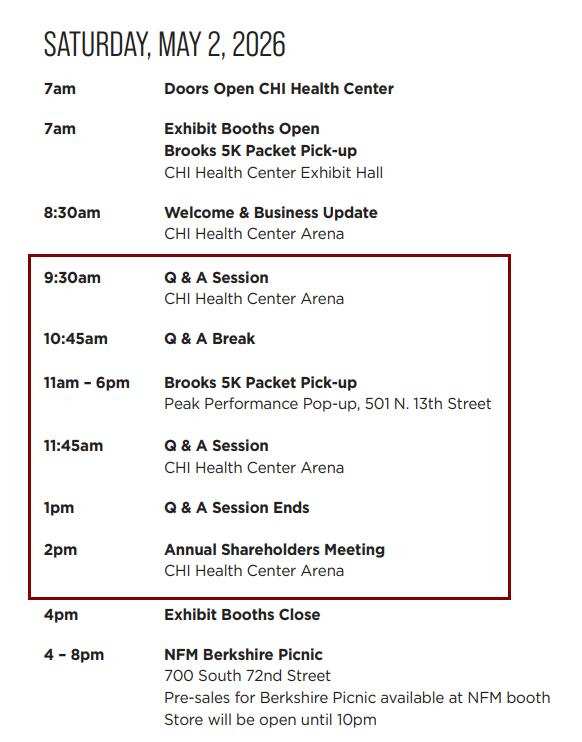
Official Shareholders' Meeting: To be convened at 2 PM local Omaha time to deliberate on routine proposals such as director elections and compensation votes. The shareholders' meeting Q&A will begin at 9:30 AM local time, or 10:30 PM Beijing time on May 2, which is one and a half hours later than last year’s meeting. (Click here to view last year’s shareholders' meeting Q&A live text broadcast.)
Core session – Q&A meeting: Led by Abel, replacing the decades-long format where Buffett took center stage as the host.
Restructuring of the Q&A format: Divided into two segments, each lasting approximately 75 minutes.
First segment: Abel and Ajit Jain, head of Berkshire Hathaway’s insurance business, jointly answering questions, from 9:30 AM to 10:45 AM local time.
Second segment: Abel, along with Katie Farmer, CEO of Burlington Northern Santa Fe Railway (BNSF), and Adam Johnson, CEO of NetJets, addressing inquiries on stage, from 11:45 AM to 1:00 PM local time. Similar to the previous conference Q&A, it will conclude at 2:00 AM Beijing time on May 3rd.
Compared to Buffett’s 4-5 hour Q&A sessions in previous years, this year’s event is notably shortened to three and a half hours overall. Introducing the heads of subsidiaries to the Q&A panel marks the most symbolic adjustment in this year’s shareholder meeting structure. Analysts believe that this arrangement is intended to distribute the spotlight previously concentrated on Buffett alone, signaling to the public that Berkshire Hathaway’s authority will no longer rely solely on individual charisma but will instead be built upon a more diversified operational framework.
Despite the noticeable changes in the Q&A structure, the conference retains its traditional elements overall.
The pre-meeting typically includes company short films, shareholder interactions, and shopping activities (a hallmark of the 'Capitalist Pilgrimage').
The Q&A remains the core content of the day, focusing on investments, macroeconomic issues, and business operations. The live audience Q&A session for shareholders is retained, supplemented by written questions selected by CNBC reporter Becky Quick.
The Q&A session will continue to be broadcast via CNBC to expand its reach, offering bilingual streaming services in English and Mandarin. The livestream will begin at 8:15 AM local time on May 2nd.
However, from an institutional perspective, this meeting places greater emphasis on corporate governance topics, including director elections and executive compensation frequency voting, underscoring the rising importance of the corporate governance framework.
Key Highlights: Cash, Buybacks, and Buffett's 'Behind-the-Scenes Influence'
One of the most anticipated topics for investors at this meeting is the destination of Berkshire Hathaway’s massive cash and treasury bond reserves, which amount to $373 billion.
One of the core issues facing Berkshire is how to deploy its vast cash reserves. By the end of 2025, the scale of Berkshire's cash holdings reached a record high, and Buffett revealed to the media last month that he had purchased an additional $17 billion in treasury bonds in March.
The trend of stock buybacks has also drawn significant attention. In March this year, Berkshire resumed its stock repurchase program, which had been suspended for nearly two years, with a repurchase size of approximately $226 million. Abel also announced that he would personally purchase Berkshire shares using his entire after-tax salary (approximately $15 million) and stated that he would continue this practice as long as he remains in his position.
UBS Group analyst Brian Meredith noted in a research report that Berkshire is currently trading at about an 8% discount to its intrinsic value, and he projected that the company would repurchase approximately $1.7 billion worth of shares throughout the year. Meredith wrote: "Given that the discount relative to intrinsic value has widened further since the announcement of the buyback, we believe the magnitude of the repurchases will be a key variable influencing investor sentiment."
Another unresolved question is the actual role Buffett plays in investment decision-making. According to Buffett’s own revelations to the media, he still goes to work every day and speaks with Mark Millard, the director of Berkshire's financial assets, before the market opens each day, adjusting limit orders based on pre-market dynamics and receiving hourly updates on daily trades. Abel subsequently reviews the trading activity and has final decision-making authority.
Buffett stated: "If Greg (Abel) thinks it’s inappropriate, I won’t proceed." This description has drawn significant market attention to the substance of the leadership transition. The Form 13F filing for the first quarter of 2025, which Berkshire will disclose on May 15, may provide additional clues.
Performance Pressure: Declining Insurance Profits and Underperformance Against the Market
The backdrop for Abel’s debut is not an easy one. Media outlets view this shareholders' meeting as a critical test of whether Abel can inherit the 'Buffett premium.' In the fourth quarter of 2025, Berkshire’s operating profits fell by nearly 30% year-over-year, with a significant 54% drop in insurance underwriting profits being the primary drag. This outcome added to investor concerns, already wary due to the impending leadership transition.
Bill Stone, Chief Investment Officer of Glenview Trust, stated: "It’s difficult to expect substantial profit growth this year. The base for insurance is too high, making year-over-year comparisons very challenging. I essentially expect near-zero profit growth for this year, which is the key driver of stock prices."
CFRA analysts highlighted potential downside risks in their report: erosion in insurance pricing and claims trends, particularly the possible reintroduction of auto tariffs reigniting claims inflation pressures, while commercial real estate insurance pricing softens simultaneously; meanwhile, broader economic weakness could also suppress demand across many of Berkshire's businesses.
Morningstar estimates Berkshire's fair value at $765,000 per Class A share ($510 for Class B shares), assigning it a four-star rating and suggesting a discount of approximately 7% relative to its fair value, with an uncertainty rating of "low."
Morningstar also noted that Abel will face evaluation standards markedly different from Buffett’s—being assessed both as an operator and as an investor, whereas "during the Buffett era, shareholders, out of trust in Buffett and Munger, long turned a blind eye to performance scorecards, but such leniency may no longer exist in the future."
Abel’s Challenge: Preserving Tradition or Forging a New Path
Analysts generally believe that Abel’s appearance this time needs to address a core question: how to demonstrate his own strategic vision while safeguarding Berkshire’s unique culture.
Macrae Sykes, portfolio manager at Gabelli Funds, stated that while no one can replace Buffett on stage, Abel’s "continuity does instill confidence in the sustainability of operations at the operational level."
Steve Check, founder of Check Capital Management, raised more specific questions: "I would like to hear an explanation of Berkshire’s investment management approach—why was it decided that Greg (Abel) should directly oversee more than 90% of the portfolio while managing the operating companies? Can he effectively handle both responsibilities?"
The direction of technology and artificial intelligence (AI)—namely, whether Berkshire increases its allocation to tech and AI assets—is also expected to be a hot topic among shareholders. UBS Group noted, "given Berkshire’s historically low exposure to the tech sector, we anticipate discussions will focus on how the company addresses tech and AI issues under Abel’s leadership."
Sykes also predicted: "There will certainly be questions about AI—what businesses will be impacted, which may benefit, and how the company will respond to this dynamic economic environment."
Notably, Berkshire quietly established a stake in Alphabet at the end of last year, interpreted by outsiders as a signal of the company’s increasingly positive stance toward the tech sector. Abel’s background in energy and utilities has also fueled market expectations regarding Berkshire’s future investment directions in energy transition issues.
On a stage overshadowed by the legendary predecessor's aura, Abel’s articulation of strategy, response to inquiries, and balancing of legacy with innovation will largely set the tone for his tenure.
Editor/Rocky