Source: CCTV News
U.S. President Trump will pay a state visit to China from May 13 to 15. This marks the second face-to-face meeting between the leaders of China and the United States since their summit in Busan last October, and it is also the first visit by a U.S. president to China in nine years. Against the backdrop of profound adjustments in Sino-U.S. relations and the global landscape, with the Gulf and Middle East at a critical juncture of shifting between conflict and peace, President Trump's visit to China has drawn significant attention. The visit is expected to focus on key issues that will guide the course of Sino-U.S. relations and address how to navigate challenges and ensure stable progress in this crucial bilateral relationship.
On the morning of May 11, China’s Ministry of Foreign Affairs officially announced President Trump’s upcoming visit to China, immediately capturing widespread attention from global media. Following the leaders’ summit in Busan, South Korea, last October, high-level exchanges between China and the United States are once again reaching a pivotal moment.
 Gao Fei, Dean of the Diplomatic Academy, told reporters from the Blue Hall Observer that President Trump’s visit to China represents the first time in nine years that a U.S. president has set foot on Chinese soil. Both China and the United States are major powers—politically and economically—and how these two nations interact will have a profound impact on the future trajectory of international affairs. Gao Fei stated, “This visit is of great significance not only to both countries but also to the future direction of global politics and economics.”
Focusing on major issues critical to Sino-U.S. relations, as well as world peace and development.
Presidential diplomacy plays an irreplaceable strategic guiding role in Sino-U.S. relations. Since last year, President Trump has repeatedly expressed his intention to visit China, and both sides have maintained communication regarding the arrangements for this visit.
At this pivotal moment of profound adjustments in Sino-U.S. relations and the global order, international observers are focused on how the two sides will use this visit to engage in in-depth discussions on trade and economic issues as well as other areas of mutual concern.
Dean Gao Fei of the Diplomatic Academy emphasized that the Taiwan issue remains a key topic in this round of high-level interactions between China and the United States. He noted that the Taiwan issue continues to be China’s most significant concern. When discussing Sino-U.S. relations, the U.S. side has frequently referenced the term “guardrails” in the past. From the U.S. perspective, there is also hope for stability in Sino-U.S. relations. However, a crucial political prerequisite for achieving such stability lies in the Taiwan issue. As Taiwan concerns China’s core interests, China will absolutely not compromise.

Diao Daming, Deputy Director of the National Development and Strategy Research Institute at Renmin University of China, told reporters from the Blue Hall Observer that since 2025, the leaders of China and the United States have engaged in five phone calls and held a summit in Busan. One of the central topics of these interactions has been trade and economic issues. President Trump’s upcoming visit to China will also prioritize this area. Diao Daming analyzed that under the guidance of presidential diplomacy since 2025, both sides have conducted multiple rounds of high-level consultations on trade and economic matters. In this domain, both parties must consider the bigger picture, plan for the long term, and continuously work toward mutual understanding, expanding areas of cooperation while narrowing differences. Such efforts would align with the interests of both nations and meet the broader expectations of the international community.
When China and the United States cooperate, both benefit; when they confront, both suffer.
Ahead of President Trump’s visit to China, a new round of trade and economic consultations between China and the United States will take place in South Korea on May 12–13. It is also anticipated that representatives from several major American companies will accompany President Trump during his visit.

At the beginning of this year, a survey released by the American Chamber of Commerce in China showed that the proportion of surveyed U.S. companies in China optimistic about the growth of the Chinese market has significantly increased. More than 70% of companies do not consider relocating their businesses from China, and nearly 60% plan to increase their investment in China. The notion that 'cooperation benefits both the U.S. and China, while conflict harms both' is not merely political rhetoric but a profound conclusion drawn from experience.

Diao Daming, Deputy Dean of the National Development and Strategy Research Institute at Renmin University of China, stated that cooperation benefits both the U.S. and China, while conflict harms both; cooperation is the only correct choice. Whether it was the turbulence in U.S.-China relations during a certain period or the overall stability maintained over the past year, it fully demonstrates the consequences of different choices on the U.S.-China relationship. The general stability of U.S.-China relations during this time further confirms that since 2017, the idea held by some in the U.S. that strategic competition with China should define the entirety of U.S.-China relations represents a complete misunderstanding of the bilateral relationship and misinterpretation of China's development.
The issue of strategic perception is the 'first button' that must be fastened in U.S.-China relations.
Notably, there have been frequent exchanges between China and the U.S. at all levels and across various fields recently. Just last week, a bipartisan delegation of U.S. Senators, led by Senator Danes, visited China, marking the first such visit by a U.S. Congressional delegation since President Trump took office.
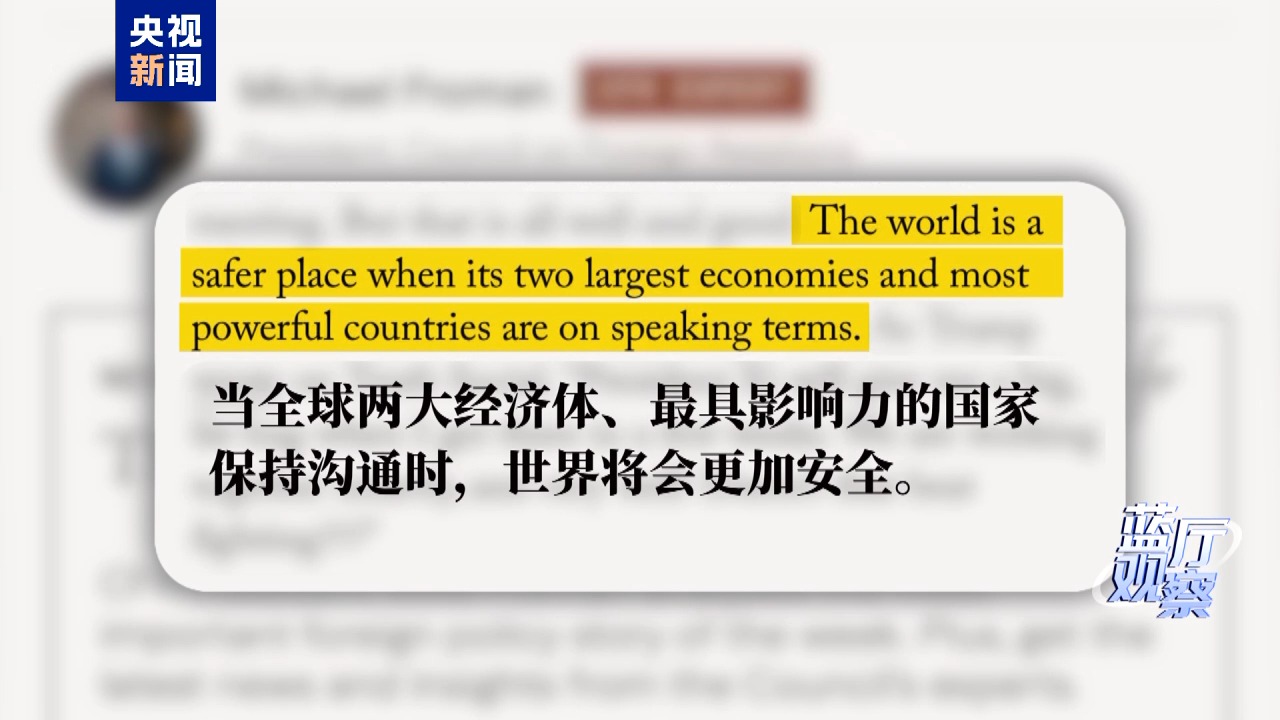
Regarding the development of relations with China, more pragmatic and rational voices have emerged from the U.S. strategic community. Richard Haass, President of the Council on Foreign Relations, recently remarked on President Trump’s upcoming visit to China, stating that when the world's two largest economies and most influential countries maintain communication, the world becomes safer.
Susan Thornton, former Acting Assistant Secretary of State for East Asian and Pacific Affairs and Senior Fellow at Yale University, told reporters from Blue Hall Observer that President Trump’s visit itself is a form of achievement. It allows leaders of both China and the U.S. to meet, communicate, and discuss a series of strategic issues. Thornton believes that both sides hope to ensure that the stability achieved over the past year will continue into the future. This meeting between the leaders of China and the U.S. will also help achieve that goal.

Gao Fei, President of the Diplomatic Academy, stated that objectively speaking, it is impossible for all issues in U.S.-China relations to be resolved through a single high-level exchange. However, this interaction, at the very least, can push both nations to rebuild new understandings and find a new, correct way to coexist. China has consistently emphasized that mutual respect, peaceful coexistence, and win-win cooperation are essential between China and the U.S. Among these, mutual respect serves as the foundation, peaceful coexistence as the principle and guideline, and win-win cooperation as the goal and direction. This meeting between the leaders of China and the U.S. is crucial for both sides to seek a path toward strategic stability.
Adhere to mutual respect, peaceful coexistence, and win-win cooperation.
This year marks the beginning of China’s 'Fifteenth Five-Year Plan,' while the U.S. approaches its 250th anniversary. Both countries will also host the APEC Informal Leaders' Meeting and the G20 Summit respectively. In this pivotal year, how to advance U.S.-China relations remains critical. China emphasizes the importance of taking one step at a time to build trust gradually, making 2026 a year where both major powers move toward mutual respect, peaceful coexistence, and win-win cooperation. Undoubtedly, President Trump’s visit to China will become a key step in this process.
Editor/Rocky