
① Under the baseline scenario, by 2030, the total global server CPU market size will reach 125 billion USD, and under the optimistic scenario, this figure will be as high as 283 billion USD; ② By 2030, under the baseline scenario, the additional DRAM demand will be approximately 74 EB, while in a bullish scenario, the additional demand could reach 221 EB; ③ The first quarter of 2026 has already become the 'AI Agent Explosion Quarter'.
Cailian Press, May 12 (Editor Xia Junxiong) Morgan Stanley pointed out in its latest research report that with the explosion of Agentic AI (AI Agents), AI infrastructure is shifting from being GPU-centric (graphics processing units) to a 'CPU (central processing unit) + memory + system synergy' architecture.
Morgan Stanley had emphasized this trend in its April 19 report, and subsequently, in its latest research report released on May 11, significantly raised its forecast for the global server CPU and memory market size.
 The bank predicts that under the baseline scenario, by 2030, the global server CPU market size will reach 125 billion USD, with an additional DRAM (dynamic random-access memory) demand of 74 EB.
Under the optimistic scenario, by 2030, the global server CPU market size could reach up to 283 billion USD, with the additional DRAM demand potentially reaching 221 EB, nearly five times the current global market size.
AI agents are reshaping data center architectures.
Morgan Stanley believes that the market has generally underestimated the impact of agents on AI infrastructure.
Over the past two years, AI capital expenditures have almost entirely revolved around GPUs. However, the industry is now realizing that Agentic AI is not as simple as 'adding a few CPUs next to a GPU'; it will drive fundamental changes in the entire data center architecture.
The report indicates that future AI data centers will adopt a 'two-tier architecture'.
The first tier is the GPU Rack, responsible for high-density computing tasks such as model training and inference.
The second layer is the entirely new Agentic CPU Rack, responsible for tasks such as Agent orchestration, data processing, tool invocation, task coordination, and memory management.
To draw an analogy, the GPU is responsible for 'thinking,' while the CPU is responsible for 'organizing actions.'
The report states that in the era of Agentic AI, emphasis is placed on the coordination capabilities of the entire system architecture. When enterprises deploy AI Agents in the future, their core competitiveness will stem from stronger CPU orchestration capabilities, lower-latency data pathways, more efficient network collaboration, and larger memory capacities.
Significantly raised forecast for the CPU market size
Based on the explosive demand for AI agents, Morgan Stanley has significantly increased its global server CPU market expectations.
The report forecasts that under a baseline scenario, by 2030, the total global server CPU market size will reach 125 billion USD, a marked increase from the previous estimate of approximately 100 billion USD; under an optimistic scenario, this figure could even soar to 283 billion USD.
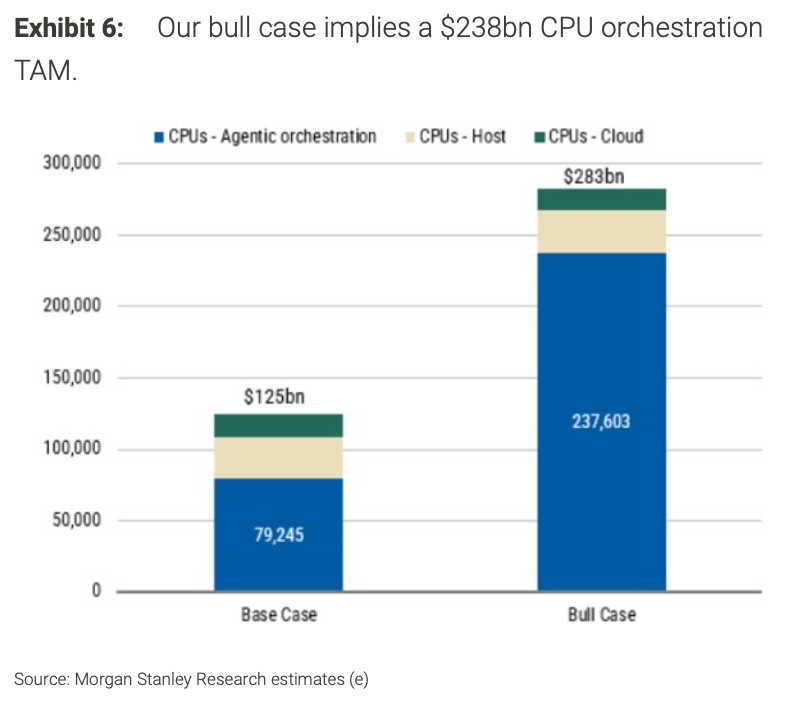
(Morgan Stanley's forecast for the server CPU market)
Among these, the primary source of new demand comes from 'Orchestration CPUs.'
Morgan Stanley believes that future AI workloads will no longer involve single-round inference but rather the concurrent operation of numerous Agents and the coordination of multi-step tasks, which will significantly increase CPU demand.
The firm predicts that the global AI penetration rate among knowledge workers will rise from 78% in 2026 to 99% in 2030; the number of AI concurrent tasks will experience a compound growth of 176% between 2026 and 2030; and the number of agents per AI session may increase from around 6 currently to nearly 100 by 2032.
At the same time, the number of CPU cores is also expected to grow rapidly. The number of cores per CPU will increase from 64 in 2025 to over 270 by 2030, and may even reach 366 cores by 2032.
Due to the increase in core count, the average selling price (ASP) of CPUs will continue to rise, exceeding USD 2,000 by 2027 and reaching over USD 3,000 by 2030.
DRAM demand may experience a historic expansion.
In addition to CPUs, Morgan Stanley believes that the market has significantly underestimated the impact of AI agents on DRAM memory.
The report points out that AI agents require long-context capabilities, persistent memory, RAG (Retrieval-Augmented Generation), KV Cache, and intermediate state storage, all of which are highly dependent on CPU-side DRAM.
As a result, AI memory requirements will no longer be limited to HBM (High Bandwidth Memory) but will extend to standard DRAM and server SSDs.
According to Morgan Stanley's latest forecast, by 2030, under the base scenario, additional DRAM demand will amount to approximately 74EB; under the bull scenario, new demand could reach 221EB.
For comparison, the global DRAM market size in 2026 is estimated to be only about 45EB.
In other words, under the bull scenario, the additional demand would be nearly five times the current global DRAM market size.
The report also notes that memory manufacturers such as Samsung Electronics and SK Hynix are promoting the signing of 3-to-5-year long-term supply agreements (LTAs) with major technology companies.
Morgan Stanley believes this indicates that the memory industry cycle may gradually shift from being a traditionally 'strongly cyclical industry' to a longer-term, more stable AI capital expenditure-driven model.
Tech giants have begun placing comprehensive bets on AI agents.
Morgan Stanley noted that the first quarter of 2026 has become the 'AI agent breakout quarter.' Recent earnings reports from multiple tech giants have sent clear signals.
AMD stated in its latest earnings report that AI agents are driving rapid growth in data processing, orchestration, and parallel execution demands, with the server CPU market expected to exceed $120 billion by 2030.
Arm noted that demand for its new CPUs designed for AGI scenarios is growing much faster than anticipated, with related orders already surpassing $2 billion.
The most representative case comes from Meta and Amazon Web Services (AWS). Meta has partnered with AWS to deploy tens of millions of Graviton CPU cores for AI agent workloads. According to Amazon, such tasks are typical 'CPU-intensive' applications.
Meanwhile, Microsoft introduced the concept of the 'Agentic Computing Era' for the first time. Alphabet, Google's parent company, launched the Gemini Enterprise Agent Platform and Agentic Data Cloud, announcing a $750 million investment to promote the development of the Agent ecosystem.
Editor/Deng