
① Since the outbreak of the Iran war, despite high oil prices, there has been no parabolic surge that triggers a global energy crisis; ② Morgan Stanley strategists stated that structural support from the US and China helps stabilize oil prices, preventing them from soaring to worst-case scenario forecast levels.
Since the US and Israel launched attacks on Iran at the end of February, the Strait of Hormuz has been closed for 10 weeks. Despite high global oil prices, there has been no parabolic surge that would trigger a global energy crisis. Analysts suggest this may be because the oil markets in the United States and China have 'protected' the global economy.
Morgan Stanley strategists noted that structural support from the US and China contributes to stabilizing oil prices, preventing them from spiking to worst-case scenario levels. Changes in oil trading activities in these two major global powers also provide a buffer for the global economy.
 “Of the year-on-year 12.3 million barrels per day decline in Middle East supply, increased US seaborne exports and reduced Chinese imports absorbed 9.3 million barrels per day, thus protecting the rest of the world,” added Morgan Stanley strategists.
JPMorgan CEO Jamie Dimon said on Tuesday that changes in US exports and Chinese imports could explain why the Iran war “has not had a significant impact” on oil prices. He noted that while the effects of the conflict are “intensifying daily,” the days of it “turning into a disaster” have been postponed.
The crisis is severe, but the impact remains moderate.
Morgan Stanley also reported that nearly one billion barrels of supply have been lost in the oil market due to this war. The bank pointed out that even if the Strait of Hormuz reopens tomorrow, the market will still lose one billion barrels during the time required for the supply chain to normalize.
“This represents the largest oil supply disruption in the history of the oil market, which is neither exaggerated nor controversial,” the strategists wrote in their report.
Currently, Brent crude prices continue to fluctuate around $106 per barrel, while WTI crude prices have settled near $101 per barrel. Current oil prices remain significantly higher than pre-war levels but have retreated from recent highs.
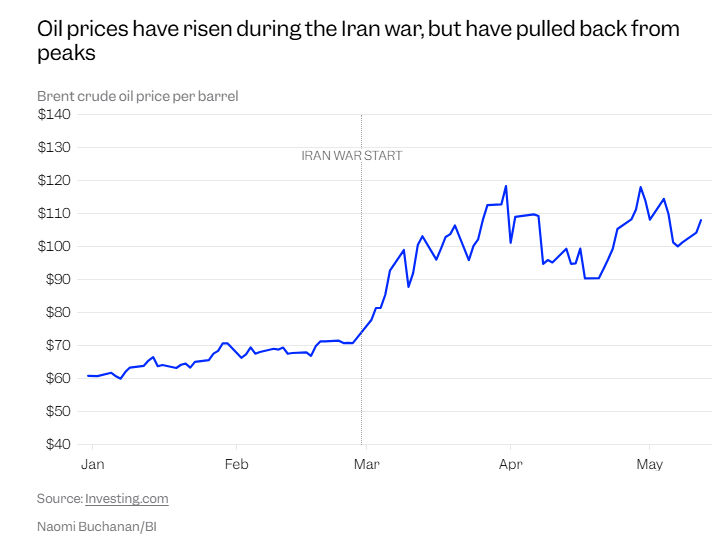
Morgan Stanley stated that from a historical perspective, current oil prices are not considered high.
The report stated, "From 2011 to 2014, the Brent crude oil price remained above $100 per barrel and reached $130 per barrel in March 2022 (after the outbreak of the Russia-Ukraine conflict), while the market turbulence at that time was much less severe than what is currently unfolding."
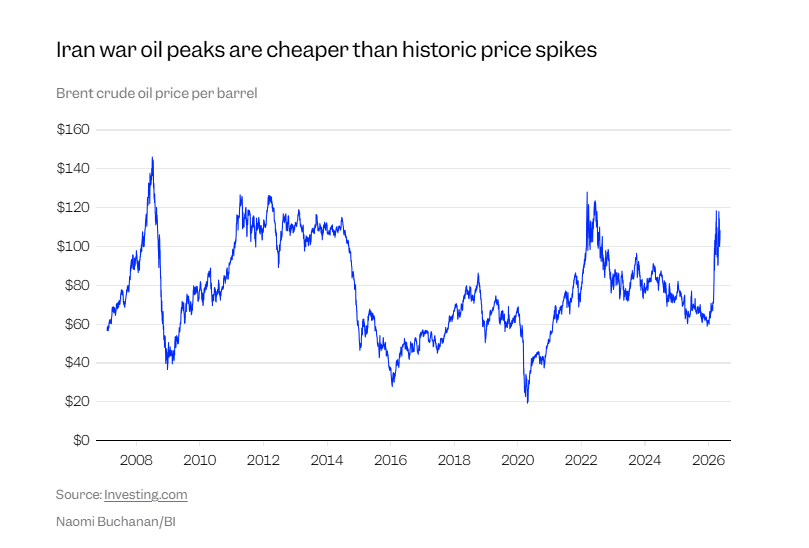
"Oil prices have risen but remain below the levels seen in 2022 — representing a much smaller shock," wrote analysts at Morgan Stanley.
Support from China and the United States
As for the reasons, Morgan Stanley noted that the most apparent explanation for the modest price increase is the pre-war oil surplus, coupled with investor expectations that the issue will be resolved quickly.
Strategists pointed out that the deeper reason behind the phenomenon of oil prices remaining at 'relatively moderate highs' despite the historic market turmoil caused by the Iran war lies in trade activities involving the world's two largest powers — the United States and China.
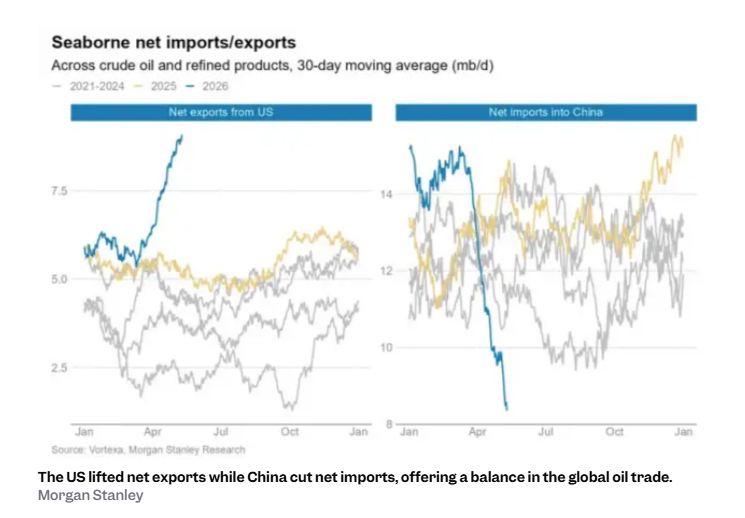
The strategists noted, "There is actually more 'oil on the sea,' rather than less." After analyzing tanker tracking data, Morgan Stanley found that global seaborne trade balance has improved recently due to import and export activities by the United States and China.
The United States 'leads the way' in boosting crude oil supply
Outside the Middle East, oil-producing countries led by the United States have significantly increased seaborne exports, exceeding expectations.
Morgan Stanley strategists analyzed export data from April 8 to May 8, 2026, compared to the same period in 2025. They found that net exports from Saudi Arabia, the United Arab Emirates, Kuwait, Iraq, Iran, Qatar, and Bahrain decreased by 12.3 million barrels per day.
However, exports from other producers increased during the same period, offsetting the loss by approximately 5.5 million barrels per day.
According to Morgan Stanley, this effort was 'led' by the United States, with the U.S. alone contributing an increase of 3.8 million barrels per day.
"The offsetting effect on the export side is largely a story of one country: the United States," the report stated.
Of course, other oil-exporting countries also increased their exports, but by smaller margins. Canada was the second-largest exporter with an increase of 400,000 barrels per day, followed by Argentina and Venezuela, each with a rise of 200,000 barrels per day.
China 'leads' in curbing demand
On the demand side, some oil-importing nations reduced their net imports, particularly China.
According to Morgan Stanley's report, during the year-on-year comparison between 2026 and 2025, typically oil-importing countries saw their daily seaborne net imports drop by 10.9 million barrels, exceeding the net reduction in exports.
This dynamic suggests a decline in demand, likely due to buyers postponing purchases in anticipation of the Strait reopening soon. China alone accounted for half of the import reduction. A year ago, China imported approximately 14 million barrels of crude oil per day, whereas now it imports about 8.5 million barrels daily.
Morgan Stanley commented, "The scale of adjustment is quite significant, and we believe this represents the most crucial piece of the puzzle. There are clear indications that China holds substantial oil reserves, which it is tapping into while reducing imports."
Of course, China is not the only country cutting oil imports. Japan, South Korea, India, and Singapore collectively reduced imports by 3.9 million barrels per day. Europe and other refining nations accounted for the remaining approximately 1.5 million barrels per day of the reduction.
Editor/KOKO