
Source: Qile Club
Baillie Gifford is best known for its Long-Term Global Growth (LTGG) investment strategy. This strategy seeks out and invests in the world's most competitive, innovative, and growth-efficient enterprises over the long term. A common characteristic of high-growth companies is high volatility. In the short term, individual stocks can experience significant declines. This is also considered the main drawback of the LTGG strategy.
In particular, since the end of 2021, the rapid rise in inflation and the subsequent interest rate hike cycle have led to market turbulence, significantly impacting the performance of the LTGG strategy. At its worst, the LTGG strategy experienced a decline exceeding 50%.
 Investors understand that downside volatility can adversely affect long-term capital appreciation. When asked about his investment principles, Buffett, also a long-term investor, said:
The first rule of investment is not to lose money.
The second rule is to remember the first rule.
Some believe that long-term investors, due to their "long-term" focus, can tolerate short-term volatility in exchange for long-term returns.
While these points are valid, volatility itself still brings pain to long-term investors. These debates do not further explore the nature of volatility, whether it imposes costs on long-term growth investors, or what volatility truly signifies.
For Baillie Gifford, uncovering the essence of issues is paramount. The right question is not whether volatility represents a short-term or long-term headwind, but whether the volatility of the LTGG strategy should be understood as an indispensable feature of successfully implementing this investment approach or as a flaw that should be mitigated.
This notion may seem straightforward, yet it is highly significant for investing:
Investors should make adjustments to continuously improve their strategies, but altering any core aspect of an investment methodology—even if it represents a cost—could undermine what the strategy does well.
Below is a detailed discussion by Baillie Gifford. (Slightly edited for ease of reading.)
Capturing Volatility and Outliers
What does the Long-Term Global Growth (LTGG) strategy excel at?
Identifying outlier stocks (those offering at least a 5x return) and holding them in large positions over the long term to maximize their extraordinary compounding growth impact on the portfolio. The motivation behind this strategy is the observation that a small number of outlier stocks disproportionately contribute to overall wealth creation in equities.
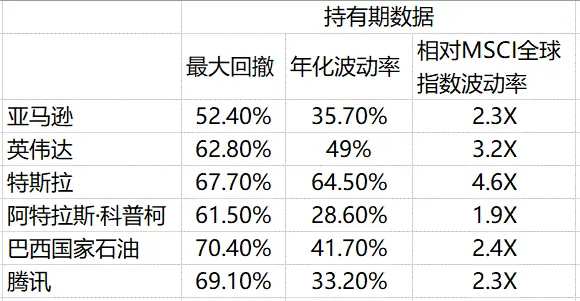
This is not merely an academic abstraction. Although the LTGG strategy has achieved an annualized outperformance of 4% over the benchmark in the past 20 years, removing just six stock positions would have been sufficient to completely eliminate the outperformance (resulting in returns equal to the benchmark). These key holdings include Amazon, Tesla, NVIDIA, Tencent, Atlas Copco, and Petrobras, which account for less than 4% of the total number of stocks invested in by LTGG during this period. The reason for LTGG's superior performance is that the strategy maintained significant positions in these six stocks.
Our performance is highly sensitive to our success in capturing outliers. However, capturing outliers and volatility comes as a package deal.
There are two main reasons for this. First, volatility is an inherent characteristic of outlier stocks. The six most successful investments were also among the most volatile stocks. The table below illustrates the volatility characteristics of the six best-performing holdings in LTGG:
This phenomenon is not unique to the LTGG strategy; it is also very evident in the broader market.
A recent study on the top 10% best-performing stocks over the past decade shows that 95% of these high-return stocks experienced at least one period of underperformance relative to the market, with a decline of 20% or more. Additionally, 45% of these stocks went through at least one period of relative market decline of 50% or more. Similarly, a survey of the top 5% best-performing stocks in the MSCI World Index over the past two decades found that 40% of these stocks experienced declines of 50% or more during their periods of exceptional performance.
If we aim to capture outliers, it is highly likely that we will end up with stocks that experience significant downward volatility.
Portfolio concentration is the second reason for capturing outliers and volatility intertwined. If the success rate of capturing outliers is defined as outlier stocks ÷ total stocks held, then over the past decade, LTGG’s capture rate has been three times that of the MSCI Global Index.
However, from another perspective, LTGG only captured 11 outlier stocks in the past decade, compared to 135 outlier stocks within the MSCI Global Index.
Baillie Gifford did not achieve its superior outlier capture rate through a larger numerator but rather through a smaller denominator. In other words, we achieved a higher outlier capture rate through highly concentrated portfolios. Although Baillie Gifford identified fewer outlier stocks than the index, their dilution was lower.
While reduced dilution makes LTGG inherently more susceptible to the impact of rising outlier stocks, it also renders the LTGG strategy more vulnerable to downside volatility.
To smooth out downside volatility, LTGG would need greater diversification. However, it has not done so because increasing the number of holdings would reduce our outlier capture rate, thereby undermining the key factor behind the strategy's outperformance.
This is why LTGG exhibits such pronounced volatility at the portfolio level, including several significant drawdowns:
2007-2009: Maximum drawdown of 55.6%
2021-2022: Maximum drawdown of 53.5%
2011: Maximum drawdown of 21.5%
2018: Maximum drawdown of 18.2%
2015-2016: Maximum decline of 15.4%
If outlier capture and volatility are intertwined at both the stock and portfolio levels, and LTGG's performance relies on outlier capture, then volatility is a feature of LTGG’s investment strategy.
Reducing volatility would be inconsistent with LTGG’s core objective — enhancing outlier capture.
Volatility comes at a cost.
Recognizing volatility as an inherent characteristic of the LTGG investment approach does not mean we should pretend it is a positive feature. We have sometimes been guilty of ignoring this. The downside volatility of the LTGG strategy introduces significant headwinds to the long-term capital growth we deliver to clients.
We can quantify this. Since its inception, LTGG has achieved an arithmetic average annual return of 17.5%, but our geometric average annual return — the compound annual growth rate (CAGR) that truly matters to us and our clients — stands at 13%.
The difference reflects LTGG’s annual volatility of 31.8%, which has translated into a 4.5% annual volatility drag. In contrast, the MSCI World Index exhibits much lower volatility at 17.2% annually, implying an annual volatility drag of only 1.5%.
The result of LTGG’s greater volatility drag is that a 10% arithmetic average annual return translates to only 5.5% for our clients in terms of compound annual growth rate (CAGR), compared to 8.5% for the MSCI World Index. Effectively, this means the index achieves higher compounding growth. To debunk the myth that downside volatility only troubles “short-term” investors, note that the cost of volatility drag only worsens over time through the effect of compounding.
Downside volatility introduces a cost that compounds over time. However, this cost cannot be assessed in isolation from value creation. Despite an annualized volatility drag three times that of the index, LTGG’s compounded returns since the index’s inception remain double that of the index because our average returns are 1.7 times higher.
Our superior average returns are attributable to the higher earnings growth in our portfolio, which correlates with our focus on outlier capture. Despite our higher volatility, LTGG delivers significantly greater wealth compounding due to our substantially higher average annual returns compared to the index.
This highlights that we can only tolerate higher volatility costs if our portfolio can deliver sufficiently superior growth (and thereby superior average returns) to offset the cost of volatility. In the absence of growth to absorb the volatility cost, the volatility cost will erode outperformance.
Understanding the Balance
I concede that the drag from volatility during downturns represents a real cost for long-term investors. I also affirm that LTGG reliably achieves superior growth and thus delivers superior average annual returns sufficient to compensate for this cost.
But the natural question arises: if we could maintain superior average returns while reducing the volatility drag, could we further create wealth for our clients? Mathematically, this should enhance our performance, and the impact could be substantial.
For instance, if LTGG were to maintain its superior average annual return while reducing the volatility drag to align with the index, over the past 20 years we would have generated an additional 69% in wealth for our clients.
Shouldn't we aim to improve our performance in this manner over the next 20 years? Theoretically, the pathway to enhancing performance by reducing volatility is compelling, but is it achievable? The fact that outlier capture and volatility come as a package deal means that without a fundamental shift in our investment philosophy, the LTGG strategy cannot achieve this goal.
We need to abandon decades of focus on outlier capture and find
an entirely different approach to achieving higher average returns,
while also figuring out how to achieve appropriate diversification to reduce excessive volatility.
To succeed, we need to address these two new challenges effectively, neither of which we currently have established capabilities for. This means our chances of achieving each new objective are at best akin to flipping a coin (collectively, our odds of succeeding on both fronts simultaneously stand at only 25%).
In contrast, if we adhere to our long-term investment approach, consistent performance requires us to excel in one area
—exceptional outlier capture rate—a capability that LTGG has developed over the past 20-plus years.
Indeed, our long-term investment methodology has demonstrated outperformance against the MSCI ACWI in 98% of five-year rolling periods.
We prefer these odds over a random coin toss, although we certainly acknowledge that our 20-year track record represents only a limited sample within the broader scope of equity market history, and past performance is not indicative of future returns.
While theoretically reducing volatility could enhance our performance, we have multiple avenues for improving outcomes, and the path we choose should reflect our assessment of their relative expected value. Although theoretically reducing volatility drag based on indices could have generated 69% of wealth for LTGG clients over the past two decades, it would also lower the probability of successfully capturing outliers. The expected value of shifting to this approach remains significantly below LTGG's long-standing focus on outlier capture.
The conclusion drawn from this costly trade-off is that there is no need for LTGG to optimize for reduced volatility unless we believe that the likelihood of our current, established focus on outlier capture outperforming the market has collapsed. We currently have no reason to believe this is the case.
Over the past decade, LTGG’s outlier capture rate has typically ranged between 5-10%, with a temporary increase in the pre-pandemic five-year period. The most recent five-year period remains at the higher end of the historical range, with an outlier capture rate approaching 9%.
How we manage sequencing risk
Of course, there will be periods when LTGG’s volatility drag is higher or lower than historical levels. However, we have determined that reducing volatility merely for the sake of reducing volatility is not meaningful.
Our management of volatility should be limited to controlling our sequencing risk (i.e., the risk that individual stock drawdowns at the portfolio level become significant enough to erode the capital base, thereby impeding return recovery). Managing sequencing risk aims to reduce the likelihood of permanent capital impairment caused by volatility.
We have two primary approaches to managing this sequencing risk.
The first is situational awareness. If we observe anomalies in the market environment that significantly increase the risk of permanent capital destruction for LTGG, we recognize this on a case-by-case basis. The magnitude of the decline experienced by LTGG clients in 2022 suggests that the extreme valuations seen in 2021 may have been a market anomaly. This period of abnormality was corroborated by an unusually high number of high-return stocks during the pandemic, with returns exceeding fivefold. This phenomenon is empirically rare and evidently crucial for an investment strategy reliant on outlier capture. In 2021, LTGG lacked sufficient situational awareness. Subsequently, we enhanced our situational awareness through collaboration with the risk team to better identify relevant anomalies in the market environment.
However, it is critical not to overstate what this awareness can help us achieve. The measures we take cannot immunize LTGG from experiencing similar significant declines again, just as the lessons from the downturn during the global financial crisis did not prevent another occurrence in 2022. More importantly, we must not confuse the purpose of this situational awareness: we do not intend to manage volatility in response to market anomalies because we lack optimized methods to reduce volatility. Instead, we hope that our improved situational awareness assists us only in rare instances where it may help mitigate the risk of permanent capital destruction—a risk that would impede our pursuit of outlier capture.
The second and most important method for managing sequencing risk is constructing a portfolio capable of recovering from downturns, thereby avoiding permanent impairment. This requires tilting the LTGG portfolio toward companies with strong prospects for earnings growth, as robust earnings growth is the best predictor of whether a company will rebound from a significant contraction within five years. Thus, tilting the portfolio toward superior earnings growth helps reduce the risk of permanent capital destruction while remaining aligned with our overall optimization for outlier capture.
This highlights how disruptive it would be if we were to follow industry conventions and respond to severe economic downturns with a defensive shift away from growth.
Conclusion
Our tolerance for excessive volatility is inseparable from our performance. This is precisely why we must acknowledge seriously that volatility comes at a cost.
If you engage in something without understanding its drawbacks, your ability to sustain it will be compromised. It would be naive to believe that LTGG’s approach to outperforming the market comes without costs.
We are obsessed with the singular objective of outlier capture because we know how difficult it is to optimize execution across multiple objectives. When goals conflict with one another, the difficulty renders operations impossible, as is the case with outlier capture and volatility reduction.
We must choose between them, and we have chosen an approach that provides greater leverage for outperformance: volatility drag can only be reduced to zero, but there is no upper limit to excess returns. Therefore, it is reasonable for LTGG to focus our ongoing efforts to improve investments on increasing the latter.
A sustained focus on excess returns through outlier capture also provides LTGG with higher expected value, as we have honed this as our core competency over two decades.
However, our volatile path does indeed incur higher costs compared to a stable one, which is also the crux of our competitive advantage. Some fund managers simply follow Professor Hendrik Bessembinder's research, viewing the capture of outliers as a way to outperform the market, but they lack practical experience regarding the associated costs. We hold significant doubts about their approach.
During certain periods, without Baillie Gifford's unique ownership structure and the memory of LTGG successfully enduring a more challenging path over the past 20 years, these costs would have been overwhelmingly burdensome to sustain.
Editor/Stephen