The recent sharp sell-off in U.S. Treasury bonds is likely far from over.
According to Zhitong Finance, the recent significant sell-off in U.S. Treasuries is likely far from over. Analysts indicate that persistently high inflation, shifting market interest rate expectations, and evolving investor trading behaviors will continue to weigh on bond prices, with bond yields expected to rise further in the coming weeks.
For months, many investors have considered a 4.5% yield on the benchmark 10-year Treasury bond an attractive entry point. However, once yields surged past this level, market participants quickly adjusted their expectations and began reassessing where the next wave of buyers might step in.
 Padhraic Garvey, Head of Global Rates and Debt Strategy at ING Groep, noted, 'The key question now is whether investors will enter the market at current levels. In my view, this sell-off is likely to continue spreading.'
He also stated that multiple underlying drivers are still fueling the sell-off, with the 10-year U.S. Treasury yield likely to rise further to 4.75%. The persistent increase in benchmark bond yields is also impacting the U.S. equity market, as rising borrowing costs continue to weigh on corporate operations and consumer spending.
Inflation remains the core driver shaping market dynamics. Recent data on consumer prices and producer prices both exceeded market expectations, confirming that the pace of price declines is much slower than previously anticipated. As more inflation data, including figures from May, are released, the industry widely expects inflation to remain elevated.
Once bond investors conclude that inflation will remain persistently high or even reaccelerate, they will demand higher bond yields to offset losses caused by eroding purchasing power.
As of last Friday, the 10-year U.S. Treasury breakeven inflation rate, which reflects long-term market inflation expectations, rose to 2.507%, nearing a three-year high. This figure partly reflects investor confidence—or lack thereof—in the Federal Reserve's ability to control inflation over the long term.
Garvey warned that even a modest increase in inflation expectations to between 2.6% and 2.7% could drive bond yields significantly higher, potentially pushing yields up by an additional 10 to 30 basis points with ease.
These signs suggest that the market has yet to fully price in the potential risks of prolonged high inflation. Investors have now begun evaluating two possibilities: the Federal Reserve may extend the duration of maintaining higher interest rates, and if inflation does not subside, there is even the possibility of resuming rate hikes.
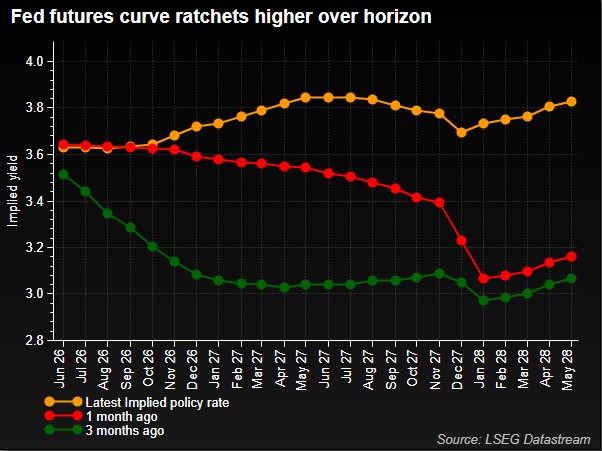
As investors gradually abandon expectations of rate cuts, short-term yields have already risen.
Jim Barnes, head of fixed income at Bryn Mawr Trust, stated outright that the overall sentiment of the market has clearly shifted completely, remarking, 'The current interest rate environment is entirely different now.'
‘Coupled with no positive developments in the situation regarding Iran and continuous economic data underscoring inflationary pressures, the bond market has fundamentally altered its pricing logic, pushing up asset valuations across the board.’
Long-end bond markets face challenges; overseas bond purchasing patterns undergo changes.
In the long end of the U.S. Treasury yield curve, conditions remain equally uncertain.
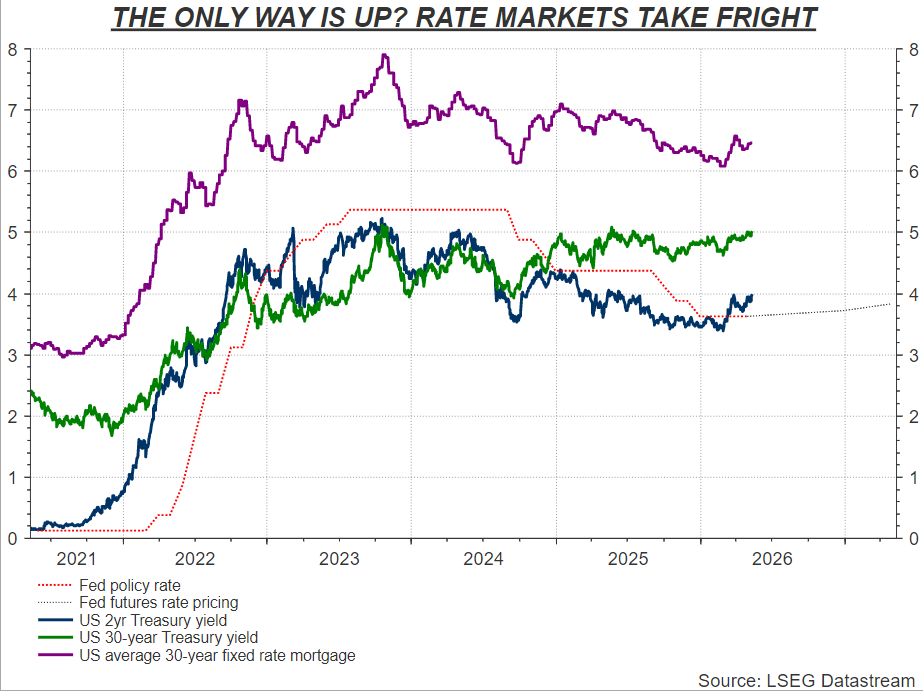
Guneet Dhingra, head of U.S. rates strategy at BNP Paribas, stated that after the 30-year U.S. Treasury yield broke through the 5% threshold, it lost all clear upward resistance levels. In the past, yields would stabilize upon reaching specific points, but once key thresholds are breached, upward movement becomes unrestricted.
He admitted frankly, 'The market has now lost its pricing anchor. Amid persistently high inflation, expanding fiscal deficits, and a general rise in global bond yields, there is no force capable of curbing further increases in U.S. Treasury yields.'
Moreover, the shift in the structure of U.S. Treasury buyers is another critical factor influencing market dynamics. In the past, countries with trade surpluses with the U.S. were stable long-term buyers of U.S. Treasuries, and this type of capital was less sensitive to short-term market fluctuations.
Dhingra noted that the main buyers of U.S. Treasuries have now changed significantly and are more sensitive to price fluctuations. Funds are concentrated in international financial centers such as the UK, Belgium, the Cayman Islands, and Luxembourg. These regions serve as core custodial locations for global hedge funds holding U.S. Treasuries and consistently rank among the top seven overseas holders of U.S. debt.
As early as March last year, the UK surpassed China to become the second-largest overseas holder of U.S. Treasuries, with its current holdings approaching $900 billion.
Dhingra stated that this transition implies that higher yields no longer automatically attract buyers as they did in the past. Investors have become more cautious and selective, which may lead to further increases in yields before demand rebounds—potentially testing higher levels before finding a true bottom.
Garvey from ING concluded, "The market adjustment is far from over. It's only the beginning of May, and upcoming inflation data will continue to rise, keeping pressure on the bond market severe."
Editor/Deng