
Goldman Sachs recommends caution and waiting for a deeper sell-off, Barclays warns yields could breach 5.5%, and BlackRock advises reducing bond exposure in favor of equities.
Analysts note that persistent inflation, widening fiscal deficits, the collapse of expectations for Federal Reserve rate cuts, and instability in the Middle East are jointly suppressing buying interest, leaving the market without a pricing anchor and maintaining upside risks to yields.
U.S. long-term Treasury bonds are facing a fresh wave of aggressive selling, with the 30-year yield surging past 5% to 5.14%, approaching its highest level since 2007. This has thrust global bond investors into an unusual and open disagreement: should they enter the market now to lock in high yields, or continue waiting for deeper price declines?
 Following the breakout in the 30-year yield, major Wall Street institutions quickly diverged in their views. Goldman Sachs noted that some value signals have emerged but recommended caution; Barclays warned clients that yields could climb further above 5.5%; BlackRock’s head of research advised investors to reduce exposure to developed-market government bonds, including U.S. Treasuries, and shift toward equities. Meanwhile, Gregory Peters, Co-Chief Investment Officer at PGIM Fixed Income, stated that although yields appear attractive to him, he maintains an underweight position on 30-year U.S. Treasuries. "Global bond markets are in chaos, and investors are losing confidence."
At the heart of this divergence lies a confluence of multiple pressures: persistent inflation, continuously widening fiscal deficits, escalating tensions in the Middle East driving energy prices higher, and deep uncertainty surrounding the Federal Reserve’s policy trajectory.
Analysts note that these factors have collectively suppressed buying interest, causing previously perceived strong support levels to break down one after another and fundamentally undermining market participants’ pricing logic for U.S. Treasuries.
With key levels repeatedly breached, the market is searching anew for a 'floor.'
Prior to this round of selling, the market widely viewed$U.S. 10-Year Treasury Notes Yield (US10Y.BD)$a yield of 4.5% as an attractive entry point and the 30-year yield of 5% as a critical threshold capable of drawing demand. However, both levels have now been breached without the anticipated strong buying support materializing.
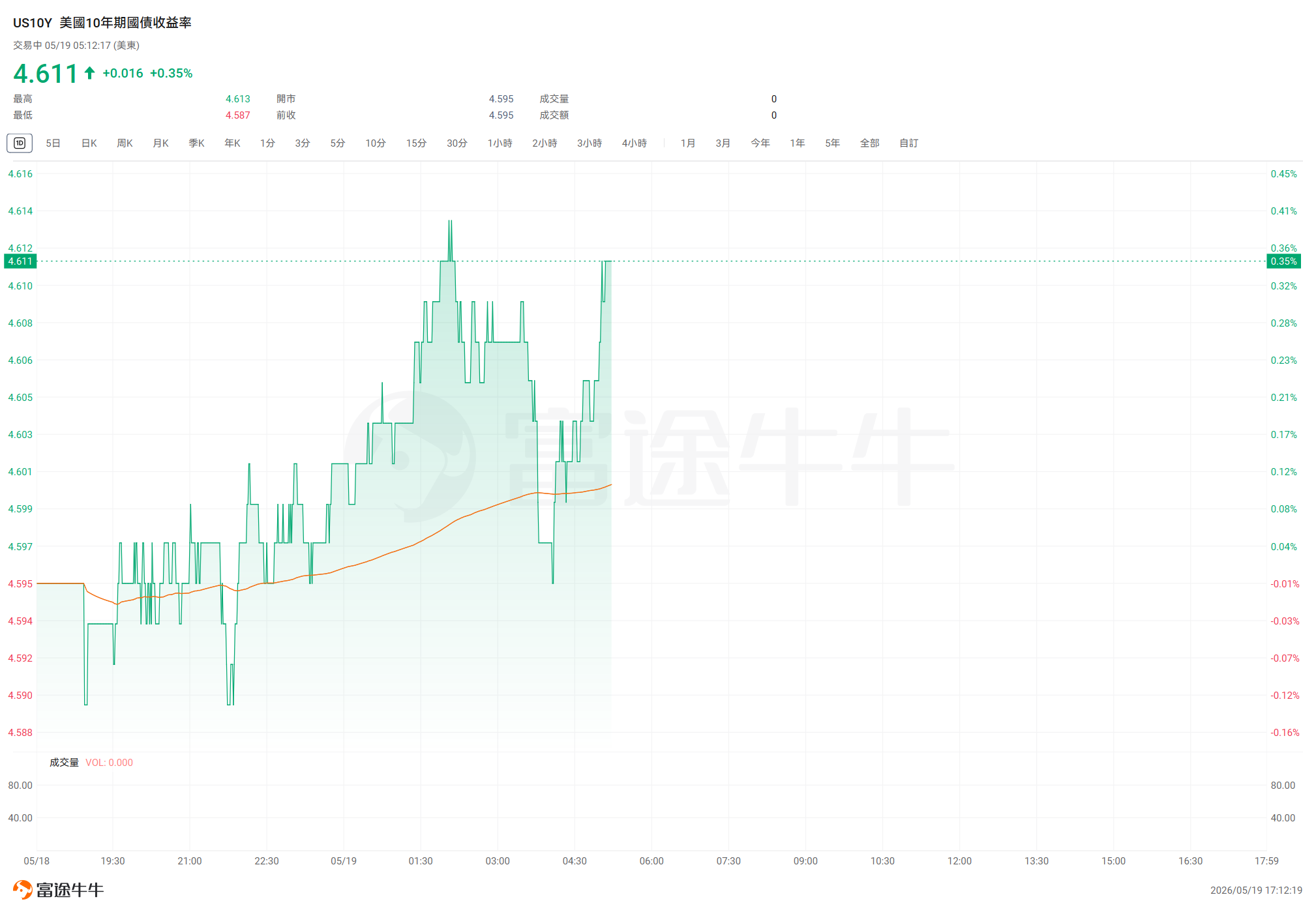
The 10-year U.S. Treasury yield currently stands at 4.61%. Padhraic Garvey, ING’s Global Head of Rates and Debt Strategy, expects the next target level to be 4.75%. "The question is whether anyone will actually step in to buy during this sell-off, because I think this situation will persist," he said.
Ajay Rajadhyaksha, Chairman of Global Research at Barclays, was even more direct:
"Yields may be near their highs for the year, but that alone does not justify taking long-duration positions. The forces driving the sell-off—deteriorating fiscal conditions, rising defense spending, sticky inflation, and central banks stuck in a policy stalemate—won’t resolve themselves within a week."
Guneet Dhingra, Head of U.S. Rates Strategy at BNP Paribas, pointed out that once the 30-year yield surpassed 5%, the previous 'ceiling' effect had already vanished.
"In an environment of high inflation, mounting deficits, and broadly rising global bond yields, there is no anchor now—what could stop yields from climbing further?"
Rising inflation expectations have closed the window for Federal Reserve rate cuts.
Inflation is the core driver behind this round of selling. Recent U.S. Consumer Price Index (CPI) and Producer Price Index (PPI) data both came in stronger than expected, dashing market hopes for a rapid decline in inflation.
On Friday, the breakeven inflation rate—a market-based measure of long-term inflation expectations—rose to 2.507%, approaching a three-year high. Garvey warned that even a modest increase in inflation expectations to 2.6%–2.7% would be sufficient to easily push yields up by another 10 to 20, or even 30, basis points. 'That’s the path for yields to break higher.'
Moreover, with expectations for rate cuts thoroughly dampened, short-end yields have risen in tandem. Jim Barnes, Director of Fixed Income at Bryn Mawr Trust, noted a clear shift in market sentiment.
"This is a different interest rate environment. With no positive developments in the Iran situation and incoming data continuing to signal inflationary pressures, the bond market appears to have laid its cards on the table—we must reprice assets."
Analysts note that investors are beginning to seriously consider the possibility that the Federal Reserve may not only refrain from cutting rates but could even hike rates again if inflation fails to subside.
Beyond inflation, deeper structural shifts in the composition of U.S. Treasury buyers are also weighing on the market.
Dhingra pointed out that historically, major buyers of U.S. Treasuries were countries with trade surpluses vis-à-vis the United States—buyers who were relatively insensitive to short-term price volatility and could provide stable demand support during periods of rising yields.
But today’s buyer base is markedly different—it now consists largely of financial centers such as the United Kingdom, Belgium, the Cayman Islands, and Luxembourg. These jurisdictions serve as primary custodial hubs for global hedge funds holding U.S. Treasuries and all rank among the top seven non-U.S. holders of U.S. government debt.
These buyers are more price-sensitive and will not automatically enter the market simply because yields rise. Dhingra stated that this means yields may need to climb even higher to genuinely trigger sustained buying interest. 'We haven’t reached the peak yet. It’s only May, and inflation data will likely get worse.'
Middle East tensions introduce uncertainty, rendering valuation-based arguments fragile at any moment.
Beyond fundamental pressures, the situation in the Middle East has added further uncertainty to markets, making any 'value-buying' rationale appear fragile.
During Asian trading on Monday, long-end U.S. Treasury yields briefly rose to their highest level since 2023, before pulling back amid market rumors of a breakthrough in U.S.-Iran negotiations and a potential reopening of the Strait of Hormuz. However, subsequent reports denied this optimistic outlook, prompting another reversal in market sentiment.
At the close of New York trading on Monday, Trump said he had called off a military strike on Iran originally scheduled for Tuesday, citing ongoing 'serious negotiations,' which provided temporary support to bond markets. However, the rally was limited, as investors remained highly cautious about a potential 'false dawn.'
"The current valuation argument is extremely fragile," said John Sidawi, senior portfolio manager at Federated Hermes. He noted that this rationale hinges entirely on developments in the Middle East: "If tensions escalate, you can throw the valuation argument out the window."
Goldman Sachs’ strategy team characterized the current situation as an 'uneasy introduction of value'—long-end U.S. Treasuries are beginning to show signs of attractiveness by several metrics, but conditions are likely to deteriorate further before improving.
The bank’s strategy team, led by George Cole, recommended that investors seeking to extend duration should adopt structured strategies that limit downside risk and wait for either 'a deeper sell-off' or 'credible signals of restored energy flows' before adding to long-duration positions.
Editor/melody