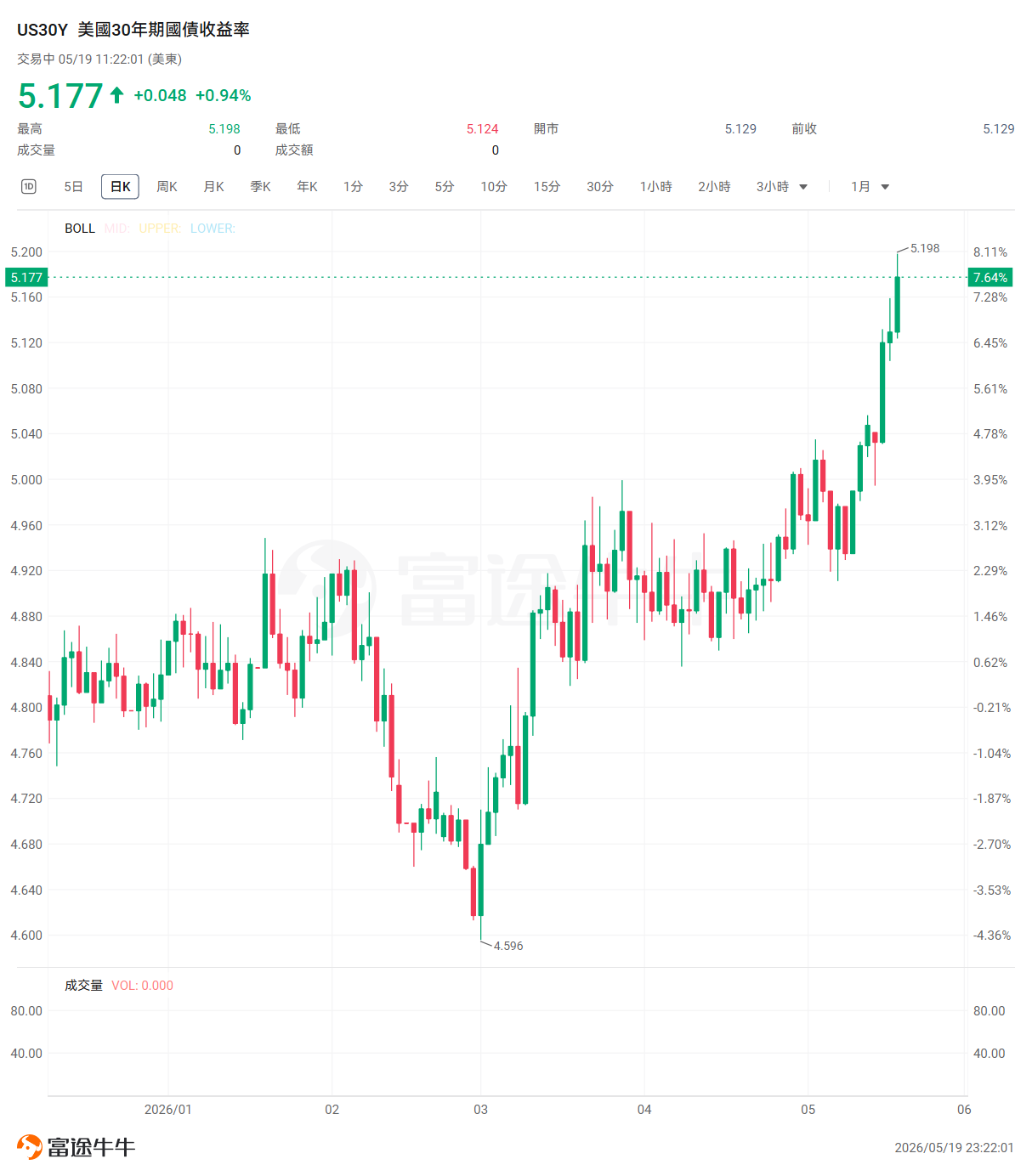
The war has driven up energy prices and persistent widening of fiscal deficits, triggering a new wave of turbulence in global bond markets. On Tuesday, the yield on the 30-year U.S. Treasury note rose to 5.18%, reaching its highest level since 2007, while the two-year Treasury yield climbed to 4.11%, a high not seen since February 2025. The narrative of 'persistently high interest rates' has gained deep market consensus, and bets on further Federal Reserve rate hikes are intensifying.
Renewed inflation concerns have triggered another wave of turbulence in global bond markets.
On Tuesday, the yield on the 30-year U.S. Treasury note rose by 5 basis points to 5.18%, hitting its highest level since 2007; the two-year yield climbed to 4.11%, a new high since February 2025. This continues weeks of persistent weakness in the bond market, with yields steadily climbing higher.
 Behind this latest sell-off are inflationary pressures stemming from war-driven energy price increases and deepening market concerns over persistently widening fiscal deficits.
Previously, most investors viewed 5% as a psychological threshold for the 30-year Treasury yield, expecting buying interest to emerge upon a breakout above that level. However, the recent sharp rise in long-end rates is undermining this assumption, potentially signaling that this $31 trillion market is entering a new era.
According to a prior article by Wall Street CN, Citi macro rate strategist Jim McCormick stated that traders have now set their next key round-number target for the 30-year Treasury yield at 5.5%. He noted that core inflation shows no clear signs of cooling and the U.S. economy remains resilient, implying that the Federal Reserve is unlikely to cut rates in the near term, prompting investors to reassess the value proposition of holding long-dated Treasuries.
Inflation and Fiscal Pressures Fuel Pessimism in Long-Duration Bonds
Institutional investors are showing increasingly pronounced pessimism toward long-end bonds. Ajay Rajadhyaksha, Chairman of Barclays Global Research, remarked: “With debt growing faster than the economy, inflation expectations continuing to deteriorate, and a lack of political will for fiscal reform, there is little rationale for chasing long-duration assets.”
This statement reflects the market’s strong consensus around the narrative of ‘higher for longer’ interest rates. With inflation expectations and fiscal concerns reinforcing each other, investors are being forced to re-evaluate their assumptions about the Federal Reserve’s policy trajectory, placing systemic pressure on positions previously built on expectations of imminent rate cuts.
Pricing in the interest rate swaps market is particularly telling. Data show that market bets on the Fed’s next rate hike are intensifying—sharply contrasting with pre-war expectations of multiple rate cuts—and reflect a fundamental shift in investor views regarding the persistence of inflation.
As the benchmark anchor for global asset pricing, the sustained rise in long-end U.S. Treasury yields is transmitting through channels such as mortgage rates and corporate borrowing costs into the real economy, exerting broad-based effects on global credit conditions.
Editor/Stephen