
NVIDIA is transforming itself from a chipmaker into a central capital force across the entire artificial intelligence industry.
According to the Financial Times on Tuesday, over the past 16 months,$NVIDIA (NVDA.US)$it has committed approximately $90 billion in total to investment and collaboration deals, spanning more than 145 companies, including AI model developers, cloud computing service providers, and infrastructure suppliers.
This scale rivals that of the largest venture capital arms among major technology firms, positioning NVIDIA as the most aggressive dealmaker in the tech sector. NVIDIA will report its quarterly earnings this Wednesday, which the market views as a key barometer of global AI spending.
 Meanwhile, NVIDIA announced it will establish its first research center in Singapore—the second such facility in the Asia-Pacific region—focusing on embodied AI and improving AI infrastructure efficiency. This move closely aligns with Singapore’s strategic ambition to position itself as a regional AI hub, further underscoring NVIDIA’s expansive ambitions in the global AI landscape.
While this large-scale deal offensive accelerates the expansion of the AI ecosystem, it also places NVIDIA at the intersection of customers, suppliers, and potential competitors—a dynamic that has already drawn scrutiny from global regulators.
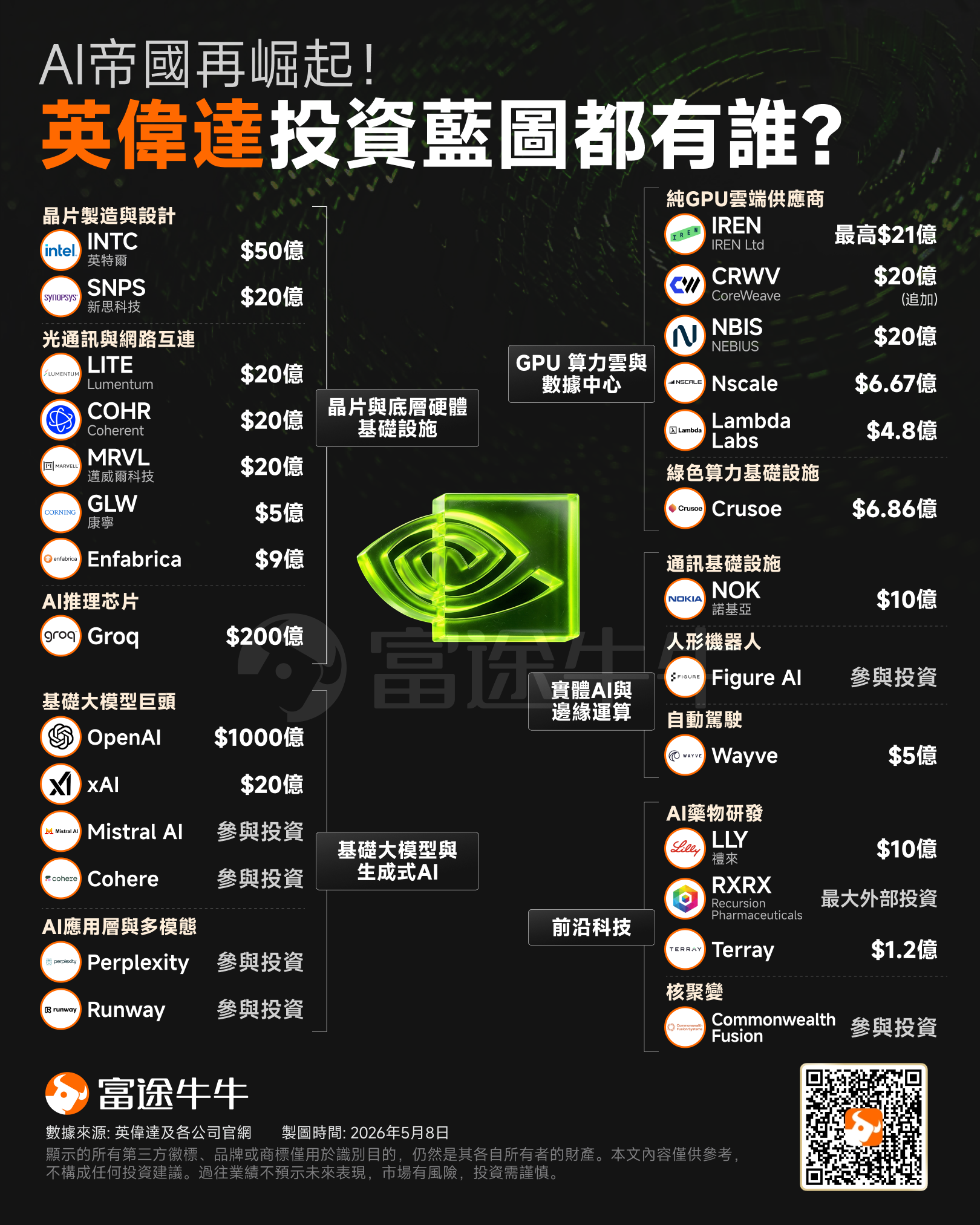
Where does the $90 billion come from: Two parallel funding streams
Citing company disclosures and PitchBook data, the Financial Times reported that$NVIDIA (NVDA.US)$in the fiscal year ending January 25 of this year, it committed approximately $47 billion to investments and collaborations, followed by an additional $43 billion over the subsequent four months.
This expenditure represents roughly 40% of NVIDIA’s operating cash flow in its latest fiscal year—far exceeding Alphabet, traditionally regarded as the most active investor in startups among major tech companies, which allocates about 6% of its cash flow to such investments.
Internally, NVIDIA operates two parallel deal-making mechanisms. While the company maintains a venture capital arm named NVentures, sources familiar with the matter indicate that its business development team has led the majority of recent transactions, often accompanied by broader commercial cooperation agreements. A San Francisco-based lawyer described the process: after NVIDIA’s technical teams engage with target companies, business development personnel—“carrying checks”—are brought in, resulting in “two concurrent lines of dialogue.”
Binding the ecosystem: From chip interconnectivity to open-source models
$NVIDIA (NVDA.US)$Its investment rationale is not driven solely by financial returns but rather by using capital as a strategic link to deeply integrate partners into its own technology ecosystem.
Patrick Little, CEO of semiconductor design startup SiFive, revealed that NVIDIA took an equity stake in SiFive shortly after the two parties reached an agreement to make SiFive’s chip designs compatible with NVLink—NVIDIA’s proprietary interconnect technology. He stated that NVIDIA’s investment logic is “to ensure that both parties’ solutions always work well together.”
NVIDIA reached a similar arrangement with chip designer$Marvell Technology (MRVL.US)$Marvell Technology, investing $2 billion in March of this year while also signing a cooperation agreement to ensure Marvell’s future custom chips are compatible with NVLink. Marvell is the chip designer behind Amazon’s Trainium AI accelerators.
On the software front, according to two informed sources, NVIDIA is also actively encouraging its portfolio companies to adopt its open-source AI model, Nemotron. Jensen Huang hopes Nemotron can replicate the success of CUDA—the proprietary software platform that constitutes one of NVIDIA’s strongest competitive moats. A venture capitalist bluntly remarked: “Founders are beginning to realize that if you build your product on NVIDIA’s ecosystem, you can raise money from Jensen Huang.”
The New Force in Cloud Computing: A Tripartite Role as Customer, Supplier, and Shareholder
$NVIDIA (NVDA.US)$Among NVIDIA’s portfolio of deals, its bets on next-generation cloud computing companies have drawn particular attention—and concern—from analysts.
Jensen Huang has publicly stated,$CoreWeave (CRWV.US)$"[They] would not exist without NVIDIA’s support." NVIDIA’s backing of these emerging AI infrastructure providers stems partly from the fact that large hyperscale cloud service providers such as Google and Amazon are not only NVIDIA’s biggest customers but also pose growing competitive threats through their in-house chip development efforts.
Earlier this month, NVIDIA entered into an agreement with emerging cloud computing company$IREN Ltd (IREN.US)$committing to pay $3.4 billion over five years to lease its GPU computing capacity and investing up to $2.1 billion for an equity stake. This arrangement positions NVIDIA simultaneously as a customer, supplier, and potential shareholder.
NVIDIA’s largest single transaction last year was a $20 billion agreement with chip designer Groq, covering technology licensing and talent acquisition. As AI workloads shift toward inference computing—a domain where Groq’s processors hold a clear advantage—NVIDIA has already launched products based on Groq’s technology.
Securing the Supply Chain: Locking in Critical Manufacturing Capacity
In addition to equity investments, NVIDIA had committed $95 billion as of the end of January this year to secure component supply and manufacturing capacity.
Recent major supplier transactions announced include: $2 billion investments each in photonics companies$Coherent (COHR.US)$and$Lumentum (LITE.US)$and a $3.2 billion investment in the form of warrants in fiber-optic manufacturer$Corning (GLW.US)$—the latter produces fiber optics used in high-speed data centers. All three companies are key suppliers to Apple, and NVIDIA’s investments are positioning it as a core customer for these suppliers.
Moon Surana, portfolio manager at asset management firm Harding Loevner, stated that NVIDIA’s financial support has enabled its suppliers’ expansion plans while “enhancing NVIDIA’s bargaining power within the supply chain amid ongoing capacity constraints.”
Regulatory Risks and Singapore Strategy
This wave of large-scale deals has drawn scrutiny from global regulators.$NVIDIA (NVDA.US)$In its annual report, it disclosed that regulatory authorities in the U.S., EU, and UK have issued 'broad requests for information' regarding its 'investments, collaborations, and other agreements with foundational model developers,' as well as its agreements with customers, suppliers, and partners.
On the global footprint front, NVIDIA announced it will establish its first research center in Singapore—the second such facility in the Asia-Pacific region. According to CNBC, the center will focus on advancing embodied AI and improving AI infrastructure efficiency, collaborating with university researchers, industry partners, and government agencies.
Singapore is positioning itself as a regional AI hub and, on the same day, announced the launch of a testing platform to help private enterprises jointly design, deploy, test, and validate commercial AI robotics technologies. Industry leaders such as Certis, DHL, Grab, and QuikBot are expected to be among the first users of the platform.
Patrick Little of SiFive described Jensen Huang as having a “tunnel vision” for the AI market’s trajectory “five to ten moves ahead,” and acting accordingly. “They have zero interest in playing just one move—they want to see the pawn become a queen.”
 Looking to pick stocks or analyze them? Want to know the opportunities and risks in your portfolio? For all your investment-related questions,just ask Futubull AI!

Editor/melody