NVIDIA management stated during the earnings call that current demand is accelerating and raised its forecast for total annual AI industry spending by the end of 2030 to between $3 trillion and $4 trillion. 'Agentic AI' is driving the next wave of infrastructure investment in computing power, and the company has, for the first time, positioned its CPU business as a core growth engine going forward. NVIDIA expects CPU revenue to reach $20 billion this year.
Benefiting from the explosive emergence of the 'AI agent' era, NVIDIA has not only delivered a record-breaking quarterly revenue of $82 billion but is also seeking to demonstrate to Wall Street the sustainability of its high growth and vast potential through a shareholder return plan that exceeded expectations and a CPU strategy targeting a new $200 billion market.
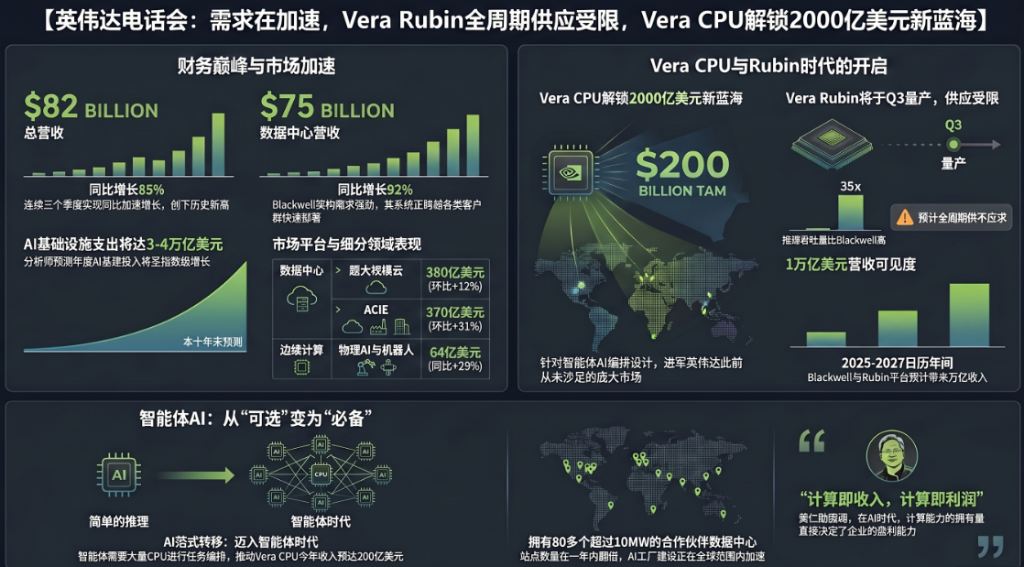
May 20, $NVIDIA (NVDA.US)$ The company reported strong financial results for the quarter, with total revenue reaching $82 billion—a year-over-year increase of 85% and a sequential increase of 20%. This marks NVIDIA’s third consecutive quarter of accelerating year-over-year growth and its 14th straight quarter of sequential growth.
 During the earnings call, company management stated that AI agents are driving the next wave of infrastructure investment in computing power and, for the first time, positioned its CPU business as a core future growth engine.
NVIDIA expects CPU-related revenue to reach $20 billion this year and expressed confidence that it will secure sufficient supply to support continued growth.
Colette Kress, NVIDIA’s CFO, noted that current demand is accelerating and raised the company’s forecast for total AI industry spending by the end of 2030 to between $3 trillion and $4 trillion annually.
NVIDIA CEO Jensen Huang also projected that Vera Rubin will face supply constraints throughout its entire lifecycle.
Amid exceptionally robust profitability, NVIDIA announced a new share repurchase authorization of up to $80 billion. Additionally, the quarterly dividend was significantly increased from $0.01 per share to $0.25 per share. The company plans to return 50% of its free cash flow to shareholders this year.
“Demand is growing parabolically,” with AI agents becoming the new growth engine
During the earnings call, NVIDIA CEO Jensen Huang stated plainly:
“Demand is growing parabolically. The reason is simple: AI agents have arrived.”
Jensen Huang noted that since the launch of ChatGPT, mainstream AI has evolved from one-off inference to logical reasoning and has now entered the 'agent' phase. AI is no longer optional—it is essential. He stated:
Tokens are now profitable. In the AI era, computing power translates directly into revenue and profit.
To address this shift, the construction of AI infrastructure is accelerating.
Management cited analyst forecasts indicating that capital expenditures by hyperscale data centers will exceed $1 trillion by 2027, and annual spending on AI infrastructure is expected to reach $3–4 trillion by the end of 2030.
Inference share surges; Rubin architecture takes over in the second half
Regarding order fulfillment and forward-looking guidance, CFO Colette Kress stated that demand for the GB300 and VL72 is particularly strong, marking the fastest product ramp in the company’s history.
In response to market concerns that its share in the inference market could be eroded by custom chips (such as ASICs or LPX), Jensen Huang responded firmly:
Our share in the inference market is growing very, very rapidly.
He pointed out that with leading model companies like Anthropic joining NVIDIA’s ecosystem, the deployment of inference compute capacity is expanding dramatically.
Regarding SRAM-based custom chips (such as LPX), Jensen Huang noted their relatively low throughput and limited context-handling capabilities, stating:
It will remain a niche product for the foreseeable future.
At the next-generation product node, Jensen Huang announced:
We will begin volume shipments of Vera Rubin starting in Q3 of this year. At this point, Vera Rubin will be even more successful than Grace Blackwell. Every leading model company I can think of will fully transition to Vera Rubin from day one.
By integrating seven specialized chips, Vera Rubin delivers up to 35 times the inference throughput of Blackwell. Looking ahead, Jensen Huang concluded:
The world is rebuilding its computing infrastructure for agentic AI and physical AI for robotics. We built our architecture well in advance of this moment, so when agentic AI arrived, NVIDIA was ready. It’s truly here now.
The new flagship Vera CPU unlocks a $200 billion market.
The most significant new information and greatest potential revealed during this earnings call stems from NVIDIA’s major strategic push into its CPU business.
Given that agentic AI requires extensive use of tools, browsers, and orchestration capabilities, GPUs alone are no longer sufficient—there is a market need for an entirely new CPU architecture. Jensen Huang announced:
Vera CPU opens up a completely new $200 billion market for NVIDIA—one we have never previously entered.
Vera will not only be sold as a companion to the Rubin GPU but also as a standalone CPU, storage node, and security node.
Jensen Huang revealed that NVIDIA is on track to achieve nearly $20 billion in standalone CPU revenue this year, marking its readiness to become a leading global CPU supplier.
The Vera Rubin system will begin volume shipments in the second half of this year (starting Q3), delivering inference throughput 35 times higher than Blackwell.
Revised business reporting framework reflects data center diversification
To help investors better understand the health of its business structure, NVIDIA revised its reporting framework in this earnings release, categorizing operations into two major platforms: “Data Center” and “Edge Computing.”
The Data Center segment (Q1 revenue: $75 billion) has been further subdivided into “Hyperscale Cloud Providers” and “ACIE (AI Cloud, Industrial, and Enterprise)”:
Hyperscale ($38 billion): Accounts for approximately 50% of Data Center revenue, up 12% quarter-over-quarter.
ACIE ($37 billion): Grew 31% quarter-over-quarter, with AI Cloud revenue more than tripling year-over-year and Sovereign AI revenue increasing over 80% year-over-year.
Notably, NVIDIA did not include any China data center computing revenue in its outlook. Analysts view this as a response to prior market concerns about NVIDIA’s perceived overreliance on a few Silicon Valley cloud giants.
Jensen Huang noted that the second segment (ACIE) is extremely fragmented yet vast, representing demand from millions of enterprises in the future, and that NVIDIA offers the easiest-to-lease, TCO-optimized, full-stack AI factory solution.
Full transcript of NVIDIA’s Q1 FY2027 earnings call, translated below (AI-assisted):
Opening Remarks
Good afternoon. I'm Sarah, the operator for today’s call. Welcome to NVIDIA’s first-quarter earnings conference call. To prevent background noise interference, all lines have been muted. Following the prepared remarks, there will be a question-and-answer session. Thank you. I’ll now turn the call over to Toshiya Hari.
Toshiya Hari (Senior Vice President of Investor Relations and Strategic Finance)
Thank you, and good afternoon everyone. Welcome to NVIDIA’s fiscal year 2027 earnings conference call. Joining me today are Jensen Huang, NVIDIA’s President and Chief Executive Officer, and Colette Kress, Executive Vice President and Chief Financial Officer. This call is being webcast live on NVIDIA’s Investor Relations website and will be available for replay until we hold our second-quarter fiscal year 2027 earnings call.
The content of this conference call is the property of NVIDIA and may not be reproduced or transcribed without our prior written consent. During this call, we may make forward-looking statements based on current expectations. These statements involve significant risks and uncertainties, and actual results may differ materially. For a discussion of factors that could affect our future financial performance and business, please refer to today’s earnings release, our most recent Forms 10-K and 10-Q, and our Form 8-K filings submitted to the U.S. Securities and Exchange Commission.
All statements made during this call are as of May 20, 2026, based on information currently available to us. Except as required by law, we undertake no obligation to update these statements. During this call, we will discuss non-GAAP financial measures. A reconciliation of GAAP to non-GAAP financial measures is available in the CFO Commentary section of our website. I’ll now turn the call over to Colette.
Colette Kress (Executive Vice President and Chief Financial Officer)
Thank you, Toshiya.
We delivered outstanding results this quarter, achieving record highs in revenue, operating profit, and free cash flow. Total revenue was $82.0 billion, up 85% year-over-year and 20% sequentially. This marks our third consecutive quarter of accelerating year-over-year growth and our 14th straight quarter of sequential growth—a remarkable achievement given the scale and complexity of our manufacturing operations.
The sequential revenue increase of $13.5 billion this quarter also set a new record. We capitalized on the inflection point in inference demand, rapidly scaling Blackwell systems across a diversified base of end customers—including hyperscale cloud providers, model developers, AI cloud service providers, and sovereign clients. At the same time, we efficiently allocated capital this quarter toward R&D, ecosystem investments, and share repurchases, returning a record $20 billion to shareholders while simultaneously advancing strategic investments across both upstream supply chains and downstream market ecosystems. These efforts are critical to the long-term development of the market and our enduring leadership position.
Data center revenue was $75 billion, up 92% year-over-year and 21% quarter-over-quarter, primarily driven by sustained strong demand for the Blackwell architecture. Demand for GB300 and VL72 is particularly robust among frontier model developers and hyperscale cloud providers, with cumulative deployments of Blackwell GPUs already reaching several hundred thousand units—marking the fastest product ramp in our company's history. Grace Blackwell is currently the fastest training system and also the most cost-efficient platform for inference on a per-token basis.
Our end-to-end Ethernet platform built specifically for AI, Spectrum X, now exceeds the combined scale of all competing Ethernet solutions. InfiniBand also delivered strong performance this quarter, growing more than fourfold year-over-year, driven by deployments of next-generation XDR technology. For frontier models, data center computing revenue reached $60 billion, up 77% year-over-year, while data center networking revenue was $15 billion, nearly tripling year-over-year.
Before delving into our data center business, we would like to introduce our transition to a new reporting framework that better reflects our current and future growth drivers.
We have two market platforms: Data Center and Edge Computing. The Data Center segment comprises two sub-markets: Hyperscale and ACIE (encompassing AI Cloud, Industrial, and Enterprise). Hyperscale includes revenue from public cloud providers and the world’s largest consumer internet companies; ACIE addresses diversified opportunities in AI-specialized data centers and AI factories across industries and countries. Edge Computing covers endpoint devices for agentic AI and physical AI, including PCs, gaming consoles, workstations, AI-RAN base stations, robotics, and automotive applications. We have published on our website a detailed breakdown of revenue for the past nine quarters based on this new platform structure for your reference.
Returning to our data center business, Hyperscale revenue was $38 billion, accounting for approximately 50% of total data center revenue and increasing 12% quarter-over-quarter. ACIE revenue was $37 billion, up 31% quarter-over-quarter, with AI Cloud revenue more than doubling year-over-year. On the customer side, the ability to rapidly scale AI compute capacity has significantly improved—partners operating data centers exceeding 10 megawatts in scale have nearly doubled in number over the past year alone, with more than 80 such sites now operational. Sovereign revenue grew over 80% year-over-year, and NVIDIA AI infrastructure is now deployed in nearly 40 countries, covering economies representing approximately $50 trillion in GDP.
As reflected in this quarter’s results, our customer base is diverse and continues to expand, underpinned by our extensive ecosystem, installed base, the breadth of CUDA-accelerated applications, and our competitive advantage as the lowest-cost provider on a per-token basis. We are exceptionally well positioned to capture this market opportunity, which far exceeds that of any other AI computing platform.
Demand for AI infrastructure continues to expand at an unprecedented pace, with AI factory construction accelerating and the value of NVIDIA AI infrastructure steadily increasing. H100 rental prices have risen 20% since the beginning of the year, and A100 cloud pricing has increased by nearly 15%. Thanks to the versatility of our platform and continuous performance improvements delivered through our software stack, customers continue to generate profitable revenue even after their GPUs reach the end of their depreciation period. NVIDIA’s large and trusted computing platform serves as the foundational bedrock supporting hundreds of billions of dollars in AI infrastructure investments across the entire ecosystem.
There are two primary drivers behind the acceleration in AI infrastructure investment:
First, large-scale workloads at hyperscalers—from search and advertising to recommendation systems and content understanding—are continuously migrating from CPU-based to GPU-accelerated computing. Second, adoption of AI-native products and services is reaching an inflection point. Since the launch of ChatGPT, mainstream AI has evolved from single-pass inference to inference-augmented workflows and, most recently, to agentic AI. AI is no longer a nice-to-have but an essential productivity tool across all industries and roles. This shift is driving accelerated revenue growth across every layer of the AI stack—including energy, chips, infrastructure, models, and applications.
Growth at the model layer has been especially striking, with Anthropic and OpenAI gaining momentum and accelerating further—OpenAI Codex, in particular, has seen explosive growth since the release of GPT-5.5. Analysts now project that hyperscalers’ capital expenditures will exceed $1 trillion by 2027. As agentic AI begins to permeate industries broadly, annual AI infrastructure spending could reach $3–4 trillion by the end of this decade.
Our Blackwell architecture is now ubiquitous, adopted and deployed by every major hyperscale cloud provider, every cloud service provider, and every leading model developer. Last month, we celebrated OpenAI’s launch of GPT-5.5—a model co-designed for Blackwell, trained on Blackwell, and served by Blackwell—which currently ranks #1 on the Artificial Analysis leaderboard. Microsoft’s Fairwater AI data center, the world’s most powerful, has come online ahead of schedule, powered by hundreds of thousands of Blackwell GPUs. Starting this year, AWS will add more than one million Blackwell and Rubin GPUs and collaborate on Spectrum networking. At Google, Blackwell will be made available to cloud customers, including support for confidential computing capabilities, establishing a new foundation for secure, high-performance AI.
Our market share in cutting-edge AI computing is continuously expanding. We have deepened our partnership with Anthropic and are proud to serve as its strategic partner to scale compute capacity, supporting Anthropic’s growth through multiple channels including AWS, Azure, CoreWeave, and SpaceX xAI. Additionally, key frontier labs currently building on NVIDIA platforms include OpenAI, Gemini, SpaceX xAI, Meta, MSL, Microsoft AI, TML, Reflection, Perplexity, and Cursor. With Anthropic’s addition, our market share in frontier AI models will increase significantly.
Today’s data centers are revenue-generating AI factories constrained by power and capital, and operators must choose the right architecture. Thanks to our extreme co-design philosophy, we deliver the industry’s lowest cost per token, highest token throughput, and highest return on investment. The latest MLPerf inference benchmark results are in: Blackwell Ultra swept all benchmarks, achieving the highest throughput across a broad range of model types and deployment scenarios. Full-stack innovations have driven a 2.7x increase in GB300 throughput compared to six months ago and reduced cost per token by 60%.
NVIDIA computing is not only the highest-performing AI infrastructure but also the most economical and financeable choice. Customers aren’t buying GPUs—they’re building AI factories. The right economic metric isn’t the GPU purchase price but the total cost of ownership for producing intelligence across the AI factory’s lifecycle: tokens per watt, tokens per dollar, uptime, utilization, time-to-production, software longevity, and asset lifespan. NVIDIA excels across all these dimensions.
Agentic AI and reinforcement learning present a new growth opportunity for CPUs. Building on the success of Grace CPU, the arrival of Vera CPU is timely and well-positioned to capture this inflection point. Vera is built on custom Arm cores and end-to-end co-designed with Rubin GPU and NVLink, delivering up to 1.5x higher single-core performance, 2x better performance per watt, and 4x greater rack density compared to x86-based solutions.
Vera CPU opens a new $200 billion market for NVIDIA—one we have never previously addressed—and every major hyperscaler and systems vendor is collaborating with us on deployment. We expect CPU revenue to approach $20 billion this year, positioning us to become the world’s leading CPU supplier.
Our unmatched annual product cadence remains a core pillar underpinning our market leadership. Volume shipments of Vera Rubin are expected to begin in the second half of this year, starting in Q3. By integrating seven specialized chips into five accelerated racks, Vera Rubin will deliver up to 35x higher inference throughput and up to 10x greater AI factory revenue compared to Blackwell.
As an early adopter, Google’s A5X bare-metal instances can support deployments of up to 960,000 Rubin GPUs across multiple sites, enabling customers to run their largest-scale AI workloads on NVIDIA-optimized infrastructure.
Regarding the China market, although the U.S. government has approved export licenses for H200 shipments to Chinese customers, we have not yet recognized any related revenue, and there remains uncertainty as to whether the goods will be permitted entry into China. Therefore, consistent with last quarter, we have excluded any China data center computing revenue from our financial outlook.
In edge computing, our edge computing platform generated $6.4 billion in revenue, up 10% sequentially and 29% year-over-year. Strong demand for Blackwell workstations was a key contributor to growth this quarter, while consumer demand declined slightly due to rising memory and system prices. Physical AI continues to show strong momentum, generating over $9 billion in revenue over the past 12 months. Our collaboration with Uber will support robotaxi fleets in nearly 30 cities across four continents by 2028. In robotics, leading companies across industrial, surgical, and humanoid applications are scaling development and deployment on NVIDIA technology.
We continue to proactively advance supply assurance efforts to support customer growth. In the first quarter, we increased our total supply—encompassing inventory, purchase commitments, and prepayments—to $145 billion. Although we cannot entirely avoid supply challenges, we remain fully confident in our ability to support future growth opportunities, as our advantages in focus, scale, and long-standing relationships with key suppliers will continue to play a critical role.
On the income statement, GAAP gross margin was 74.9%, and non-GAAP gross margin was 75%, both essentially flat sequentially, with Blackwell systems continuing to dominate shipments. Both GAAP and non-GAAP operating expenses increased by 12% sequentially, primarily driven by higher compensation and rising compute and infrastructure costs. The non-GAAP effective tax rate was 16%, slightly below prior expectations due to an improved geographic mix. On the balance sheet, days sales outstanding (DSO) stood at 45 days, primarily benefiting from favorable timing of cash collections, and is expected to return to approximately 55 days in the second quarter. Free cash flow for the quarter reached a record $49 billion, up from $35 billion in the fourth quarter.
With respect to capital allocation, our top priority remains ensuring sufficient funding for research and development and strategic investments. This enables us to nurture our ecosystem, drive market expansion, and strengthen our market position. As the foundational enabling platform for AI, we will continue making the necessary investments to achieve the industry’s lowest cost per token and highest token throughput, empowering our customers and partners to continuously expand the boundaries of AI.
Our shareholder return program is another core component of our capital allocation strategy. Given our confidence in our long-term free cash flow outlook and our commitment to sharing the benefits of our growth with shareholders, we have increased our quarterly dividend from $0.01 per share to $0.25 per share and will periodically review our dividend policy as our business continues to scale. We also announced a new $80 billion stock repurchase authorization, in addition to the remaining $39 billion under existing programs. As announced at GTC, we plan to return 50% of our free cash flow to shareholders this year.
Second-quarter outlook: Total revenue is expected to be $91 billion, plus or minus 2%, with sequential growth primarily driven by Data Center. We are aggressively advancing the development of our supply chain ecosystem to meet the substantial demand we anticipate, which gives us strong confidence that cumulative revenue from the Blackwell and Rubin platforms will reach $1 trillion between fiscal years 2025 and 2027. GAAP and non-GAAP gross margins are expected to be approximately 74.9% and 75%, respectively, plus or minus 50 basis points, and are still expected to remain in the mid-70% range for the full year. GAAP and non-GAAP operating expenses are expected to be approximately $8.5 billion and $8.3 billion, respectively, with full-year operating expense growth projected in the high 40% range, primarily driven by increased R&D investment and accelerated adoption of AI tools.
For the full fiscal year 2027, we expect GAAP and non-GAAP tax rates to be in the range of 16% to 18% (excluding discrete items related to significant changes in the tax environment), lower than our previous expectation of 17% to 19%, due to an improved geographic mix.
That concludes my prepared remarks. We will now move to the Q&A session, which I will hand over to Toshiya to moderate.
Toshiya Hari (Senior Vice President of Investor Relations and Strategic Finance)
Thank you, Colette. We will now open the call for questions. Operator, please begin the Q&A.
II. Q&A Session
First question: Segment reporting methodology (Joseph Moore, Morgan Stanley)
Joseph Moore (Morgan Stanley): Thank you for the opportunity to ask a question. I’d like to understand the rationale behind this segmentation adjustment. How do the competitive dynamics differ between the two segments? Additionally, regarding the surprising CPU data you mentioned, how should we interpret it across these two segments? Thank you.
Toshiya Hari: Thank you, Joseph. First, I’d like to correct a point: Colette mentioned earlier that the quarterly dividend will be increased from $0.01 per share to $0.25 per share—please note the additional $0.05 per share for major shareholders.
Regarding the segment realignment, our goal is to help everyone better understand our business. AI is inherently diverse, and so is computing itself, manifesting across multiple dimensions:
First, AI itself is diverse. Depending on the industry, AI takes different forms—for example, 3D graphics in manufacturing and industrial robotics, protein structure prediction in life sciences, small-molecule chemistry in life sciences or materials science, and physics-based simulations in physical sciences, whether in energy applications or academic research laboratories, among others.
Second, application scenarios are diverse. These span enterprises, energy, manufacturing, and virtually every other industry.
Third, deployment environments are diverse. Workloads can run on hyperscale clouds, on AI-native clouds—which are emerging globally—or be deployed on-premises at enterprises, in factories and shop floors, in supercomputing centers, or at the edge. Edge deployments include well-known examples such as autonomous vehicles and robots, but also encompass the expanding compute networks inside semiconductor fabs, packaging facilities, and various manufacturing plants. In the future, every base station and wireless network will become an AI-driven wireless network.
Fourth, governance models are diverse. While some workloads can run on public clouds, others cannot due to industrial regulatory compliance requirements, confidential computing needs, or national security considerations, necessitating purpose-built, standalone data centers.
NVIDIA’s uniqueness lies in being the only company that builds all technology components, developing them in a deeply co-designed, end-to-end, full-stack manner while maintaining platform openness to integrate into diverse environments. Certain environments—such as enterprise customers—require all components to work together seamlessly, enabling them to purchase and operate a complete solution without having to build it themselves.
Therefore, we have structured our business into three major segments:
Hyperscale Cloud: This is our first major segment. In this segment, we help hyperscale cloud providers accelerate their data processing and machine learning workloads, support their internal AI operations, and bring significant NVIDIA ecosystem business onto their public cloud platforms.
AI-native cloud, on-premises enterprise deployment, on-premises industrial deployment, and sovereign AI: This is the second major segment, growing extremely rapidly because every industry, every country, and every company needs AI—and each wants to build it in a different way. We provide a complete solution that makes this possible and significantly reduces implementation complexity.
Robotics edge computing: This is the third major segment. Historically, computing has been centered around personal computing; in the future, it will be centered around personal AI. A quintessential example of personal AI is an autonomous vehicle—essentially a robotic system functioning as a personal AI. In the future, we will see robotic systems in many forms, including wireless base stations, which will themselves essentially become robotic systems.
These three segments each have distinct software stacks, operating systems, and operational models, and our go-to-market strategies differ significantly across them. The hyperscale cloud segment is the simplest to address, as there are only about five or six global hyperscalers. The other segments involve approximately 250,000 enterprises worldwide, making market entry highly complex and requiring deep, highly diversified expertise in AI. NVIDIA possesses the world’s largest suite of accelerated libraries—spanning computational lithography, fluid dynamics, particle physics, molecular dynamics, and beyond—which are essential for our deep engagement with these second- and third-category vertical industries.
In summary, this realignment reflects how our business has evolved and scaled to such an extent that a logical segmentation now helps everyone better understand how our business operates.
Second Question: Growth Philosophy and Hyperscaler Capital Expenditure Outlook (Ben Reitzes, Melius Research)
Ben Reitzes (Melius Research): Thank you very much. Jensen Huang, I’d like to ask you about your growth philosophy. This quarter, your data center business (excluding China) grew by approximately 120%, and your guidance is around 100%. Many analysts—including myself—forecast that hyperscaler capital expenditures will grow by 90% to 100% this year. You’ve also mentioned that the data center market could reach $3–4 trillion by the end of this decade. Do you believe NVIDIA can sustain growth that outpaces hyperscaler capex growth? And will hyperscaler capital expenditures continue to grow at a high rate beyond this year?
Jensen Huang: Thank you, Ben. First, we should indeed grow faster than hyperscaler capital expenditures—the reason being exactly what I just explained regarding our segmentation logic.
Our data center business consists of two main components (in reality, it’s more complex, but I’ll simplify it into two for clarity):
The first component is the hyperscale business. This is precisely the segment tied to the hyperscaler capital expenditures you’re tracking. Hyperscaler capex this year is roughly $1 trillion, and I have strong confidence this figure will continue to rise. This is simply how computing will operate in the future—without compute, there is no revenue. The logic is clear: compute equals revenue; compute equals profit. Traditional SaaS models consumed relatively little compute, but AI demands massive compute capacity while simultaneously generating unprecedented value. That’s why we’re seeing frontier AI companies like Anthropic and OpenAI achieve in one month what some SaaS companies take a decade to accomplish. This first category of hyperscaler capex, currently at about $1 trillion, is on track to reach $3–4 trillion.
The second component includes AI-native clouds and others—such as regional AI-native clouds deployed globally, startups building platforms to support them, and approximately 250,000 enterprises, many of which are either building or aspire to build their own AI factories. There are also numerous industrial companies that have no choice but to deploy compute where the action happens—where physical operations occur—because relying on the cloud is simply not feasible. Imagine a semiconductor fabrication plant connecting to a public cloud provider—it just wouldn’t work. Additionally, there are sovereign AI clouds. Semi-custom chips cannot serve this second category of data centers, as they prefer to purchase and operate complete systems rather than design and build their own. Unlike the first category, which involves only five or six companies, this second category comprises hundreds, then thousands, and eventually hundreds of thousands of organizations—each relatively small in scale.
This second category will continue to grow at an astonishing pace. When I speak of physical AI—referring to the nearly $100 trillion real-economy industries that have largely remained untouched by IT over the past 30 years—they are now on the cusp of profound AI-driven transformation. This is precisely the market represented by the second category. In this segment, our market share is extremely high; we are virtually the only company capable of serving this market. Our platform is architected like a vertically integrated system where everything works cohesively together, yet it can also be disaggregated, allowing customers to mix and match components and integrate them in their preferred manner. The significance of this second category is still vastly underappreciated, given the sheer number of companies involved and the fact that each individual deployment is relatively small compared to those of hyperscalers.
Therefore, taken together, our share among hyperscalers is growing—Anthropic, as our new partner, will see us significantly help scale its compute capacity over the next few years. Meanwhile, in the second category, very few companies can genuinely serve this market, making our platform solutions critical.
Question Three: Vera Rubin and Inference Market Share (Cantor Fitzgerald, CJ Muse)
CJ Muse (Cantor Fitzgerald): Good afternoon, and thank you for the opportunity to ask a question. Vera Rubin is coming soon, and you’ve demonstrated clear insights into the trajectory of frontier model iteration and the optimization direction for diverse AI workloads. Investors are closely watching your inference market share—how will Vera Rubin and extreme co-engineering impact your inference market share as we head into late 2026 and 2027?
Jensen Huang: Our inference market share is growing rapidly, primarily because the number of frontier model companies has surged this year, with emerging players like Cursor and Perplexity, as well as new model firms such as TML and Reflection. We also onboarded Anthropic into our partnership ecosystem this year, and they are scaling at an extraordinary pace—we’ve already collaborated to secure compute capacity for them on platforms like Azure, AWS, and CoreWeave, with additional partners in the pipeline. The amount of compute capacity we will deliver for Anthropic this year and next will be substantial. Prior to this, our compute footprint with Anthropic was nearly zero, which explains the rapid acceleration in our inference market share.
Vera Rubin will likely be even more successful than Grace Blackwell. Right now, I can hardly think of any frontier model company that wouldn’t migrate to Vera Rubin from day one—a situation that wasn’t true when Blackwell launched. Vera Rubin is starting from an exceptionally strong position and will undoubtedly surpass Grace Blackwell’s achievements.
Returning to Ben’s earlier question, the discussion above regarding inference market share growth primarily focuses on the first category—hyperscale cloud providers. In the second category of AI data centers, we are virtually the sole supplier, with nearly 100% of inference workloads running on NVIDIA. Moreover, in the domain of physical AI, NVIDIA is essentially the only provider currently serving the market, as we have been deeply engaged in physical AI for a long time. Thus, overall, our inference market share is growing rapidly.
Question Four: LPX and Platform Strategy (UBS, Timothy Arcuri)
Timothy Arcuri (UBS): Thank you very much. Jensen, I’d like to ask about the market traction of LPX. You previously mentioned that Groq holds roughly a 20% share in certain markets—I’d like to understand LPX’s current momentum and how it fits into your broader platform strategy.
Jensen Huang: LPX is specifically designed for low-latency, high-token-rate scenarios, but it has relatively lower throughput, supports only limited model scales, and has weaker capabilities for handling long-context workloads—such as software programming or agent-based tasks that require extensive context.
As I previously explained, LPX has limited applicability. It is specifically targeted at providers offering a diversified portfolio of token-based services, where certain services are premium-priced, serve a limited number of clients, and require extremely high per-user token throughput. This assessment is fully consistent with my earlier analysis.
Therefore, I expect LPX and other SRAM-based accelerators focused on decoding and high token-throughput generation to remain niche-market products for the foreseeable future. In contrast, Grace Blackwell and Vera Rubin support the full AI lifecycle—from data processing and pre-training preparation, through pre-training and reinforcement learning-based post-training, to inference—with Grace Blackwell being the optimal platform for all these tasks. For providers already delivering high token-throughput services, LPX can be deployed in specific scenarios to further enhance service delivery quality.
As for LPX’s market share—whether 20%, 10%, or otherwise—it depends on the stage of AI development. I believe it is currently well below 20%. However, as premium token-based services grow, this share could potentially reach 20% in the future. We also look forward to collaborating with service providers to jointly advance this capability.
Question 5: Relationship Between CPUs and GPUs, and Scale of Vera CPU (Vivek Arya, Bank of America)
Vivek Arya (Bank of America): Thank you for the opportunity to ask a question. Jensen Huang, there has been considerable recent discussion about CPUs in the context of agent applications, with some even suggesting that CPU units will outnumber GPU units. Could you please address this from two angles: First, does this represent incremental new workloads, or is it displacing existing GPU workloads? Second, regarding the $20 billion figure you mentioned, does this refer solely to standalone Vera CPUs, or does it include the CPU component embedded within the Vera Rubin system? Please help us understand the relationship between CPUs and GPUs—are they competitive or complementary—and how we should interpret this $20 billion figure.
Jensen Huang: The $20 billion refers to standalone Vera CPUs. Let me outline the four usage models for Vera:
First: The Vera Rubin integrated system. We will sell millions of Rubin units, with one Vera CPU paired for every two Rubin systems, under a corresponding pricing structure.
Second: Standalone Vera CPU.
Third: Vera paired with CX9 NICs and the associated software stack, optimized for storage use cases.
Fourth: Vera combined with CX9, along with security and compute isolation features, and a confidential computing software stack.
All four of the above scenarios are built on Vera. I expect supply to remain constrained relative to demand throughout the entire lifecycle of Vera Rubin.
Regarding the role of CPUs in agentic AI—the agent is essentially a 'harness' or execution framework. This framework could be OpenClaw, Hermes, or others; Anthropic’s Claude Code is fundamentally a layer wrapped around the Claude Opus model, and OpenAI’s Codex is essentially a layer wrapped around the GPT-5.5 model. The framework handles I/O, orchestration, memory management, and tool invocation—for example, interfacing with a browser, C compiler, Python interpreter, etc. Both the framework and tool invocations run on the CPU. For instance, when an AI performs a search or uses a browser, those operations occur on the CPU.
The human world has one billion users; the future world will have billions of AI agents—not today, but we are steadily moving toward that reality. Each agent will use tools analogous to the PCs we use today. In the future, agents will each have their own 'AI PC.' Assume there are currently hundreds of thousands of agents globally; in the future, there will be billions, each equipped with its own 'PC' for operation.
Each agent will also spawn sub-agents, and every such spawning requires inference—all 'thinking' occurs on GPUs, while all orchestration happens on CPUs. Sub-agents use GPUs when 'thinking' and may use either CPUs or GPUs when invoking simulators. This is precisely why we are deeply collaborating with companies like Cadence, Synopsys, Siemens, and Adobe—we are accelerating all global design tools, data processing pipelines, and database engines to run on CUDA. The reason is simple: agents have even lower tolerance for latency than humans and require faster response times, and offloading tools onto GPUs significantly enhances efficiency.
Vera is purpose-built as the CPU for the agentic era. Traditional CPU design logic emphasized multi-core architectures optimized for core-based leasing—customers paid per core, reflecting the economics of conventional cloud computing. In contrast, the economics of the AI era revolve around tokens per dollar or cost per token, with the primary objective being to generate and process tokens as quickly as possible—which is precisely where Vera excels.
What we are building is a complete AI infrastructure stack: exceptional storage (which is why we developed STX), exceptional networking (which motivated Spectrum X), exceptional GPUs and inference capabilities (NVLink 72), exceptional security and confidential computing (Vera Rubin is the world’s first platform to support end-to-end confidential computing), and an exceptional CPU. We have it all.
Question Six: Growth Beyond the $1 Trillion Outlook (Jim Schneider, Goldman Sachs)
Jim Schneider (Goldman Sachs): Good afternoon, and thank you for taking my question. At GTC, you mentioned a visible revenue opportunity of $1 trillion associated with the Blackwell and Rubin platforms, but I believe this figure excludes LPX, Rubin CPX, and Vera CPU racks. Will the Vera CPU become the largest upside driver beyond the $1 trillion mark? Or are you considering other product combinations, including CPUs, to further expand your share of the total addressable market?
Jensen Huang: Regarding incremental opportunities beyond the $1 trillion horizon, I see three primary sources:
First, continued market share gains in frontier AI models. I anticipate further increases in our share, making this one of the largest drivers of incremental growth.
Second, the standalone Vera CPU—which was not included in the prior $1 trillion forecast. The total addressable market for agent systems is substantial, and our customers’ enthusiasm for Vera is extremely high. We will sell a significant volume of Vera CPUs, representing the second-largest incremental revenue driver.
Third, LPX—as previously noted, due to its SRAM-based architecture offering low latency and high interactivity, alongside relatively limited throughput and context processing capabilities, LPX will serve a specific market segment. With the combination of Vera, Vera Rubin, and LPX, we will be able to address the full lifecycle and complete spectrum of AI requirements—from pre-training and post-training to inference and agent systems.
Question 7: Vera Rubin Ramp-Up Trajectory (Joshua Buchalter, TD Cowen)
Joshua Buchalter (TD Cowen): Thank you very much, and congratulations on the outstanding results. Colette, in your prepared remarks, you mentioned that GB300 is the fastest-ramping product in the company’s history. How should we think about the ramp trajectory for Vera Rubin? Although Vera Rubin features a completely new architecture at the chip level, its rack form factor is similar—does this imply a ramp slope comparable to GB300, or will it be more gradual due to the new silicon?
Colette Kress: We have previously indicated that Vera Rubin will launch in the second half of the year, with initial shipments occurring in Q3. The ramp will continue to accelerate into Q4, and Q1 of next year is also expected to be strong. At this point, it’s difficult to determine which product will ramp faster, but demand is clear—we already have purchase orders, and nearly all major customers are ready. These systems are highly complex and require time to assemble and bring to market. Overall, the primary constraint lies in the mass production timelines of all system components, not in demand itself.
Concluding Remarks
Toshiya Hari: Thank you all for participating in the Q&A session. Here are a few upcoming event reminders: Jensen Huang will deliver a keynote address at Computex in Taipei on June 1; we will also participate in the TD Cowen TMT Conference on May 28 and the Bank of America Global Technology Conference on June 4. Our Q2 FY2027 earnings call is scheduled for August 26. Now, I’ll turn it over to Jensen Huang for closing remarks.
Closing Remarks by Jensen Huang
This has been an extraordinary quarter, with demand growing parabolically. The reason is simple: Agent AI has arrived. AI can now perform genuinely valuable, productive work. Tokens have become profitable, and model developers are racing to scale output. In the AI era, compute capacity equals revenue and profit—and NVIDIA is the foundational platform of this era.
Among all global platforms, NVIDIA supports the most diverse set of workloads. Let me highlight five key points:
First, NVIDIA is the only platform capable of running all frontier AI models. With Anthropic joining our existing partners—including OpenAI, xAI, Meta-MSL, and Gemini—our market share in the frontier AI model space continues to grow.
Second, we cover every hyperscale cloud provider, supporting their core data processing and machine learning workloads, internal AI services, and the needs of NVIDIA customers on their public clouds.
Third, our full-stack, end-to-end AI factory solution and extensive global ecosystem uniquely position us to serve the emerging AI data center segment—including new AI-native clouds, sovereign AI clouds, and enterprise and industrial on-premises infrastructure—which I previously referred to as the second market category.
Fourth, NVIDIA CUDA extends all the way to the edge: robotics, autonomous vehicles, embedded medical devices, and AI-RAN telecom base stations. The next wave is physical AI—billions of autonomous robotic systems operating in the physical world—which I previously described as the third market category.
Fifth, we have introduced a major new growth engine—Vera: the world’s first CPU purpose-built for agentic AI. Vera opens up a $200 billion market opportunity for NVIDIA in a domain we have never previously entered, and every major hyperscaler and systems manufacturer is collaborating with us to deploy it.
The world is rebuilding its computing infrastructure to support agentic AI and physical AI robots, and NVIDIA sits at the heart of this transformation. We spent three decades building the NVIDIA computing platform—a unified architecture, a vast ecosystem, and extreme co-design across chips, systems, networking, and software. We prepared well in advance for this moment, and when agentic AI arrived, NVIDIA was ready. That moment has now arrived.
Moderator: This concludes today’s conference call. Thank you for participating. Goodbye.
Editor/Lee