
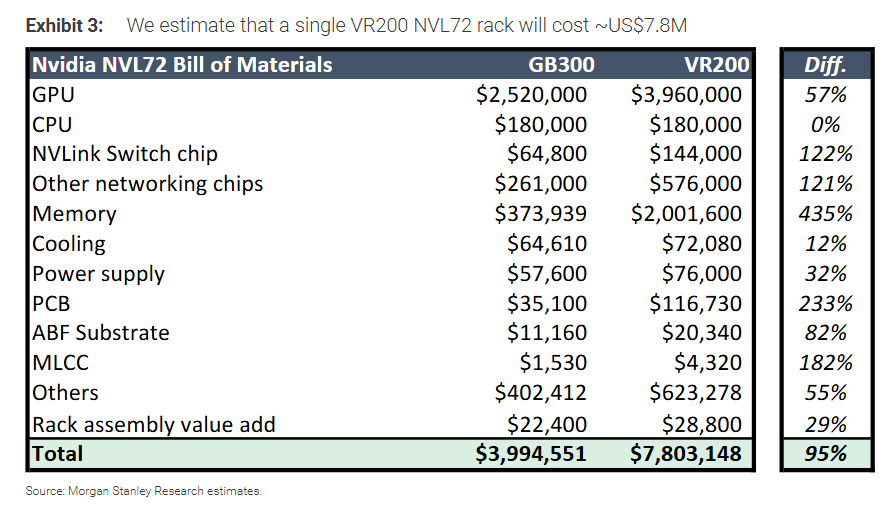
Morgan Stanley’s teardown of NVIDIA’s next-generation Rubin rack reveals that its price will reach approximately $7.8 million—nearly double that of the GB300—with the increase in value not primarily driven by GPUs. PCBs (+233%), MLCCs (+182%), and ABF substrates (+82%) emerged as the biggest beneficiaries, while memory content surged by 435%, raising its share of the rack’s bill of materials (BOM) to roughly 26% and correspondingly compressing the GPU’s share. Meanwhile, contrary to market concerns about declining ODM value-added, Morgan Stanley expects ODM dollar-value addition to actually rise by 35–40%, indicating that value in the AI supply chain is shifting from GPUs toward a broader range of hardware components.
Morgan Stanley maintains an overweight rating on $NVIDIA (NVDA.US)$A comprehensive bill of materials (BOM) teardown of the next-generation Rubin rack has revealed a reassessment of component values far exceeding market expectations.
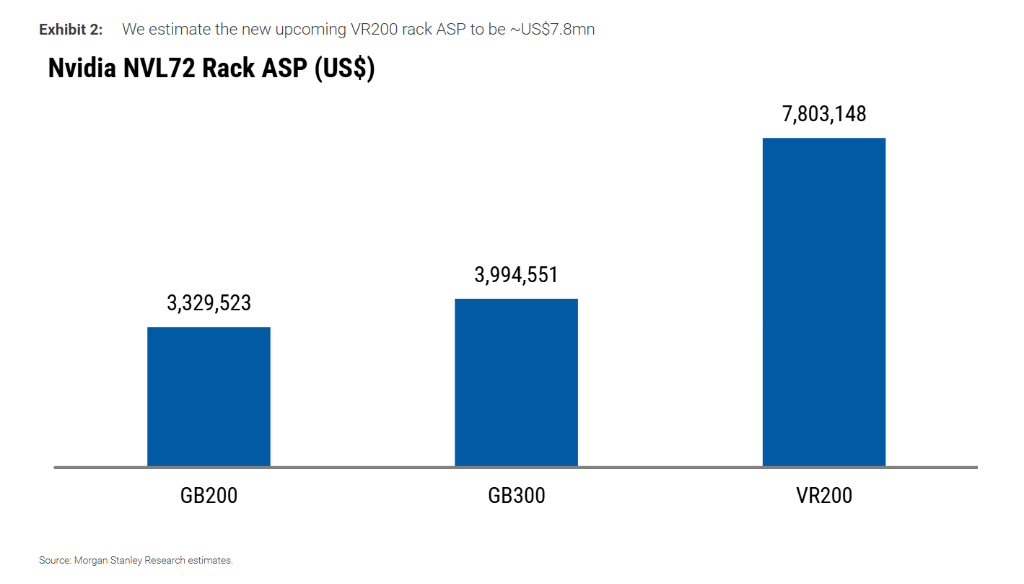
According to the Zhui Feng trading desk, Morgan Stanley’s latest research report indicates that the Rubin rack, procured from ODMs, is priced at approximately USD 7.8 million—nearly double the roughly USD 3.99 million price tag of the previous-generation GB300 rack—and this surge in value is not driven solely by the core GPU.
 Among the downstream components covered in the report, printed circuit boards (PCBs) saw the most substantial increase in content value, rising 233% compared to the GB300, followed by multilayer ceramic capacitors (MLCCs, +182%), ABF substrates (+82%), power supplies (+32%), and liquid cooling components (+12%).
Meanwhile, the report also notes that ODM value-added content is expected to rise by 35% to 40%, contrary to market expectations, overturning the prevailing assumption that standardization in the Rubin system would compress ODM margins. The ODM sector as a whole remains attractively valued, currently trading at an estimated CY27 price-to-earnings (P/E) ratio of around 13x—slightly above the historical 20-year average of 11.5x, though not by a wide margin.
Total rack price approaches USD 7.8 million, with memory share surging to 26%
Morgan Stanley’s bottom-up BOM analysis shows that hyperscalers pay approximately USD 7.8 million per Rubin VR200 NVL72 rack when sourcing directly from ODMs; prices would be higher if procured through OEM channels such as Lenovo, Asustek, Gigabyte, or Dell.
One key driver behind the sharp increase in rack costs is the significant rise in memory pricing. The report notes that memory prices have surged since NVIDIA launched the GB200 NVL72. Under the prior memory pricing regime, memory accounted for only 5% to 10% of the GB200 NVL72 rack’s BOM. In the VR200, however, the combination of higher memory capacity and substantially elevated prices has pushed memory’s share to approximately 25% to 30%, translating into an absolute value of roughly USD 2 million—up about 435% from the GB300’s estimated USD 370,000.
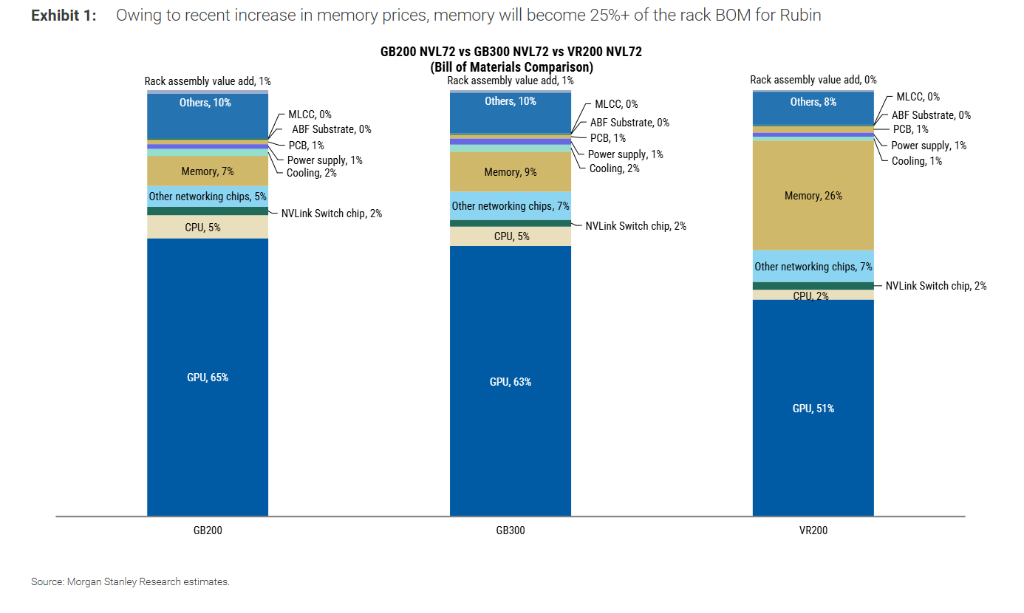
This shift has directly reduced the GPU’s share of the BOM—from approximately 65% in the GB200 to about 51% in the VR200—though the GPU’s absolute dollar value increased from roughly USD 2.52 million to approximately USD 3.96 million, representing a gain of about 57%.
Additionally, the report outlines an alternative scenario: if hyperscalers opt to source SOCAMM memory modules directly, the rack’s average selling price (ASP) would decline from approximately USD 7.8 million to around USD 6.7 million.
PCBs: The downstream component with the largest increase, driven primarily by new modules
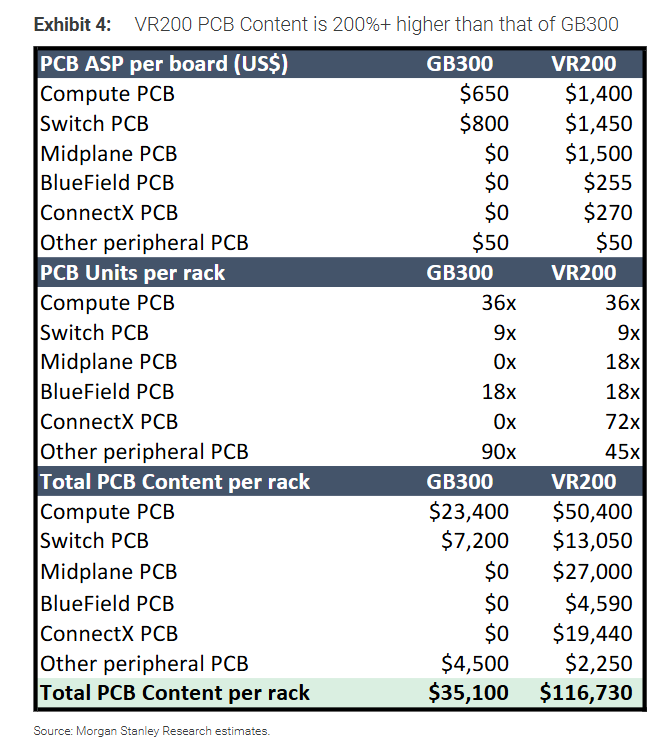
Among the downstream components covered by Morgan Stanley, PCB content value shows the most significant increase, rising approximately 233% compared to GB300—from about USD 35,100 to roughly USD 116,700.
This surge is driven by a combination of multiple factors.
First is the introduction of new modules: the Rubin system adds ConnectX module PCBs (72 per rack at USD 270 each) and midplane PCBs (18 per rack at USD 1,500 each), neither of which existed in GB300. Together, these two new PCB types contribute approximately USD 46,400 in incremental content value.
Second is a comprehensive upgrade of existing PCB specifications: the compute board has been upgraded from a 22-layer HDI PCB in GB300 to a 26-layer version, with the copper-clad laminate (CCL) grade improving from M7 to M8; the switch tray PCB has been upgraded from 24 layers to 32 layers; and a new 44-layer midplane PCB has been added to the compute tray. Additionally, the physical dimensions of the compute board have slightly increased.
MLCCs and ABF Substrates: New Modules Drive Demand Beyond Expectations
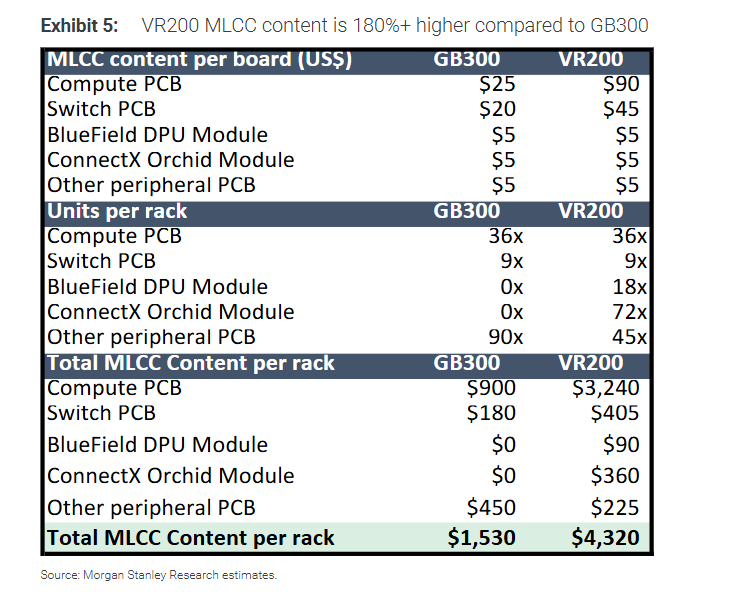
Regarding MLCCs, Morgan Stanley estimates that the MLCC content value per VR200 rack is approximately USD 4,320, representing an increase of about 182% compared to GB300’s roughly USD 1,530.
The increase stems primarily from two dimensions:
First, the per-board MLCC usage on both compute and switch boards has risen substantially (from USD 25 to USD 90 for compute boards, and from USD 20 to USD 45 for switch boards);
Second, newly introduced BlueField DPU modules (18 units) and ConnectX Orchid modules (72 units) generate additional demand.
The report notes that demand for MLCCs in high-end AI servers is already showing strong momentum, with ODMs actively building inventory ahead of the Rubin rack’s volume ramp-up starting in the second half of 2026.
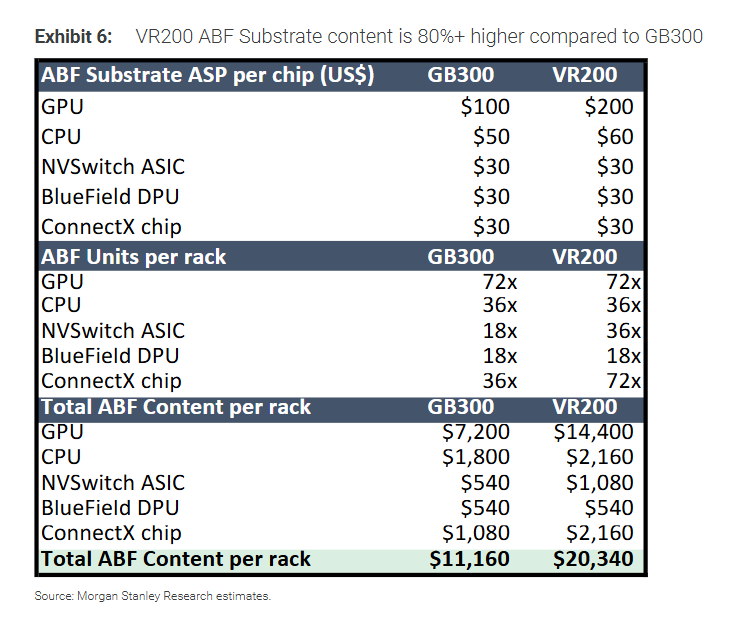
Regarding ABF substrates, the content value per VR200 rack has increased by approximately 82% compared to the GB300, rising from about $11,200 to approximately $20,300.
Key drivers include:
The unit price of ABF substrates for Rubin GPUs has risen from approximately $100 to around $200 (a 100% increase);
The number of NVSwitch ASICs per rack has doubled from 18 to 36;
The number of ConnectX chips has increased from 36 to 72.
Morgan Stanley cited analyst Shoji Sato’s estimate that the unit price of ABF substrates for Rubin GPUs is approximately $200.
Power and liquid cooling: Higher power density drives solid growth
In terms of power systems, the content value per VR200 rack is approximately $76,000, representing a roughly 32% increase over the GB300.
According to Morgan Stanley’s supply chain survey, in addition to the standard 110kW power shelf included with the Vera Rubin platform, at least one U.S. cloud service provider has already adopted an HVDC standalone power rack within the Vera Rubin platform.
The report forecasts that an 800V DC architecture will be widely adopted in NVIDIA’s Rubin Ultra platform (scheduled for launch in the second half of 2027). Delta is already collaborating with at least three U.S. cloud service provider customers to implement HVDC platforms in ASIC power rack projects, with initial deployments expected to begin in the second half of 2026.
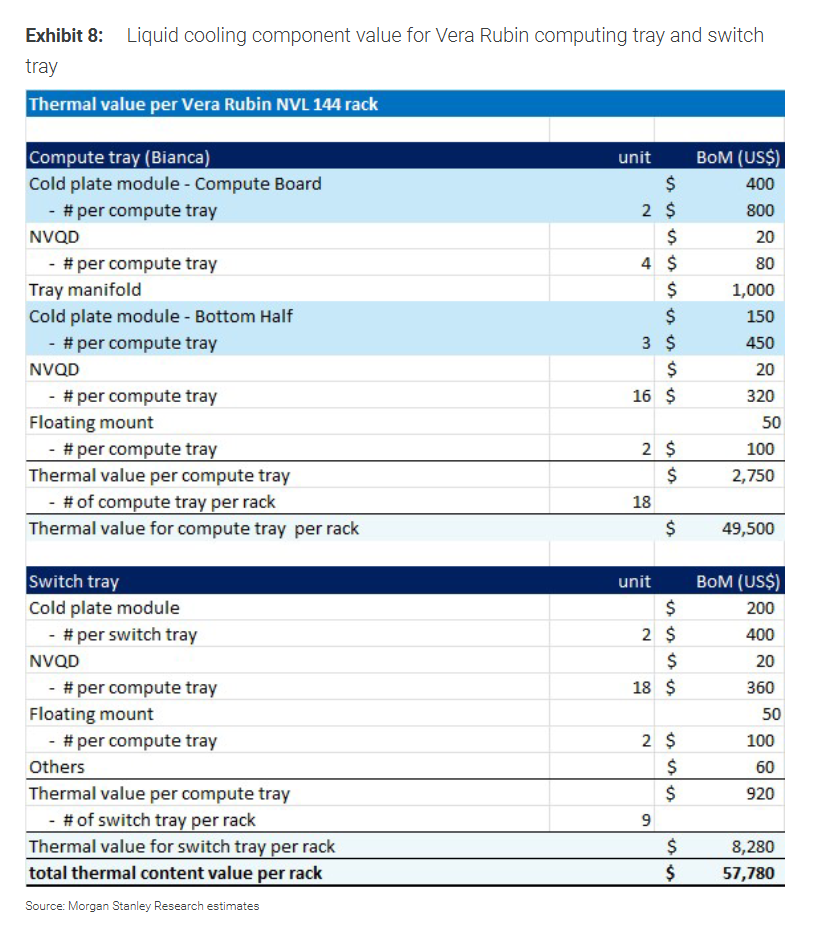
Regarding liquid cooling, the Vera Rubin server rack will feature a fully liquid-cooled design (fanless), with a total thermal solution value per rack of approximately USD 72,100 (excluding the side-mounted CDU), representing an increase of about 12% compared to the GB300’s approximately USD 64,600.
The incremental value primarily stems from increased usage of tray manifolds and quick disconnects (QDs), as well as optimization of the cold plate design for bottom components. Including the side-mounted CDU, the total thermal solution value amounts to approximately USD 122,100.
ODM value-added is rising contrary to expectations; absolute profitability is the key metric.
Morgan Stanley’s analysis directly challenges the prevailing market consensus.
The report notes that while the market widely expects the 'standardization' of Rubin compute trays to reduce ODM value-added, bottom-up calculations indicate that ODM value-added will instead increase by approximately 35% to 40%, rising from about USD 108,200 for the GB300 to roughly USD 149,600 for the VR200.
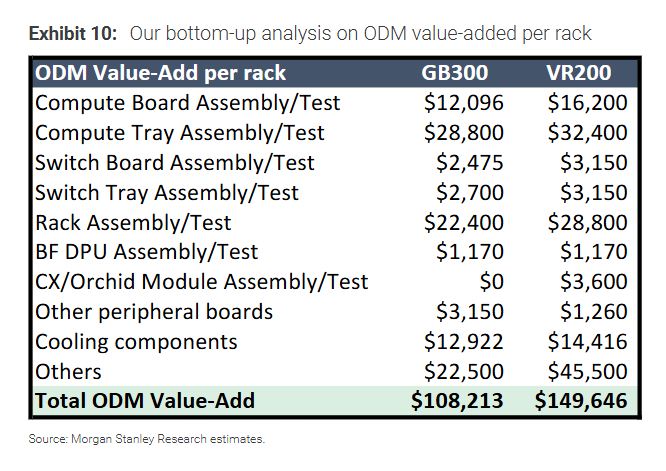
This increase in value-added is distributed across the entire rack: compute board assembly/testing (from approximately USD 12,100 to USD 16,200), compute tray assembly/testing (from approximately USD 28,800 to USD 32,400), full-rack assembly/testing (from approximately USD 22,400 to USD 28,800), and newly added ConnectX/Orchid module assembly/testing (adding approximately USD 3,600).
This rise in value-added aligns with management comments made by Wistron during its Q4 earnings call—management explicitly stated that the ODM dollar value-added for Rubin would increase.
At the gross margin level, however, due to a significant increase in the rack’s overall ASP, ODM gross margin is expected to decline from approximately 2.7% for the GB300 to about 1.9% for the VR200.
Nevertheless, the report emphasizes that investors should focus on the growth in absolute dollar profitability rather than the decline in gross margin. If hyperscalers procure SOCAMMs themselves, reducing the rack ASP to approximately USD 6.7 million, ODM gross margin would rebound to about 2.2%.
Shift in Manufacturing Model and ODM Investment Prioritization
The report also highlights a structural trend worth monitoring: an increasing number of ODMs are beginning to discuss the consignment business model.
Hon Hai was the first to mention this model during its Q4 2025 earnings call, followed by Quanta, which stated on its Q1 2026 earnings call that it expects certain projects to transition to the consignment model in the second half of 2026.
Morgan Stanley believes this shift could help alleviate working capital pressures for ODMs and represents a positive signal in the long term, although it remains unclear what proportion of projects will ultimately make the switch.
From a valuation perspective, the ODM sector is trading at an average CY27 forward P/E of approximately 13x, implying a modest premium over its historical 20-year average of 11.5x; however, the report still considers the risk-reward profile attractive.
 Looking to pick stocks or diagnose stock performance? Want to know the opportunities and risks in your portfolio? For all investment-related questions,just ask Futubull AI!

Editor /rice