
SpaceX believes its total addressable market could be comparable in size to the U.S. economy.
The highly anticipated IPO prospectus recently released by SpaceX, a global leader in space exploration, reveals that the company’s self-assessed total addressable market (TAM) for SpaceX is an astonishing $28.5 trillion. If this ambitious vision—dubbed a 'space-based AI empire'—is fully realized, it would approach the entire annual economic output of the United States. In its IPO filing, the company stated that it has 'identified the largest executable total addressable market opportunity in human history,' primarily driven by AI-powered software, with significant contributions also expected from the space sector.
SpaceX also noted that, for the 'illustrative purpose of measuring our addressable market opportunity,' it excluded certain countries in its latest global estimation framework. This $28.5 trillion projection is comparable to the U.S. nominal GDP of nearly $32 trillion projected for Q1 2026. Of this, the enterprise-facing AI super-applications market alone is estimated at $22.7 trillion—roughly 70% of total U.S. economic output. Furthermore, if SpaceX, Tesla (TSLA.US), and xAI eventually move toward deeper integration, their combined narrative and valuation ceiling could be significantly elevated; according to Dan Ives, senior analyst at Wedbush, SpaceX and Tesla could potentially merge by 2027.
 Notably, these figures do not represent performance forecasts, secured orders, or valuations for the space technology giant. Rather, they reflect SpaceX’s effort to demonstrate to capital markets that it is more than just a rocket or satellite internet company—it is packaging Starlink, AI capabilities, potential orbital AI computing infrastructure, enterprise software, and space-based solutions for defense and commercial applications into a unified 'super-platform narrative' spanning AI and space-enabled AI data centers.
This TAM is extraordinarily ambitious, representing a long-term addressable market opportunity. Its realization ultimately hinges on Starlink’s cash flow generation, commercialization of AI businesses, technical feasibility of orbital data centers, launch costs, regulatory approvals, and capital expenditure efficiency.
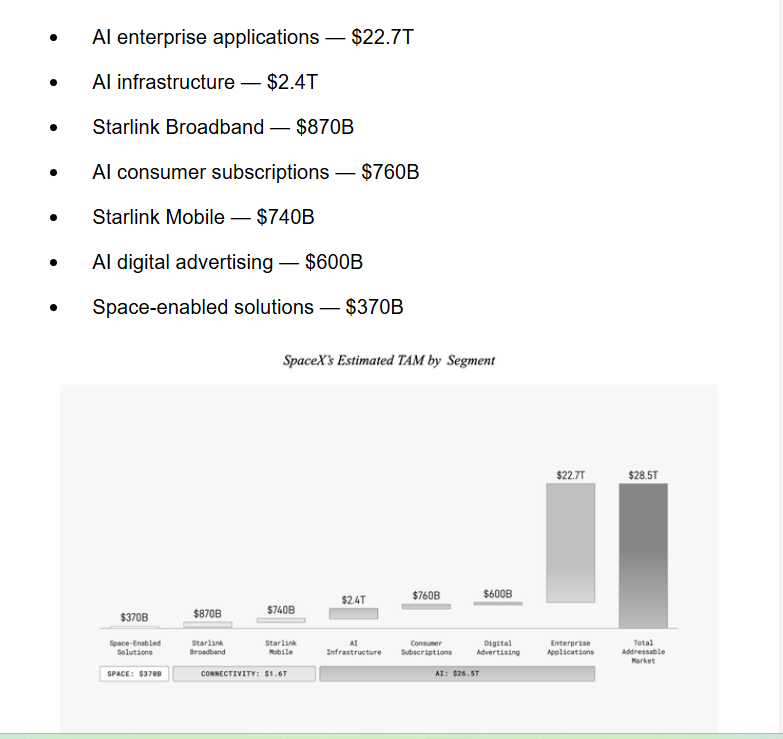
The $28.5 trillion outlook does not solely encompass the 'space AI data center market size' Elon Musk has repeatedly referenced recently. Instead, it represents SpaceX’s internally calculated total addressable market (TAM) disclosed in its IPO filing, with the vast majority stemming from AI software and enterprise applications rather than space or space-based data centers. According to its breakdown, AI-related segments total approximately $26.5 trillion, comprising $22.7 trillion in enterprise AI applications, $2.4 trillion in AI infrastructure, $760 billion in consumer AI subscriptions, and $600 billion in AI-driven digital advertising. In contrast, genuinely 'space-enabled solutions' account for only $370 billion, with Starlink broadband and mobile services together contributing about $1.61 trillion.
As the wealthiest individual globally to date, Musk has previously achieved what many considered impossible—establishing a commercially viable high-frequency rocket launch business through SpaceX, mainstreaming electric vehicles through Tesla, Inc., the global leader in EVs, and providing internet infrastructure services from space via Starlink. However, some investors remain skeptical about whether Musk can truly accomplish his latest ambitious 'epic' chip-making initiative outlined in Austin or realize his grand vision for 'artificial intelligence, autonomous driving, humanoid robotics, and super-large AI data centers in space.'
Below is SpaceX’s detailed breakdown of its $28.5 trillion mega-outlook:
Enterprise AI super-applications – $22.7 trillion
AI computing infrastructure – $2.4 trillion
Starlink broadband system – $870 billion
Consumer subscription market centered on AI – $760 billion
Starlink mobile market – $740 billion
AI digital advertising market – $600 billion
Space-enabled solutions market – $370 billion
SpaceX is selling more than just a space story! A $28.5 trillion TAM underpins its epic IPO narrative.
Overall, Musk has repositioned SpaceX as a tripartite capital markets story: 'leader in space-based AI computing infrastructure + satellite internet cash flow + AI applications giant.' According to its IPO prospectus, SpaceX claims a total addressable market (TAM) of $28.5 trillion, of which approximately $26.5 trillion stems from AI-related markets, while the genuine 'space-enabled solutions' segment accounts for only $370 billion. In other words, the focus of this IPO valuation narrative has shifted from traditional commercial aerospace toward AI software, AI infrastructure, the Starlink connectivity network, and future orbital computing capabilities.
From a financial structure perspective, Starlink is currently the most credible cash cow, while xAI represents both the largest variable and the biggest capital sinkhole. Public disclosures indicate that SpaceX generated approximately $18.67 billion in revenue in 2025, with Starlink contributing over $11 billion; however, the company still recorded a loss of approximately $4.9 billion, and capital expenditures rose to around $20.7 billion. The inclusion of xAI further amplified losses and capital consumption. According to The Verge, xAI incurred an operating loss of approximately $6.4 billion in 2025; Reuters also reported that SpaceX’s AI business generated $818 million in Q1 revenue but posted an operating loss of $2.5 billion. This means Starlink is indeed 'generating blood,' but AI infrastructure development is 'draining blood' at an even faster pace.
Anthropic’s $1.25 billion monthly procurement of computing capacity from SpaceX/xAI serves as the most critical external validation of this narrative: if the contract continues through May 2029, the theoretical total value could exceed $40 billion—sufficient to propel SpaceX from a 'satellite internet company' to an AI infrastructure provider. However, the risks are equally clear: Reuters, Business Insider, and TechCrunch have all noted that the agreement allows either party to terminate with 90 days’ notice, and initial fees are subject to adjustment as computing capacity ramps up. Therefore, it cannot be simplistically viewed as risk-free or guaranteed long-term revenue.
Engineering-wise, SpaceX’s long-term vision hinges on Starship, Starlink V3, ground-based Colossus/Colossus II data centers, and future orbital AI computing. The logic is as follows: Starship reduces launch costs, Starlink expands communication and data access points, xAI/Colossus fulfills AI inference demand, and eventually, space-based solar power and orbital thermal management could overcome terrestrial constraints on power and cooling. However, to date, 'orbital AI data centers' remain a long-term technological option rather than a proven business model. What truly supports the short-term financial credibility of the IPO are Starlink user growth, broadband margins, the Anthropic computing contract, and the Starship commercialization timeline.
Will the 'trifecta' ultimately materialize?
Dan Ives, senior analyst at Wedbush Securities, stated that his firm continues to believe that SpaceX (which has previously merged with xAI) and another tech giant led by Elon Musk—$Tesla (TSLA.US)$will ultimately merge into a single company by 2027. He noted that the foundational integration of both businesses into one organization is already in place. Importantly, following Tesla’s $2 billion investment in xAI—which was converted into SpaceX shares after xAI’s acquisition earlier this year—Tesla effectively now holds an equity stake in SpaceX.
Notably, SpaceX and Tesla recently announced a joint venture to build the Terafab chip manufacturing mega-factory, widely seen as a further step toward integrating the operations of the two companies and increasing the likelihood of a business merger, given the growing overlap between them. Elon Musk has personally ignited a new AI computing power storm with 'Terafab,' aiming to end the global chip supply shortage through what he calls a 'human-made semiconductor miracle.'
In a recent report, Ives stated: 'Musk wants to own and control more components of the AI ecosystem, and step by step, this holy grail of integration could ultimately involve merging SpaceX and Tesla in some form, creating an organizational bridge between these two disruptive tech giants that aspire to lead the AI and computing infrastructure revolution alongside the energy transition.'
The convergence of Tesla, SpaceX, and xAI into a unified entity may represent the ultimate destiny of these three companies founded by Musk, forming what could be described as the 'Musk Super Business Empire.'
With Musk recently unveiling positive developments in areas such as space-based AI data centers, large-scale energy storage, artificial intelligence, fully autonomous driving (FSD), Robotaxi, and the revolutionary 'Optimus' humanoid robot, the world’s wealthiest individual appears to be integrating 'commercial aerospace systems + Starlink satellite communications + space-based AI computing power systems/AI large models + energy/storage + electric vehicles + autonomous driving + robotics manufacturing' into a highly financeable and coherent 'super vertically integrated asset chain,' leveraging both capital markets and industrial operations to amplify growth potential.
Editor/melody