
Core Summary:
1. Starlink is a genuine cash cow. In 2025, the Connectivity segment (primarily Starlink) generated revenue of $11.39 billion, up 50% year-over-year; operating profit reached $4.42 billion, with an operating margin of 39%; and segment Adjusted EBITDA amounted to $7.17 billion, representing an EBITDA margin of 63%. As of March 2026, global subscribers surpassed 10.3 million across 164 countries.
2. xAI represents the greatest uncertainty. xAI, which was merged into SpaceX in February 2026, reported a full-year operating loss of $6.36 billion in 2025, accounting for the vast majority of the company’s total losses. In Q1 2026 alone, its capital expenditures totaled $7.7 billion—triple the prior-year level—implying an annualized burn rate exceeding $30 billion.
3. The financial structure is highly imbalanced. The company reported a consolidated net loss of $4.94 billion in 2025 and a net loss of $4.28 billion in Q1 2026—nearly equivalent to the full-year loss of the prior year. Anthropic has signed a compute capacity procurement agreement valued at $1.25 billion per month (approximately $40 billion in total), though either party may terminate the contract with 90 days’ notice.
 4. Elon Musk holds absolute control. Through Class B shares (carrying 10 votes per share), Musk will retain 85.1% of the combined voting power following the IPO. The company is classified as a ‘Controlled Company,’ exempting it from certain Nasdaq corporate governance requirements, effectively precluding retail investors from influencing corporate decisions.
5. The Space segment is undergoing strategic transformation pains. In 2025, its launch business captured over 80% of the global mass-to-orbit market share, yet cumulative Starship development expenditures have already exceeded $15 billion. The Space segment recorded an operating loss of $660 million in 2025, with R&D expenses of $3 billion—both substantially higher than the prior year. Starship is expected to commence commercial operations in the second half of 2026 and will serve as the foundational infrastructure for the next phase of expansion across the company’s three core businesses.
6. Valuation disputes are significant. The target valuation of USD 1.75 trillion implies a price-to-sales (P/S) ratio of approximately 94x based on projected 2025 revenue. Renowned valuation expert Aswath Damodaran’s discounted cash flow (DCF) analysis yields a valuation of approximately USD 1.22 trillion, roughly 30% below the IPO price. However, market enthusiasm remains high, and this IPO is poised to become the largest in U.S. stock market history.
01. Overall Assessment
SpaceX’s prospectus essentially tells a story of a trilemma: the company simultaneously possesses the world’s most advanced space infrastructure (launch + satellite internet), the fastest-growing satellite internet service globally (Starlink), and an expensive, high-stakes AI transformation initiative with uncertain outcomes (xAI).
The three are not naturally integrated, but rather the result of Musk forcibly merging them through an all-stock exchange.M&Aa forced merger.
From a financial standpoint, Starlink’s profitability is beyond doubt: its segment EBITDA margin of 63% ranks among the highest globally for technology companies.
But this beacon is being eclipsed by xAI’s black hole. The AI segment burned through $12.7 billion in capital expenditures in 2025, consuming the vast majority of the company’s cash flow, and its net cash burn for Q1 2026 alone neared $9 billion.
Investors buying into SpaceX are effectively betting on an unfalsifiable vision: orbital AI computing power, Starship commercialization, and Elon Musk’s personal influence—not merely the near-term profitability of satellite internet.
Perhaps the biggest issue with this IPO is not valuation, but information asymmetry:
The initial draft of the prospectus disclosed that data center construction costs were significantly below industry benchmarks, but the final version removed the specific figures; Anthropic’s $1.25 billion monthly contract includes a 90-day termination clause and thus cannot be considered assured revenue.
When a core competitive advantage metric is deliberately omitted, and the largest customer contract can be terminated within 90 days, what exactly are investors paying for? This is the critical question IPO investors must answer.
02. On the Eve of the Largest IPO in History
On May 20, 2026, Space Exploration Technologies Corp. filed its S-1 registration statement with the U.S. Securities and Exchange Commission (SEC), under the ticker symbol$Space Exploration Technologies (SPCX.US)$, planning to list on Nasdaq.
This 280-page document marks the first time that the privately held company— which has steadfastly avoided going public for 24 years—has fully disclosed its financials to the public.
At its currently reported target valuation of $1.75 trillion, SpaceX would surpass Saudi Aramco’s $1.7 trillion valuation from 2019, becoming one of the largest stock offerings in human history.
The underwriter list includes nearly all of Wall Street’s top-tier institutions: led by Goldman Sachs, followed closely by Morgan Stanley, Bank of America, Citi, and JPMorgan, totaling 20 joint bookrunners, with subscription channels also opened to retail platforms such as Robinhood and Fidelity.
The roadshow is scheduled to commence on June 4, pricing will occur on June 11, and the listing will take place on June 12. Musk has orchestrated a precise countdown for this cosmic-scale IPO. However, investors must first navigate through 280 pages of text to answer one core question: What exactly is this company?
In its prospectus, SpaceX divides its business into three segments: Space / Connectivity / AI.
This structure itself sends a clear signal: this is no longer just a rocket company, nor even merely a satellite internet company—it is striving to become a vertically integrated empire spanning space, communications, and artificial intelligence.
[Chart 1: Revenue and Operating Profit by Segment (2023–2026Q1, in millions of USD)]
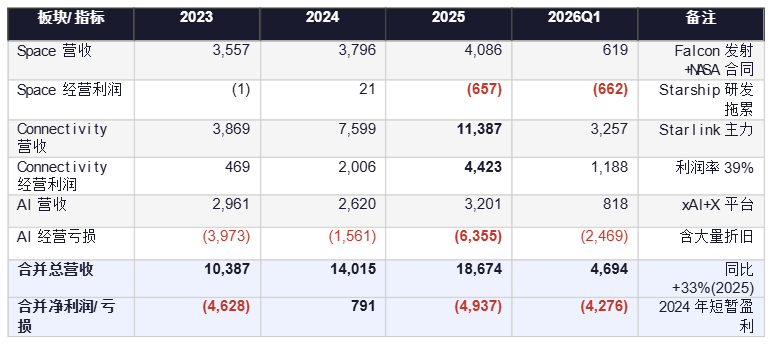
Three years of data reveal a clear narrative: the company was deeply unprofitable in 2023 (including Twitter-related impairments), briefly achieved profitability in 2024 prior to the integration of xAI, and then reported a single-quarter loss of $4.3 billion in Q1 2026—nearly equivalent to its total losses for the entire year of 2025. The rapidly expanding AI business is steering the company onto a dramatically different financial trajectory.
03. Starlink: How Profitable Is This Money Printer?
Starlink is the clearest and most compelling asset disclosed in SpaceX’s prospectus.
In 2025, the Connectivity segment (primarily Starlink) generated revenue of $11.39 billion, up 50% year-over-year; operating profit reached $4.42 billion, a 120% increase year-over-year; and segment EBITDA amounted to $7.17 billion, yielding an EBITDA margin of 63%—surpassing that of most internet platforms.
User growth has been equally explosive: 2.3 million at the end of 2023, 4.4 million at the end of 2024, 8.9 million at the end of 2025, and surpassing 10.3 million as of March 31, 2026—an impressive year-over-year growth rate of 105%. The service now covers 164 countries and regions, reaching a potential user base of 3.3 billion.
[Chart 2: Starlink Subscriber Count and Average Revenue Per User (ARPU) Trend (2023–2026Q1)]
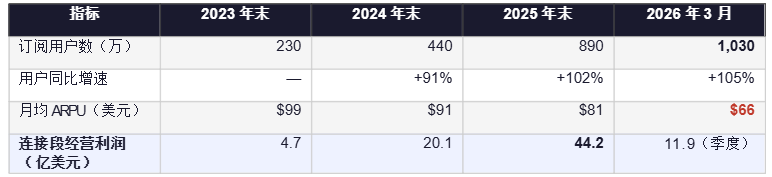
However, one figure warrants caution: average monthly ARPU has steadily declined from USD 99 in 2023 to USD 66 in Q1 2026—a 33% drop over three years.
This decline reflects the natural dilution resulting from Starlink’s international expansion, as users in lower- and middle-income countries have weaker purchasing power, and lower-priced plans inevitably reduce the average. The company frames this as a strategic choice—offsetting lower per-user revenue with a larger subscriber base.
This logic currently holds: subscriber numbers have grown 4.5-fold, more than compensating for the ARPU decline and enabling overall revenue to maintain a 50% growth rate. However, whether ARPU has reached its floor remains a critical variable in Starlink’s long-term model. The prospectus does not provide any guidance on a potential bottom.
Another key catalyst is the next-generation V3 satellite. Deployment via Starship is expected to begin in the second half of 2026, with each satellite offering 1 Tbps of capacity—20 times that of the current V2 Mini satellites.
At that point, network quality will undergo a qualitative leap, potentially supporting higher-tier pricing. This represents the most significant technological upgrade milestone in Starlink’s long-term narrative.
04. xAI: The Most Expensive AI Bet in History
On February 2, 2026, SpaceX completed an all-stock acquisition of xAI.
This transaction has transformed Musk from a rocket builder into an AI player, and turned SpaceX from a satellite internet company with promising profitability into a cash-burning machine deeply entrenched in the AI arms race.
xAI’s core assets are the Grok large language model and the X social media platform.
Grok has been iterated to version Grok-4.3, achieving state-of-the-art performance on the GPQA Diamond scientific reasoning benchmark. The X platform has approximately 550 million monthly active users, of whom around 117 million use Grok AI features and about 6.3 million are paying subscribers.
The issue lies in scale and cost.
To support Grok’s training and inference, SpaceX has built two supercomputing clusters in Texas, codenamed Colossus and Colossus II.
The first cluster comprises approximately 100,000 H100 GPUs, while the second includes roughly 220,000 GB200/GB300 GPUs, together delivering a total computational power of about 1 gigawatt (GW)—making it one of the largest single AI computing clusters on Earth today.
[Exhibit 3: Capital Expenditure Breakdown (2023–2026Q1, in millions of USD)]
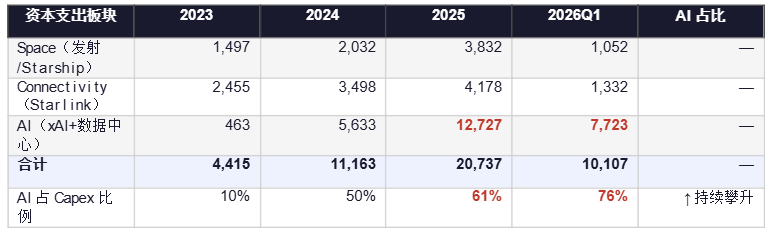
The data speaks for itself: of the $10.7 billion in capital expenditures in Q1 2026, $7.7 billion was allocated to AI, accounting for 76%. Most of the profits generated by Starlink have flowed into this computational black hole.
Anthropic is currently xAI’s largest external customer.
The two parties signed an agreement in May 2026, under which Anthropic committed to paying SpaceX $1.25 billion per month for access to the computing capacity of Colossus/Colossus II, resulting in a total contract value of approximately $40 billion, valid until May 2029.
This is currently one of xAI’s largest revenue streams, underpinning its revenue expectations for the AI segment in 2026.
However, an investigation by The Information revealed a critical risk: either party may terminate the agreement with just 90 days’ notice—a highly unusual contractual provision. A $40 billion contract could vanish within 90 days.
Another narrative promoted by xAI is orbital AI computing. Musk has painted a vision of running AI workloads in orbit powered by solar energy at a lower cost than on Earth.
However, the S-1 filing explicitly states: 'We have not, and no one else has, previously operated or attempted to operate orbital AI compute.'
While promoting this disruptive vision, the company is simultaneously constructing massive ground-based data centers powered by gas turbines.
Notably, the initial draft of the prospectus disclosed that SpaceX’s data center construction cost was only $2.7 million per megawatt (compared to an industry benchmark of approximately $12.3 million per megawatt), but this figure was removed from the final version, replaced only with the phrase 'considerably lower than industry benchmarks.'
This means potential investors cannot verify the company’s core claim regarding cost competitiveness.
05. Space: Growth Constraints of a Monopolist
Among the three business segments, the Space segment is the most undervalued and misunderstood.
It contributed approximately 22% of the company's revenue in 2025, but the segment reported an operating loss of $660 million due to Starship's annual R&D expenses of $3 billion.
Falcon 9’s launch monopoly is beyond doubt.
In 2025, SpaceX completed 165 orbital launches, accounting for over 80% of global mass-to-orbit capacity and achieving a mission success rate exceeding 99%. Of these, 122 were internal Starlink missions and 43 served external commercial or government customers.
Main competitors Blue Origin and ULA together hold less than 20% market share.
However, the space launch market is approaching its ceiling: SpaceX’s revenue grew by only 7.6% year-over-year in 2025, far below Connectivity’s 50% growth. External launch orders totaled 43 in 2025, slightly down from 45 in 2024. The launch services business has matured significantly; the real growth driver lies in Starship’s commercialization.
Starship’s milestones form the foundation of SpaceX’s entire commercial logic.
Only with Starship achieving large-scale, fully reusable launches can the deployment of V3 satellites (60 per launch) be realized, enabling accelerated expansion of Starlink coverage and allowing SpaceX to pursue its long-term vision of orbital AI computing satellites.
As disclosed in the prospectus, Starship has completed 11 flight tests to date, and the company expects to begin commercial payload deliveries in the second half of 2026—this is the most significant near-term catalyst for the IPO.
06. Behind the 85% Voting Control: The Governance Logic of Musk’s Empire
SpaceX’s prospectus reveals a carefully designed dual-class share structure: Class A shares carry one vote per share (issued in this IPO), while Class B shares carry ten votes per share (held by Musk).
Prior to the IPO, Musk held approximately 5.6 billion Class B shares (representing 93.6% of all Class B shares). Combined with his holdings of Class A shares, his aggregate voting power reached 85.1%—exceeding the control stakes held by founders of any other major U.S. public company.
According to a Wall Street Journal report, this structure makes it virtually impossible for investors to remove Musk. The company will list on Nasdaq as a controlled company, exempting it from governance rules requiring a majority of independent directors. Musk simultaneously serves as CEO, CTO, and Chairman of the Board.
Of greater concern is the design of Musk’s compensation package: in 2025, his cash salary was only $54,000, but he holds a tranche of equity awards subject to exceptionally aggressive vesting conditions.
Among these, 1 billion Class B shares are subject to vesting upon the establishment of a permanent Martian colony with a population of one million and the company achieving a market capitalization of $7.5 trillion. The existence of such equity awards renders the scale of potential future dilution highly unpredictable.
Meanwhile, the prospectus discloses for the first time on a large scale related-party transactions between SpaceX and other companies controlled by Musk: in 2025, the company purchased $131 million worth of Cybertrucks and $506 million worth of Megapacks from Tesla; xAI had previously paid Tesla $731 million in various fees.
Tesla is mentioned 87 times in the prospectus—a figure that underscores the deep interconnectivity within Musk’s corporate empire.
Is $750 Billion Worth It? The Divide Between Markets and Academia
At a valuation of USD 1.75 trillion, SpaceX’s price-to-sales (P/S) ratio is approximately 94x (based on projected 2025 revenue of USD 18.67 billion).
By comparison, mainstream cloud computing businesses such as Amazon AWS and Microsoft Azure trade at P/S ratios of roughly 12–15x, though they are already mature and profitable operations.
Aswath Damodaran, a renowned valuation scholar and professor of finance at New York University, derived a discounted cash flow-based valuation of approximately $1.22 trillion—about 30% below the targeted IPO valuation.
Damodaran believes the current valuation is entirely based on trust in Musk personally.
But the market clearly sees it differently. Public information shows that SpaceX’s valuation in the private secondary market has been revised upward multiple times over the past year, and its IPO order book has already attracted substantial institutional demand.
What analysts refer to as the FOMO premium (fear-of-missing-out premium) is now driving pricing logic—not because discounted cash flow (DCF) models say one should buy, but because no one dares admit they don’t hold SpaceX shares.
It is worth noting that data from the past decade indeed supports caution: Franco Granda, a research analyst at PitchBook, points out that historically, mega-cap IPOs have generally underperformed the broader market after listing.
However, SpaceX’s uniqueness lies in its dominant position across two markets—it is both a monopolist in launch services and a leader in satellite internet. This scarcity alone justifies a premium.
Three Key Leading Indicators
Based on the prospectus and external information, investors should monitor the following three key signals:
Starship Commercialization Timeline: The first orbital payload delivery in the second half of 2026 represents the most critical milestone for validating the company’s narrative. Any delay would push back the V3 satellite deployment plan and the orbital AI computing schedule, requiring a reassessment of growth expectations across all three of the company’s business segments.
Anthropic Contract Renewal or Replacement: The $1.25 billion-per-month contract expires in May 2029 and includes a 90-day termination clause. If Anthropic shifts to in-house computing capacity before the contract ends—a trend increasingly common across the industry—the revenue forecast for the xAI segment will face significant pressure.
Starlink ARPU Bottom Confirmation: Average revenue per user (ARPU) has declined from $99 to $66 per month. If it falls below $50 by 2026, it would indicate that international expansion is diluting margins more than scale economies can offset, putting downward pressure on the Connectivity segment’s profitability.
Conclusion: Are You Buying the Company—or Musk?
SpaceX’s prospectus ultimately presents a paradox: Starlink is one of the fastest-growing and highest-margin broadband businesses in human history to date.
However, xAI represents an AI bet whose capital consumption rivals that of nuclear power plant construction, with core customer contracts cancellable within 90 days and key competitive data deliberately omitted from the prospectus.
Traditional financial analysis frameworks break down here.
Valuation analysts cite $1.22 trillion, but the market has priced it at $1.75 trillion—and some even call for $2 trillion. This is no longer a financial question; it is a matter of faith—do you believe Musk can simultaneously commercialize Starship, enable global satellite-to-phone connectivity, deploy orbital AI computing power, and achieve Mars colonization?
Historically, every great tech company’s IPO has drawn criticism for being overvalued—and left many investors regretting they didn’t buy in.
The issue with SpaceX isn’t whether it will succeed, but this: when you enter at a $1.75 trillion valuation, how much success do you need to avoid losses? That answer is not provided in the prospectus.
 Looking to pick stocks or analyze them? Want to know the opportunities and risks in your portfolio? For all your investment-related questions,just ask Futubull AI!

Editor/melody