
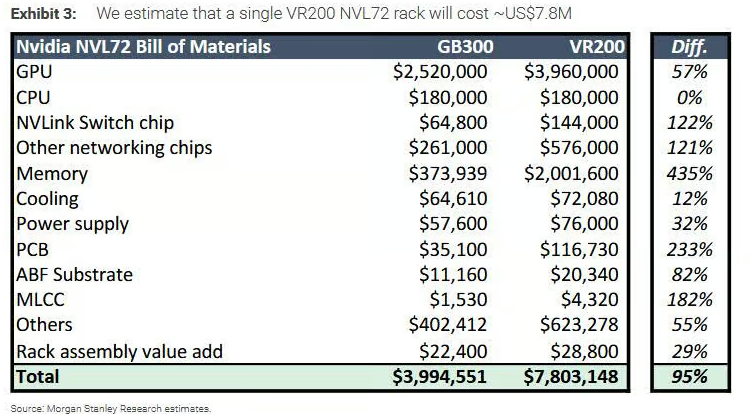
Morgan Stanley estimates that NVIDIA’s Vera Rubin rack is priced at nearly twice the current GB300 Blackwell rack, which costs approximately $4 million. Memory costs have surged by 435%, PCB content costs have risen by 233%, MLCC prices have increased by 182%, and ABF substrate costs are up by 82%—with virtually all components seeing price increases across the board. However, if hyperscale cloud providers purchase memory modules directly, the rack price could be reduced to approximately $6.7 million.
$NVIDIA (NVDA.US)$ The price of next-generation AI server racks is surging rapidly.
According to a report released by Morgan Stanley analyst Howard Kao on May 22, the procurement price of NVIDIA’s upcoming Vera Rubin (VR200) rack from ODMs (original design manufacturers) is approximately $7.8 million, compared to less than $4 million for the current GB300 Blackwell rack—indicating that the price per rack has nearly doubled within a single product generation.
 Notably, NVIDIA’s share price fell nearly 2% following its earnings release that day, while memory-related stocks surged by 6%–10%. The reason lies precisely in the logic revealed by this report: NVIDIA itself is not the only beneficiary of the price increase.
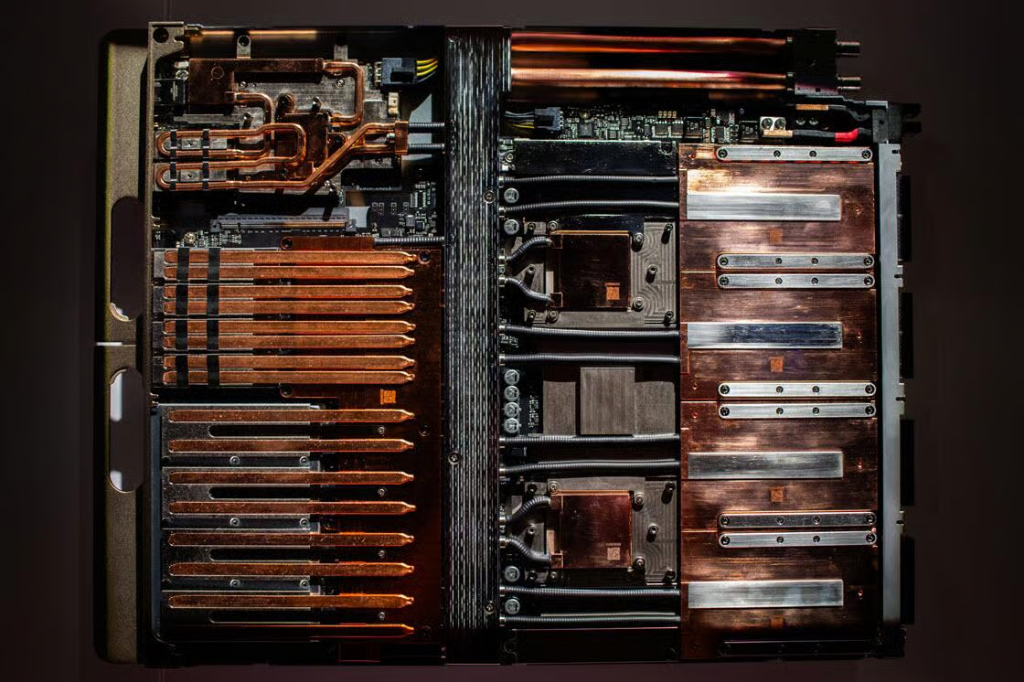
Memory: From 'Supporting Role' to 'Leading Role'
Memory is the strongest driver behind this round of price hikes.
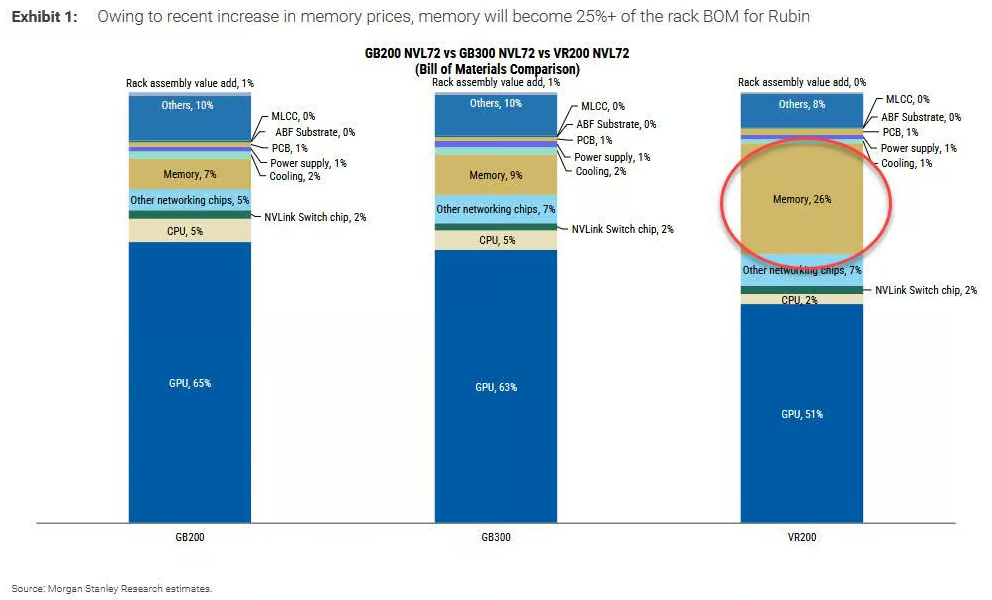
Analysts noted that memory prices have risen sharply since NVIDIA launched the GB200 NVL72. Under the previous pricing structure, memory accounted for only 5%–10% of the bill of materials (BOM) cost for the GB200 NVL72 rack; however, for the VR200, memory’s share has soared to 25%–30%, representing a cost increase of 435%.
The sharp rise in memory’s cost share has directly reduced the GPU’s proportion of total rack costs—from approximately 65% in the GB200 to around 51% in the VR200.
It’s not just memory—virtually all components are seeing price increases.
The firm’s supply chain survey indicates that the price increases are widespread:
PCB (printed circuit board): Cost increased by 233%
PCB content increased from approximately $35,000 in the GB300 to about $117,000. This is due to Rubin introducing new modules (such as ConnectX modules and midplane PCBs), along with an increase in the number of PCB layers and an upgrade in material grade. For example, the compute board was upgraded from a 22-layer HDI PCB in the GB300 to a 26-layer design, and the material grade improved from M7 to M8; the switch tray PCB increased from 24 layers to 32 layers. Additionally, a new 44-layer midplane PCB was added to the compute tray—a component absent in the GB300.
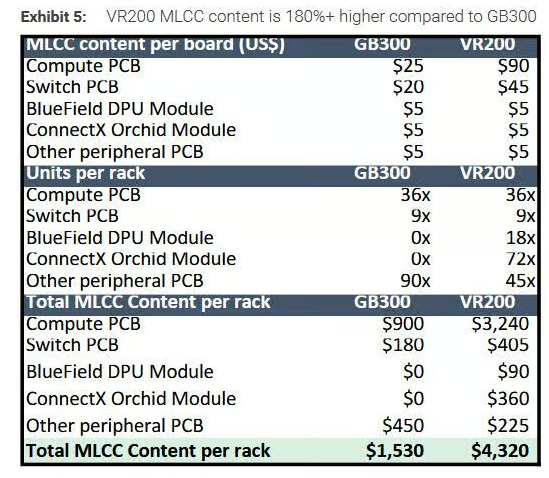
MLCC (Multilayer Ceramic Capacitors): Cost increased by 182%
Each VR200 rack contains approximately $4,300 worth of MLCCs, compared to only about $1,500 in the GB300. Newly introduced BlueField and ConnectX modules have also driven additional MLCC demand. Analysts believe this is the direct reason behind the current surge in demand for high-end AI server MLCCs and the rush among ODMs to stockpile inventory—Rubin racks are expected to enter mass production in the second half of 2026.
ABF Substrates: Cost increased by 82%
The number of NVLink and ConnectX chips in the VR200 is double that of Blackwell systems, leading to higher substrate consumption. The ABF substrate for each Rubin GPU costs approximately $200 per unit, up 100% from Blackwell’s roughly $100.
Power supply costs increased by 32%; cooling materials also rose by 12%.
Hyperscale cloud providers may bypass NVIDIA and purchase memory directly
Analysts highlighted a key variable: the procurement method for SOCAMM (Small Outline Compression Attached Memory Modules). If hyperscale cloud providers procure memory modules directly, rack prices could fall to approximately $6.7 million.
In the base case scenario, NVIDIA procures SOCAMMs and resells them at a 70% gross margin, resulting in a rack price of approximately $7.8 million. However, if hyperscale cloud providers (such as Microsoft, Google, and Amazon) opt to purchase SOCAMMs directly—bypassing NVIDIA’s markup—the rack price would drop to around $6.7 million.
This variable directly impacts NVIDIA’s memory business revenue and remains a critical factor for the market to monitor closely.
ODM Vendors: Margins Decline, but Absolute Profits Rise
The market had widely expected that ODM vendors would see reduced value-added opportunities on Rubin racks due to increasing standardization in compute tray design. However, analysts have reached the opposite conclusion.
The report estimates that the ODM value-added component will increase by 35%–40%, rising from approximately $108,000 per rack for GB300 to about $149,600 per rack for VR200. This assessment aligns with comments made by Wistron management during its Q4 2025 earnings call—Wistron explicitly stated that the dollar value added by ODMs on Rubin racks would increase.
However, gross margins are indeed declining: ODM gross margins for GB300 stand at approximately 2.7%, falling to around 1.9% for VR200. Regarding this, analyst Kao remarked, “Investors should focus on the growth in absolute dollar profits rather than the decline in margins.”
Consignment Model Quietly Expands, Long-Term Risks Warrant Attention
Analysts also highlighted a concerning trend: an increasing number of ODM vendors are beginning to discuss adopting a consignment business model.
Hon Hai was the first to mention this model during its Q4 2025 earnings call. Quanta followed suit during its Q1 2026 earnings call, stating it expects some projects to shift to a consignment model in the second half of 2026.
Under the consignment model, customers (cloud providers) procure key components themselves, while ODMs are responsible only for assembly. This reduces working capital pressure on ODMs but also compresses their revenue scale.
Analysts noted that it remains unclear what proportion of projects will transition to consignment, but if the aforementioned 'absolute profit growth' fails to materialize, this trend could pose long-term concerns.
Power Supplies and Liquid Cooling: The Next Upgrade Frontier
Supply chain surveys indicate that the Vera Rubin platform comes standard with 110kW power modules, but at least one U.S. cloud service provider has already adopted HVDC (high-voltage direct current) standalone power racks on the Vera Rubin platform. Analysts expect 800V DC power to be widely adopted on the Rubin Ultra platform, scheduled for launch in the second half of 2027. Delta Electronics has partnered with at least three U.S. cloud service providers to advance the deployment of HVDC platforms, with initial rollouts expected to begin in the second half of 2026.
In terms of cooling, Vera Rubin racks will feature a fully liquid-cooled design (fanless), with the total value of liquid cooling components per rack amounting to approximately USD 72,080.
Editor/Lambor