
According to reports, the negotiation framework indicates that Iran has agreed in principle to open the Strait of Hormuz in exchange for the United States lifting its maritime blockade and disposing of its highly enriched uranium stockpile; both sides intend to establish a 60-day window to finalize the agreement.
However, Iran responded firmly, stating it would "not yield to pressure," and significant differences remain between the two sides on core issues such as sanctions relief, nuclear matters, and regional conflicts, with the agreement yet to be signed.
U.S.-Iran negotiations have entered a critical window, with both the prospect of a diplomatic breakthrough and the risk of military escalation remaining unresolved.
 According to CCTV News, on May 25 local time, U.S. Secretary of State Rubio stated that there is currently a "fairly solid" proposal on the table concerning the possibility of Iran "opening the Strait of Hormuz" and engaging in "a substantive, significant, and time-bound negotiation on Iran's nuclear issue."
According to media reports, Rubio said the same day that every effort would be made to achieve success through diplomatic channels and hinted that an agreement "could happen as early as today," though he quickly added that this should "not be overinterpreted." Nevertheless, Rubio also issued a clear warning: if diplomatic efforts fail, the United States will "pursue alternative paths" to address the Iran issue.
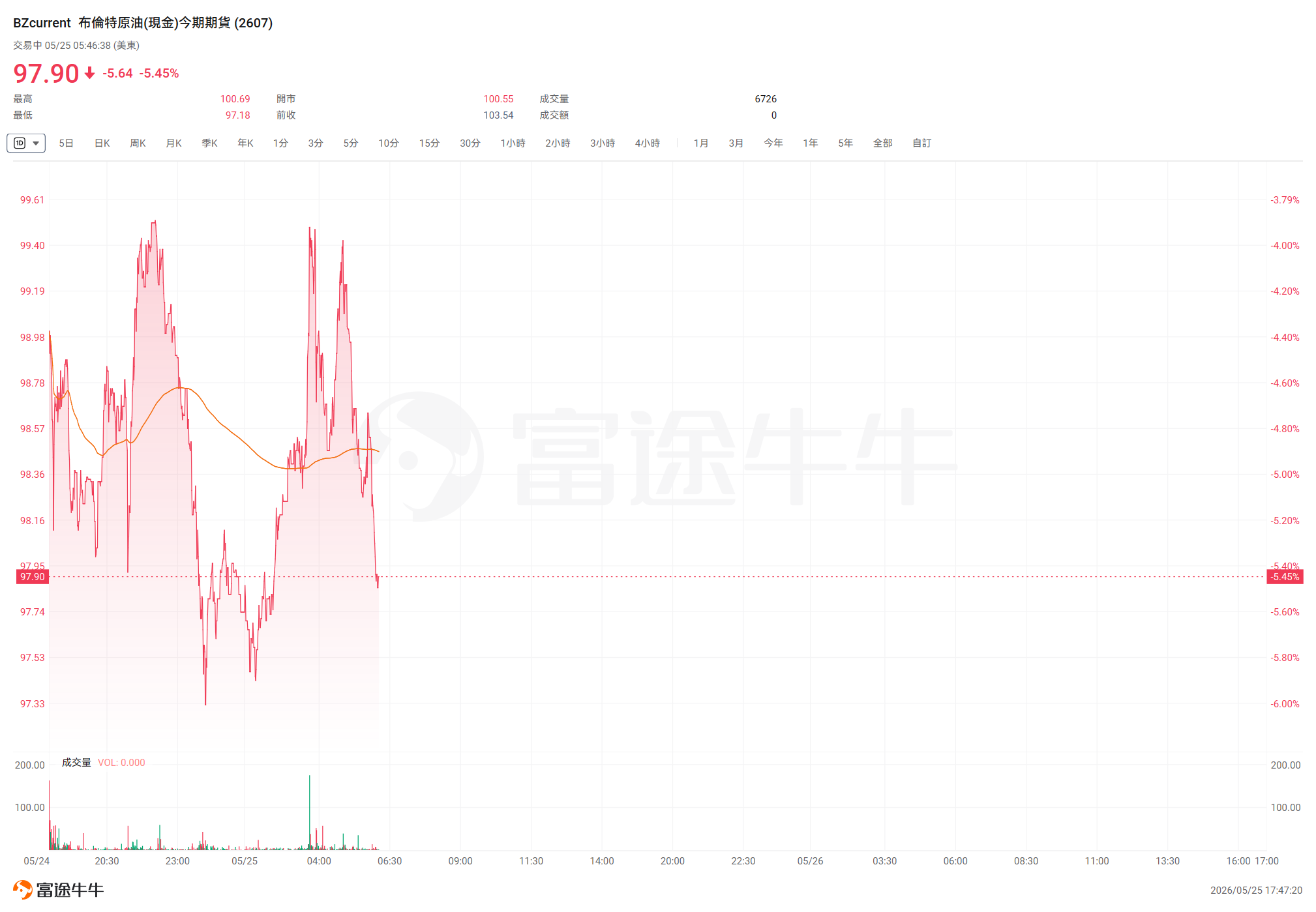
Analysts noted that this statement clearly reflects the dual nature of the negotiations—the diplomatic window remains open, but tougher options remain on the table. Bolstered by optimism over a potential U.S.-Iran peace deal, oil prices fell by approximately 6% that day, hitting a two-week low as of the time of reporting.$Brent Last Day Financial Futures Current Contract (JUL6) (BZcurrent.US)$the drop exceeded 5%.
According to the latest report from Xinhua News Agency, U.S. media indicated that the U.S.-Iran framework agreement is "95% complete," with an expected finalization within five to seven days.
Agreement Outline: Opening the Strait in Exchange for Lifting the Blockade, with Nuclear Issues Deferred to Subsequent Negotiations
According to media reports, a senior Trump administration official revealed that the latest contours of the negotiation framework have become increasingly clear. The official stated that Iran has "in principle" agreed to open the Strait of Hormuz in exchange for the United States lifting its maritime blockade and has also agreed to dispose of its stockpile of highly enriched uranium.
The official also noted that the U.S. side understands that Iran’s Supreme Leader, Ayatollah Mojtaba Khamenei, has endorsed this general framework. Under the U.S. proposal, the first step would involve reopening the strait and lifting the U.S. maritime blockade, while detailed negotiations on the nuclear issue would require additional time.
Separately, according to reports, a second senior government official disclosed that the proposed framework would grant negotiators 60 days to reach a final agreement. On the nuclear issue, the official denied claims that Iran had refused to dispose of its highly enriched uranium stockpile, clarifying that the disagreement lies in "how" to dispose of it, not whether to do so.
According to prior media reports, Iranian sources indicated that in subsequent phases, the parties might identify a "workable solution" to resolve the dispute over Iran's stockpile of highly enriched uranium, including diluting the material under the supervision of the United Nations nuclear watchdog agency.
Notably, according to Xinhua News Agency, The Washington Post reported on the 24th, citing an anonymous senior U.S. government official, that the United States and Iran have developed a “framework” for a memorandum of understanding that includes extending a ceasefire by 60 days to allow both sides to reach a “final agreement” on permanently ending hostilities involving Iran. During this period, mines will be cleared from the Strait of Hormuz and the waterway will reopen. The official stated that the memorandum includes a “commitment” that Iran will not acquire nuclear weapons.
Divergences Remain: Iran Issues Firm Statements as Key Issues Stay Unresolved
Reportedly, Iranian authorities have not immediately confirmed the aforementioned developments. Tasnim News Agency, which is affiliated with Iran’s Islamic Revolutionary Guard Corps, stated that the United States continues to obstruct the implementation of certain elements of a potential agreement, including Iran’s demand for the release of frozen funds.
On the same day, Ebrahim Rezaei, spokesperson for Iran’s parliament, stated that Iran would not yield to pressure or threats, responding firmly: “If the United States wants an agreement, it should negotiate; if it wants gasoline at six dollars per gallon, it can keep ‘bluffing.’” He also cited Iran’s position that the principle in military conflicts is “an eye for an eye,” while in diplomatic disputes, the principle is “action for action.”
Currently, significant disagreements persist between the two sides on several core issues, including Iran’s nuclear ambitions, the conflict in Lebanon between Israel and Hezbollah (backed by Iran), and Iran’s demands for sanctions relief and access to tens of billions of dollars in Iranian oil revenues held in foreign banks. On the same day, Rubio also stated that the United States is currently focused intensively on the situation in Lebanon and that “work is still ongoing” regarding Iran.
According to the latest Xinhua report, Fox News cited a U.S. official on the 24th as saying that the U.S.-Iran framework agreement is currently “95% complete,” with both sides having reached understandings on Iran’s “nuclear stockpile” and the Strait of Hormuz, and are now negotiating the precise “wording.”
The unnamed U.S. official denied the likelihood of a swift agreement between the United States and Iran, stating, “We have not yet reached an agreement, nor will we sign one today or tomorrow.” He speculated that President Trump might give negotiators from both sides five to seven days to finalize an agreement.
Editor/melody