
Recently, memory chips and optical communications have undoubtedly been the hottest investment themes on Wall Street over the past several months.
For ordinary investors, whether to stand in the 'light' and keep it in their 'chip' depends on three factors: first, whether they clearly understand the company and its industry; second, whether they can accurately assess its valuation; and third, whether they remain truly true to themselves.
Whether or not to 'join the crowd' is not the core of investing. If you lack clarity and cannot perform a sound analysis—merely swept along by market optimism—then chasing the 'light' as part of a herd entails enormous risk. However, if you see clearly, calculate accurately, and remain true to your own principles, then it simply does not matter whether others join the crowd or not; you will proceed resolutely, even if faced with overwhelming opposition.
01. Can You See Clearly?
 Ten years ago, Buffett invested $35 billion in Apple, and that stake is now worth $185 billion—a move widely regarded as one of the most successful investments in history.
Clarity was the prerequisite for Buffett’s investment in Apple. In 2017, Buffett publicly discussed Apple for the first time, articulating his view: 'Apple is more like a consumer goods company than a technology firm. We can analyze Apple’s business model using the concept of an economic moat—IBM and Apple serve different customers, representing two distinct strategic decisions.'
Companies in the 'light' sector are not consumer goods companies; they resemble IBM far more than Apple. Whether optical chips or optical modules, these are intermediate goods that must be embedded into downstream products, which are then delivered to end consumers through those downstream companies’ offerings.
Ordinary investors find it difficult to track products from 'light'-sector companies as directly as they would with consumer goods. Thus, their information about the 'light' industry typically comes from institutional sources or other third parties. By the time this information reaches retail investors, it is already outdated. Moreover, if one lacks industry expertise, even verifying the accuracy of such information becomes challenging. It is highly unlikely that anyone can succeed in a game they do not understand.
Munger once said, 'Unless I can refute my own viewpoint more convincingly than anyone else, I am not qualified to speak on the matter.' The same applies to investing: unless you truly understand the industry and the specific company, you will inevitably occupy a disadvantaged position—leading you to rush into buying during rallies and panic-sell during downturns.
The foundation of sound investing must rest on understanding. During the decade that Duan Yongping and Buffett held Apple shares, Apple’s stock price experienced multiple drawdowns of 50% or more. Someone who does not understand Apple would find it extremely difficult to hold steady during such declines. True understanding is demonstrated by a willingness to buy more shares when the price falls—not by fleeing in fear.
02. Can You Calculate Accurately?
“Understanding” is a qualitative metric, whereas the valuation at which one buys is a quantitative metric. Ten years ago, when Buffett began purchasing Apple, the company’s forward P/E ratio was only 10x. Even when he added to his position, Apple’s valuation did not exceed 15x.
Even for a leading company with abundant cash reserves, robust operating cash flows, consistent dividends and share buybacks, pricing power, and strong mindshare among global consumers, Buffett did not act impulsively. He only swung at the pitch when the price was extremely cheap—well within his comfort zone for buying.
Value investors instinctively remain wary of “popular companies in popular sectors” because their prices are typically too high to offer the margin of safety they seek. Although the term “margin of safety” may sound like financial jargon, it actually reflects a mindset of self-protection: under this approach, even if something goes very wrong, investors would not suffer significant losses.
Among A-share companies chasing the “light,” valuations are significantly higher than the overall market average and also exceed those of comparable companies in mature markets. Investors might justify these valuations by projecting profit growth over the next three to five years and conclude that the stock is not expensive. However, the challenge in investing lies in the fact that companies face numerous uncertainties over such a period. Without sufficient room built into the valuation to account for this uncertainty, a stroke of bad luck could trigger a sharp decline in both valuation multiples and share price.
Buffett’s purchase of Apple at a 10x valuation implied that even if Apple experienced no future growth, he could recoup his investment within ten years. Apple had already secured a dominant position in investor psychology, and its competitive landscape was unlikely to change dramatically over the next decade. Veteran value investor Zhang Yao, known for achieving a 2,000-fold return over 20 years, generated nearly a 10x return on his investment in Shaanxi Coal Industry over the past decade. His success stems from adhering to a principle: invest when valuations appear cheap based on current fundamentals and even cheaper when viewed through a forward-looking lens.
Zhang Yao articulated an even clearer investment criterion: invest in companies that can return the initial capital via dividends within five to six years. This standard embodies straightforward value-investing principles—low valuation, high dividend yield, strong cash flow, sustainable (though not necessarily high) profitability, and high business visibility.
Buying well is the prerequisite to selling well; the margin of safety functions as a mechanism for error tolerance. Over the long term, mistakes are inevitable in investing, and bad luck will eventually strike. Investors must prepare for these eventualities by avoiding aggressive valuations and leaving ample room for potential errors.
03. Independent Decision-Making
When hot sectors experience sustained, sharp rallies, it becomes easy for observers to lose rationality. It is difficult for individuals to resist market sentiment, especially when those around them appear to be making substantial profits. However, decisions driven by market sentiment resemble playing a game of “hot potato”—investors are essentially betting they won’t be left holding the last pass. Market sentiment acts as fuel, but all fuel eventually runs out. Once it has drawn in all available bullish momentum, the shift from bullish to bearish often occurs unexpectedly.
In a past interview, Buffett likened the market to “a church with an attached casino,” where people can freely move between the two. Currently, more participants still reside in the “church” (value investing) than in the “casino” (short-term speculation), but the allure of the casino has grown increasingly powerful.
If investors make investment decisions independently based on industry fundamentals, company quality, and valuation, then whether or not stocks are 'held in a group' is irrelevant—they would not refrain from investing merely because others are not抱团, nor invest solely because others are. However, if investment decisions are driven by market sentiment, it means entrusting one’s investment outcomes to the hands of others.
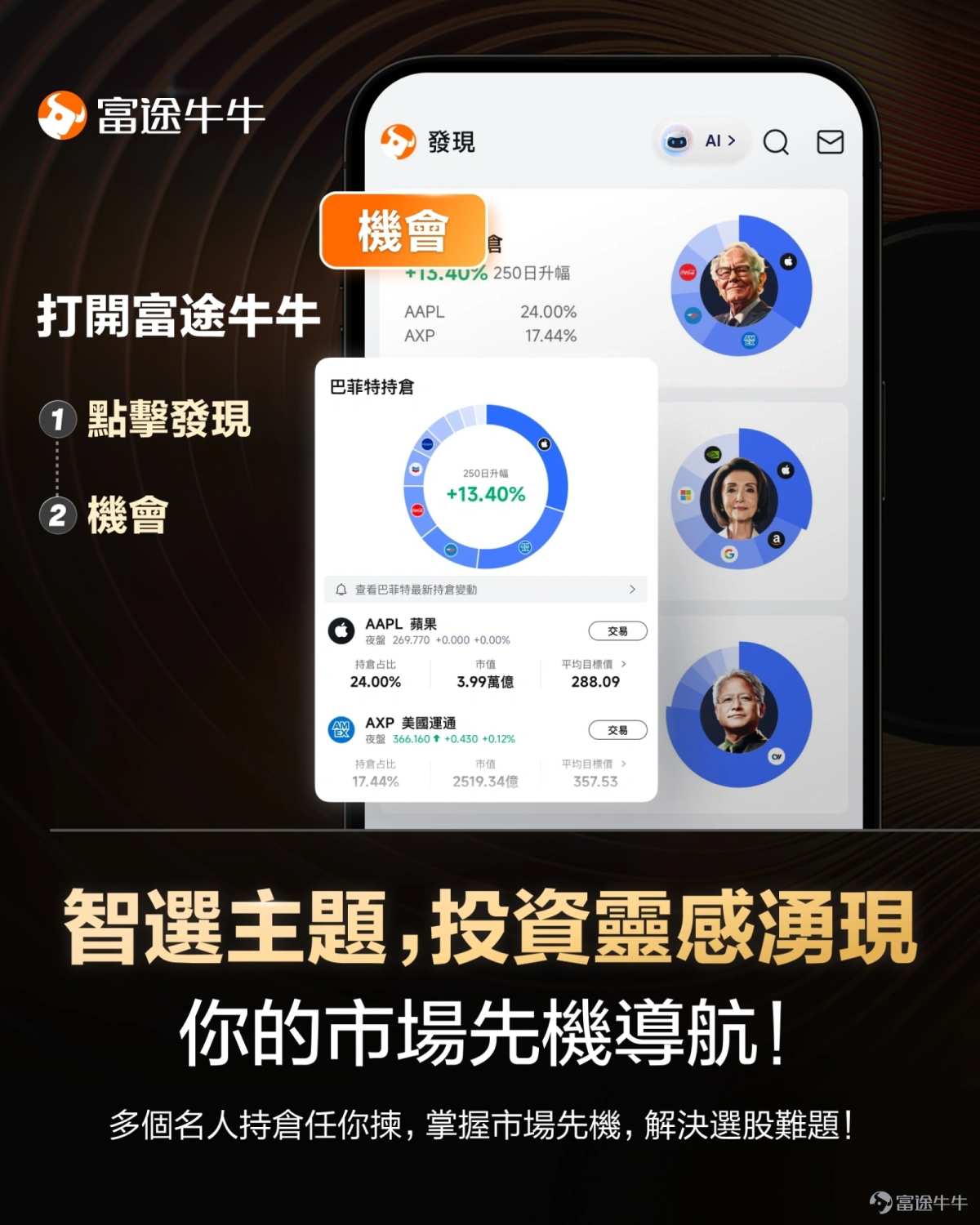
 Futubull[Opportunities Page]Celebrity portfolio tracking is now live! Choose from multiple celebrity holdings, follow institutional moves with one click, precisely identify high-quality assets, and invest with greater confidence!
Editor /rice