
The explosive growth in AI demand is reshaping the valuation logic for memory chips. UBS Group raised Micron's target price to $1,625, driving its stock to surge 19.3% in a single day and pushing its market capitalization above $1 trillion; Barclays doubled SanDisk’s target price to $2,300, contributing to a cumulative gain of 4,063% over the past year. As cloud computing giants sign long-term agreements (LTAs), the industry is undergoing 'de-cyclicality,' breaking historical valuation discounts.
Wall Street investment banks significantly raised their target prices, triggering another round of gains for the memory chip giant.
Boosted by UBS Group’s upgrade of Micron Technology’s target price to the highest level on Wall Street, Micron’s shares surged 19.3% at Tuesday’s close. Amid expectations of supply shortages driven by explosive AI demand, its market capitalization surpassed the $1 trillion mark, further cementing its status as one of the core assets in the current AI trade. Over the past year, Micron’s stock has risen by more than 800%.
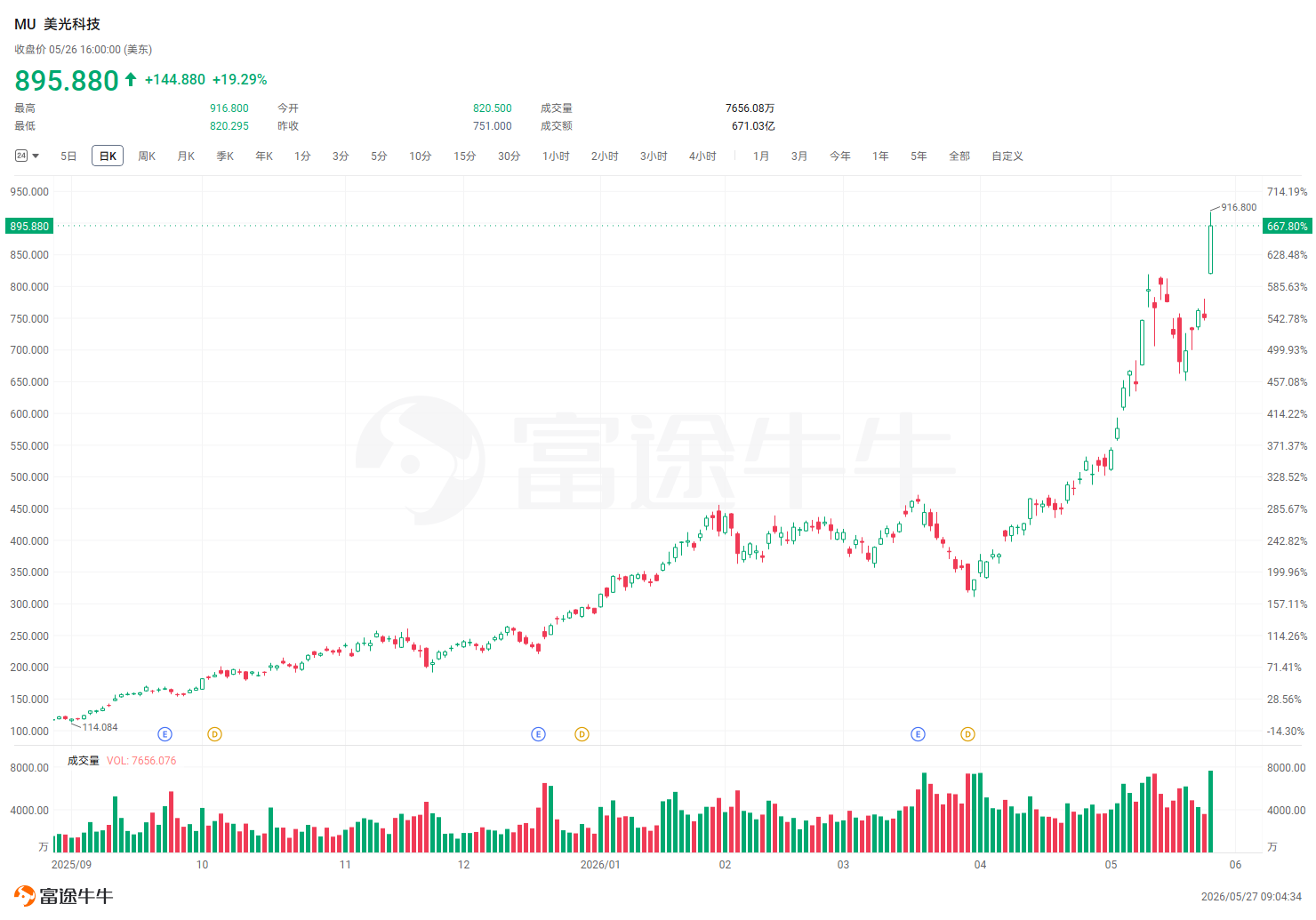
 This wave of revaluation quickly spread across the entire memory and computing sector. Barclays followed suit by doubling its target price for SanDisk, propelling the pure-play NAND flash manufacturer’s shares up 7.5%. Western Digital, another pillar of storage hardware, rose 8.3%, while Qualcomm climbed 4.5%, collectively driving the Philadelphia Semiconductor Index up 5.5% overall.
The key catalyst behind this market frenzy lies in a fundamental shift in the industry’s business model. Hyperscale cloud providers have begun signing long-term agreements (LTAs) with memory suppliers that include partially fixed pricing—a structural change driven by AI demand that is expected to significantly smooth earnings volatility and gradually render obsolete the long-standing 'super-cycle discount' logic that has historically plagued the memory sector.
AI Reshapes Valuation Logic, Sparking Broad Rally Across Memory Sector
The memory chip industry has traditionally exhibited strong cyclicality, but large-scale AI infrastructure buildouts are now disrupting this pattern. The massive volumes of data processed during AI training and inference are not only boosting demand for high-bandwidth memory but also broadly elevating demand for all types of data center storage devices.
UBS Group analyst Timothy Arcuri noted in a research report that as the structural implications of AI for the memory industry continue to unfold, the market will gradually assign storage stocks valuation multiples that are more 'normalized.' Hyperscale cloud providers are increasingly willing to lock in long-term supply agreements, accepting modest pricing concessions in exchange for multi-year supply certainty and greater predictability over future deployment costs.
This spillover effect from AI demand is also evident among hard disk drive (HDD) manufacturers like Western Digital. Western Digital CEO Irving Tan stated that nearly all AI workloads generate vast amounts of data, and HDDs remain the most cost-efficient medium for persistently storing such data. Financial results show that Western Digital reported third-quarter fiscal 2026 revenue of $3.34 billion, with non-GAAP gross margin exceeding 50% for the first time and earnings per share reaching $2.72—beating expectations for the fourth consecutive quarter. Management also announced a 20% increase in its dividend to $0.15 per share.
UBS Bullish on Micron: LTA Model Eliminates Cyclical Discount
UBS Group significantly raised its price target for Micron Technology from USD 535 to USD 1,625. UBS expects that under this new valuation framework, Micron’s market capitalization will approach USD 1.8 trillion within the next 12 months, surpassing the current market values of companies such as Meta, Tesla, and Berkshire Hathaway.
UBS Group’s bullish core thesis extends beyond high-bandwidth memory (HBM) to the industry’s first-ever enhanced long-term agreements (LTAs). Supply chain surveys indicate that 20% to 30% of DDR shipments in 2027 are expected to be covered under these 3- to 5-year contracts featuring fixed pricing frameworks. Tech giants such as Microsoft and Google have already secured approximately 60% to 70% of the industry’s server DDR5 capacity. Model simulations suggest that LTAs could reduce peak-to-trough DDR price volatility by roughly half.
Regarding HBM, UBS Group forecasts that Micron Technology, SK hynix, and Samsung will re-establish price premiums by 2027. Micron’s HBM average selling price is projected to rise 50% year-over-year in 2027, reaching $18.60 per gigabyte, with gross margins climbing to approximately 75%. Coupled with an extended supply-demand imbalance window now pushed into Q2 2028, UBS has significantly raised its EPS estimates for Micron’s fiscal years 2027 through 2029 and abandoned its traditional sum-of-the-parts valuation approach, instead assigning Micron a forward twelve-month (NTM) price-to-earnings multiple of approximately 15x—aligned with NVIDIA’s valuation.
According to Bloomberg data, among analysts currently covering Micron Technology, 49 have issued buy or equivalent ratings, 5 recommend hold, and none advise sell.
Barclays doubles SanDisk target price: New contracts lock in long-term supply-demand dynamics
While Micron leads the DRAM market rally, SanDisk has emerged as the breakout winner in the NAND flash segment in the AI era. Barclays raised SanDisk’s target price sharply from $1,200 to $2,300, maintaining its Overweight rating. Since its spin-off from Western Digital in February 2025, SanDisk’s share price has surged 4,063% over the past year.
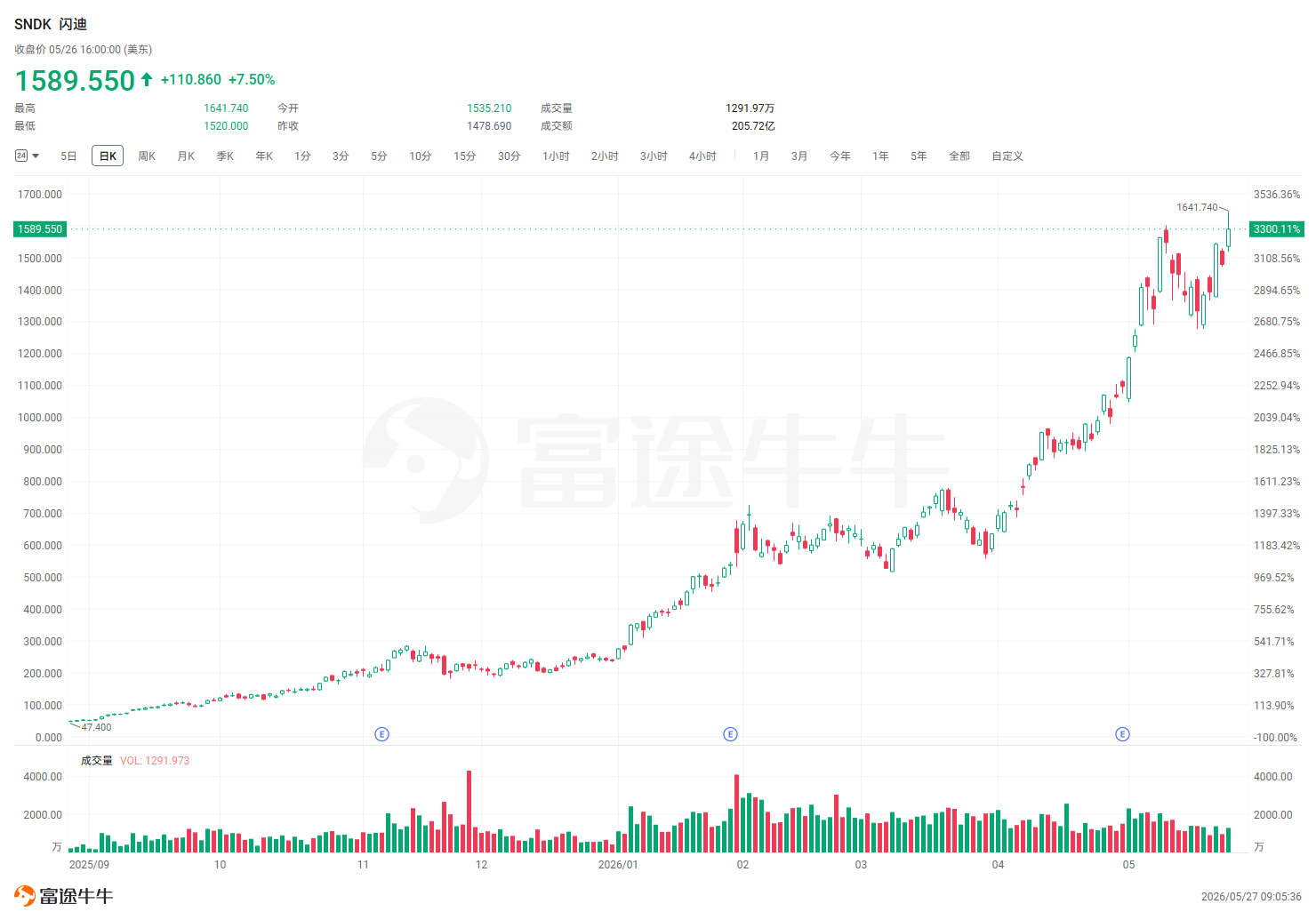
In its research report, Barclays noted that SanDisk exhibits exceptional structural innovation in contract design. Its new business model (NBM) agreements extend as far as 2031 and combine short-term fixed pricing with long-term floating pricing mechanisms. This structure provides customers with supply assurance while securing demand certainty for SanDisk.
Data show that three contracts signed by SanDisk in the most recent quarter guarantee minimum contractual revenue of approximately $42 billion, all backed by financial guarantees totaling over $11 billion. In the third fiscal quarter, SanDisk recognized $400 million in advance payments on its balance sheet. CEO David Goeckeler described this period as a fundamental inflection point for the company. Third-quarter results showed revenue of $5.95 billion, up 251% year-over-year, including $1.47 billion in data center revenue—a 645% year-over-year surge. A debt-free balance sheet and an authorized share repurchase program provide significant financial flexibility.
Market Concerns and Key Monitoring Indicators
Although Wall Street investment banks have outlined a long-term vision of reduced cyclicality for the memory sector, memory has historically remained the most cyclical segment within semiconductors. Whether AI can permanently reshape this dynamic remains to be validated across multiple cycles.
Market data highlight certain potential risks. As analysts continue raising target prices, short interest in Micron shares is reportedly increasing, and insider activity shows a pronounced bias toward selling—with 48 executive sales transactions concentrated on May 1 alone. For SanDisk, a more than 40-fold gain within one year implies a significantly higher financial threshold for further upside.
Editor/Lambor