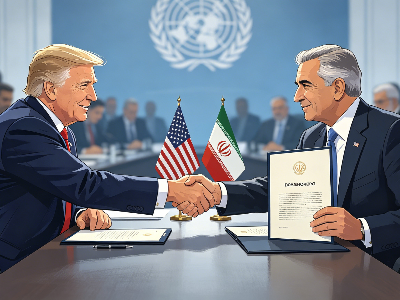
According to the draft, the United States will commit in the first phase to a comprehensive 60-day ceasefire across all fronts, particularly within Lebanon; meanwhile, the release of a substantial portion of Iran's frozen assets and the lifting of the maritime blockade are also included as elements of the agreement.
Iran stated that the likelihood of renewed conflict with the United States is "low," but added that its armed forces have "loaded their magazines" and remain fully prepared for combat at any time.
The U.S.-Iran nuclear negotiations have reached a critical juncture, with the outline of a preliminary agreement gradually taking shape. However, ongoing disputes over the extent of concessions on Iran's nuclear program and the sequencing of asset unfreezing continue to cast uncertainty over the prospect of a final deal.
 According to CCTV News, a correspondent reported that on the 27th local time, Ali Larijani, a member of Iran’s Supreme National Security Council, disclosed that under the preliminary draft agreement reached between Iran and the United States, Washington would commit in the first phase to a comprehensive 60-day ceasefire across all fronts, especially within Lebanon; additionally, the release of a significant portion of Iran’s frozen assets and the termination of the maritime blockade are stipulated as components of the agreement.
Meanwhile, according to Xinhua News Agency, Mohammad Akbarzadeh, an official from Iran’s Islamic Revolutionary Guard Corps Navy, stated that the possibility of renewed war with the United States is "low," but emphasized that Iran’s armed forces have "loaded their magazines" and stand ready for immediate combat.
However, hardline statements from Iran have introduced uncertainty into the negotiation outlook. According to CCTV News, Ali Akbar Velayati, foreign affairs advisor to Iran’s Supreme Leader, wrote on social media on the 27th that Iran’s red lines are crystal clear: "Documents and signatures are no longer guarantees—the real assurance for the agreement’s continuity lies in the Strait of Hormuz," adding, "Geography does not lie—it is geography that will ultimately serve as the arbiter of paper agreements."
Outline of the Draft Agreement: Ceasefire, Asset Unfreezing, and Lifting of Blockade
According to Larijani’s disclosure, the preliminary draft agreement adopts a phased implementation framework. The core focus of Phase One is military: the United States commits to a comprehensive 60-day ceasefire across all fronts, including Lebanon. Concurrently, lifting the maritime blockade on Iran and releasing frozen assets are incorporated into the overall arrangement of the agreement.
As previously reported by the Global Times, during his visit to Qatar, Iranian Parliament Speaker Mohammad Bagher Ghalibaf actively promoted the unfreezing of USD 24 billion in Iranian funds, demanding that half be released immediately upon issuance of the memorandum of understanding, with the remainder disbursed within 60 days. Reports indicate Iran is nearing a compromise on a phased unfreezing plan. However, citing U.S. officials, the Global Times noted that Washington insists it will only unfreeze Iranian funds after the Strait of Hormuz reopens—a condition that has created a reciprocal leverage dynamic between access to funds and control over the strait.
Larijani further stressed that Iran’s diplomatic institutions "will not base decisions on Trump’s social media statements," and that any document advancing to the signing stage must adhere to Iran’s institutional red lines and be oriented toward safeguarding national interests.
Trump’s Calculus: Appeasing Hawks and Packaging a Bigger Victory
During the final sprint of negotiations, Trump faced intense pressure from within the Republican Party. Hardliners such as Senator Ted Cruz criticized the proposed framework agreement as "wrong," arguing that it was too similar to the Iran nuclear deal reached under the Obama administration—the very agreement Trump himself dismantled during his first term.
In response to this criticism, Trump abruptly unveiled an ambitious proposal to expand the Abraham Accords, demanding that Saudi Arabia, Qatar, Pakistan, Turkey, Egypt, and Jordan immediately join en masse to normalize relations with Israel—or else be excluded from mediating the U.S.-Iran deal. According to The Paper, this idea originated directly from Trump himself rather than his advisors, and leaders of Middle Eastern countries were caught off guard when informed of it suddenly during phone calls without prior notice. Analysts believe this move aims to repackage a limited U.S.-Iran agreement as a broader regional diplomatic achievement, making it easier to justify to domestic hardliners.
Iran’s Dilemma: Balancing Economic Relief Against Nuclear Concessions
According to media reports citing Iranian officials and Arab mediators, Iran is pursuing two intertwined objectives in the negotiations: first, securing financial relief for its deeply distressed economy; and second, avoiding nuclear concessions substantial enough to allow Trump to claim a 'complete victory.'
Economic pressure remains the core driver keeping Iran at the negotiating table. The combined effects of war, U.S. sanctions, and a pre-existing economic crisis have severely damaged Iran’s energy infrastructure, led to gasoline rationing, fueled high inflation, and caused a sustained decline in living standards. More pragmatic factions within the Iranian regime are actively pushing for an agreement to gain breathing room and prevent economic grievances from escalating into renewed street protests.
At the same time, constraints imposed by hardliners are very real. According to the Global Times, Iran’s Supreme Leader has issued a directive prohibiting the export of enriched uranium stockpiles abroad. Majid Moosavi, commander of the Islamic Revolutionary Guard Corps’ missile and drone programs, publicly stated, "Negotiating with the enemy is pure loss."
These internal divisions have also raised concerns among mediators. Media reports indicate that mediating countries are striving to determine whether the current negotiation framework has the backing of Supreme Leader Khamenei and hardline factions, or whether it reflects only the stance of moderate figures such as Foreign Minister Araghchi. Mediators also worry that hardliners might undermine the deal through covert operations in the Strait.
Editor/melody