
U.S. space-related stocks surged.
On May 27 local time, U.S. space-related stocks showed strong intraday performance. Commercial space companies$Momentus (MNTS.US)$After surging nearly 110% in the previous trading session, the stock rose again by more than 26% during intraday trading. Among other stocks,$Intuitive Machines (LUNR.US)$rose more than 10%,$Voyager Technologies (VOYG.US)$rose nearly 7%,$Redwire (RDW.US)$up more than 4%.
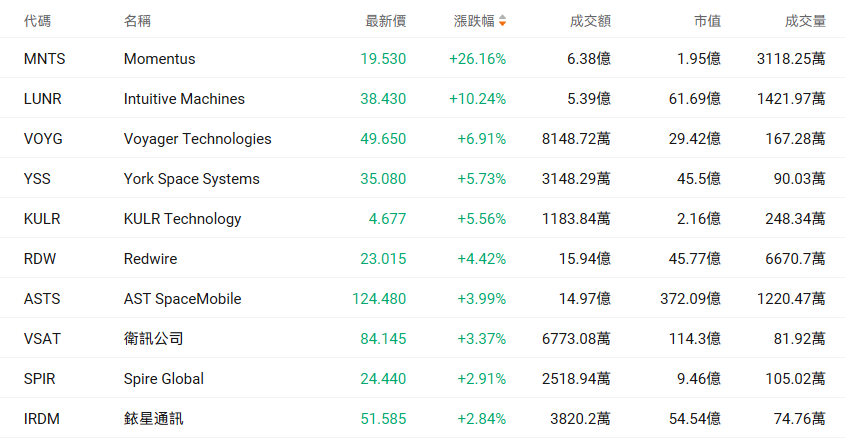
Additionally,$Astrotech (ASTC.US)$jumped as much as nearly 220% at the open; as of this report, gains have narrowed somewhat but remain above 160%. On the news front, the company previously announced it had approved a strategic plan focused on lunar resource development, autonomous lunar industrial infrastructure, and future opportunities in advanced computing and semiconductor manufacturing based on the Moon.
 Recently, there has been no shortage of 'cosmic-scale' news.
Last week, SpaceX filed documents with the U.S. Securities and Exchange Commission (SEC) indicating its intention to go public. Analysts noted that SpaceX's IPO is drawing increased investor attention to space industry companies already in favorable positions.
Additionally, according to CNBC citing sources, discussions about a potential merger between SpaceX and Tesla are intensifying. The two companies already share an extensive list of resources, and Elon Musk has previously discussed with colleagues the possibility of merging the two firms. Sources indicated that ongoing collaboration has become routine due to constraints both companies face regarding power and computing resources.
Furthermore, on the 26th, NASA unveiled a roadmap for establishing a lunar base, further detailing its development goals and implementation pathways for building long-term habitation facilities in the Moon’s south polar region.
According to this roadmap, the United States will advance lunar base construction in three phases—leveraging robotic exploration, technology demonstrations, and crewed missions—to enable sustained human presence on the Moon and lay the groundwork for future Mars missions.
The first phase will last until 2029, focusing on robotic exploration and key technology validation; the second phase, from 2029 to 2032, will involve deploying early habitation facilities along with infrastructure for power, communications, and other essential systems; the third phase, beginning in 2032 and beyond, aims to enable long-term human presence on the Moon and gradually initiate lunar resource utilization and routine scientific research activities.
NASA stated that the lunar base will support scientific research, commercial activities, and deep space exploration missions, while also accumulating experience for future crewed missions to Mars.
Compiled from: CCTV Finance and Xinhua News Agency
Editor/melody