
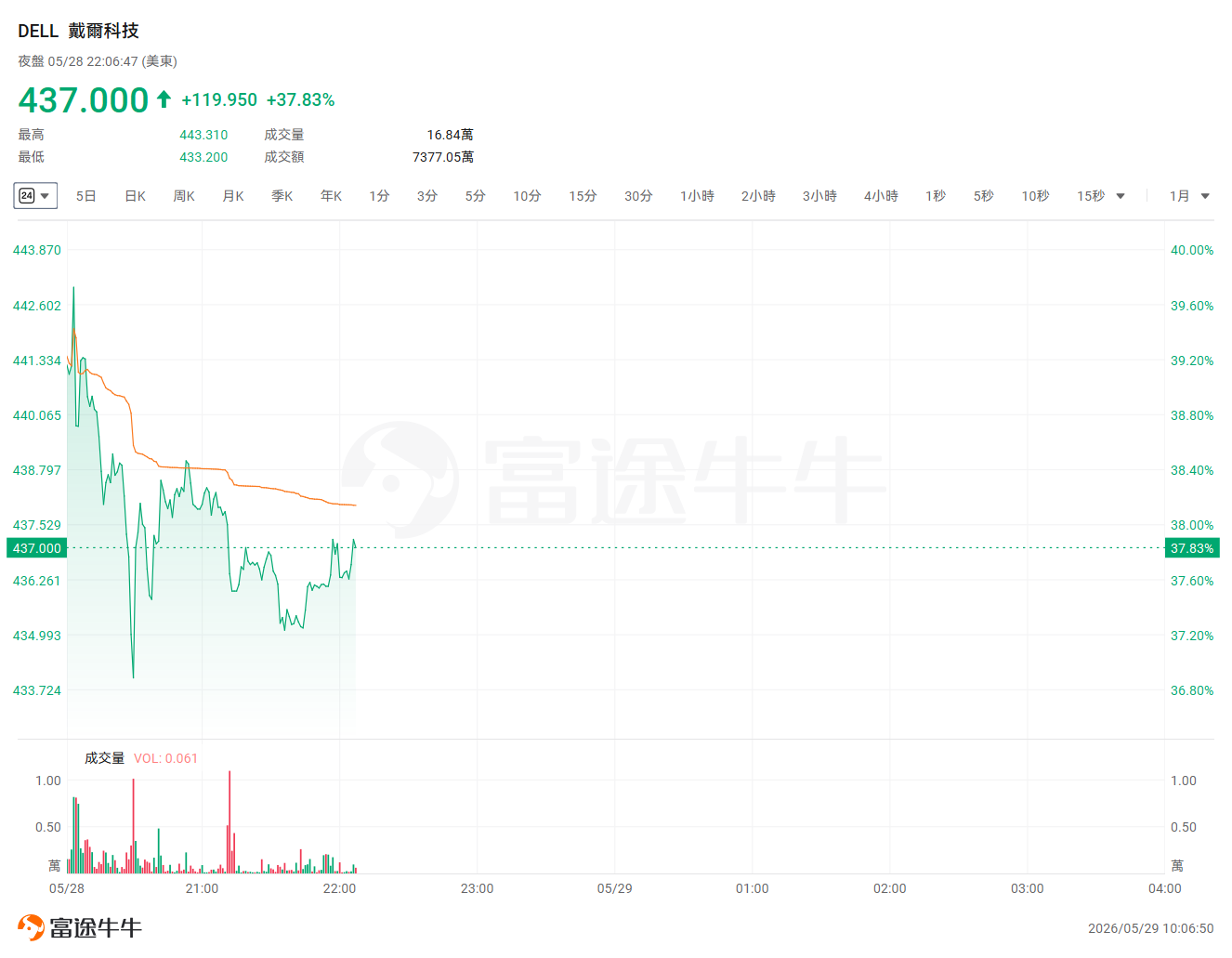
Dell’s shares surged 38% in after-hours trading. But what truly excited the market during the earnings call wasn’t just the 757% surge in AI server revenue or the $51.3 billion backlog—it was the fact that this company, long known as a 'PC vendor,' exceeded expectations across the board in its traditional server, storage, and PC businesses. In the words of the COO: 'We are winning.'
Dell, a company long labeled as a 'traditional PC vendor,' is quietly emerging as a central player in the AI infrastructure boom.
On May 29, $Dell Technologies (DELL.US)$Released its first-quarter fiscal 2027 earnings report. The figures can only be described as explosive: revenue of $43.8 billion, up 88% year-over-year; EPS of $4.86, a 214% increase year-over-year. Both metrics set all-time records. Additionally, the company’s AI server revenue for the quarter surged 757% year-over-year to $16.1 billion, with total AI orders for the quarter reaching $24.4 billion and a backlog of $51.3 billion. Based on this performance, Dell significantly raised its full-year AI server revenue guidance to $60 billion and lifted the midpoint of its full-year total revenue guidance to $167 billion.
 However, what truly unsettled analysts was not the numbers themselves, but the underlying structure: Dell isn’t just growing in AI servers—it’s seeing growth across all four of its core business segments. In the words of management: 'All four major businesses—PCs, servers, storage, and AI servers—are gaining market share. We are winning.'
The company’s stock price soared 38% in after-hours trading.
All four core businesses are thriving.
When pressed by analysts on whether this surge reflects genuine demand or front-loaded purchases, Dell COO Jeff Clarke offered an unequivocal response.
“The final two points represent what you should expect from Dell: we are winning,” Clarke said during the earnings call. “We are gaining market share across all three areas—and if you include AI servers, that makes four. All four major businesses—PCs, servers, storage, and AI servers—are capturing market share. We are winning.”
This isn’t just rhetoric. The data speaks for itself:
AI Servers: Revenue of $16.1 billion, up 757% year-over-year. New orders for the quarter totaled $24.4 billion, with a record backlog of $51.3 billion.
Traditional Servers and Networking: Revenue of $8.5 billion, up 92% year-over-year. Demand continues to far outstrip supply.
Storage: Revenue of $4.3 billion, up 8% year-over-year. Dell's proprietary IP storage products have outpaced market demand growth for the fifth consecutive quarter.
PC (Client Solutions Group): Revenue of $14.6 billion, up 17% year-over-year. Gained market share for the second consecutive quarter, with commercial PC revenue growing 18%—marking its seventh straight quarter of growth.
“Dell AI Factory”: More than just GPUs—it’s a complete solution.
What enables Dell to win these orders?
Dell has long been perceived externally as a seller of PCs and servers. However, over the past two years, Dell has quietly undertaken a strategic shift: transforming itself into an “integrator” of AI infrastructure.
During this earnings call, Dell repeatedly emphasized one term: the Dell AI Factory. Jeff Clarke, Chief Operating Officer, explained that two years ago, Dell partnered with$NVIDIA(NVDA.US)$to jointly introduce the 'AI Factory' concept. In simple terms, it bundles all the hardware required for AI training and inference—GPU servers, networking, and storage—into an integrated, rapidly deployable solution delivered directly to enterprises.
“Dell is extending the AI Factory from the data center to the desktop, encompassing compute, storage, networking, software, and services,” Clarke said. “We offer customers choices that help them protect their data and accelerate their transition from pilot to production.”
He stressed that customers are not purchasing individual components. “Customers aren’t buying parts—they’re buying integrated solutions that can be quickly deployed into production, run on infrastructure they control, and meet the performance, security, and data requirements of their specific workloads.”
Over the past six months, Dell’s number of AI customers has grown by more than 50%, now exceeding 5,000. These customers include new cloud providers, sovereign nations, and enterprises across various sectors.
“This isn’t a demand issue”: Orders are abundant—the constraint lies in component availability, with memory being the biggest bottleneck.
Chief Operating Officer Jeff Clarke stated directly: "We have a supply issue. This is not a demand issue."
Chief Financial Officer David Kennedy immediately added: "Demand continues to outstrip supply, and this demand is broad-based—not just for GPUs, but also CPUs, traditional servers, and PCs."
Where is the supply chain getting stuck? Clarke identified four components: DRAM (memory), NAND (flash memory), CPUs (processors), and hard drives. Among these, memory is the primary bottleneck. He said, "Every single memory chip matters, and every processor matters—that’s what we work on every day."
Why is memory so critical? In response to an analyst’s question, Clarke offered an insightful explanation. He said AI is evolving from an “advisor” to an “operator”—previously, AI provided recommendations; now, AI agents are actually executing tasks. And these task-executing agents require substantial CPU resources to manage every action, every function call, and every memory state.
Clarke said, "GPUs perform the magical work, but there’s a tremendous amount of work that needs to happen around them—IO processing, branch management, state maintenance—all of which are sequential, serial tasks that fall under the CPU’s responsibility. The CPU is constantly cycling through every decision made by the agent."
This means AI’s demand for memory comes not only from GPUs but also from CPUs, which are consuming large amounts of DRAM. Rising memory prices are also prompting customers to lock in supply in advance. Clarke noted that many large customers are now signing multi-year procurement agreements spanning three to five years to secure future availability.
AI is ‘overloading’ traditional servers: an unforeseen new market
The 92% surge in revenue from traditional servers was the most surprising point for the market during this earnings call. Clarke offered a straightforward explanation.
He said AI is shifting from being an “advisor” to an “operator”—it’s now actually executing tasks. But every AI invocation, every decision, and every state management operation requires a “management framework” to support it. This framework runs on the CPU.
“If you think about this concept, it’s often referred to as the ‘management framework.’ This framework is executed by the CPU,” Clarke said. “GPUs are doing the magical and wonderful work, but all the input/output handling, branching, retries, and state management around them—these are highly sequential, serialized tasks—and that’s the CPU’s workload.”
He candidly admitted, 'I didn’t know this back in October last year. This is a completely new market, and even today I can’t tell you exactly how big it is—I only know that it’s larger, growing, and we’re still at a very early stage.'
CFO Kennedy directly articulated the investment rationale: 'I believe historical models are no longer appropriate for predicting the market today. What is the value of embedding intelligence into every workflow, every decision, every product, and every customer interaction? I think it’s extremely high.'
PCs also benefited indirectly: economies of scale reduced expense ratios.
The explosive performance of the PC business stems from another factor: scale.
Dell’s operating expense ratio this quarter fell to 8.4%, the lowest level in over two decades. The substantial revenue scale diluted fixed costs, directly boosting the PC segment’s profitability—its operating margin reached 8% this quarter.
Clarke revealed that approximately one-third of PCs currently in use have been deployed for four years or longer, and the Windows 11 upgrade cycle is accelerating. Meanwhile, AI workloads are moving toward edge devices (PCs), driving demand for more powerful machines.
However, he also acknowledged that the company may have 'moved too early' on price increases, which slightly dampened demand from certain small and medium-sized enterprises and consumers. As a result, the company expects the PC segment’s operating margin to moderately normalize to around 6% going forward.
Full-year guidance significantly raised across the board
Based on its exceptional Q1 performance, Dell has substantially raised its full-year guidance:
Full-year revenue: $165 billion to $169 billion, with a midpoint of $167 billion—an upward revision of approximately $27 billion from prior guidance, representing roughly 50% year-over-year growth.
AI server revenue: Full-year target of $60 billion, approximately 2.4 times that of the same period last year
Traditional servers: Full-year growth expected to exceed 60%
Full-year EPS (non-GAAP): $17.90 (±$0.25), an upward revision of approximately $5 from prior guidance, representing a year-over-year increase of about 75%
Q2 guidance: Revenue of $44–45 billion, with AI server revenue projected at $15.5 billion and EPS of $4.80 (±$0.10)
Clarke concluded by saying, “Our pipeline shows that demand is not slowing down—it’s accelerating and significantly outpacing supply.”
Dell Technologies Fiscal Year 2027 First Quarter Earnings Call Transcript
Meeting Date: May 28, 2026 Company Name: Dell Technologies Meeting Type: Fiscal Year 2027 First Quarter Earnings Conference CallI. Management Presentation
Opening Remarks (No speaker introduction provided)
This conference call contains forward-looking statements based on current expectations. Actual results and events may differ materially from those anticipated due to various risks and uncertainties, which are described in detail in the company’s webcast presentation materials and filings with the U.S. Securities and Exchange Commission (SEC). The company undertakes no obligation to update any forward-looking statements. I will now turn the call over to Jeff.Chief Operating Officer Jeff Clarke
Thank you, Paul, and thank you all for joining us. Fiscal 2027 is off to a very strong start. Our first-quarter results clearly demonstrate the strength and flexibility of our operating model, as well as the competitive advantages of our diversified portfolio. Our team delivered outstanding performance in a challenging environment, achieving record revenue and earnings per share.This quarter, revenue totaled $43.8 billion, an 88% increase year-over-year, and earnings per share were $4.86, up 214% year-over-year. Demand across all business segments and geographies exceeded expectations, as customers actively procured to secure broad access to IT supply. This drove significant economies of scale, record cash generation, and continued strong returns for shareholders.
Our strong performance reflects not only current market demand but also our sustained pace of innovation across our full-stack portfolio of PCs, computing, and storage solutions. Since our last earnings call, we have announced several key developments:
At GTC, we celebrated the second anniversary of the 'Dell AI Factory with NVIDIA' and further solidified our leadership in accelerated computing. We introduced new infrastructure based on the NVIDIA Vera Rubin platform, Rubin GPU architecture, and RTX GPUs, spanning deployment scenarios from the world’s largest clusters to flexible, efficient enterprise solutions—extending the AI factory from the data center to the endpoint. Additionally, we launched the new Dell Pro Max desktop powered by the GB10 chip and introduced the industry’s first OEM desktop featuring the GB300 chip, bringing AI to the desktop.
At Dell Technologies World, we built on this momentum with multiple innovations in desktop servers, storage, and data management. Our desktop AI solutions enable enterprises to run production-ready AI workloads locally—supporting use cases such as coding, research, and secure personal assistants—while keeping sensitive data and intellectual property on-premises.
In rack-scale integrated systems—where Dell is a leading infrastructure provider—we unveiled Dell PowerRack, an end-to-end, factory-integrated solution designed to accelerate the co-deployment of compute, networking, and storage.
In servers, our 18th-generation PowerEdge portfolio has been expanded to support AI, high-performance computing, and enterprise workloads, with new air-cooled systems delivering higher compute density and improved energy efficiency.
On the data platform front, enhancements to the Dell AI Data Platform help customers prepare enterprise data at scale, offering stronger orchestration capabilities, faster indexing of unstructured data, and improved analytics performance.
Furthermore, we have strengthened our storage foundation for modern and AI workloads: PowerStore delivers up to 3x higher performance and density compared to the previous generation, along with an industry-leading 6:1 data reduction guarantee; ObjectScale offers higher-density object storage; and PowerFlex extends our hyperscale storage architecture through unified management of block, file, and object workloads.
We continue to expand the Dell AI Factory ecosystem, with partners including NVIDIA, Google Cloud, OpenAI, SpaceX AI,$ServiceNow(NOW.US)$、$Palantir(PLTR.US)$、$Netskope(NTSK.US)$and$CrowdStrike(CRWD.US)$Taking Google Distributed Cloud as an example, we are integrating the Gemini model with trusted computing capabilities and deploying it in customers’ on-premises environments, enabling them to run AI closer to their data while meeting requirements for data residency, privacy protection, and data sovereignty.
In summary, Dell is extending the AI Factory from the data center to the desktop, delivering full-stack capabilities across compute, storage, networking, software, and services. We offer customers a broad range of choices to help them protect their data and accelerate the transition from proof-of-concept to scaled production deployment.
Below is a detailed overview of each business segment this quarter:
AI Server Business
Market opportunities in AI remain exceptionally strong, as evidenced by sustained and widespread demand. In the first quarter, our AI orders reached $24.4 billion, and AI server revenue amounted to $16.1 billion. By the end of the quarter, our AI backlog hit a record high of $51.3 billion. Our pipeline continues to grow sequentially—even after converting $24.4 billion into orders this quarter, the pipeline remains multiple times larger than the backlog.
Demand continues to outpace supply, with memory being the primary constraint. We anticipate a significant backlog will persist through year-end. Our customer base has now exceeded 5,000, with growth observed across emerging cloud providers (NeoCloud), sovereign clients, and enterprise customers. Our differentiated portfolio continues to gain market recognition, supported by an expanding platform and capabilities that enable us to steadily increase our market share.
We believe this market share growth stems from Dell’s long-standing core competitive advantages: strong engineering design, large-scale deployment and delivery capabilities, ongoing service and support, and flexible financing and consumption options. In the AI space, these strengths are particularly critical. Customers are not just purchasing hardware components; they seek integrated solutions that can be rapidly deployed into production, run on infrastructure they control, and deliver the required performance, security, and data foundation.
Traditional Server Business
Revenue increased by 92% year-over-year. Demand significantly exceeded supply in the first quarter, with strong performance across all regions. The primary driver of demand was large enterprise customers refreshing their compute environments and expanding capacity to support growing workloads. For many large clients, ensuring compute availability, modernizing infrastructure, and supporting business growth remain top priorities.
Additionally, customers are increasingly focused on infrastructure density—seeking platforms that deliver higher compute capacity, greater efficiency, and better integration within existing data center footprints to optimize both spending and space utilization. Notably, we are also observing incremental demand for traditional compute driven by AI inference workloads.
Currently, the majority of installed servers remain Generation 14 or older models, indicating substantial headroom for future upgrades and replacements. Uncertainty in the memory market has prompted customers to proactively secure infrastructure resources in advance, covering both traditional and AI workloads, with procurement cycles generally extended.
We have also continued the pricing and margin management discipline established in the fourth quarter. Overall, we remain confident in the demand outlook for traditional servers, as our product portfolio is highly competitive and well-positioned to capture this market opportunity.
Storage Business
Revenue increased by 8% year-over-year, primarily driven by the sustained strong performance of Dell’s proprietary (Dell IP) storage portfolio.
Demand for Dell IP storage reached a record high, marking the fifth consecutive quarter of above-market demand growth. In primary storage, PowerMax and PowerStore stood out notably. Momentum in the midrange portfolio continued, with PowerStore delivering double-digit demand growth for the eighth consecutive quarter. In unstructured storage, PowerScale and ObjectScale have grown for three straight quarters, achieving double-digit growth in each of the most recent two quarters.
The share of Dell IP storage within Dell’s overall storage business continues to rise. Its higher margins have significantly enhanced the profitability of the storage segment, making it a key contributor to ISG’s overall profitability in the first quarter.
Client Solutions Group (CSG)
Revenue grew by 17%, marking the second consecutive quarter of market share gains, with broad-based demand growth led primarily by large enterprise customers. Commercial revenue rose by 18%, representing the seventh consecutive quarter of growth, and demand has now increased for nine straight quarters, with double-digit growth achieved across large enterprise customers in all regions.
Significant refresh opportunities remain, as approximately one-third of the installed base consists of devices aged four years or older. Consumer revenue grew by 9%, marking the third consecutive quarter of demand growth, supported significantly by sustained strength in the gaming market. Overall, CSG profitability improved, driven by stronger demand expectations that boosted attach rates and delivered better economies of scale; consumer segment profitability also improved in tandem.
Summary
The first quarter marked a strong start to fiscal year 2027, once again validating the strength of our operating model. We delivered record revenue, earnings per share, and cash flow, while maintaining strict operational discipline amid challenges on both the demand and supply sides—particularly under significant constraints in commodity components such as DRAM and NAND—and continued returning capital to shareholders.
During periods of significant market volatility, customers consistently choose to trust Dell, and we expect this trend to continue throughout the current fiscal year. Our customers are investing in AI infrastructure, modernizing their computing environments, expanding storage capacity, and refreshing their PCs to support next-generation workloads. Our portfolio is well-positioned to meet these needs. I am proud of our team’s exceptional execution and confident in our ability to create long-term value for both customers and shareholders.
Now, please welcome David to provide a detailed overview of our financial results and outlook.
David Kennedy, Chief Financial Officer
Thank you, Jeff. This quarter, we delivered record first-quarter results, establishing a strong foundation for the full year. Strong execution across all areas—from supply chain to sales and pricing—drove record-high revenue, earnings per share, and cash flow, enabling us to maintain robust shareholder returns.Overall Performance
Total revenue increased by 88% year-over-year to $43.8 billion
Gross profit rose by 57% to $7.9 billion; gross margin was 18.1%, primarily impacted by product mix due to AI server revenue growing nearly ninefold year-over-year; excluding the impact of AI-related product mix, gross margin actually improved
Operating expenses increased by 9% year-over-year to $3.7 billion, primarily driven by variable compensation linked to better-than-expected performance
Operating expenses as a percentage of revenue declined significantly by 610 basis points to 8.4%, the lowest level in over 20 years—an important reflection of economies of scale
Operating income grew by 154% year-over-year to $4.2 billion, representing 9.7% of revenue, primarily driven by higher revenue and solid margins across traditional servers, storage, and the Client Solutions Group (CSG)
Net income increased by 194% year-over-year to $3.2 billion, primarily driven by strong operating income
Diluted earnings per share increased by 214% year-over-year to a record high of $4.86.
Infrastructure Solutions Group (ISG) BusinessISG revenue reached a record high of $29 billion, up 181% year-over-year, marking the ninth consecutive quarter of double-digit or higher revenue growth.
Momentum in AI servers remains strong: orders totaled $24.4 billion this quarter, revenue reached $16.1 billion, and ending backlog stood at $51.3 billion.
Revenue from traditional servers and networking was $8.5 billion, up 92% year-over-year, with demand continuing to outpace supply.
Storage revenue was $4.3 billion, up 8% year-over-year, driven by robust demand for Dell IP products, which have consistently delivered above-market growth; unstructured storage grew the fastest, and primary storage demand also performed strongly.
ISG operating profit hit a record high of $3.1 billion, up 206% year-over-year, marking the eighth consecutive quarter of double-digit or higher growth. Operating margin was 10.5%, an 80-basis-point improvement year-over-year—a notable achievement given that AI server revenue grew nearly 800% year-over-year.Key drivers of margin expansion include: improved storage profitability, benefiting from a higher mix of Dell IP products and expanded solution-level margins; stable traditional server margins despite high inflation; and AI server profitability aligning with our mid-single-digit operating margin target. Combined with stronger-than-expected revenue growth, these factors collectively drove significant scale benefits at the P&L level.
Client Solutions Group (CSG) Business
CSG revenue increased by 17% year-over-year to $14.6 billion. Commercial revenue rose for the seventh consecutive quarter, up 18% year-over-year to $13.0 billion, while consumer revenue grew 9% year-over-year to $1.6 billion. CSG operating profit was $1.2 billion, representing an 8% operating margin, supported by higher commercial revenue and an optimized product mix that further boosted sales of higher-margin peripherals and accessories, also delivering significant scale benefits.
Cash Flow and Balance Sheet
Cash performance this quarter reached a record high for the first quarter, with operating cash flow amounting to $4.1 billion, primarily driven by sequential revenue growth and improved profitability. Cash and investments at the end of the period totaled $14.1 billion, an increase of $800 million from the prior quarter. The core leverage ratio stood at 1.2x.
The company returned $2.1 billion to shareholders this quarter, including repurchasing 11 million shares at an average price of $147 per share and paying a dividend of approximately $0.63 per share. Share repurchase activity remains robust as we continue to fulfill our shareholder return framework commitment.
Performance Outlook
Customers continue to prioritize their IT infrastructure needs, and their willingness to secure supply remains strong. We expect this trend to persist throughout the year.
Second Quarter Outlook:
Revenue is expected to be in line with first-quarter performance, in the range of $44.0 billion to $44.5 billion, with a midpoint of $44.5 billion, representing year-over-year growth of approximately 50%.
ISG revenue is expected to grow by approximately 75%, with AI server revenue projected at $15.5 billion; CSG revenue is expected to grow by approximately 20%.
Operating expenses are expected to decline by a low single-digit percentage sequentially.
Operating profit is expected to increase by approximately 80%; ISG operating margin is expected to improve sequentially, while CSG operating margin is expected to normalize to approximately 6% (balancing demand, market share, and profitability).
Diluted shares outstanding are expected to be approximately 652 million.
Diluted non-GAAP earnings per share are expected to be $4.80 (plus or minus $0.10), representing an increase of over 100% at the midpoint year-over-year.
Full-Year Outlook:Revenue is expected to be in the range of $165 billion to $169 billion, with a midpoint of $167 billion, reflecting nearly 50% year-over-year growth.
ISG is expected to grow by approximately 80%, driven by AI server revenue of around $60 billion at the midpoint, up roughly 2.4x year-over-year; traditional servers are expected to grow by more than 60%; storage is projected to grow in the mid-single digits; and CSG is anticipated to grow in the low double digits.
Excluding the impact of AI product mix, the gross margin outlook has improved compared to 90 days ago and is expected to increase year-over-year.
Operating expenses in absolute terms are expected to increase in the high single digits, primarily due to variable compensation. At the same time, the benefits of our ongoing modernization transformation continue to materialize—through simplification, standardization, automation, and AI-enabled operating models, operating expenses as a percentage of revenue have declined to single-digit levels, delivering significant operating leverage.
Operating profit is expected to grow by more than 55%, with a corresponding improvement in operating margin.
Net interest and other income is expected to be between $1.4 billion and $1.5 billion.
Diluted non-GAAP earnings per share are expected to be $17.90 (plus or minus $0.25), representing approximately 75% year-over-year growth at the midpoint.
SummaryWe delivered an outstanding first-quarter performance, achieving record highs in revenue, earnings per share, and cash flow: revenue of $43.8 billion, up 88% year-over-year; earnings per share of $4.86, up 214% year-over-year; and $4.1 billion in cash generated, with $2.1 billion returned to shareholders. This strong performance reflects company-wide execution excellence, sustained momentum in our AI business, and solid contributions from our other business segments. Our portfolio and operating model continue to demonstrate differentiated competitive advantages in a dynamic supply environment. We remain focused on supporting our customers while driving shareholder value. We are confident in our full-year outlook. Thank you to the team for your exceptional execution, and thank you all for joining us today. I’ll now turn it back to Paul to begin the Q&A session.
II. Q&A Session
Paul Frantz, Vice President of Investor Relations:Thank you all. We’ll now move to the Q&A session. To ensure as many participants as possible have an opportunity to ask questions, please limit yourself to one concise question each. Let’s begin with the first question.
Q1: Ben Reitzes, Analyst at Melius Research
Thank you, and congratulations to everyone. These results are truly outstanding and impressive. My question concerns the layers of underlying demand. When performance is this strong, there’s naturally concern about demand pull-in—particularly in traditional servers and PCs. However, based on your full-year guidance, you’ve raised your second-half outlook, implying that any pull-in hasn’t significantly impacted the full year. Could you walk us through the pros and cons of demand pull-in across each of your major business segments, and explain how you arrived at the conclusion that the second half will still be stronger? Thank you.
Jeff Clarke, Chief Operating Officer:
Certainly. The current demand environment is very different from historical patterns, driven by several converging factors:
First, pull-in purchasing behavior. Customers are indeed buying ahead of schedule—they’re seeking to secure supply and are concerned about further price increases, so they’re acting proactively.
Second, the inflexible replacement cycle driven by aging equipment. Whether it’s PCs—where roughly one-third of the installed base is four years old or older, and we addressed historical delays in Windows 11 upgrades this quarter—or servers, where a significant portion of the installed base remains on Generation 14 and requires upgrading. At the same time, customers are refreshing edge devices and seeking higher-performance PCs to support generative AI applications at the edge, while also aiming to improve efficiency through consolidation of space, power, and cooling. Our Generation 18 servers, with their 13:1 consolidation ratio, are ideally suited to meet this need.
Third, entirely new incremental demand driven by AI. AI is creating a market for traditional servers that simply didn’t exist before.
Fourth, continued market share gains. We are gaining share across all four of our core business segments: PCs, servers, storage, and AI servers.
Fifth, a trust premium driven by market disruptions. During periods of supply volatility and market uncertainty, customers tend to rely on Dell Technologies for stable support, and we are actively responding to customer needs across all business segments.
Looking ahead, our current pipeline is the healthiest in history and is growing at a pace above historical levels. This gives us confidence to raise our full-year revenue guidance by $27 billion.
Q2: Mark Newman, Analyst at Bernstein
Thank you, and congratulations once again. Could you elaborate further on the respective contributions of volume and pricing behind the better-than-expected performance of traditional servers? Additionally, how confident are you that this growth trend can be sustained—not just for one or two quarters, but throughout the remainder of this year and into next year?
Jeff Clarke, Chief Operating Officer:
In PCs, we achieved shipment growth in both consumer and commercial segments, resulting in an overall increase in market share. We were already the industry leader in PC revenue, and the inflationary environment has pushed up average selling prices, particularly in the premium price tier—where our leadership position has further strengthened. Moreover, our strategy execution in gaming and high-end consumer products has been effective, and premium-tier commercial PCs have performed exceptionally well. Additionally, attach rates for peripherals and services remain robust, generating incremental revenue per unit sold.
In servers, we have seen absolute growth in shipments, alongside an increase in content value per unit—core count, DRAM capacity, and NAND capacity per server continue to rise. Therefore, revenue growth has been driven by a combination of higher shipment volumes, increased content per server, and inflationary effects.
One additional point worth highlighting is the 'AI drag' effect. We are observing that traditional servers are increasingly being used to run AI workloads, particularly inference workloads—these are entering emerging cloud service provider environments as well as internal systems of high-end enterprise customers such as semiconductor companies and large technology firms, often deployed in high-density server configurations.
Q3: Amit Daryanani, Analyst at Evercore
Thank you, and congratulations again on the outstanding results. You mentioned maintaining a 'modestly cautious' stance while raising your second-half guidance. Historically, the second half accounts for approximately 52% of annual revenue, but this year it is projected at around 48%. To what extent is this below-historical split attributable to inventory digestion versus deliberate conservatism? And does this caution primarily stem from component supply constraints, or other factors?
Jeff Clarke, Chief Operating Officer:
The core issue lies in supply. There are supply constraints in the second half of the year—this is not a demand issue.
David Kennedy (Chief Financial Officer):
Yes, that’s precisely the crux of the matter—demand continues to outstrip supply, and this demand has broadened beyond GPUs to include CPU-related traditional servers and PCs. These are complex product designs, and we will continue working closely with our supply chain, marketing, and product teams to align available supply with demand as effectively as possible. The team executed exceptionally well in the first quarter, and we intend to maintain that same level of execution in the second half of the year, continuously unlocking additional supply capacity to support the healthy, sustained business pipeline Jeff mentioned.
Q4: Wamsi Mohan, Analyst at Bank of America
Thank you—your results are very impressive. You mentioned that customers are prioritizing securing supply, and you expect this behavior to persist throughout the year. In such an environment, how are you assessing the potential volatility in IT budgets for this year? Are these advance purchases also drawing down enterprise budget allocations for next year? Additionally, regarding AI-driven demand shifts in traditional servers, what is the current demand situation among Tier-2 cloud service providers (CSPs)? Could they serve as a potential buffer against fluctuations in enterprise demand?
Jeff Clarke, Chief Operating Officer:
I’m not in a position to comment on customer budgets for next year at this time. However, I can share that our current deep-dive discussions with customers are typically multi-year in nature—centered on securing supply, supporting business growth, and infrastructure upgrades—usually spanning three to five years, and these conversations are happening broadly across our customer base. The core objective of these agreements and arrangements is to ensure large customers receive the resources they need.
Our business pipeline grew at a rate higher than historical levels during the quarter, and visibility into the pipeline for the next two quarters remains strong—breaking from the historical pattern where we typically saw only the current and immediately following quarter. An increasing number of customers want to lock in resources well in advance, which marks a significant shift. We’re seeing both budget growth and structural reallocation of budgets. Of course, we’ve only completed one quarter so far, and actual conditions in the second half remain to be seen—that’s one reason we’re maintaining a measured degree of caution.
David Kennedy (Chief Financial Officer):
Two additional points: First, given that demand continues to outstrip supply, we expect a significant order backlog to remain at year-end, providing strong support for next year. Second, our Dell Financial Services (DFS) business represents a key competitive advantage—we are seeing many customers who typically do not require financing proactively leverage our financing solutions to purchase more equipment within the year and better manage their budget cadence. Currently, we have achieved double-digit growth in financing originations across CSG, traditional servers, storage, and AI businesses, demonstrating Dell’s diverse approaches to accelerating customer technology deployment.
Q5: Catherine Murphy, Analyst at Goldman Sachs
Thank you for the opportunity to ask a question. How do you view the breakdown of sources behind the upward revision of your full-year AI server guidance to $60 billion? Among the 5,000 customers you mentioned, which specific customer segments primarily account for this $10 billion incremental opportunity? Additionally, what level of AI server production capacity can your current manufacturing partners support?
Jeff Clarke, Chief Operating Officer:
We started the year strongly: Q1 revenue was $16.1 billion, orders reached $24.4 billion, and our backlog has already grown to $51.3 billion. In just 90 days, we raised our full-year guidance by $10 billion while continuing to drive delivery and deployment of complex products and collaborating closely with customers on data center readiness.
From a portfolio perspective, we have expanded across all customer segments—including emerging cloud service providers, sovereign clients, and enterprise customers. At Dell Technologies World, Michael noted that our customer count has surpassed 5,000, an increase of over 50% compared to six months ago.
Another noteworthy data point is that our pipeline over the next five quarters is already several times larger than our current backlog, with growth observed across all segments—emerging cloud service providers, sovereign clients, and enterprise customers—and exhibiting balanced and broad geographic and customer-type distribution.
Regarding capacity, the issue is not capacity itself but component supply.
Q6: Samik Chatterjee, Analyst at JPMorgan
Thank you, and congratulations on the outstanding results. In your prepared remarks, you mentioned that excluding the impact of AI product mix, your full-year gross margin outlook is better than it was 90 days ago. Could you elaborate on whether this improvement primarily stems from price increases, improved product mix, or shifts in customer demand relative to expectations 90 days ago?
Jeff Clarke, Chief Operating Officer:
This is primarily driven by our Dell IP storage portfolio. We have raised our revenue guidance not only for the second quarter but also for the second half of the year. Both our unstructured storage solutions, such as PowerScale, and our mid-market offering, PowerStore, have received strong market recognition. The increasing share of Dell IP storage has provided a clear positive contribution to margins.
Regarding CSG and traditional servers, we are committed to maintaining stable margins and see a clear path to achieving this objective. Taken together, these core businesses show an overall upward trend in gross margin.
Q7: Asiya Merchant, Analyst at Citigroup
Thank you, and congratulations again. As enterprise customers continue to ramp up their AI server deployments, what are your attach rates for storage and services with AI servers? Is part of the recent growth in Dell IP storage attributable to bundling with AI servers? And does your margin outlook for AI servers remain in the mid-single-digit range?
Jeff Clarke, Chief Operating Officer:
We are indeed selling increasing amounts of storage and services to AI customers—that’s undeniable. At last week’s Dell Technologies Summit, Michael specifically highlighted our progress with unstructured data solutions and the wins we’ve secured with multiple large customers, which is a significant indicator of shifting market dynamics.
We are selling more storage—specifically Dell IP storage—to emerging cloud service providers, sovereign customers, high-frequency trading firms, and leading global technology and semiconductor companies. Demand for our unstructured storage portfolio reached a record high this quarter, and unstructured data is the essential 'fuel' for AI. This is where we’re seeing the fastest growth and the most tangible progress.
Across our broader portfolio: PowerMax has grown for five consecutive quarters, PowerStore has delivered double-digit growth for nine straight quarters, PowerScale has grown for four consecutive quarters, ObjectScale for three, and data protection products for two—demonstrating momentum across the entire product line. This reflects both enhanced product competitiveness and improved alignment with AI-era architectures.
I’d like to highlight 'Lightning'—our AI-optimized parallel file system purpose-built for AI workloads. It is fully certified with NVIDIA’s complete technology stack, and we are deepening our collaboration with NVIDIA on data ingestion, data management, and end-to-end data layer integration to help enterprises accelerate AI adoption more easily.
Architectural advantages are more critical today than ever before. Take PowerStore Elite as an example: it delivers three times the performance of its predecessor, achieving 1.5 million IOPS, supports a 6:1 data reduction ratio—enabling 6PB of effective storage for every 1PB of raw storage purchased—and offers 70% faster access speeds and four times higher throughput. We have also built hyperscale storage specifically for these customers, integrating storage, networking, and compute at the rack-level architecture to significantly enhance overall performance. In terms of data protection, our architecture achieves a 75:1 compression ratio, meaning that compared to competitors, we require fewer servers and SSDs to store the same amount of information.
All of these capabilities are being systematically rolled out across our entire customer base and specifically promoted to AI-focused clients—whether sovereign entities, emerging cloud service providers, or enterprise customers. Our service capabilities—deployment speed and high availability assurance—have consistently been key differentiators in the market, and we will continue to increase our investments across all customer segments.
Q8: Erik Woodring, Analyst at Morgan Stanley
This quarter’s results are truly remarkable—congratulations once again. If we were to go back to October of last year, armed with what you now know—about incremental demand dynamics for traditional servers, the evolution of use cases, and your ability to capture share from competitors—how would you adjust the medium-term outlook you provided at your Investor Day, which projected 7% to 9% revenue growth and EPS growth above 15%?
David Kennedy (Chief Financial Officer):
Clearly, we won’t discuss adjustments to our five-year plan on a first-quarter earnings call, but I’d like to offer a more important perspective: using historical models or assumptions to understand today’s market is no longer valid.
The real question is: What value is created by embedding intelligence into every workflow, every decision, every product, and every customer interaction? I believe the answer is: immense value. And that is precisely what has changed the game since last October.
We are witnessing the emergence of new TAMs (Total Addressable Markets). All three major microprocessor vendors are discussing an expanding CPU market, driven fundamentally by the rise of Agentic AI—AI is evolving from an 'advisor' to an 'executor.' It’s now actually doing things, and those things carry real significance.
This AI agent requires infrastructure support—just as human employees need tools and resources. In this case, the supporting infrastructure is the CPU. GPUs handle highly parallel workloads, while the tasks surrounding the AI agent—such as I/O processing, branching logic, state management, and retry mechanisms—are highly sequential in nature and squarely within the CPU’s domain. This execution framework built around GPU invocations (often referred to as a 'harness') is run by the CPU, which participates in every decision made by the AI agent.
I didn’t understand this back in October last year. This is a brand-new market, driven by the imperative to embed intelligence into every workflow and every knowledge-based task—and we’re only just getting started.
Another way to understand this is that, whether it’s edge devices on PCs, smartphones, servers running this 'scaffolding,' or the value generated by GPUs, the premium placed on computing power is growing at an unprecedented pace and driving the entire ecosystem forward.
And all of this ultimately requires storage—high-performance storage to record every action of AI agents for auditing, error correction, and comprehension. I can’t tell you exactly how large this total addressable market (TAM) is, but I know it’s larger than before, still growing, and we’re still in a very early stage.
Q9: David Vogt, Analyst at UBS Group
Thank you both for the detailed overview. I’d like to focus on the CSG business. Could you elaborate on the key drivers behind the significant margin expansion in CSG this quarter? This level of improvement is rare in the history of the PC industry. Is it sustainable? How much did pricing factors versus historical inventory structure contribute respectively? In the long term, will PC margins revert to the historically normal range outlined during Investor Day, or have we entered a new equilibrium?
Jeff Clarke, Chief Operating Officer:
There are several key drivers:
First, economies of scale. Operating expenses declined by approximately 600 basis points year-over-year, resulting in sequential savings of about $300 million—an impact that is highly significant for a business of the PC segment’s size.
Second, phased adjustments to our pricing strategy. In the prior quarter, we intentionally delayed price increases relative to the market to first build momentum in unit sales, which helped us gain share in Q4. Entering this quarter, we implemented price adjustments earlier after receiving our Q2 cost data. In hindsight, this timing may have been slightly premature; we observed some demand dampening in transactional markets (consumers and small and medium-sized businesses). We are actively seeking the optimal balance, which has already been reflected in our forward guidance—projecting a modest decline in CSG operating margins.
Third, product mix enrichment (higher TRU) has yielded higher profitability, and attach rates for peripherals and services continue to contribute positively to earnings.
It should be noted that our current margins have not yet reached pandemic-era levels, though they are approaching or slightly below that peak. Our margins benefit from enterprise-wide scale efficiencies and disciplined pricing controls—particularly in transactional markets (consumers and SMBs), where we are still refining the optimal balance, while large customers are managed through deal-by-deal pricing. We believe our direction is correct, though we have not yet achieved perfection.
Q10: Tim Long, Analyst at Barclays
Thank you. Two questions: First, your full-year guidance indicates traditional server growth of over 60%, while storage is expected to grow in the mid-single digits—does this imply that the tailwind effect for storage will persist for an even longer period? Second, you’ve managed price volatility very effectively; if there’s another significant round of price increases in the coming months, would it become more difficult to pass those costs on to customers, or would the dynamics remain similar to those of the past few quarters?
Jeff Clarke, Chief Operating Officer:
Regarding the growth tailwind in storage, our second-half growth rate remains constrained to some extent by supply rather than demand—which aligns with the overall situation for ISG. Additionally, as the mix between our Dell-branded IP products and third-party offerings continues to evolve, the structural shift will gradually become revenue-neutral by year-end. Beyond that point, sustained storage growth will increasingly depend on genuine end-market demand—a trend we view with optimism.
On pricing, we are repricing virtually every day, which our customers clearly recognize. Given the inflationary environment we operate in—whether it involves fuel, raw materials, DRAM, NAND, or CPUs—this situation will persist into the foreseeable future, and in some cases, the pace of change is unprecedented. All indications suggest this state of affairs will continue. Inevitably, some customers may choose to wait, but many others are accelerating their decisions because they understand that locking in supply years ahead is the smarter approach.
Q11: Simon Leopold, Analyst at Raymond James
Thank you. I’d like to delve deeper into the risks and constraints on the supply side. While the market already has a reasonable understanding of memory-related issues, aside from memory, what other factors are currently limiting further upside potential? Could you rank them by priority?
Jeff Clarke, Chief Operating Officer:
The three core constraints we’ve devoted significant effort to managing, in order of priority, are NAND, DRAM, and microprocessors. Following these, hard disk drives represent the fourth clear bottleneck.
Looking more broadly at the semiconductor supply environment, utilization rates for mature process nodes are ramping up more rapidly, while advanced nodes are already operating at full capacity with lead times stretching to a year. The entire supply ecosystem remains tight, but pressure is most concentrated in the key categories mentioned above. Our supply chain team is fully aware of this reality—it’s precisely what we focus on every day: ensuring we never run out of stock. We have a highly proactive sales force in the field, strong pipeline visibility, and we are continuously securing additional supply resources, where every byte and every microprocessor counts.
Q12: Krish Sankar, Analyst at TD Cowen
Thank you. Regarding server CPU architectures, could you share the approximate split between x86 and ARM? Does this mix matter to Dell? Are there differences in profitability between the two architectures?
Jeff Clarke, Chief Operating Officer:
Traditional servers are currently dominated by x86. We are excited about the opportunities presented by the upcoming Vera platform (Vera Rubin), particularly as advanced workloads continue to drive higher compute demands—CPUs running AI 'scaffolding' require greater processing power, which will expand architectural choices and market opportunities, and may also help alleviate microprocessor supply constraints.
On the GPU side, memory configurations tend to favor ARM architectures. Large-scale direct liquid-cooled deployments—such as GB200, GB300, and subsequent Vera deployments—lean toward ARM, whereas enterprise-grade, air-cooled deployments—like B200, B300, and RTX 6000 Pro—favor x86.
III. Closing Remarks
Jeff Clarke, Chief Operating Officer:Thank you, Paul, and thank you all for joining us today. The first quarter marked a strong start to fiscal year 2027, with robust execution across both ISG and CSG business segments and sustained momentum in our AI business.
Looking ahead to the second quarter and the second half of the year, our pipeline indicates that demand is not slowing—it is accelerating—and significantly outpacing supply amid ongoing constraints on the supply side. Customers are prioritizing the securing of resources across AI infrastructure, traditional compute, storage, and PCs.
Reflecting this confidence, we are raising our full-year fiscal 2027 revenue guidance by approximately $27 billion and our earnings per share guidance by about $5. Amid a challenging supply environment, we are maintaining operational discipline, continuing to scale our business, and remaining committed to returning capital to shareholders. We are confident in our market positioning, growth trajectory, and ability to create long-term value. Thank you again for participating today.
Editor/Rocky