Source: Shenchao TechFlow
Author: Xiaobing
If, at the end of 2022, you told a U.S. equity fund manager, “I’m going all-in on Dell,” he would most likely have politely ended the conversation.
At that time, $Dell Technologies (DELL.US)$ the stock price was struggling around $30. The entire company had been categorized by the market as “mature to the point of obsolescence.” Its PC business was squeezed between Apple and Lenovo, demand for its traditional servers was being eroded by cloud computing, and its outdated direct-sales model$NVIDIA (NVDA.US)$and$Taiwan Semiconductor (TSM.US)$defined in$SHINSEGAE INC. (004170.KR)$sounded like a joke from the last century. Its price-to-earnings ratio was in the single digits, analysts’ target prices were below the current share price, and institutional investors were quietly reducing their positions.
 Three and a half years later, on May 30, Dell’s shares surged nearly 33%, hitting an intraday high of $429.151—a record—and pushing its market capitalization to $273.4 billion.
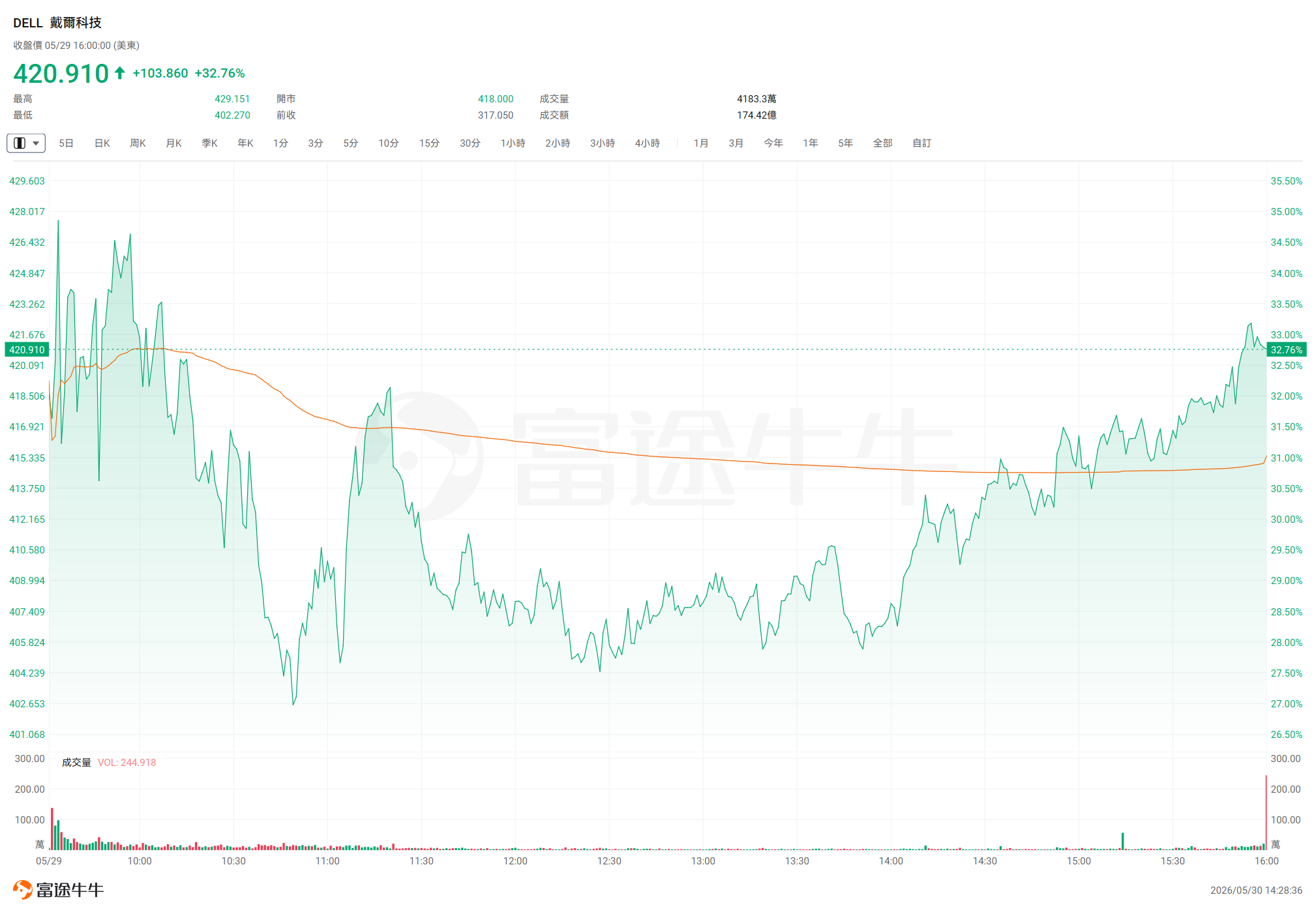
From the 2022 low, it has surged more than tenfold. Michael Dell's personal net worth has soared to $165 billion, making him the world's seventh-richest person.
This has been one of the least noticed yet most misunderstood turnarounds in the U.S. stock market over the past three years. Examining this company under a microscope, how exactly have the AI wave and Trump’s influence converged within Dell? Which narrative is Wall Street buying into, and which one is the White House nurturing?
The Dell that Wall Street bought
Let’s start with the numbers on the books.
After the market close on May 28, Dell reported first-quarter results for fiscal year 2027: revenue surged 88% year-over-year to $43.8 billion, and EPS increased by 214%. However, what truly ignited the stock price was the full-year guidance—management raised its original revenue forecast of $14 billion all the way to a range centered around $16.7 billion, with AI servers contributing $60 billion.
This is nearly $2.5 billion above Wall Street’s consensus estimate—an upward revision of this magnitude is virtually unheard of among large-cap stocks.
The logic behind these figures is clear: during the earnings call, COO Jeff Clarke disclosed that AI server orders for the quarter totaled $24.4 billion, with $16.1 billion already shipped, leaving backlog orders at a record high. The customer list includes$Eli Lilly and Co (LLY.US)$、$Honeywell (HON.US)$, Samsung, and the AI Factory product line added approximately 1,000 new enterprise customers, bringing the total to 5,000.
This is a classic ‘selling shovels’ story—but what makes it compelling is that the gold miners have changed.
Over the past two years, demand for AI servers has been almost entirely dominated by the four major cloud providers:$Microsoft (MSFT.US)$、 $Alphabet-C (GOOG.US)$ 、 $Meta Platforms (META.US)$ 、$Amazon (AMZN.US)$. It was an extremely concentrated market with highly asymmetric bargaining power, where Dell essentially acted as a premium assembler—integrating NVIDIA GPUs into server racks and earning modest margins.
Starting in the second half of 2025, the demand curve began to broaden laterally. Enterprises started making large-scale purchases of ‘private AI’: they no longer wanted to store their customer data, proprietary models, or compliance records in an AWS rack. Eli Lilly and Co plans to train its drug discovery models in its own data centers, while Honeywell intends to run predictive maintenance for its production lines on its own servers.
The demand for 'on-prem AI' aligns precisely with what Dell has excelled at over the past four decades: bundling servers, storage, networking, and services to sell to enterprise IT departments. Cloud providers simply do not operate in this space, $Super Micro Computer (SMCI.US)$ Super Micro Computer cannot handle deployment and services, and HPE struggles to scale. In this market, Dell is almost the default choice.
Management cited a statistic during the earnings call: over the next 24 months, approximately 85% of enterprises will deploy generative AI workloads on-premises. This represents a market that is longer-term, more fragmented, and features a healthier profit structure than the capital expenditure cycles of hyperscale cloud providers.
Wall Street is betting on this trajectory.
The Gross Margin Curse
This narrative has one unavoidable flaw: Dell’s gross margin is collapsing.
Gross margin stood at 24.3% in FY2024 and has already compressed to 20.1% by FY2026, with further declines continuing into Q1 of FY2027.
The reason is straightforward: in AI servers, the most valuable component is NVIDIA’s GPU. In a single 8-GPU H200 server, GPU costs account for over 60% of the total bill of materials (BOM). Dell essentially acts as an integrator—most of the GPU-related revenue merely passes through its books, flowing from NVIDIA on one side to the customer on the other, leaving Dell with very limited room for markup. The more AI servers Dell sells—and the faster its revenue grows—the more its gross margin gets diluted.
This is a classic case of the 'paradox of plenty': a company exchanging explosive revenue growth for declining gross margins. In theory, the market should assign it a discount, not a premium.
Yet the market has awarded it a premium.
The first reason is mathematical: although gross margin is declining, absolute gross profit is soaring. Dell’s AI server shipments will exceed $25 billion in FY2026, with FY2027 guidance at $60 billion. Even if the gross margin is only half that of its traditional business, the absolute gross profit contribution already far surpasses the combined total of PCs and traditional servers. The market has grown savvy and now focuses on 'gross profit dollars' rather than 'gross margin percentage.'
The second reason is more subtle: the market is pricing based on attach rates. For every AI server sold, Dell bundles its own storage solutions (PowerStore, PowerScale), networking equipment, and five-year operations and maintenance service contracts. These backend businesses carry gross margins two to three times higher than those of AI servers. The AI server is the hook—the real profits come from the fish it reels in.
The repricing of Dell’s stock over the past year essentially reflects the market’s revised understanding of its business model: shifting from a 'low-margin hardware reseller' to a 'high-margin service platform that uses low-margin hardware as bait.'
This is the Dell that Wall Street has bought into—a legacy IT giant whose business model has been unexpectedly revitalized by the AI demand curve.
The Dell nurtured by the White House
There is another half to this story.
On December 10, 2025, in the Roosevelt Room of the White House, Michael Dell and his wife Susan Dell stood beside Trump to announce a $6.25 billion donation to the 'Trump Accounts' initiative.
This is a statutory program enshrined in the One Big Beautiful Bill Act, which establishes tax-free investment accounts for every American child born between 2025 and 2028. The Dells’ contribution will provide an initial $250 investment for each of 25 million American children. This is one of the largest private donations ever made to a sitting U.S. president’s signature initiative—more than double the total of all the Dells’ publicly disclosed charitable contributions since 1999.
Michael Dell made a particularly telling remark that day: 'When I founded this company 41 years ago, we invented the direct-sales model. This time, we’re doing direct-sales-style philanthropy.'
Five months later, on May 8, 2026—the day before Mother’s Day—Trump, speaking at a public event at the White House with Michael Dell present, addressed the nation: 'Go out and buy a Dell.' Dell’s stock price surged 14% that day.
In two weeks, on May 27, 2026, the Pentagon announced it had awarded Dell Federal Systems a $9.7 billion contract spanning five years to consolidate Microsoft software licensing across the entire U.S. military, intelligence community, and Coast Guard. This is one of the largest IT contracts awarded by the U.S. Department of Defense in recent years. The next day, Dell’s stock surged 40% in after-hours trading following its earnings release.
Bloomberg recounted nearly the same timeline with similar detail: a $6.25 billion donation in December, White House endorsement in May, and a $9.7 billion defense contract at the end of May. One additional detail must not be omitted: Trump himself quietly purchased $5 million worth of Dell stock in 2025.
Michael Dell personally holds approximately 42% of Dell’s equity. From the day Trump endorsed Dell at the White House, his paper wealth increased by tens of billions of dollars. The $6.25 billion donation, measured against this return, amounts to an investment yielding over tenfold returns.
We set aside the ethical controversy for now. What’s noteworthy is another observation: this is not an isolated incident. On April 30, 2026, Trump posted praise for Intel on Truth Social, prompting Intel’s stock to rise 3% in after-hours trading—the U.S. government holds a 9.9% stake in Intel.$Palantir (PLTR.US)$ Similar instances of a 'presidential boost' have occurred before. A new market dynamic is emerging: in the 2026 U.S. equity market, the president’s social media account, the White House schedule, and even his personal stock holdings are becoming a novel form of 'policy-driven alpha.'
Two Dells, One Valuation
When these two storylines are placed side by side, things become intriguing.
If you believe only in the first Dell—the one Wall Street buys—you see an aging company unexpectedly revived by the AI demand curve. The core valuation question becomes: 'How long and how large will the AI server market grow, and can gross margins stabilize?'—a standard growth-stock valuation problem.
If you believe only in the second Dell—the one nurtured by the White House—you see a company that heavily bet on political connections and won. The core valuation question then becomes: 'How many presidential terms and congressional cycles can this relationship endure?'—a political risk pricing problem.
Yet the market has layered the valuations of both Dells onto a single balance sheet.
GuruFocus estimates an intrinsic value of $153, compared to the current share price of $317—implying Dell is overvalued by 106% based on this metric. The consensus analyst target price stands at $218, also significantly below the current market price. Even the most optimistic sell-side analysts are failing to keep pace with the stock’s rally.
What does this valuation gap signify? It means the market is paying for something that isn’t captured in conventional models.
That 'something' isn’t AI, because AI has already been priced into every model. Rather, it’s a political narrative—the market is front-running expectations that Dell will continuously secure federal contracts, receive ongoing presidential endorsements, and become the preferred supplier for America’s AI national champion under a potential Trump 2.0 administration.
A New Chapter in U.S. Equities
At this point in Dell’s story, it’s worth zooming out.
For the past three decades, the dominant narrative in U.S. equities has been Silicon Valley’s ethos of ‘technological power versus political power’: Apple refusing the FBI’s request to unlock the iPhone, Google employees protesting the company’s AI contract with the Pentagon, and Zuckerberg repeatedly summoned to Capitol Hill yet steadfastly avoiding partisan alignment. This reflected an engineer-driven culture’s instinctive defensive posture toward Washington.
The U.S. equity market in 2026 is telling a different story: a new breed of company is emerging—one that actively embraces politics, treats the White House as its most important client, and views the president’s approval rating as its own beta coefficient. Dell is the clearest exemplar of this trend, with Intel and Palantir as two others.
This shift signals that traditional financial analysis frameworks are beginning to break down. When a U.S. company can be simultaneously priced on both ‘AI demand’ and ‘presidential endorsement,’ you must look beyond its balance sheet—to its CEO’s political calendar.
Dell’s most valuable asset may not be its server factories or its customer roster—but rather the direct line between Michael Dell himself and the White House.
The next question is: how long can that line hold?
Trump’s second term still has nearly three years remaining. If the Republican Party suffers a setback in the midterm elections, if an investigation uncovers a political scandal involving 'contracts in exchange for charitable donations,' or if Michael Dell himself falls out with the White House for any reason, this upward trajectory will break. At that point, the portion of Dell’s stock price attributed to political narrative will be stripped away by the market just as quickly.
Therefore, whether you already hold Dell shares or are considering buying them, you now need to ask yourself two questions: Which Dell are you buying? And when do you plan to sell the other Dell?
Editor /rice