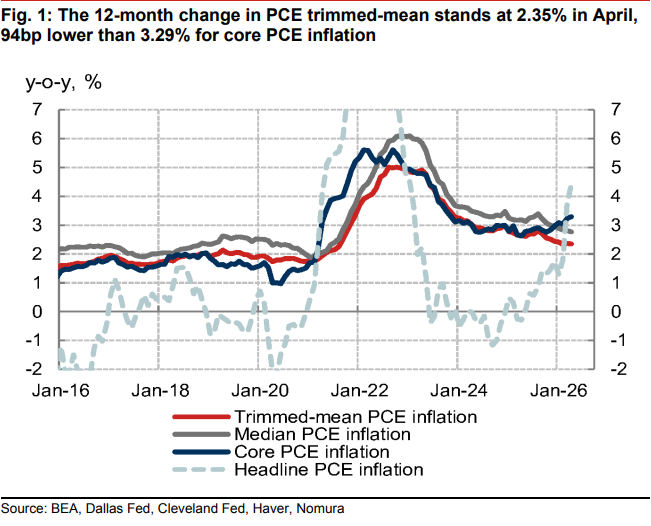
Federal Reserve Chair nominee Kevin Warsh is strongly advocating for the "trimmed mean PCE" to replace the traditional core PCE as the policy anchor. The trimmed mean PCE reading for April stood at just 2.3%, significantly below the core PCE’s 3.3%. Nick Timiraos of The Wall Street Journal argues that this divergence in data directly influences the Federal Reserve’s interest rate path and market expectations for rate cuts. Several institutions have warned that this measure systematically underestimated inflation in 2021, and its current bias could be as large as 48 basis points—Wall Street’s greatest fear is that history is repeating itself.
Fed Chair nominee Kevin Warsh is attempting to shift the central bank's policy anchor toward a more moderate alternative inflation metric, a significant underlying framework change that has raised market concerns the Fed could repeat its 2021 misstep by once again underestimating underlying price pressures.
Current inflation data are presenting two starkly different faces. According to the latest figures released by the U.S. Department of Commerce, the traditional core PCE—which excludes the more volatile food and energy components—rose 3.3% over the past year, marking its fastest pace since 2023. However, as previously noted by Wall Street Journal, the Dallas Fed’s trimmed mean PCE inflation index showed a year-over-year increase of only 2.3% in April.
 In his latest article, Nick Timiraos of The Wall Street Journal—often dubbed the ‘Fed’s unofficial spokesperson’—stated that this statistical discrepancy directly shapes the Federal Reserve’s interest rate trajectory and financial markets’ expectations for rate cuts. During his confirmation hearing in April, Warsh explicitly expressed his preference for the trimmed mean PCE, arguing that it better filters out one-off shocks such as tariffs and geopolitical disruptions, thereby supporting the dovish narrative that inflation is improving. In contrast, Federal Reserve Governor Lisa Cook publicly cautioned that core inflation indicators are ‘clearly moving in the wrong direction.’
For investors, the key question now is which inflation gauge the Federal Reserve should trust. If Warsh’s policy framework assigns greater weight to the trimmed mean PCE, the case for the Fed to maintain accommodative policy or cut rates in the near term would be strengthened. However, if this indicator currently suffers from systematic bias, such a ‘false sense of security’ could cause the Fed to once again fall behind the inflation curve.
Core Disagreement: A Cooler Alternative Metric Counters Traditional Inflation Concerns
For years, the Consumer Price Index (CPI) published by the U.S. Bureau of Labor Statistics has drawn broad public attention due to its early release schedule and its linkage to numerous contracts. However, Federal Reserve policymakers have traditionally placed greater emphasis on the Department of Commerce’s Personal Consumption Expenditures (PCE) price index, particularly core PCE. Warsh, however, has dismissed core PCE as a “rough swag,” arguing that it retains too many distortions from one-time price shocks.
The Dallas Fed’s trimmed mean PCE, favored by Warsh, seeks to eliminate noise through a systematic filtering mechanism. Unlike the fixed exclusion of food and energy in core PCE, this metric each month trims the items with the largest price increases and decreases, retaining only the middle portion. According to researchers at the Dallas Fed, trimmed mean inflation in April was 0.7 percentage points lower than core PCE, primarily because the measure reduced the weight of goods directly affected by tariffs.
In Warsh’s view, recent price increases driven by tariff policies, the AI investment boom, and geopolitical shocks are temporary phenomena that policymakers should ‘look through’ and not respond to with tighter monetary policy. The persistently cooling readings from the trimmed mean PCE provide direct empirical support for this policy stance.
Design Flaw: Risk of Repeating the 2021 Misjudgment
Although the Dallas Fed’s trimmed mean PCE has historically demonstrated strong predictive performance, its behavior during the 2021 inflation surge has drawn widespread criticism. At that time, as inflation surged sharply, this indicator significantly understated actual inflationary pressures and was used by policymakers as evidence supporting the view that inflation was ‘transitory.’
This error stems from the underlying design of the metric. Between 1977 and 2009, price declines in the United States were typically larger in magnitude than price increases. To correct for the upward bias caused by this skewed distribution, the Dallas Fed designed its measure to exclude the top 31% of items with the largest price increases in a given month, but only the bottom 24% with the largest declines.
However, in 2021 following the pandemic outbreak, this historical pattern reversed, with price increases beginning to outpace declines. By mechanically excluding a greater share of items with large price gains, the Dallas Fed’s index inadvertently underestimated the actual upward trend in inflation. Today, a similar divergence has reemerged, sparking debate over whether the metric is once again failing to capture true inflationary pressures.
Bias and Underestimation: How High Is True Inflation?
In response to the widening divergence in data, both research institutions and officials within the Federal Reserve have issued warning signals.
Dallas Fed economist Tyler Atkinson cautioned against drawing excessive optimism from the current trimmed-mean PCE reading. He noted that tariffs implemented under the Trump administration have pushed up prices across a broad range of goods, causing price increases to become more widespread—a development that may lead the existing trimming rules to exclude too many high-inflation items.
Nomura further quantified this bias in a recent research report. Nomura pointed out that post-pandemic core goods prices no longer consistently exert disinflationary pressure. Instead, surging AI-related investment demand for computing and software, coupled with higher corporate price-adjustment frequencies, has made the distribution of price changes more right-skewed. After adjusting for this bias, the current trimmed-mean inflation rate stands at approximately 2.8%, suggesting the official measure may be understating underlying inflation by about 48 basis points.
Data from the left-leaning think ****mploy America corroborates this underestimation. The group’s symmetrically trimmed PCE measure—which excludes equal proportions from both the top and bottom of the distribution—reached 3% in April, significantly narrowing the gap with core PCE. Another of its measures, which excludes housing and imputed prices, registered 2.8% in April and has posted year-over-year increases for 13 consecutive months.
Market Implications: Policy Framework Reconfiguration and the Risk of Falling Behind the Curve
In his article, Timiraos stated that Waller’s shift in preference toward alternative inflation metrics essentially represents a reconfiguration of the Fed’s framework for addressing price shocks in a new era.
Riccardo Trezzi, a former Federal Reserve economist and head of an inflation research firm, stated bluntly that the key question is whether 'looking through' price volatility reflects a principled policy framework or merely a convenient tool used selectively to downplay inconvenient inflation readings. Trezzi emphasized that with the entire price distribution having shifted upward in recent months, evidence that inflation has not meaningfully improved remains strong.
Other market participants are similarly skeptical of the disinflationary signal conveyed by the trimmed mean PCE.
Standard Chartered Bank analysts Steve Englander and Dan Pan argue that, based on historical experience, this metric has been less effective than core PCE in forecasting future inflation, making it difficult to substantiate the current disinflationary trend it suggests. Harvard economist Jason Furman has also voiced concerns, noting that while referencing alternative indicators is not inherently unreasonable, the real risk lies in whether these metrics were selectively chosen ex post to align with a particular policy bias.
For financial markets, this shift implies that the narrative for near-term rate cuts has gained a more supportive data point. If these price shocks are indeed one-off factors, the trimmed mean PCE could provide the Federal Reserve with grounds to avoid tightening policy; however, if these alternative measures obscure broader demand pressures and structural inflationary forces, overreliance on them may offer markets a false sense of reassurance and could ultimately compel the Fed to adopt more aggressive tightening measures in the future.
Editor/Joe